# AP1: Air Pollution

<table data-card-size="large" data-column-title-hidden data-view="cards" data-full-width="false"><thead><tr><th></th><th></th><th></th><th></th><th data-hidden data-card-cover data-type="image">Cover image</th></tr></thead><tbody><tr><td><i class="fa-bullseye">:bullseye:</i> Maximum Score</td><td><strong>Determined by</strong> <a href="/pages/42qnOyhGR7874fJrbvWm"><strong>materiality</strong></a></td><td></td><td></td><td></td></tr><tr><td><i class="fa-pen-to-square">:pen-to-square:</i> Prefill</td><td><i class="fa-check">:check:</i> <strong>Eligible</strong></td><td></td><td></td><td></td></tr><tr><td><i class="fa-shield-check">:shield-check:</i> Validation</td><td><strong>Automatic; Evidence not validated</strong></td><td></td><td></td><td></td></tr><tr><td><i class="fa-arrow-trend-up">:arrow-trend-up:</i> 2026 Updates</td><td><strong>None</strong></td><td></td><td></td><td></td></tr></tbody></table>

***

**Can the entity report on air pollution?**

{% columns %}
{% column width="83.33333333333334%" %}

<figure><img src="/files/HZ18fb6tL2V9tLN5fCVi" alt=""><figcaption></figcaption></figure>

{% endcolumn %}

{% column width="16.666666666666657%" %}

{% endcolumn %}
{% endcolumns %}

**External review**

**Has the data reported been reviewed by an independent third party?**

{% columns %}
{% column width="75%" %}

<figure><img src="/files/WmAysIh9s12C40Coy1IJ" alt=""><figcaption></figcaption></figure>
{% endcolumn %}

{% column width="25%" %}

{% endcolumn %}
{% endcolumns %}

**Exceptions**

**Does the entity's data reported above cover all, and only, the facilities (as reported in RC3) and activities (RC4) for the entire reporting year (EC4)? (for reporting purposes only)**

{% columns %}
{% column width="75%" %}

<figure><img src="/files/NHW0WAzXlcKnzEPRM9T0" alt=""><figcaption></figcaption></figure>
{% endcolumn %}

{% column width="25%" %}

{% endcolumn %}
{% endcolumns %}

## Assessment Instructions

<details>

<summary><strong>Intent</strong>: What is the purpose of this indicator?</summary>

The intent of this indicator is to assess the entity’s measurement of air pollution emissions. Air pollution can have significant impacts on human health and the environment. Additionally, air pollutants can also put entities at risk of regulation and maintaining a social license to operate. Significant air pollutants are ground-level ozone (O<sub>3</sub>), nitrogen oxides (NO<sub>x</sub>), sulphur oxides (SO<sub>x</sub>), particulates and heavy metals such as lead and mercury.

</details>

<details>

<summary><strong>Input</strong>: How do I complete this indicator?</summary>

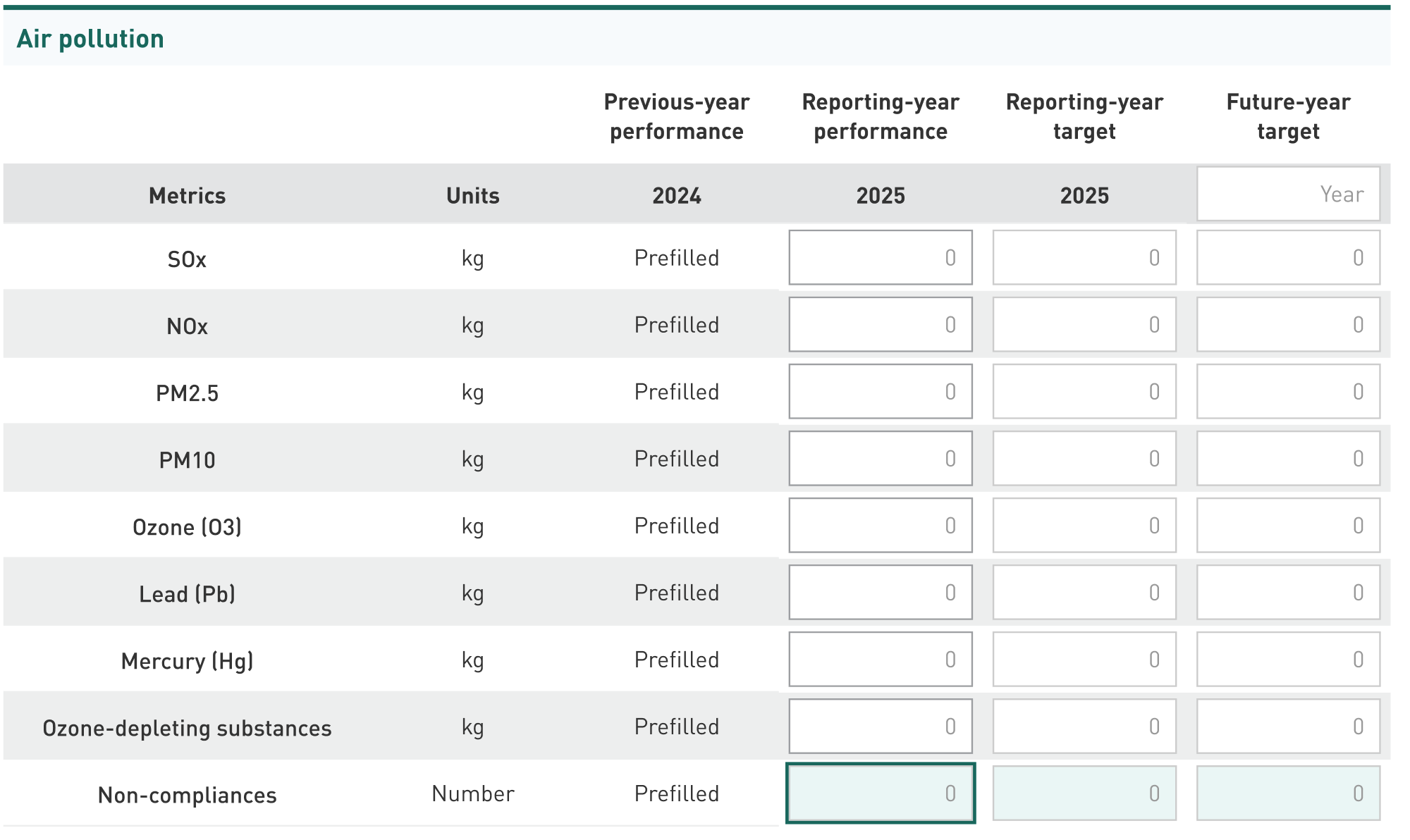
**Select Yes or No:** If ‘Yes,’ complete the performance table and sub-questions.

### Performance Tables

| Key                                                                                                                                                                                                                                                                                                                                                                                                                                                                                                                                                |
| -------------------------------------------------------------------------------------------------------------------------------------------------------------------------------------------------------------------------------------------------------------------------------------------------------------------------------------------------------------------------------------------------------------------------------------------------------------------------------------------------------------------------------------------------- |
| <p><i class="fa-circle-exclamation">:circle-exclamation:</i> Cells with a <strong>dark green border</strong> are <strong>mandatory</strong>.</p><p><i class="fa-star-exclamation">:star-exclamation:</i> Cells with a <strong>light green shade</strong> are <strong>scored.</strong><br><br><em>Not all scored cells are mandatory. Leaving a scored (i.e., shaded) cell blank will have negative scoring impacts. ‘Zero’ is an acceptable answer if it is true and accurate (i.e., if no target exists, the cell should be left blank).</em></p> |

<table data-header-hidden><thead><tr><th width="128.78125"></th><th></th></tr></thead><tbody><tr><td><i class="fa-chart-simple">:chart-simple:</i> <mark style="background-color:$primary;"><strong>Data</strong></mark> </td><td><i class="fa-message-pen">:message-pen:</i> <mark style="background-color:$primary;"><strong>Instructions</strong></mark></td></tr><tr><td><strong>Performance:</strong> Previous Year</td><td><p><strong>It is not possible to edit any data in this column.</strong> </p><p></p><p>As previous-year data is directly drawn from the previous year's GRESB Asset Assessment, it is not possible to amend erroneous data. If the previous-year data is incorrect (for example, due to a reporting error), the entity can use the open text box below the indicator to inform investors.<br><br>This column shows the reported performance for the previous year (e.g., calendar year 2024). If a metric is new or has changed substantially compared to last year’s assessment, or if there is no data available for the entity for the previous year, it is indicated as ‘N/A'.</p></td></tr><tr><td><strong>Performance:</strong> Reporting Year</td><td><p><strong>Enter data for performance during the reporting year for each metric.</strong> </p><p></p><p><i class="fa-star-exclamation">:star-exclamation:</i> <strong>Scored and mandatory:</strong> Reporting year performance of 'Non-compliances'</p><p></p><p>See definitions for each metric in the <a href="#terminology">Terminology</a> section below.</p></td></tr><tr><td><strong>Target</strong>: Reporting Year</td><td><p><strong>Enter any targets that were applicable for the reporting year for each metric.</strong> </p><p></p><p><i class="fa-star-exclamation">:star-exclamation:</i> <strong>Scored but not mandatory:</strong> Reporting year target of 'Non-compliances'</p><p></p><p>A reporting year target can be interpolated from a future-year target.<br><br>The target (or the future-year target from which it is derived) must be formally adopted. This means that the entity must have set and communicated the target, at least internally, and implemented or is preparing actions to achieve it.</p></td></tr><tr><td><strong>Target:</strong> Future Year</td><td><p><strong>Enter the relevant year for which the targets are set at the top of the column, and enter the future-year targets for each metric where available.</strong> </p><p></p><p><i class="fa-star-exclamation">:star-exclamation:</i> <strong>Scored but not mandatory:</strong> Future year target for 'Non-compliances'</p><p></p><p>The target must be set for any future year that is <strong>not</strong> the reporting year.<br><br>The target (or the future-year target from which it is derived) must be formally adopted. This means that the entity must have set and communicated the target, at least internally, and implemented or is preparing actions to achieve it.</p></td></tr></tbody></table>

{% hint style="info" %}
**Estimation Note**

As a general rule, GRESB Participants are required to use **actual** data (i.e., directly measured from utilities or meters, documented, or derived using recognized standards) when reporting material performance data.&#x20;

Broad extrapolations of data and general estimates should not be reported.&#x20;

Participants must explain the methodology used to measure data and to calculate data coverage in an open text box below the performance table.
{% endhint %}

### **External Review**

**Select Yes or No:** If selecting “Yes”, state whether the data submitted has been checked, verified, or assured (select one option; the most detailed level of scrutiny to which the data was subjected). If selecting ‘verified’ or ‘assured,’ select the standard from the dropdown menu.

*The* [*Scheme Lists*](/completing-gresb-assessments/completing-the-assessment/supporting-information/assurance-and-verification-schemes.md) *page contains the complete lists of 1) accepted sustainability reporting standards and frameworks, and 2) assurance and verification schemes.*

{% hint style="info" %}
*Additional assurance schemes may also receive recognition if they meet GRESB’s criteria. To submit a new scheme for review, please contact the* [*GRESB team*](https://www.gresb.com/nl-en/about-us/contact//)*.*&#x20;

*The final deadline for submitting a new assurance/verification scheme for review by the GRESB team is **March 15th.** Schemes submitted for review after March 15th will not be reviewed until the subsequent reporting year.*
{% endhint %}

GRESB does not require the selected standard to be specific to air pollution data. A standard initially designed to verify/assure other types of sustainability data (e.g., energy) can be selected as long as the same thoroughness and review criteria are applied to data reported in AP1.

### Exceptions

**Select Yes or No:** GRESB is seeking to standardize the scope and boundaries of reporting to allow for more accurate benchmarking and to progressively move towards scoring of performance. If the scope of the data reported for this indicator does not exactly match the reporting scope (facilities, ancillary activities, and time period) as reported in “Entity and Reporting Characteristics” (EC3, RC3, RC4), then answer ‘No’ to this question and describe these exceptions in the “Exceptions” text box.\
\
**Please note that if the entity answers 'No', then GRESB will not provide reporting-year performance data intensity values in the Benchmark Report.**

Examples include:

* **Temporal**:  toll road includes data on energy consumption from its street lighting within its boundary, but due to a data glitch, it lost this data for a two-month period during the reporting year.
* **Physical**: A power plant includes a switchyard facility within its reporting boundary but does not have data on water discharge for this facility.
* **Operational:** An airport includes the operation of mobile equipment within its reporting boundary, but not for aircraft, since these are operated by airlines.

#### Terminology

**Air pollution**

> Air pollutants are particles and gases released into the atmosphere that may adversely affect living organisms. Additionally, some pollutants contribute to climate change or exacerbate the effects of climate change locally. Pollutants of major public health concern include ozone-depleting substances (ODS), NOx, SOx, particulate matter (PM), lead, mercury and/or other standard categories of air emissions identified in relevant regulations.

**Externally checked**

> Applies to instances when a third party has reviewed the data in a structured and consistent process, but no official certification has been awarded.

**Externally verified**

> Applies to instances where a third party has reviewed the reporting against an existing scheme. When this checkbox is ticked, participants must select the scheme name from the dropdown.
>
> * Note that GRESB treats verification and assurance equally in the context of the assessment

**Externally assured**

> Applies to instances where a third party has reviewed the data against an existing scheme. When this checkbox is ticked, participants should select the scheme name from the dropdown.
>
> * Note that GRESB treats verification and assurance equally in the context of the assessment

**Lead (Pb)**

> Lead emissions can result from industrial process or the use of fuel that contains lead. Exposure to lead has adverse effects on human health and ecosystems.

**Mercury (Hg)**

> Mercury can enter the environment in elemental or inorganic forms. Burning of fossil fuels can result of emissions of mercury into the air. Mercury is harmful to humans and ecosystems.

**Nitrogen oxides (NO**<sub>**X**</sub>**)**

> A group of gases that are harmful to human health and the environment by contributing to smog and acid rain. They can also lead to nutrient pollution in ecosystems and cause the formation of ozone, another pollutant. NO<sub>X</sub> are mainly released to the air via the burning of fuels.

**Non-compliances**

> Failure to comply with covenants, environmental permits, laws and/or regulation due to the performance of air pollutant emissions or discharges to bodies of water.

**Ozone (O**<sub>**3**</sub>**)**

> Ground-level ozone can result in health problems and affect people with lung conditions. It can also harm vegetation growth.

**Ozone-depleting substances**

> Also known as ODS, ozone-depleting substances are any substances that deplete ozone (O<sub>3</sub>) in the Earth’s atmosphere. A full list of substances can be found in the Montreal Protocol. Ozone-depleting substances that have a global warming potential should also be reported in “Greenhouse gas emissions” but expressed in the tCO<sub>2</sub>e that they are equivalent to. In “Air pollution” ozone-depleting substances should be reported in kg emitted.

**Particulate matter (PM)**

> Particulate matter are any solid particles or small droplets in the air, such as smoke or dust. They are measured based on their diameter. PM10 are any particles with a diameter of 10 micrometers or smaller; PM2.5 are any particles that are 2.5 micrometers or smaller. Particulate matter can result from the burning of fuels or directly from industrial processes and/or construction. Inhalation of particulates may cause adverse health effects.

**Sulfur oxides (SO**<sub>**X**</sub>**)**

> A group of gases that are harmful to human health and the environment. They can contribute to acid rain and can increase particulate matter concentrations in the air. SO<sub>X</sub> are mainly released to the air via the burning of fuels.

</details>

<details>

<summary><strong>Validation</strong>: What evidence is required?</summary>

**Data**: GRESB automatically validates data in the performance tables.&#x20;

**Evidence**: Providing evidence of external review in the form of a third-party letter or certificate is optional. Evidence will not be subject to manual validation for this indicator in 2025.

Evidence should include:

* Proof of the existence of a third-party review of the data;
* Clear indication that the reviewed data reflects the reported data;
* A description of the type of third-party review (checked, verified, or assured) and the used assurance standard (if applicable);
* Proof that the data review applies to the entity.

<a href="/pages/SbyIZR3DwtXvJRcoPz0h" class="button primary" data-icon="shield">Validation Basics</a>

</details>

## Scoring

<details>

<summary><strong>Scoring</strong>: How does GRESB score this indicator?</summary>

#### **Materiality-Based Scoring**

The relevance of the 'Air pollution' issue (determined by the GRESB Materiality Assessment) defines this indicator's maximum score.

For more details, refer to the [Asset Scoring Basics](/completing-gresb-assessments/getting-started/scoring-basics.md) page or download the [Asset Materiality & Scoring Tool.](https://cdn.svc.gresb.com/gresb-prd-public/2026/INF_Documents/2026_GRESB_Infrastructure_Asset_Materiality_and_Scoring_Tool.xlsx)

#### **Scoring of Metrics**

The only scored metric for Air Pollution is ***Non-compliances.***

For this metric, participants must complete **all columns** to obtain points as follows:

* **60%** of the indicator score: based on the reporting of a value in ***Reporting-year performance***
* **20%** of the indicator score: based on the reporting of a target in ***Reporting-year target.***
  * The scoring is based on whether a target was set, not on whether the target was achieved.
* **20%** of the indicator score: based on the reporting of a target in ***Future-year target.***
  * The scoring will be based on whether a target was set, not on whether the entity is on track to achieve the target.

#### **Notes**

* Participants must input a target year under "Future-year target" as well as a numeric value in the underlying scored metric to score for this metric.
* Not all scored cells/metrics are mandatory. If a scored (light green) cell is not outlined in dark green, **leaving it blank will still result in a negative scoring impact.** This applies to the following metrics: Non-Compliances, Reporting-Year Target, and Future-Year Target.
* Reporting of external data review and exceptions is not scored.

<a class="button primary" data-icon="hundred-points">Scoring Basics</a>

</details>

***

<details>

<summary><em>References</em></summary>

[Eurostat - Environment Glossary](https://ec.europa.eu/eurostat/statistics-explained/index.php?title=Category:Environment_glossary)[Montreal Protocol](https://ozone.unep.org/treaties/montreal-protocol/montreal-protocol-substances-deplete-ozone-layer)[US EPA - Criteria Air Pollutants](https://www.epa.gov/criteria-air-pollutants)

[The Taskforce on Nature-related Financial Disclosures Recommendations (TNFD) version 1.0 September 2023 – Table 6. TNFD core global disclosure indicators and metrics for nature-related dependencies and impacts](https://tnfd.global/publication/recommendations-of-the-taskforce-on-nature-related-financial-disclosures/)

**Alignment with External Frameworks**

[GRI Standards 2016 - 305-7: Nitrogen oxides (NOx), sulfur oxides (SOx), and other significant air emissions](https://www.globalreporting.org/standards/gri-standards-download-center/)

**Relevant UN Sustainable Development Goals**

[SDG 3 - Good Health and Well-being](https://sustainabledevelopment.un.org/sdg3)

3.9 By 2030, substantially reduce the number of deaths and illnesses from hazardous chemicals and air, water and soil pollution and contamination

[SDG 11 - Sustainable Cities and Communities](https://sustainabledevelopment.un.org/sdg11)

11.6 By 2030, reduce the adverse per capita environmental impact of cities, including by paying special attention to air quality and municipal and other waste management

[SDG 12 - Responsible Consumption and Production](https://www.un.org/sustainabledevelopment/sustainable-consumption-production/)

12.4 By 2020, achieve the environmentally sound management of chemicals and all wastes throughout their life cycle, in accordance with agreed international frameworks, and significantly reduce their release to air, water and soil in order to minimize their adverse impacts on human health and the environment

</details>

## Get Support: Solution Providers

**GRESB Solution Providers** are independent, third-party organizations within the GRESB Partner network that offer specialized products, tools, and services to support sustainability performance outside the GRESB Assessment process.

Currently, there are no GRESB Solution Providers associated with this indicator.

GRESB will continue to update this section as the GRESB Solution Provider network grows. Please check back regularly to find GRESB Solution Providers who can support your sustainability performance.


---

# Agent Instructions: Querying This Documentation

If you need additional information that is not directly available in this page, you can query the documentation dynamically by asking a question.

Perform an HTTP GET request on the current page URL with the `ask` query parameter:

```
GET https://guides.gresb.com/completing-gresb-assessments/completing-the-assessment/2026-asset-assessment/performance-component/air-pollution/ap1-air-pollution.md?ask=<question>
```

The question should be specific, self-contained, and written in natural language.
The response will contain a direct answer to the question and relevant excerpts and sources from the documentation.

Use this mechanism when the answer is not explicitly present in the current page, you need clarification or additional context, or you want to retrieve related documentation sections.
