# Assessment Structure & Scope

## About the Assessments

The GRESB Infrastructure Assessments are the global standard for sustainability benchmarking and reporting for institutional investors, fund managers, infrastructure companies, and asset managers operating in the infrastructure sector. The methodology is consistent across different regions, investment vehicles, and asset types, aligning with international reporting frameworks such as the Task Force on Climate-Related Financial Disclosures (TCFD), the Global Reporting Initiative (GRI), and the Principles for Responsible Investment (PRI).

There are three complementary GRESB Infrastructure Assessments:&#x20;

* Infrastructure Fund Assessment
* Infrastructure Asset Assessment
* Infrastructure Development Asset Assessment

GRESB also offers two [SFDR Infrastructure Assessments](#sfdr-assessments) (SFDR Asset & SFDR Fund) to support infrastructure participants in meeting their SFDR disclosure requirements.

All assessments cover the full breadth of infrastructure sectors, including but not limited to data infrastructure, energy and water resources, environmental services, network utilities, power generation except renewables (x‑renewables), renewable power, social infrastructure, and transport.

#### Which assessment should I complete?

<table><thead><tr><th width="72.8359375" align="center"></th><th width="266.8934326171875" align="center">Participant</th><th align="center">Assessment</th><th>Component(s)</th></tr></thead><tbody><tr><td align="center"><i class="fa-building-columns">:building-columns:</i></td><td align="center">Infrastructure <strong>fund managers</strong> and <strong>investors</strong> that <strong>invest directly in</strong> infrastructure.</td><td align="center"><a href="#fund-assessment">Fund</a> </td><td>Management</td></tr><tr><td align="center"><i class="fa-tower-observation">:tower-observation:</i></td><td align="center"><strong>Listed</strong> infrastructure <strong>companies and private</strong> infrastructure asset <strong>operators.</strong></td><td align="center"><a href="#asset-assessment">Asset</a> </td><td>Management + Performance + <br>NZIF Module </td></tr><tr><td align="center"><i class="fa-user-helmet-safety">:user-helmet-safety:</i></td><td align="center"><strong>Greenfield/pre-operational</strong> infrastructure <strong>assets</strong> or infrastructure <strong>companies</strong> that <strong>invest</strong> in <strong>greenfield/pre-operational assets</strong></td><td align="center"><a href="#development-asset-assessment">Development Asset </a></td><td>Development</td></tr></tbody></table>

{% hint style="info" %}
The Infrastructure Assessment output depends on a participant's component selection, which is entirely under their discretion.

Please refer to the **"*****Who should participate"*** sections below for details on the scope of each assessment and its associated component(s).
{% endhint %}

## Asset Assessment

<details>

<summary>What is the Asset Assessment, and how is it structured?</summary>

#### Components

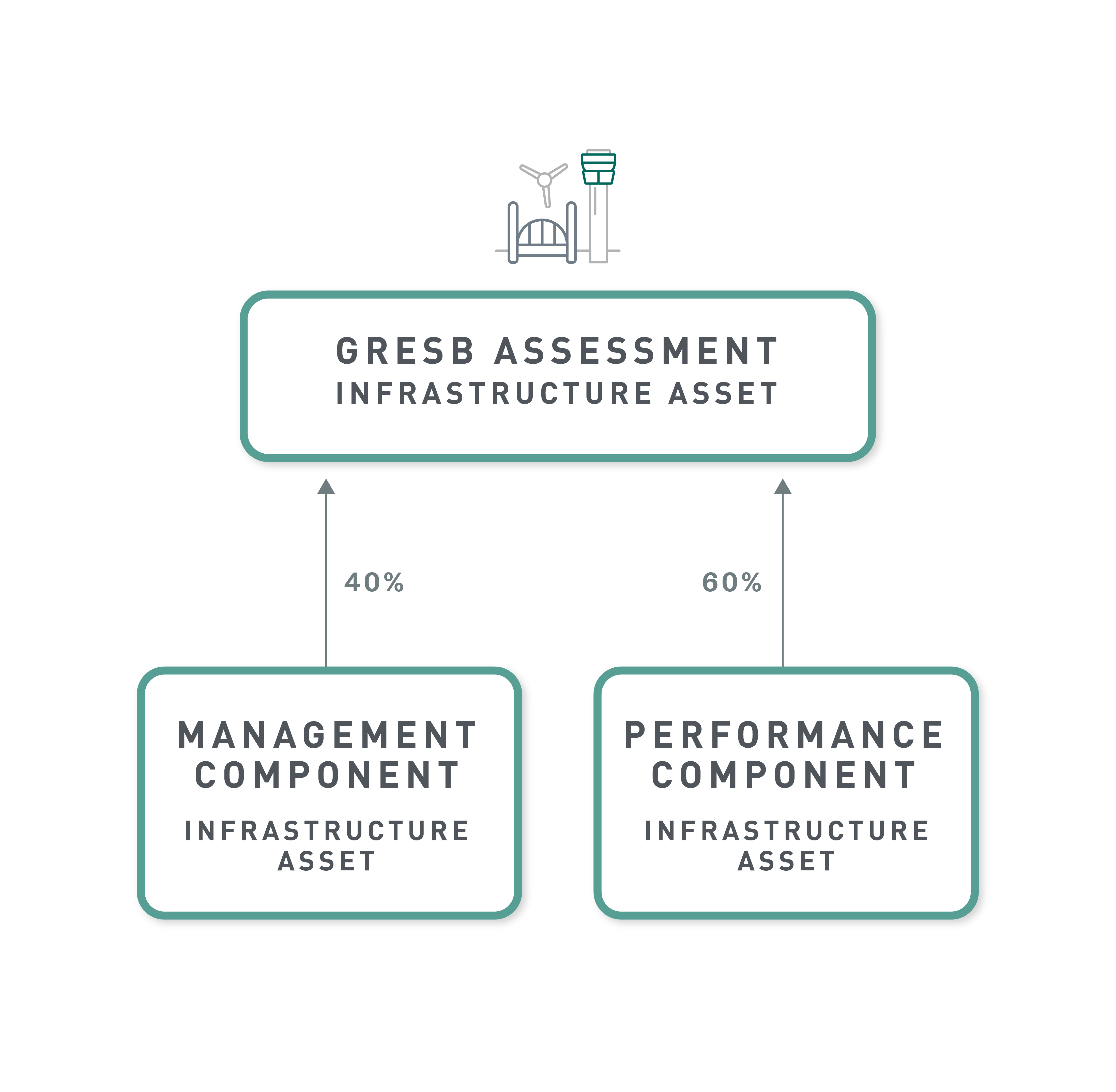
The Asset Assessment is made up of two components:

<table><thead><tr><th width="163.953125">Component</th><th width="156.32421875">Maximum Score</th><th>Aspects </th></tr></thead><tbody><tr><td><a href="broken-reference"><strong>Management</strong></a></td><td>40 points</td><td><p>Leadership</p><p>Policies</p><p>Reporting</p><p>Risk Management</p><p>Stakeholder Engagement</p></td></tr><tr><td><a href="broken-reference"><strong>Performance</strong></a></td><td>60 points</td><td><p>Energy</p><p>Greenhouse Gas Emissions</p><p>Air Pollution</p><p>Water</p><p>Waste</p><p>Biodiversity &#x26; Habitat</p><p>Health &#x26; Safety</p><p>Employees</p><p>Customers</p><p>Certifications</p></td></tr></tbody></table>

Participants may choose to complete one or both Components. However, only entities that submit both Components will receive a GRESB Score and GRESB Rating.&#x20;

<div align="center"><figure><img src="https://3125261017-files.gitbook.io/~/files/v0/b/gitbook-x-prod.appspot.com/o/spaces%2FpuhmrMAX3Y5D6ODFHo2L%2Fuploads%2F8VIy9JA2U0FJvJwBkKHr%2Fimage.png?alt=media&#x26;token=042c8c96-1d3d-4429-976a-46112506aef6" alt="" width="375"><figcaption></figcaption></figure></div>

**GRESB Score** = **Management Score** + **Performance Score**

#### **Net Zero Investment Framework (NZIF) Module**

The NZIF Module is available exclusively to GRESB Infrastructure Asset Assessment participants. This optional and complementary module can be enabled through the Component Selection page within the Assessment. See [here](https://guides.gresb.com/completing-gresb-assessments/getting-started/broken-reference) for more details on how to enable it.

See the [NZIF](#net-zero-investment-framework-module) section below for more information about this module.

</details>

<details>

<summary>Who should participate?</summary>

**Precisely what constitutes an infrastructure asset is typically defined by investors at the level of the investable entity.**&#x20;

These assets (investable entities) may comprise single or multiple facilities. Either type of asset may participate in the Asset Assessment; however, reporting as a single facility provides the best basis for benchmark comparisons and is, therefore, recommended.&#x20;

Different approaches to participation are explained in the following sections. Note that these are only illustrative, and other scenarios are possible.

#### **Single-Facility Assets**

Single-facility assets undertake their activities at a single facility or across a single facility network. These entities may be large and complex or small and narrowly focused. The full description of the facility and business activities should be expressed in the Entity & Reporting Characteristics section of the asset assessment.

Examples of single‑facility assets include:

* A provider of water and wastewater services in a single network
* An airport
* A telecommunications company with a single telecommunications network (e.g., in a single country)

#### **Multi-Facility Assets**

In some cases, the asset’s activities may be spread across several facilities—GRESB considers this to be a multi‑facility asset. A multi‑facility asset has the option to report:

1. Separately for each facility using multiple asset assessments
2. As a group using a single asset assessment

Completing multiple assessments allows comparisons between assets and is strongly encouraged, whilst a single assessment may take less time if the relevant data is more readily available at the aggregated asset level.

Examples of multi‑facility assets include:

* An entity that operates several toll roads as one asset
* An entity that owns a portfolio of small wind farms
* An entity that operates a collection of distributed‑scale solar projects

If a participant elects to report on multiple facilities within a single asset assessment, GRESB strongly recommends aggregating facilities to a single sector and country combination; otherwise, peer group comparisons are likely to be less granular and less relevant.&#x20;

Multi‑facility assets that participate as a single entity should have centralized management and aggregated performance data. See “[Sector and Geography” (RC3)](https://guides.gresb.com/completing-gresb-assessments/getting-started/broken-reference) in the Entity and Reporting Characteristics Aspect for more details.

</details>

<details>

<summary>How are E, S, and G represented in the assessment?</summary>

Each indicator in the assessment is allocated to one of the three sustainability dimensions (E‑ environmental; S‑ social; G‑ governance):

* E - indicators related to actions and efficiency measures undertaken to monitor and decrease the environmental footprint of the asset
* S - indicators related to the entity’s relationship with and impact on its stakeholders and the direct social impact of its activities
* G - indicators related to the governance of sustainability, policies and procedures, and approach to sustainability at the entity or organization level

|                 | E                          | S                          | G                          |
| --------------- | -------------------------- | -------------------------- | -------------------------- |
| **Management**  | 11%                        | 28%                        | 61%                        |
| **Performance** | Dependent upon materiality | Dependent upon materiality | Dependent upon materiality |

Participants may use the [GRESB Materiality & Scoring Tool](https://guides.gresb.com/completing-gresb-assessments/getting-started/broken-reference) to identify the weight of E, S, and G issues based on their specific asset characteristics and learn more about the role of materiality in the assessment.

</details>

#### \[New in 2026] Net Zero Investment Framework Module

<details>

<summary>What is the NZIF module, and how is it structured?</summary>

The GRESB Infrastructure NZIF Module is a short, optional set of **five** additional indicators to be completed alongside the GRESB Infrastructure Asset Assessment.

* NZ1: Separate Scope 3 Target
* NZ2: Governance and Management Responsibility
* NZ3: Decarbonization Plan
* NZ4: Emissions Performance
* NZ5: Achievement

It is designed to support a consistent view of how an infrastructure asset is positioned in relation to net zero, including whether it has appropriate targets, governance, plans and emissions performance in place, using the [IIGCC’s Net Zero Investment Framework (NZIF) 2.0 for infrastructure](https://www.iigcc.org/hubfs/NZIF%202.0%20Report%20PDF.pdf) as a reference.&#x20;

### Background

#### What Are the NZIF and the IIGCC?&#x20;

The Net Zero Investment Framework (NZIF) was developed to help investors and managers assess whether assets and portfolios are aligned with a credible pathway to net- zero greenhouse gas emissions. It covers a range of asset classes, including infrastructure, and sets out clear expectations for net- zero alignment across ambition, targets, governance, decarbonization planning, emissions performance and achievement.&#x20;

The NZIF is developed and maintained by the Institutional Investors Group on Climate Change (IIGCC), a membership body representing investors committed to addressing climate change and supporting the transition to a net-zero economy. IIGCC works with investors globally to provide guidance, frameworks, and tools that support credible, science-based climate action.

#### Why Does the Tool Exist and How Can it Help?

As  the Net Zero Investment Framework (NZIF) has become a widely adopted reference point for net-zero alignment, investors and infrastructure managers have increasingly sought to use it to assess alignment across portfolios. In practice, however, different market participants have interpreted NZIF criteria in different ways, particularly when translating the framework into data requests, engaging with portfolio companies, and comparing alignment levels across assets. This has led to inconsistencies in implementation and has adversely affected impacts the investor confidence that investors have in the resulting analyses.&#x20;

To address this challenge, GRESB and the IIGCC brought together a coalition of industry partners to develop a more consistent, practical approach to NZIF alignment. The GRESB NZIF Alignment tool builds on existing GRESB data points and combines them with new standardized NZIF Module questions, creating a shared, transparent methodology for alignment across all NZIF criteria.&#x20;

This approach is intended to establish a common language for NZIF alignment, improve comparability across portfolios, and support clearer, more value-add conversations and decision-making between investors and infrastructure businesses.&#x20;

#### How Net-Zero Alignment is Determined Using the GRESB NZIF Alignment Tool

Some NZIF requirements are already fully addressed by the GRESB Assessment. Others require additional confirmation through the NZIF Module. NZIF alignment is assessed using a combination of data from:&#x20;

* A selection of GRESB Infrastructure Asset Assessment indicators, and&#x20;
* Five additional NZIF Module questions&#x20;

The methodology for the GRESB Assessment, scoring, and benchmarking remains completely unchanged by the additional NZIF Module, and that NZIF Module questions and data do not affect GRESB scores or benchmarks in any way.&#x20;

Therefore, regardless of of whether or not you complete the NZIF Module participation, the your GRESB Assessments and Benchmark Reports will remain the same unaffected and continue to is based sole entirely on the GRESB Standards.&#x20;

</details>

<details>

<summary>Who should participate?</summary>

The NZIF Module is available exclusively to GRESB Infrastructure Asset Assessment participants. GRESB encourages any participant with an interest (or that is connected to a fund or investor with an interest) in assessing their NZIF alignment to complete it.

Participants completing the NZIF Module will receive a dedicated NZIF Alignment report alongside their Infrastructure Asset Benchmark Report. This report provides actionable insights into net-zero alignment, decarbonization progress, and transition planning at the asset level.&#x20;

</details>