# DSE5.1: Community Impact Assessment

<table data-column-title-hidden data-view="cards" data-full-width="false"><thead><tr><th></th><th></th><th></th><th data-hidden data-card-cover data-type="image">Cover image</th></tr></thead><tbody><tr><td><i class="fa-bullseye">:bullseye:</i> Maximum Score</td><td><strong>2 points</strong></td><td></td><td></td></tr><tr><td><i class="fa-input-pipe">:input-pipe:</i>  Input Method</td><td><strong>Assessment Portal</strong></td><td></td><td></td></tr><tr><td><i class="fa-pen-to-square">:pen-to-square:</i> Prefill</td><td><i class="fa-check">:check:</i> <strong>Eligible</strong></td><td></td><td></td></tr><tr><td><i class="fa-calculator">:calculator:</i> Scoring method</td><td><strong>Static</strong></td><td></td><td></td></tr><tr><td><i class="fa-shield-check">:shield-check:</i> Validation</td><td><strong>Other answer is manually validated</strong></td><td></td><td></td></tr><tr><td><i class="fa-arrow-trend-up">:arrow-trend-up:</i> 2026 Updates</td><td><strong>None</strong></td><td></td><td></td></tr></tbody></table>

***

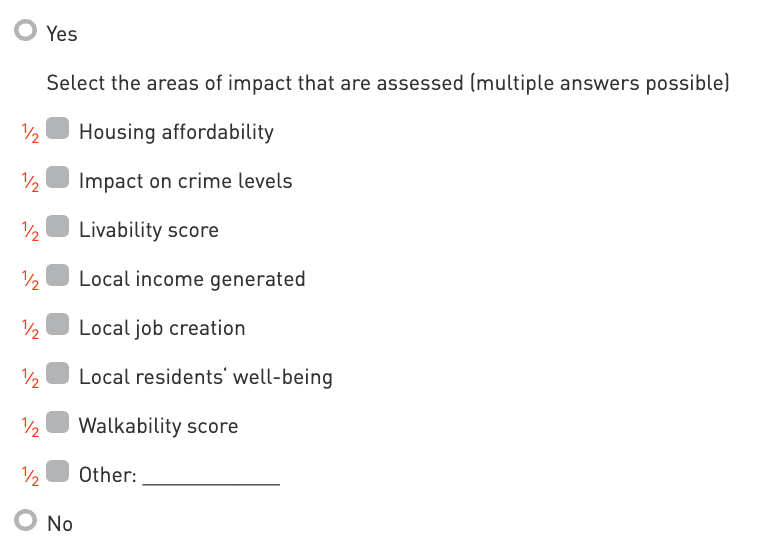
**Does the entity assess the potential long-term socio-economic impact of its development projects on the community as part of planning and pre-construction?**

{% columns %}
{% column width="75%" %}

<figure><img src="/files/6xui6jYjsQJT6DB2GAGX" alt=""><figcaption></figcaption></figure>
{% endcolumn %}

{% column width="25%" %}

{% endcolumn %}
{% endcolumns %}

## Assessment Instructions

<details>

<summary><strong>Intent</strong>: What is the purpose of this indicator?</summary>

This indicator assesses how the entity evaluates the socio-economic impacts of its development projects. The built environment can influence social well-being, quality of life, and the prosperity of local communities. Understanding these impacts helps minimize potential negative effects and supports the creation of more livable, prosperous, and sustainable communities.

</details>

<details>

<summary><strong>Input</strong>: How do I complete this indicator?</summary>

Select yes or no. If yes, select all applicable sub-options.

### Terminology

**Crime levels**

> The impact of the use of the asset and related facilities/direct surroundings on crime levels. For example, inadequate lighting or security may lead to increased crime levels including vandalism and theft.

**Housing affordability**

> Affordability refers to the general ability of individuals or households to pay for goods or services within their financial means. In the context of housing, it typically describes the relationship between a household’s income and the cost of housing (rent or mortgage, utilities, etc.).

**Livability score**

> A score designed to measure the standard of living, typically within a city.

**Local income generated**

> Contributing to local economic benefits, and creating business diversity and opportunities for economic development and innovation. For example, providing tax revenues.

**Local job creation**

> Contributing to local employment creation so as to ensure all members of the labor force can participate in, and contribute to, future economic growth.

**Local residents' well-being**

> Includes health and safety of local residents that may be impacted by the asset’s operation. For example, noise pollution issues.

**Walkability score**

> A score designed to measure the walkability of a given address to community amenities.

</details>

<details>

<summary><strong>Validation</strong>: What evidence is required?</summary>

No evidence required. Only the 'Other' answer is manually validated.

#### **Other Answer**

State the other area of impact assessed. It is possible to report multiple other answers. If multiple other answers are acceptable, only one will be counted towards scoring.

<a href="/pages/utxKQNLSUKyW8QMeUwEi" class="button primary" data-icon="shield">Validation Basics</a>

</details>

## Scoring

{% columns %}
{% column width="75%" %}

<figure><img src="/files/4keBTnH5P7rtEwIIthYW" alt=""><figcaption></figcaption></figure>
{% endcolumn %}

{% column width="25%" %}

{% endcolumn %}
{% endcolumns %}

<details>

<summary><strong>Scoring</strong>: How does GRESB score this indicator?</summary>

The scoring of this indicator is equal to the fraction assigned to the selected option, multiplied by the total score of the indicator.

**Other:** The 'Other' answer is manually validated and assigned a score which is used as a multiplying factor, as per the table below:

| Validation status | Score |
| ----------------- | ----- |
| Accepted          | 1/1   |
| Not Accepted      | 0     |
| Duplicate         | 0     |

<a href="/pages/SmkaMa2MwR7Pm97QbSwO" class="button primary" data-icon="hundred-points">Scoring Basics</a>

</details>

***

<details>

<summary><em>References</em></summary>

Green Star, Communities PILOT Version 0.1

Mercer Quality of Life Index

AARP Livability Index

</details>

## Get Support: Solution Providers

**GRESB Solution Providers** are independent, third-party organizations within the GRESB Partner network that offer specialized products, tools, and services to support sustainability performance outside the GRESB Assessment process.

Currently, there are no GRESB Solution Providers associated with this indicator.

GRESB will continue to update this section as the GRESB Solution Provider network grows. Please check back regularly to find GRESB Solution Providers who can support your sustainability performance.


---

# Agent Instructions: Querying This Documentation

If you need additional information that is not directly available in this page, you can query the documentation dynamically by asking a question.

Perform an HTTP GET request on the current page URL with the `ask` query parameter:

```
GET https://guides.gresb.com/completingassessments/2026-real-estate-assessment/re/development-component/development-stakeholder-engagement/dse5.1-community-impact-assessment.md?ask=<question>
```

The question should be specific, self-contained, and written in natural language.
The response will contain a direct answer to the question and relevant excerpts and sources from the documentation.

Use this mechanism when the answer is not explicitly present in the current page, you need clarification or additional context, or you want to retrieve related documentation sections.