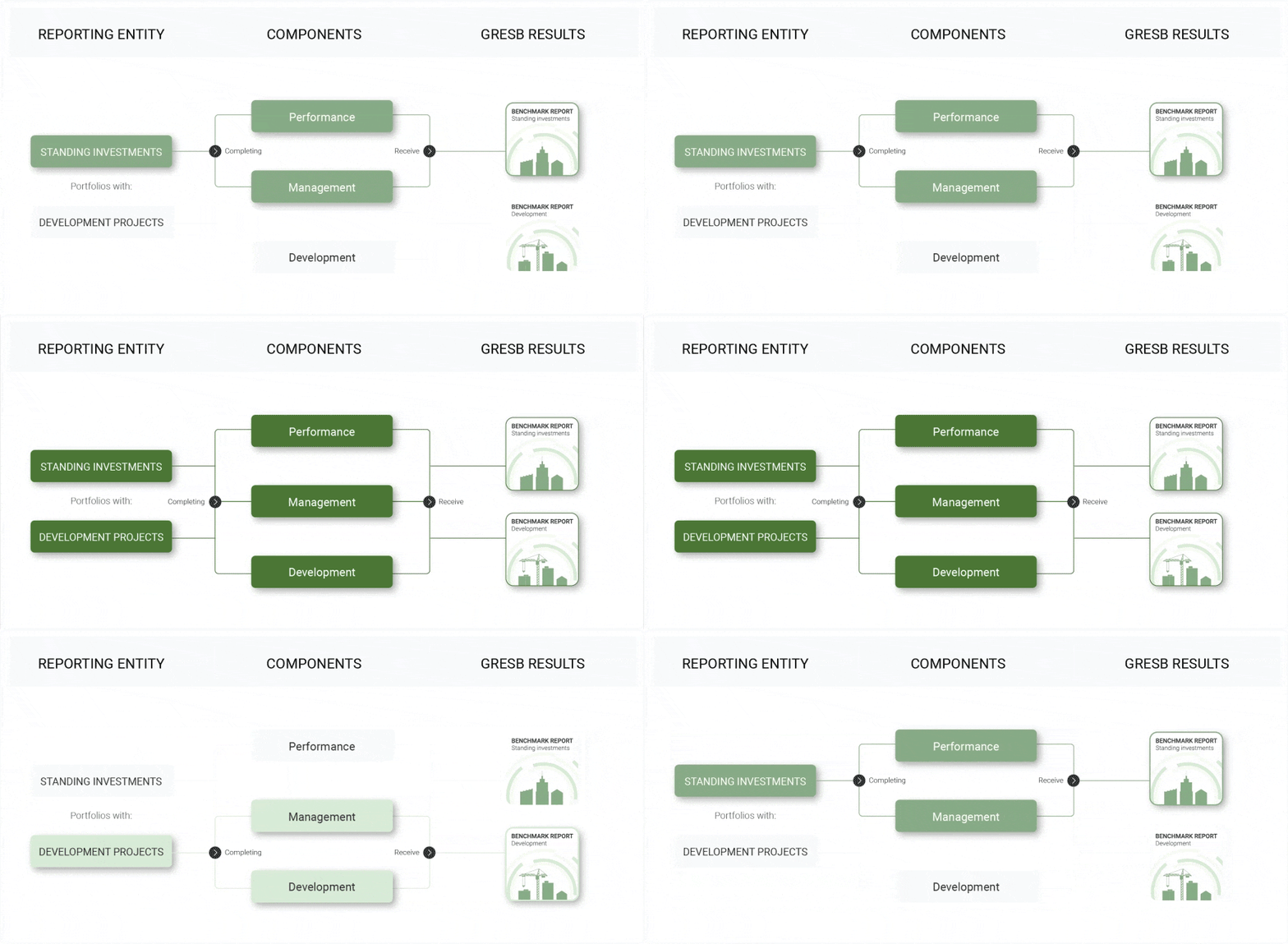
# Assessment Structure & Scope

## About the Assessment

The GRESB Real Estate Assessment is the global standard for sustainability benchmarking and reporting for listed property companies, private property funds, developers, and investors that invest directly in real estate. Its methodology is consistent across different regions and investment vehicles, and it aligns with international reporting frameworks, such as the Task Force on Climate-Related Financial Disclosures (TCFD), Global Reporting Initiative (GRI), and Principles for Responsible Investment (PRI).

{% hint style="info" %}
The Real Estate Assessment output depends on a participant's component selection, which is entirely under their discretion. However, **once an entity chooses to complete a component, it must report 100% of owned assets within its scope.**&#x20;

Please refer to the **"*****What are the participation requirements?"*** sections below for details on GRESB's reporting boundary requirements.
{% endhint %}

#### Which component(s) should I choose?

<table><thead><tr><th width="129.18841552734375" align="center"></th><th width="212.078125" align="center">Portfolio Composition</th><th align="center">Component Completion</th><th align="center">Output</th></tr></thead><tbody><tr><td align="center"><i class="fa-building">:building:</i></td><td align="center">Portfolios with <strong>operational</strong> assets</td><td align="center">Management + Performance</td><td align="center"><a href="#standing-investments-benchmark">Standing Investments Benchmark</a></td></tr><tr><td align="center"><i class="fa-user-helmet-safety">:user-helmet-safety:</i></td><td align="center">Portfolios with <strong>development</strong> assets</td><td align="center">Management + Development</td><td align="center"><a href="#development-benchmark">Development Benchmark</a></td></tr><tr><td align="center"><i class="fa-building">:building:</i> + <i class="fa-user-helmet-safety">:user-helmet-safety:</i></td><td align="center">Portfolios with <strong>operational</strong> and <strong>development</strong> assets</td><td align="center">Management + Performance + Development</td><td align="center"><a href="#standing-investments-benchmark">Standing Investments</a> <em>AND</em> <a href="#development-benchmark">Development Benchmarks</a></td></tr><tr><td align="center"><i class="fa-building">:building:</i> + <i class="fa-house">:house:</i></td><td align="center">Portfolios with <strong>operational</strong> ><strong>75% residential</strong> assets</td><td align="center"><p>Management + Performance + </p><p>Residential</p></td><td align="center"><a href="#standing-investments-benchmark">Standing Investments  Benchmark</a> <em>AND</em>  <a href="#residential-sector-insight">Residential Sector Insight</a></td></tr></tbody></table>

<details>

<summary>Best Practice</summary>

While most GRESB Participants complete two assessment components (for either the Standing Investments Benchmark or the Development Benchmark), some choose to only complete the Management Component in their first year of participation.

In cases where an entity has standing investments and development projects and considers itself both a building operator and involved in development activities, GRESB highly recommends participating in both benchmarks (Standing Investment & Development).&#x20;

As a result, participants will receive two GRESB Scores, two GRESB Ratings, two Peer Groups, etc., capturing how an entity approaches its respective activities in both benchmarks.\
\
For more information on the results metrics in the Benchmark Report, refer to the [*Leveraging your Data*](https://app.gitbook.com/o/Bveezar1nazy8275RL7l/s/4JimzOsSAFxLb0gEWVHN/) page.

<figure><img src="/files/Al6xIRUPqnFTiwy4ozqV" alt="" width="563"><figcaption></figcaption></figure>

</details>

***

## Standing Investments Benchmark

<details>

<summary>What is the Standing Investments Benchmark?</summary>

The Standing Investments Benchmark is made of two components:

* Management Component (30 points)
* Performance Component (70 points)

<figure><img src="/files/93wAVlOXVS8RShrXIaTU" alt=""><figcaption></figcaption></figure>

</details>

<details>

<summary>Who should participate?</summary>

The Standing Investment Benchmark is suitable for any real estate company or fund that owns operational assets during the reporting period.

</details>

<details>

<summary>What are the participation requirements?</summary>

### Performance Component Scope

#### *In scope:* What are participants required to include?

Participants must report on **all standing investments** in their portfolio during the reporting year, **regardless of ownership or operational control** percentage. This **includes those sold or purchased** and/or assets that may not be recorded as physical assets on the entity’s balance sheet (e.g., assets structured as a financial lease).&#x20;

> A standing investment is a **physical** real estate asset owned by the reporting entity that has completed construction and is not undergoing major renovation.&#x20;
>
> To be considered a **standing investment,** the asset must either:
>
> * exist for the primary purpose of **income** generation, or,
> * actively **consume** **resources**.
>
> Examples of assets that consume resources without the primary goal of generating rental income include security and monitoring centers, water treatment or irrigation pump stations, boiler or chiller plants serving multiple buildings, playgrounds, fitness centers in residential or mixed-use buildings, and maintenance sheds.

#### *Excluded from scope:* What are participants required to **exclude**?

**Non-real estate** assets owned by the entity are **excluded** from the reporting boundary requirements. Participants must therefore exclude **vacant** land, **dormant** assets, **cash**, and **ground** **leases**. Assets owned for only **one** day during the reporting year should be **excluded** from the scope.

> A **non-real estate** asset is:
>
> * Any asset that does not constitute a physical property that consumes resources or generates income.&#x20;

#### Example Scenarios

<table><thead><tr><th width="181.3671875"></th><th width="158.828125"></th><th></th></tr></thead><tbody><tr><td><strong>Scenario</strong></td><td><strong>Is it within scope?</strong></td><td><strong>Explanation</strong></td></tr><tr><td>Financial stake in a company that owns real estate</td><td><i class="fa-question">:question:</i> <strong>Depends</strong></td><td>A financial interest in a company or fund that owns real estate does not, in itself, determine whether the underlying assets are eligible for exclusion from reporting.</td></tr><tr><td>FRI Lease</td><td><i class="fa-check">:check:</i> <strong>Include</strong> </td><td>In an FRI lease, the entity still owns the building, even if the tenant handles repairs and insurance. Because the entity owns a resource-consuming asset, it must report it.</td></tr><tr><td>Triple Net Lease</td><td><i class="fa-check">:check:</i> <strong>Include</strong></td><td>Triple Net leases shift certain costs and operational control to the tenant, but the entity continues to own the property. Since the asset remains part of the portfolio and consumes resources, the entity must include it in reporting.</td></tr><tr><td>Non-real estate asset structured as a financial lease</td><td><i class="fa-check">:check:</i>  <strong>Include</strong></td><td>When an asset is structured as a financial lease, the entity effectively owns and controls the physical asset. Because the entity holds the economic benefits and operational risks, it must report the asset’s performance.</td></tr><tr><td>Physical real estate assets that do not consume any resources </td><td><i class="fa-xmark-large">:xmark-large:</i> <strong>Exclude</strong></td><td><p>A property that is entirely non-operational during the reporting period and, as such, neither consumes energy nor water nor generates emissions or waste, must be excluded.</p><p></p><p>This designation applies primarily to assets marked for major redevelopment or similar inactive status. </p></td></tr><tr><td>Physical real estate assets that consume residual resources</td><td><i class="fa-check">:check:</i> <strong>Include</strong></td><td>Assets consuming residual resources, such as standby energy for minimal operations, do not qualify as dormant and must be included in the Performance Component. The dormant classification applies strictly to assets without operational activity or resource use.</td></tr><tr><td>Manufactured Homes</td><td><i class="fa-question">:question:</i> <strong>Depends</strong></td><td><p>If the entity owns the land upon which manufactured homes are leased, this is considered a ground lease and must be excluded. </p><p></p><p>However, if the entity owns some physical buildings on the land, it is required to report them. In this scenario, the entity must consider the value of the land when calculating the Gross Asset Value of those physical buildings.</p></td></tr></tbody></table>

{% hint style="info" %}
Still unsure whether to include an asset? Contact the GRESB [Helpdesk](mailto:undefined).
{% endhint %}

### What if the entity lacks operational control?

GRESB distinguishes between landlord-controlled and tenant-controlled areas in the Energy, GHG Emissions, Water, and Waste aspects of the Performance Component. This is done to recognize the fact that landlords of tenant-controlled areas may have little or no control over the use or purchase of utilities for the asset or over waste management practices.&#x20;

**How to determine operational control:**

* **Landlord-Controlled Areas:** The landlord has operational control if they can introduce and implement policies. If both the landlord and tenant share this authority, the area should be classified as Landlord-Controlled.
* **Tenant-Controlled Areas:** The tenant has operational control if they hold the primary authority to implement operating and environmental policies. For example, areas under a full repairing and insuring (FRI) lease in England and Wales are Tenant Controlled.

GRESB does not explicitly distinguish between landlord- and tenant-controlled areas outside the Energy, GHG Emissions, Water, and Waste aspects.

### What if the entity lacks complete ownership? (J*oint Ventures*)

Participants are required to report on all assets held as part of a joint venture, joint operation, or joint ownership, regardless of whether they have direct operational control over an asset.&#x20;

There are two primary types of joint ventures, and each should be reported as follows:

* **Partial Ownership of Floor Area:** If the reporting entity owns only a portion of an asset’s floor area, the entity may report exclusively on the portion it owns and indicate 100% ownership for that portion in the submission.
* **Shared Financial Stake in the Entire Asset:** If the reporting entity owns the entire asset jointly with other funds but holds only a partial financial stake, the entire asset and its operational data must be included in the submission. Additionally, participants must report the percentage ownership that represents their financial stake in the asset.

In both cases, participants must report on any measures taken for these assets, even if the joint arrangement limits the participant’s direct operational control. This ensures that investors are aware of the associated risks and exposure.

If an asset is part of multiple portfolios managed by the same fund manager, it should be treated as a joint venture in each portfolio, following the rules outlined above.

</details>

### Residential Sector Insight

<details>

<summary>What is the Residential Sector Insight?</summary>

The Residential Sector Insight is a tailored output for entities that complete three components:

* Management Component
* Performance Component
* Residential Component

The Residential Component is a set of sector-specific indicators for real estate participants who invest predominantly in residential assets. The residential-specific indicators (RES1–RES6)  address sector-relevant topics such as fair housing, infrastructure quality, and affordability.

</details>

<details>

<summary>Who should participate?</summary>

The Residential Component is suitable for any entity whose portfolio comprises 75% or more residential assets by Gross Asset Value (GAV).

All asset types that begin with “Residential” contribute to this threshold. This includes:&#x20;

* Residential: Multi-Family: Low-Rise&#x20;
* Residential: Multi-Family: Mid-Rise&#x20;
* Residential: Multi-Family: High-Rise&#x20;
* Residential: Family Homes&#x20;
* Residential: Student Housing&#x20;
* Residential: Retirement Living&#x20;
* Residential: Other

Conversely, mixed-use asset types such as “Mixed use: Office/Residential” are **not** counted toward the residential GAV when evaluating the 75% threshold for participation in the Residential Component​.&#x20;

</details>

<details>

<summary>What are the participation requirements?</summary>

Participants' Standing Investment portfolio **must** comprise at least 75% residential assets by Gross Asset Value (GAV). Diversified portfolios with less than 75% residential GAV will not receive a Sector Insight: Residential Report even if they select the Residential Component within the Assessment Portal. 

</details>

## Development Benchmark

<details>

<summary>What is the Development Benchmark?</summary>

The Development Benchmark is made of two components:

* Management Component (30 points)
* Development Component (70 points)

<figure><img src="/files/rARzGF6JymSNNsx5Ymg9" alt=""><figcaption></figcaption></figure>

</details>

<details>

<summary>Who should participate?</summary>

The Development Benchmark is suitable for any entity involved in new construction (building design, site selection, or construction) or major renovation projects

</details>

<details>

<summary>What are the participation requirements?</summary>

### Development Component Scope

Participants must report on **all assets under design, new construction, and/or major renovation** that were in progress during the reporting year, **regardless of** [**ownership**](https://app.gitbook.com/o/Bveezar1nazy8275RL7l/s/31ovOsfsdlwYDiJclXFF/~/changes/14/publish-your-docs/structure-and-scope#what-if-the-entity-lacks-complete-ownership) percentage.

#### *In scope:* What is considered a development asset?

1. **New construction**
   1. **What:** All activities to obtain or change building or land use permissions and financing, including:
      1. Construction work for the project to enhance the property’s value.&#x20;
      2. The development of new buildings and additions to existing buildings that affect usable space.&#x20;
   2. **When:** Any time during the reporting year.

2. **Major renovations**&#x20;
   1. **What**: Alterations that affect more than 50 percent of the total building floor area or cause the relocation of more than 50 percent of regular building occupants.
   2. **When:** Any time during the reporting year.

#### *Excluded from scope:* What is not considered a development asset?

Participants should exclude vacant land, cash, projects funded through forward funding or purchase funds, and other non–real estate assets owned by the entity.

### What if the entity lacks complete ownership?

Participants are required to report on all assets held as part of a joint venture, joint operation, or joint ownership, regardless of whether they have direct operational control over an asset. There are two primary types of joint ventures, and each should be reported as follows:

* **Partial Ownership of Floor Area:** If the reporting entity owns only a portion of an asset’s floor area, the entity may report exclusively on the portion it owns and indicate 100% ownership for that portion in the submission.
* **Shared Financial Stake in the Entire Asset:** If the reporting entity owns the entire asset jointly with other funds but holds only a partial financial stake, the entire asset and its operational data must be included in the submission. Additionally, participants must report the percentage ownership that represents their financial stake in the asset.

In both cases, participants must report on any measures taken for these assets, even if the joint arrangement limits the participant’s direct operational control. This ensures that investors are aware of the associated risks and exposure.

If an asset is part of multiple portfolios managed by the same fund manager, it should be treated as a joint venture in each portfolio, following the rules outlined above.

</details>

***

## Allocation of E, S, and G across the Assessment

Each indicator in the assessment is allocated to one of the three sustainability dimensions (E‑ environmental; S‑ social; G‑ governance):

* E - indicators related to actions and efficiency measures undertaken to monitor and decrease the environmental footprint of the asset
* S - indicators related to the entity’s relationship with and impact on its stakeholders and the direct social impact of its activities
* G - indicators related to the governance of sustainability, policies and procedures, and approach to sustainability at the entity or organization level

|                 | Environmental | Social | Governance |
| --------------- | ------------- | ------ | ---------- |
| **Management**  | 0%            | 34.2%  | 65.8%      |
| **Performance** | 88.6%         | 11.4%  | 0%         |
| **Development** | 75.7%         | 18.6%  | 5.7%       |

<br>


---

# Agent Instructions: Querying This Documentation

If you need additional information that is not directly available in this page, you can query the documentation dynamically by asking a question.

Perform an HTTP GET request on the current page URL with the `ask` query parameter:

```
GET https://guides.gresb.com/completingassessments/prepare/basics/reporting_scope.md?ask=<question>
```

The question should be specific, self-contained, and written in natural language.
The response will contain a direct answer to the question and relevant excerpts and sources from the documentation.

Use this mechanism when the answer is not explicitly present in the current page, you need clarification or additional context, or you want to retrieve related documentation sections.