> For the complete documentation index, see [llms.txt](https://guides.gresb.com/llms.txt). Markdown versions of documentation pages are available by appending `.md` to page URLs; this page is available as [Markdown](https://guides.gresb.com/lender/completing-the-assessment/2026-lender-assessment/management-component/borrower-and-asset-review/lbr1-sustainability-due-diligence.md).
# LBR1: Sustainability Due Diligence
Cover image
:bullseye: Maximum Score
6 points
:pen-to-square: Prefill
:xmark:Not eligible
:shield-check: Validation
Evidence and other answer are manually validated
***
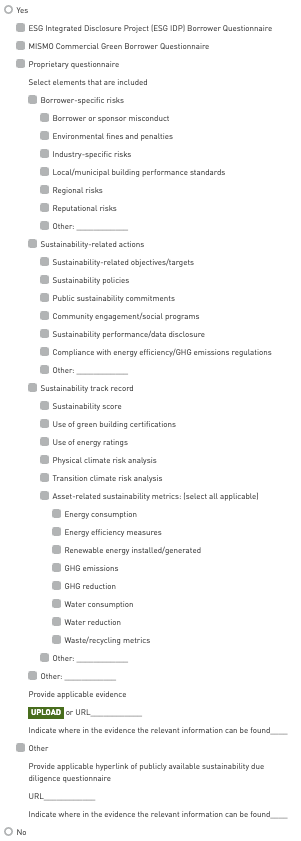
**Does the lender evaluate the borrower/sponsor based upon a Sustainability Due Diligence Questionnaire?**
{% columns %}
{% column width="75%" %}
{% endcolumn %}
{% column width="25%" %}
{% endcolumn %}
{% endcolumns %}
## Assessment Instructions
Intent: What is the purpose of this indicator?
The focus is on the lender process to better understand the borrower/sponsor risk profile by using a Sustainability Due Diligence Questionnaire. In case a proprietary questionnaire is used, Participants should indicate which sustainability metrics are used to assess the borrower/sponsor.
Input: How do I complete this indicator?
Select Yes or No. If Yes, please select all applicable checkboxes.
**Other:** Answers provided under 'Other' must be outside the options listed in the indicator to be valid.
If a Proprietary questionnaire is used, the indicator contains three additional answer options:
1. Under 'Borrower-specific risks' participants should indicate the risk group reviewed.
2. Under 'Sustainability-related actions' participants should specify metric(s) related to the borrower/sponsor's sustainability actions, objectives and/or targets.
3. Under 'Sustainability track record' participants should indicate which (asset-level) sustainability metrics are being tracked.
#### Terminology
**Community engagement**
> Community engagement refers to the communication, interaction, and formation of relationships between the entity and those groups.
**Environmental fines and/or penalties**
> Sanctions resulting from an illegal act, which directly harms the environment.
**ESG Integrated Disclosure Project (ESG IDP)**
> An industry initiative bringing together leading lenders in the private credit and syndicated loan markets to improve transparency and accountability. The goal is to promote greater harmonisation and consistency of disclosure of key ESG indicators by borrowers in private credit and syndicated loan transactions.
**Misconduct**
> Unethical behavior, and more specifically, poor stewardship of environmental, social or governance issues, which may or may not result in legal action.
**MISMO Commercial Green Borrower Questionnaire**
> This industry resource standardizes questions for commercial lenders to ask borrowers when applying for a commercial mortgage loan. These standardized questions are designed to assist lenders in gathering borrower information when originating, underwriting or servicing commercial loans in order to increase borrower participation in ESG.
**Sustainability commitment**
> Long and/or short term aims connected to specific metrics/impacts made by the lender.
**Sustainability objectives**
> Strategic priorities and key topics to improve the management of sustainability issues.
**Sponsor**
> The entity that provides equity to a Borrower in a real estate finance transaction.
**Sustainability performance**
> Indicators of environmental, social, or governance, management, implementation, or performance.
**Sustainability track record**
> Data that reflects the sustainability performance of a borrower or sponsor.
Validation: What evidence is required?
#### **Evidence**
The evidence provided will be subject to manual validation.
**Document upload or hyperlink**\
Two separate uploads are required. If a hyperlink is provided, ensure it is active and that the relevant content can be accessed within two steps. Multiple documents may be uploaded for each upload type, as long as it is clear where the relevant information can be found.
**Evidence upload 1: Proprietary questionnaire**\
The uploaded questionnaire must be the lender’s own Sustainability Due Diligence Questionnaire used to evaluate borrowers or sponsors. The evidence must clearly show that the questionnaire includes the element(s) selected in the checkboxes for this question. It must be possible to locate the relevant questions or sections that correspond to the selected elements. A high level policy statement is not sufficient without the actual questionnaire content.
**Minimum requirements**
* The document must be identifiable as a borrower/sponsor due diligence tool and not only an internal strategy document.
* The selected elements must be explicitly covered in the questionnaire, either as standalone questions, section headers, or required disclosures.
* If the lender uses separate modules, evidence must include the full set of modules needed to demonstrate coverage of the selected elements.
**Evidence upload 2: Third party questionnaire**\
The uploaded document must be an existing third party Sustainability Due Diligence Questionnaire used to assess borrowers or sponsors. Evidence must make clear it is third party, for example the provider name and branding, licensing language, or a link to the provider source.
**Minimum requirements**
* The questionnaire must assess both the borrower/sponsor and the asset.
* Coverage must span multiple aspects consistent with the themes in this question, including borrower/sponsor risks, sustainability actions, and sustainability track record, as well as asset related sustainability metrics.
* A general sustainability survey or scorecard is not sufficient unless it clearly functions as a borrower/sponsor due diligence questionnaire and includes asset level assessment components.
**Examples of acceptable evidence**\
Proprietary borrower/sponsor due diligence questionnaires, lender due diligence templates used in underwriting, third party DDQ tools from recognized providers. Sensitive information may be redacted as long as the structure and relevant sections remain clear.
## Scoring
{% columns %}
{% column width="75%" %}
{% endcolumn %}
{% column width="25%" %}
{% endcolumn %}
{% endcolumns %}
Scoring: How does GRESB score this indicator?
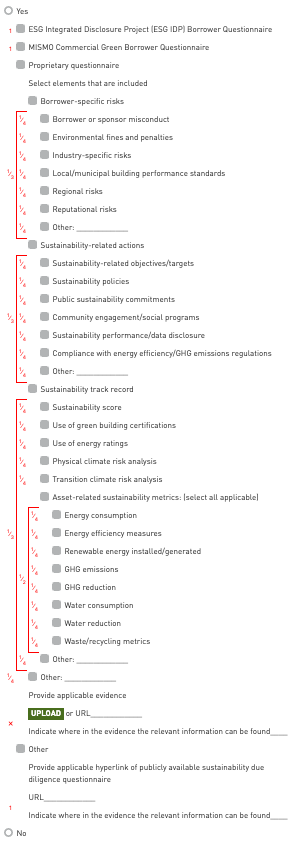
Scoring for this indicator is based on the implementation of a sustainability Due Diligence Questionnaire to evaluate borrowers/sponsors.
The scoring of this indicator is equal to the sum of the fractions assigned to the selected options and respective sub-options, multiplied by the total score of the indicator.
**Evidence:** The evidence is manually validated and assigned a multiplier, according to the table below. The evidence must support the validation requirements.
If any requirements are not met, the evidence may be partially accepted or not accepted, depending on the level of alignment with the requirements.
| Validation status | Multiplier |
| ------------------ | ---------- |
| Accepted | 2/2 |
| Partially Accepted | 1/2 |
| Not Accepted | 0 |
**Other:** The 'Other' answer is manually validated and assigned a score which is used as a multiplying factor, as per the table below:
| Validation status | Score |
| ----------------- | ----- |
| Accepted | 1/1 |
| Not Accepted | 0 |
| Duplicate | 0 |
Scoring Basics
***
References
[ESG Integrated Disclosure Project (ESG IDP)](https://www.esgidp.org/)
[MISMO Commercial Green Borrower Questionnaire](https://www.mismo.org/standards-resources/mismo-product/commercial-green-borrower-questionnaire)
---
# Agent Instructions
This documentation is published with GitBook. GitBook is the documentation platform designed so that both humans and AI agents can read, navigate, and reason over technical content effectively. Learn more at gitbook.com.
## Querying This Documentation
If you need additional information that is not directly available in this page, you can query the documentation by asking a question.
Perform an HTTP GET request on the following URL with the `ask` and `goal` query parameters:
```
GET https://guides.gresb.com/lender/completing-the-assessment/2026-lender-assessment/management-component/borrower-and-asset-review/lbr1-sustainability-due-diligence.md?ask=&goal=
```
`ask` is the immediate question: it should be specific, self-contained, and written in natural language.
`goal` is what the user is ultimately trying to achieve, the reason they need the answer. Sharing it helps GitBook give you a better, more relevant answer. A goal is most helpful when it describes the outcome the user wants rather than restating the question. For example, with `ask=how do I create an API token`, a goal like `automate deployments from our CI pipeline` lets GitBook tailor the answer to that use case.
The response will contain a direct answer to the question and relevant excerpts and sources from the documentation.
Use this mechanism when the answer is not explicitly present in the current page, you need clarification or additional context, or you want to retrieve related documentation sections.