> For the complete documentation index, see [llms.txt](https://guides.gresb.com/llms.txt). Markdown versions of documentation pages are available by appending `.md` to page URLs; this page is available as [Markdown](https://guides.gresb.com/lender/completing-the-assessment/2026-lender-assessment/management-component/borrower-and-asset-review/lbr3-asset-risk-identification.md).
# LBR3: Asset Risk Identification
Cover image
:bullseye: Maximum Score
4 points
:pen-to-square: Prefill
:check:Eligible
:shield-check: Validation
Other answer is manually validated
***
**Does the lender review asset-specific risks and opportunities during the asset due diligence process?**
{% columns %}
{% column width="75%" %}
{% endcolumn %}
{% column width="25%" %}
{% endcolumn %}
{% endcolumns %}
## Assessment Instructions
Intent: What is the purpose of this indicator?
Identify asset-specific sustainability risks and opportunities incorporated during due diligence. Participants should mark which risk factors are reviewed, then elaborate as to how this information is integrated into loan decision-making.
Input: How do I complete this indicator?
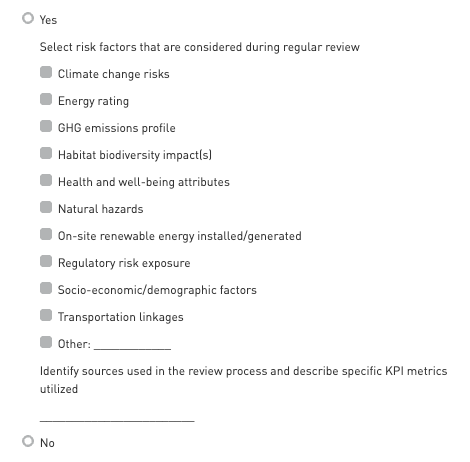
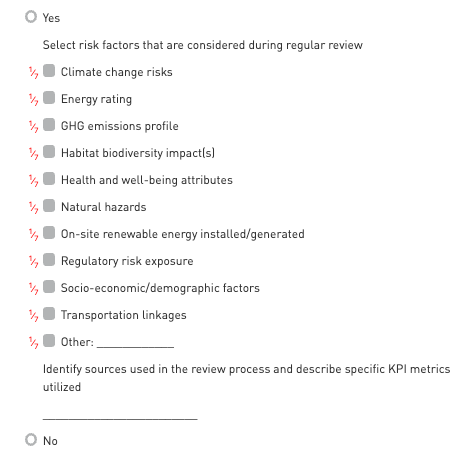
Select Yes or No. If Yes, please select applicable checkboxes and complete the open text box.
**Open text box:** Description provided should fully support each checkbox selected, along with the following elements:
1. Describe sources used to review/analyze risks and/or opportunities during loan underwriting.
2. Elaborate on the granular KPIs/metrics checked during this process.
**Other:** Answers provided under 'Other' must be outside the options listed in the indicator to be valid. Please describe the sustainability-related risk and/or opportunity.
### **Terminology**
**Biodiversity and habitat**
> Issues related to wildlife, endangered species, ecosystem services, habitat management, and relevant topics. Biodiversity refers to the variety of all plant and animal species. Habitat refers to the natural environment in which these plant and animal species live and function.
**Climate change adaptation**
> Preparation for long-term change in climatic conditions or climate related events. Examples of climate change adaptation measures can include, but are not limited to: building flood defenses, xeriscaping and using tree species resistant to storms and fires, adapting building codes to extreme weather events.
**Energy Rating**
> A scheme that measures the energy efficiency performance of buildings.
**GHG emissions**
> GHGs refers to the seven gases listed in the GHG Protocol Corporate Standard: carbon dioxide (CO2); methane (CH4); nitrous oxide (N2O); hydrofluorocarbons (HFCs); perfluorocarbons (PFCs); nitrogen trifluoride (NF3) and sulfur hexafluoride (SF6). They are expressed in CO2 equivalents (CO2e).
**Health and well-being attributes**
> Health and well-being can refer to a broad range of activities that address the determinants of health or the conditions that lead to health outcomes. Health, safety and well-being attributes are associated with employees, customers, surrounding communities or all of the above.
**Natural hazards**
> Naturally occurring physical phenomena that have the potential to cause serious disruptions to the functioning of a community. Natural hazards can be geophysical, hydrological, climatological, meteorological, or biological. Examples include but are not limited to earthquakes, wildfires, hurricanes, and droughts.
**On-site renewable energy**
> Any source of energy produced at the site that can be used without depleting reserves, including energy from the sun, wind, water and the earth’s core. Technologies should be available onsite, such as photovoltaic panels, wind turbines, transpired solar collectors, solar hot water heaters, small-scale hydroelectric power plants, ground pump heating systems, etc.
**Regulatory risks**
> Examples include, but are not limited to: mandatory energy/carbon disclosure schemes, changes in taxes e.g. carbon tax, extreme volatility in energy prices due to regulation, zoning.
**Socio-economic risks**
> Impact on social well-being, livelihoods and prosperity of local communities and individuals. Examples include: economic/political instability, social housing, vulnerability to pandemics and epidemics, crime and vandalism, and the displacement of people.
**Transportation risks**
> Risks associated with transportation around the location of a building in relation to pedestrian, bicycle and mass-transit networks, in context of the existing infrastructure and amenities in the surrounding area.
Validation: What evidence is required?
No evidence required. Only the 'Other' answer is manually validated.
#### **Other Answer**
State which other actions and/or risk factors are considered during regular review.
Validation Basics
## Scoring
{% columns %}
{% column width="75%" %}
{% endcolumn %}
{% column width="25%" %}
{% endcolumn %}
{% endcolumns %}
Scoring: How does GRESB score this indicator?
The scoring of this indicator is equal to the fraction assigned to the selected option, multiplied by the total score of the indicator.
**Other:** The 'Other' answer is manually validated and assigned a score which is used as a multiplying factor, as per the table below:
| Validation status | Score |
| ----------------- | ----- |
| Accepted | 1/1 |
| Not Accepted | 0 |
| Duplicate | 0 |
**Open text box:** The open text box is not scored and is for reporting purposes only.
Scoring Basics
***
---
# Agent Instructions
This documentation is published with GitBook. GitBook is the documentation platform designed so that both humans and AI agents can read, navigate, and reason over technical content effectively. Learn more at gitbook.com.
## Querying This Documentation
If you need additional information that is not directly available in this page, you can query the documentation by asking a question.
Perform an HTTP GET request on the following URL with the `ask` and `goal` query parameters:
```
GET https://guides.gresb.com/lender/completing-the-assessment/2026-lender-assessment/management-component/borrower-and-asset-review/lbr3-asset-risk-identification.md?ask=&goal=
```
`ask` is the immediate question: it should be specific, self-contained, and written in natural language.
`goal` is what the user is ultimately trying to achieve, the reason they need the answer. Sharing it helps GitBook give you a better, more relevant answer. A goal is most helpful when it describes the outcome the user wants rather than restating the question. For example, with `ask=how do I create an API token`, a goal like `automate deployments from our CI pipeline` lets GitBook tailor the answer to that use case.
The response will contain a direct answer to the question and relevant excerpts and sources from the documentation.
Use this mechanism when the answer is not explicitly present in the current page, you need clarification or additional context, or you want to retrieve related documentation sections.