> For the complete documentation index, see [llms.txt](https://guides.gresb.com/llms.txt). Markdown versions of documentation pages are available by appending `.md` to page URLs; this page is available as [Markdown](https://guides.gresb.com/lender/completing-the-assessment/2026-lender-assessment/management-component/leadership/lle2-sustainability-objectives.md).
# LLE2: Sustainability Objectives
Cover image
:bullseye: Maximum Score
2 points
:pen-to-square: Prefill
:check:Eligible
:shield-check: Validation
Evidence not validated
***
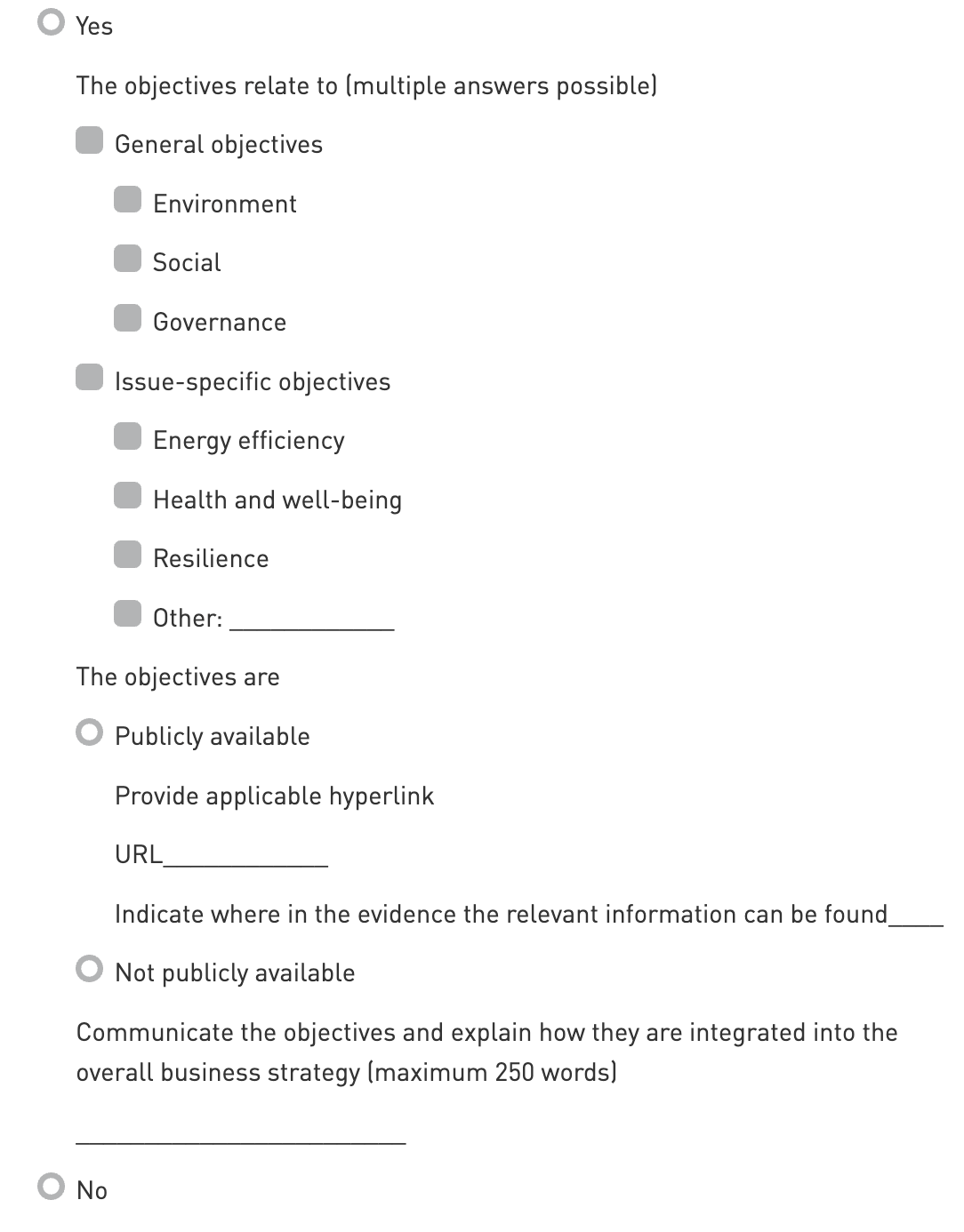
**Does the lender have sustainability objectives?**
{% columns %}
{% column width="66.66666666666666%" %}
{% endcolumn %}
{% column width="33.33333333333334%" %}
{% endcolumn %}
{% endcolumns %}
## Assessment Instructions
Intent: What is the purpose of this indicator?
This indicator evaluates how the entity sets clear, measurable objectives to advance sustainability performance. Defining these objectives helps organizations identify their most material issues and integrate sustainability, resilience, and efficiency considerations into everyday management and long-term strategic planning.
Input: How do I complete this indicator?
Select yes or no. If yes, select all applicable sub-options.
**URL:** When selecting "Publicly available," it is mandatory to include a hyperlink. The link will only be used for reporting purposes. Ensure that the hyperlink is not outdated and that the relevant page can be accessed within two steps. The URL should demonstrate the existence of publicly available sustainability objectives for each of the objectives selected.
**Open text box:** The content of this open text box is not used for scoring, but will be included in the Benchmark Report. Participants should use this open text box to communicate on the following:
1. The scope of the objectives. The text should identify key sustainability priorities and issues relevant to the entity. If applicable, explain how these objectives relate to specific elements of the entity’s overall business strategy. Sustainability objectives can relate to quantifiable goals or to strategic developments.
2. Defined timeframes for objectives. The text should include a description indicating whether the objectives are short-term (one to two years), medium-term (two to three years), or long-term (more than three years).
3. Explanation of the extent of integration of sustainability objectives with business strategy and next steps to foster further alignment.
### Terminology
**Energy efficiency**
> Refers to the works resulting in products or systems using less energy to provide the same consumer benefit.
**Environmental objectives**
> Overall goals arising from policies that an entity sets itself to achieve regarding relevant environmental issues, such as greenhouse gas emissions, renewable energy, or sustainable procurement. These objectives should be quantifiable and correlated with the entity's ambitions. The objectives should be quantifiable and correlated with the entity's ambitions. In turn, they determine targets, which are detailed performance requirements necessary to achieve the environmental objectives.
**Governance objectives**
> Overall goals arising from policies that an entity sets itself to achieve regarding relevant governance issues, such as bribery and corruption, cybersecurity, or board composition. These objectives should be quantifiable and correlated with the entity's ambitions.
**Health and well-being**
> “Health is a complete state of physical, mental and social well-being, not merely the absence of disease or infirmity” (WHO). Health & well-being is impacted by genetics and individual behavior as well as environmental conditions. Particularly relevant to GRESB stakeholders are the social determinants of health, which are the “conditions in which people are born, grow, work, live and age, and the wider set of forces and systems shaping the conditions of daily life.” These are the conditions that enable or discourage healthy living. This could include issues such as physical activity, healthy eating, equitable workplaces, maternity and paternity leave, access to healthcare, reduction in toxic exposures, etc.
**Resilience**
> Preparedness of the built environment towards existing and future climate changes (i.e., the ability to absorb disturbances such as increased precipitation or flooding while maintaining its structure). This can be achieved by management policies, informational technologies, educating tenant, community, suppliers and physical measures at the asset level.
**Social objectives**
> Overall goals arising from policies that an entity sets itself to achieve regarding relevant social issues, such as customer satisfaction, employee engagement, or stakeholder relations. These objectives should be quantifiable and correlated with the entity's ambitions.
**Sustainability objectives**
> Strategic priorities and key topics for the management and/or improvement of sustainability, resilience, and efficiency issues.
Validation: What evidence is required?
Evidence not validated.
## Scoring
{% columns %}
{% column width="66.66666666666666%" %}
{% endcolumn %}
{% column width="33.33333333333334%" %}
{% endcolumn %}
{% endcolumns %}
Scoring: How does GRESB score this indicator?
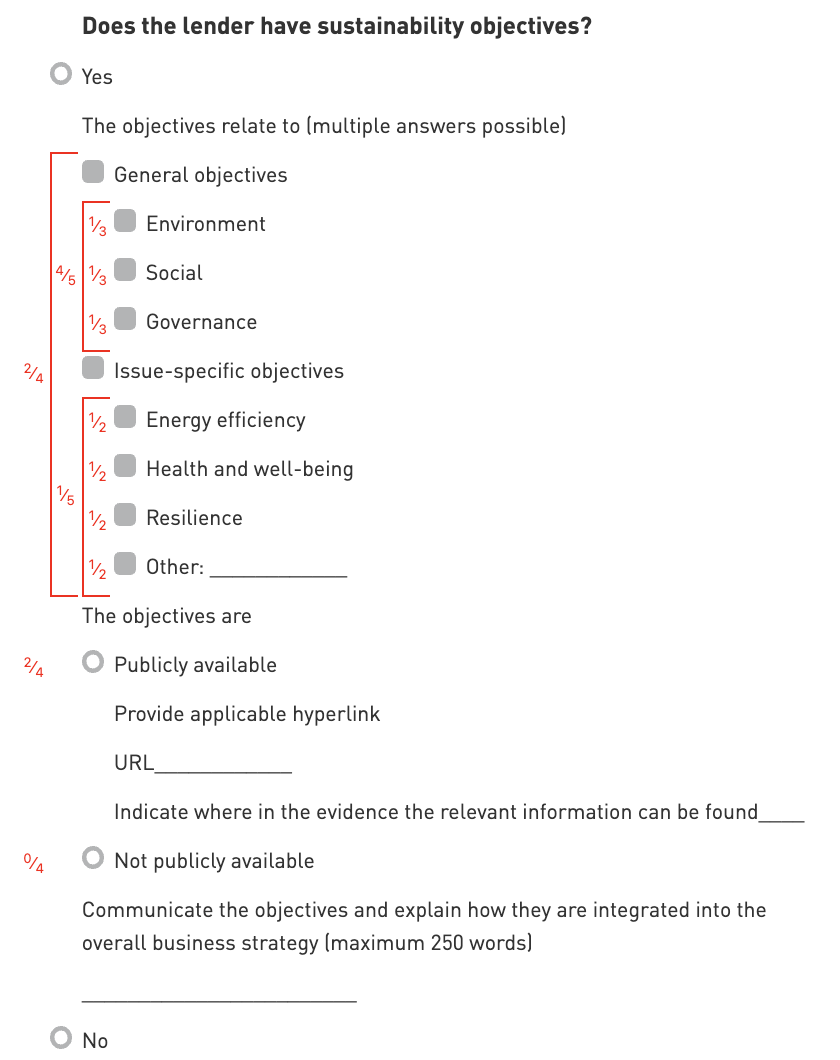
The scoring of this indicator is equal to the fraction assigned to the selected option, multiplied by the total score of the indicator.
**Other:** The 'Other' answer is manually validated and assigned a score, which is used as a multiplying factor, as per the table below:
| Validation status | Score |
| ----------------- | ----- |
| Accepted | 1/1 |
| Not Accepted | 0 |
| Duplicate | 0 |
**Open text box:** The open text box is not scored and is for reporting purposes only.
Scoring Basics
***
## Frequently Asked Questions
I don't have documented human capital objectives to report in indicator LLE2. Does this mean I can't answer LLE4?
No. While LLE2 asks about formal objectives, LLE4 (*Sustainability, Climate-related, and/or Human Capital Senior Decision Maker*) asks about responsibility. You can still answer LLE4 if you have individuals or senior leaders responsible for human capital matters, even if those responsibilities aren't tied to specific objectives.
***
References
EPRA Best Practices Recommendations on Sustainability Reporting, 3rd version, September 2017: 5.7, Analysis
SASB (March 2016)-Real Estate Owners, Developers & Investment Trusts: IF0402-05
---
# Agent Instructions
This documentation is published with GitBook. GitBook is the documentation platform designed so that both humans and AI agents can read, navigate, and reason over technical content effectively. Learn more at gitbook.com.
## Querying This Documentation
If you need additional information that is not directly available in this page, you can query the documentation by asking a question.
Perform an HTTP GET request on the following URL with the `ask` and `goal` query parameters:
```
GET https://guides.gresb.com/lender/completing-the-assessment/2026-lender-assessment/management-component/leadership/lle2-sustainability-objectives.md?ask=&goal=
```
`ask` is the immediate question: it should be specific, self-contained, and written in natural language.
`goal` is what the user is ultimately trying to achieve, the reason they need the answer. Sharing it helps GitBook give you a better, more relevant answer. A goal is most helpful when it describes the outcome the user wants rather than restating the question. For example, with `ask=how do I create an API token`, a goal like `automate deployments from our CI pipeline` lets GitBook tailor the answer to that use case.
The response will contain a direct answer to the question and relevant excerpts and sources from the documentation.
Use this mechanism when the answer is not explicitly present in the current page, you need clarification or additional context, or you want to retrieve related documentation sections.