> For the complete documentation index, see [llms.txt](https://guides.gresb.com/llms.txt). Markdown versions of documentation pages are available by appending `.md` to page URLs; this page is available as [Markdown](https://guides.gresb.com/lender/completing-the-assessment/2026-lender-assessment/management-component/risk-management/lrm1-process-to-implement-governance-policies.md).
# LRM1: Process to Implement Governance Policies
Cover image
:bullseye: Maximum Score
2 points
:pen-to-square: Prefill
:check:Eligible
:shield-check: Validation
Other answer is manually validated
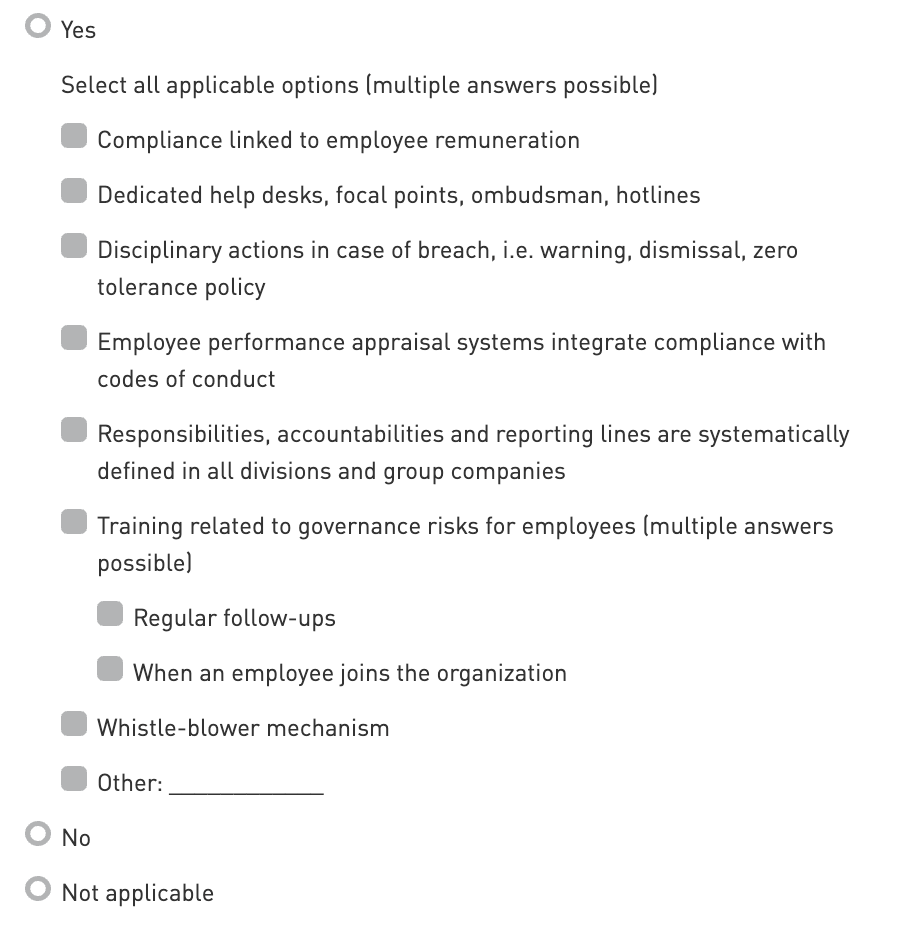
**Does the lender have processes to implement governance policy/policies?**
{% columns %}
{% column width="75%" %}
{% endcolumn %}
{% column width="25%" %}
{% endcolumn %}
{% endcolumns %}
## Assessment Instructions
Intent: What is the purpose of this indicator?
This indicator examines specific actions taken to limit exposure to governance-related risks. It refers to the implementation of the policy that addresses risks from exposure to governance issues.
Input: How do I complete this indicator?
Select yes or no. If yes, select all applicable sub-options.
#### Terminology
**Governance risks for employees**
> Examples can include, but are not limited to: bribery and corruption risks, insider trading, sharing of confidential information.
**Regular follow-ups**
> Training offered at least once a year to employees, starting from their second year of employment.
**Training related to governance risks for employees**
> Employee training ensures that employees understand and adhere to the laws, regulations and internal corporate policies that apply to their daily roles is essential to ensuring that compliance regulations are met in the workplace.
**Whistle-blower mechanism**
> A process that offers protection for individuals that want to reveal illegal, unethical or dangerous practices. An efficient whistle-blower mechanism prescribes clear procedures and channels to facilitate the reporting of wrongdoing and corruption, defines the protected disclosures, outlines the remedies and sanctions for retaliation.
Validation: What evidence is required?
No evidence required. Only the 'Other' answer is manually validated.
#### Other Answer
State the other system or procedure in place. Ensure that the other answer provided is not a duplicate of a selected option above (e.g., Anti-bribery training when 'Training related to governance risks for employees' is selected). It is possible to report multiple other answers. If multiple other answers are acceptable, only one will be counted towards scoring.
Validation Basics
## Scoring
{% columns %}
{% column width="75%" %}
{% endcolumn %}
{% column width="25%" %}
{% endcolumn %}
{% endcolumns %}
Scoring: How does GRESB score this indicator?
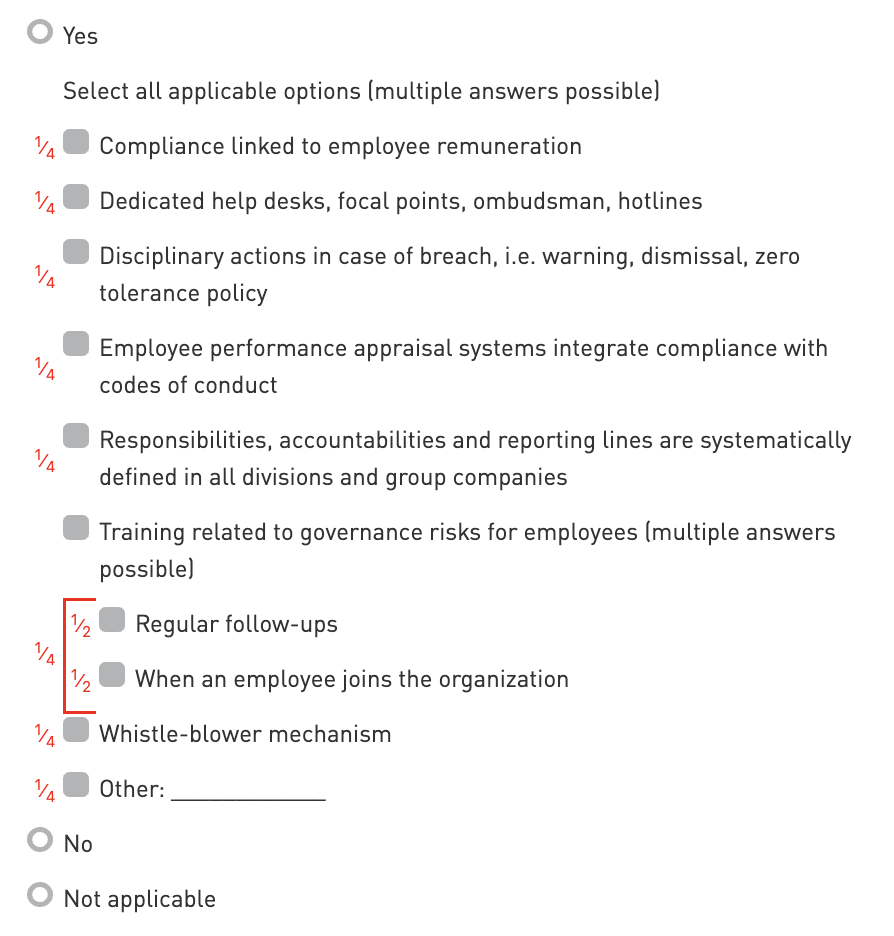
The scoring of this indicator is equal to the fraction assigned to the selected option, multiplied by the total score of the indicator.
**Other:** The 'Other' answer is manually validated and assigned a score which is used as a multiplying factor, as per the table below:
| Validation status | Score |
| ----------------- | ----- |
| Accepted | 1/1 |
| Not Accepted | 0 |
| Duplicate | 0 |
Scoring Basics
***
References
OECD Cleangovbiz, “Whistleblower protection: encouraging reporting”, 2012
---
# Agent Instructions
This documentation is published with GitBook. GitBook is the documentation platform designed so that both humans and AI agents can read, navigate, and reason over technical content effectively. Learn more at gitbook.com.
## Querying This Documentation
If you need additional information that is not directly available in this page, you can query the documentation by asking a question.
Perform an HTTP GET request on the following URL with the `ask` and `goal` query parameters:
```
GET https://guides.gresb.com/lender/completing-the-assessment/2026-lender-assessment/management-component/risk-management/lrm1-process-to-implement-governance-policies.md?ask=&goal=
```
`ask` is the immediate question: it should be specific, self-contained, and written in natural language.
`goal` is what the user is ultimately trying to achieve, the reason they need the answer. Sharing it helps GitBook give you a better, more relevant answer. A goal is most helpful when it describes the outcome the user wants rather than restating the question. For example, with `ask=how do I create an API token`, a goal like `automate deployments from our CI pipeline` lets GitBook tailor the answer to that use case.
The response will contain a direct answer to the question and relevant excerpts and sources from the documentation.
Use this mechanism when the answer is not explicitly present in the current page, you need clarification or additional context, or you want to retrieve related documentation sections.