> For the complete documentation index, see [llms.txt](https://guides.gresb.com/llms.txt). Markdown versions of documentation pages are available by appending `.md` to page URLs; this page is available as [Markdown](https://guides.gresb.com/lender/completing-the-assessment/2026-lender-assessment/management-component/risk-management/lrm2-sustainability-due-diligence-for-new-loan-originations-or-loan-acquisitions.md).
# LRM2: Sustainability Due Diligence for New Loan Originations or Loan Acquisitions
Cover image
:bullseye: Maximum Score
4 points
:pen-to-square: Prefill
:check:Eligible
:shield-check: Validation
Other answer is manually validated
***
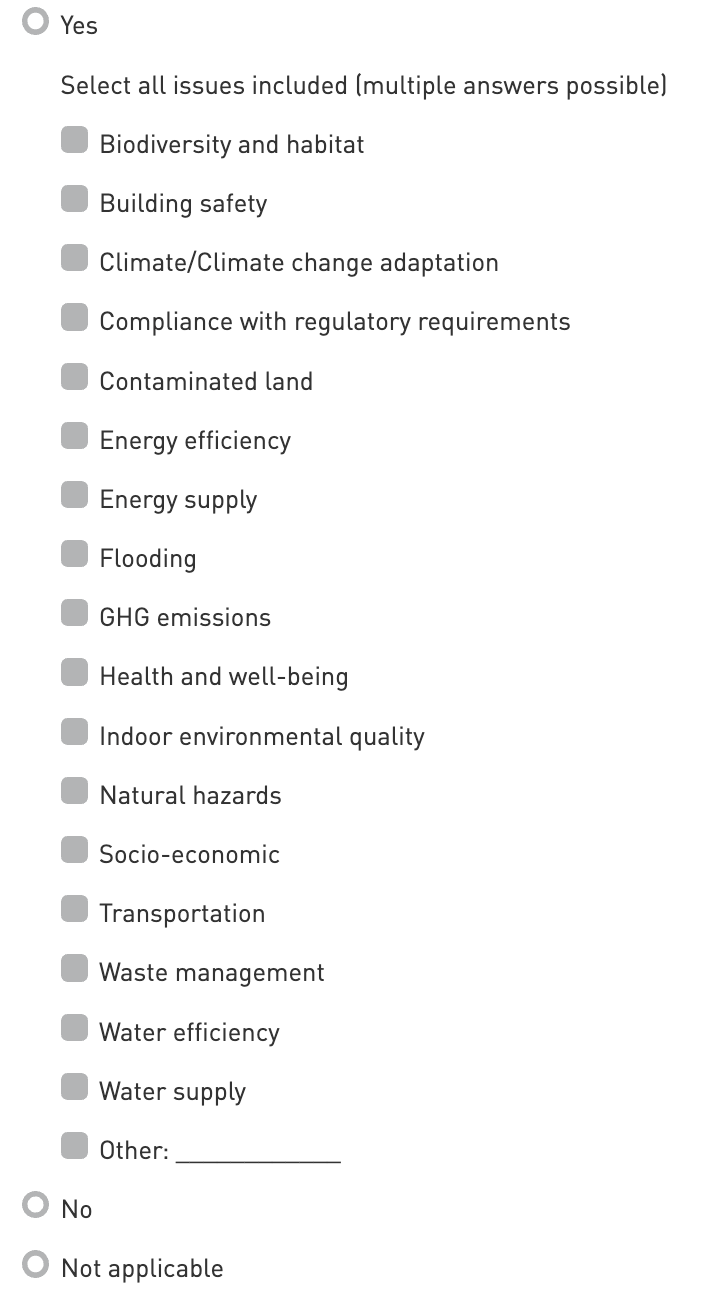
**Does the lender perform asset-level environmental and/or social risk assessments as a standard part of its due diligence process for new loan originations?**
{% columns %}
{% column width="75%" %}
{% endcolumn %}
{% column width="25%" %}
{% endcolumn %}
{% endcolumns %}
## Assessment Instructions
Intent: What is the purpose of this indicator?
This indicator identifies if the entity performs asset-level environmental and/or social assessments as a standard part of the due diligence process for new originations. Risk assessments help to reduce exposure to long-term sustainability risks. Integration of sustainability risk assessments into the origination process demonstrates a commitment to sustainability management, a focus on mitigating risks that might impact returns, and a forward-looking approach to the development of the portfolio.
Input: How do I complete this indicator?
Select yes or no. If yes, select all applicable sub-options.
#### Terminology
**Biodiversity and habitat**
> Issues related to wildlife, endangered species, ecosystem services, habitat management, and relevant topics. Biodiversity refers to the variety of all plant and animal species. Habitat refers to the natural environment in which these plant and animal species live and function.
**Building Safety**
> Environmental issues with the potential to create or exacerbate risks to human safety. Examples of building safety topics include fire safety, structural safety, and electrical and gas safety during development. Building safety strategies can include, but are not limited to, having site inspections at key construction milestones, having a reporting system in place for recording building safety observations, and having designated personnel to oversee building safety compliance during development.
**Climate change adaptation**
> Preparation for long-term change in climatic conditions or climate related events. Examples of climate change adaptation measures can include, but are not limited to: building flood defenses, xeriscaping and using tree species resistant to storms and fires, adapting building codes to extreme weather events.
**Compliance with regulatory requirements**
> Examples include, but are not limited to: mandatory energy/carbon disclosure schemes, changes in taxes e.g. carbon tax, extreme volatility in energy prices due to regulation, zoning.
**Contaminated land**
> Land pollution which may require action to reduce risk to people or the environment. As an example, contamination can be assessed through a Phase I or II Environmental Site Assessment.
**Due diligence process**
> The process through which a potential acquirer evaluates a target asset for an acquisition, contributing to well-informed investment decision-making.
**Energy efficiency**
> Refers to the works resulting in products or systems using less energy to provide the same consumer benefit.
**Energy supply**
> Availability of conventional power (generated by the combustion of fuels: coal, natural gas, oil) or renewable energy (e.g. sun, wind, water, organic plant and waste material).
**Environmental risks**
> Impact on living and non-living natural systems, including land, air, water and ecosystems. This includes, but is not limited to biodiversity, transport and product and service-related impacts, as well as environmental compliance and expenditures.
**Greenhouse gas emissions**
> GHGs refers to the seven gases listed in the GHG Protocol Corporate Standard: carbon dioxide (CO2); methane (CH4); nitrous oxide (N2O); hydrofluorocarbons (HFCs); perfluorocarbons (PFCs); nitrogen trifluoride (NF3) and sulfur hexafluoride (SF6). They are expressed in CO2 equivalents (CO2e).
**Employee health & well-being**
> The health & well-being of employees responsible for the entity.
**Indoor environmental quality**
> Refers to the conditions inside the building. It includes air quality, access to daylight and views, pleasant acoustic conditions and occupant control over lighting and thermal comfort.
**Natural hazards**
> Naturally occuring physical phenomena that have the potential to cause serious disruptions to the functioning of a community. Natural hazards can be geophysical, hydrological, climatological, meteorological, or biological. Examples include but are not limited to earthquakes, wildfires, hurricanes, and droughts.
**Risk assessment**
> Careful examination of the factors that could potentially adversely impact the value or longevity of a real estate asset. The results of the assessment assist in identifying measures that have to be implemented in order to prevent and mitigate the risks.
**Socio-economic risks**
> Impact on social well-being, livelihoods and prosperity of local communities and individuals. Examples include: economic/political instability, social housing, vulnerability to pandemics and epidemics, crime and vandalism, and the displacement of people.
**Transition risks**
> The risks associated with the transition to a lower-carbon global economy. These risks most commonly relate to policy and legal developments, technological changes, market responses, and reputational concerns. These risks are particularly relevant for actors with high GHG emissions within their value chain and are thus sensitive to policy and regulatory actions aimed at emissions reductions, energy efficiency, etc.
**Waste management**
> Issues associated with hazardous and non-hazardous waste generation, reuse, recycling, composting, recovery, incineration, landfill and on-site storage.
**Water efficiency**
> Refers to the conservative use of water resources through water-saving technologies to reduce consumption.
**Water supply**
> Provision of surface water, groundwater, rainwater collected directly or stored by the entity, waste water from another organization, municipal water supplies or other water utilities, usually via a system of pumps and pipes.
Validation: What evidence is required?
No evidence required. Only the 'Other' answer is manually validated.
#### **Other Answer**
State the other risk factor assessed. Ensure that the other answer provided is not a duplicate of a selected option above (e.g., seismic assessments when ‘Natural hazards’ is selected). It is possible to report multiple other answers. If multiple other answers are acceptable, only one will be counted towards scoring.
Validation Basics
## Scoring
{% columns %}
{% column width="75%" %}
{% endcolumn %}
{% column width="25%" %}
{% endcolumn %}
{% endcolumns %}
Scoring: How does GRESB score this indicator?
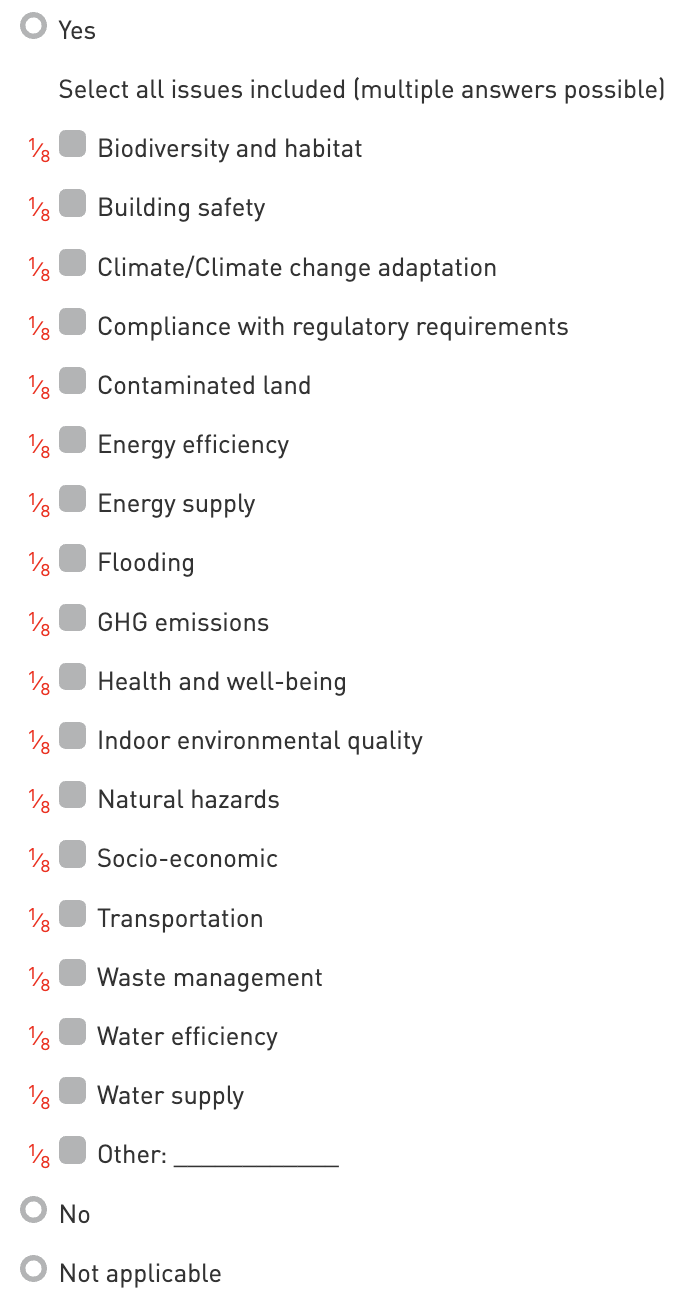
The scoring of this indicator is equal to the fraction assigned to the selected option, multiplied by the total score of the indicator.
**Other:** The 'Other' answer is manually validated and assigned a score, which is used as a multiplying factor, as per the table below:
| Validation status | Score |
| ----------------- | ----- |
| Accepted | 1/1 |
| Not Accepted | 0 |
| Duplicate | 0 |
Scoring Basics
***
References
World Economic Forum, Global Risks, 2014 Environment Agency, Groundwater protection: Principles and practice, 2013
World Health Organization
SASB-Real Estate Owners, Developers & Investment Trusts (March 2016): IF0402-05; IF0402-09; IF0402-14
RobecoSAM Corporate Sustainability Assessment 2017: 3.2.2 Risk Correlation
Recommendations of the Task Force on Climate-Related Financial Disclosures June 2017: Strategy A\&B; Risk Management A\&B
---
# Agent Instructions
This documentation is published with GitBook. GitBook is the documentation platform designed so that both humans and AI agents can read, navigate, and reason over technical content effectively. Learn more at gitbook.com.
## Querying This Documentation
If you need additional information that is not directly available in this page, you can query the documentation by asking a question.
Perform an HTTP GET request on the following URL with the `ask` and `goal` query parameters:
```
GET https://guides.gresb.com/lender/completing-the-assessment/2026-lender-assessment/management-component/risk-management/lrm2-sustainability-due-diligence-for-new-loan-originations-or-loan-acquisitions.md?ask=&goal=
```
`ask` is the immediate question: it should be specific, self-contained, and written in natural language.
`goal` is what the user is ultimately trying to achieve, the reason they need the answer. Sharing it helps GitBook give you a better, more relevant answer. A goal is most helpful when it describes the outcome the user wants rather than restating the question. For example, with `ask=how do I create an API token`, a goal like `automate deployments from our CI pipeline` lets GitBook tailor the answer to that use case.
The response will contain a direct answer to the question and relevant excerpts and sources from the documentation.
Use this mechanism when the answer is not explicitly present in the current page, you need clarification or additional context, or you want to retrieve related documentation sections.