> For the complete documentation index, see [llms.txt](https://guides.gresb.com/llms.txt). Markdown versions of documentation pages are available by appending `.md` to page URLs; this page is available as [Markdown](https://guides.gresb.com/lender/completing-the-assessment/2026-lender-assessment/management-component/risk-management/lrm4-transition-risk-identification.md).
# LRM4: Transition Risk Identification
Cover image
:bullseye: Maximum Score
3 points
:pen-to-square: Prefill
:check:Eligible
:shield-check: Validation
Evidence is manually validated
***
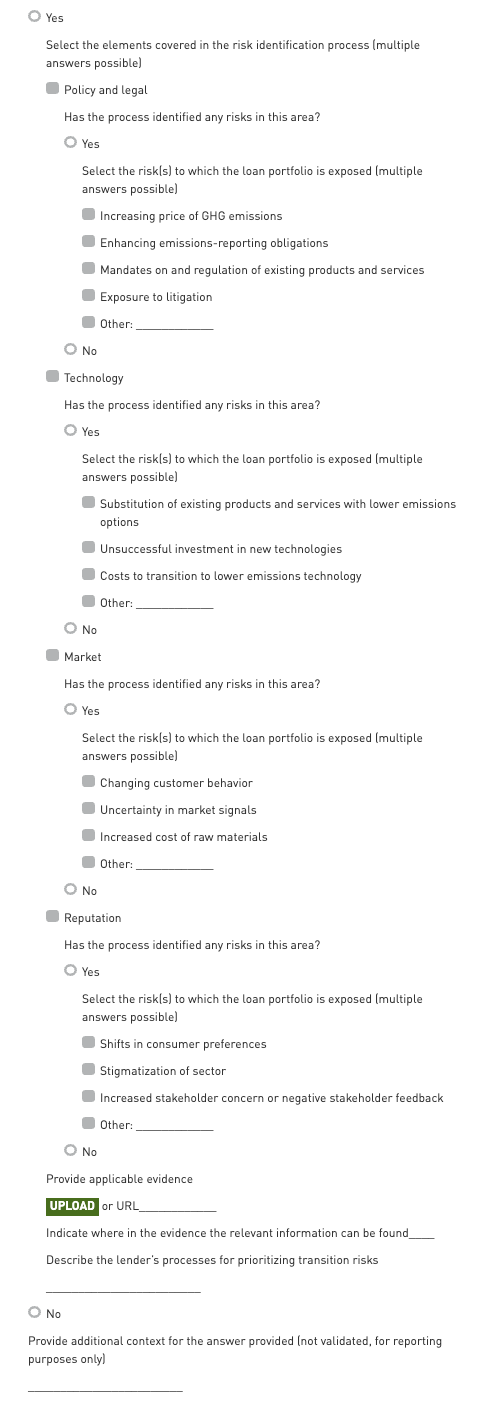
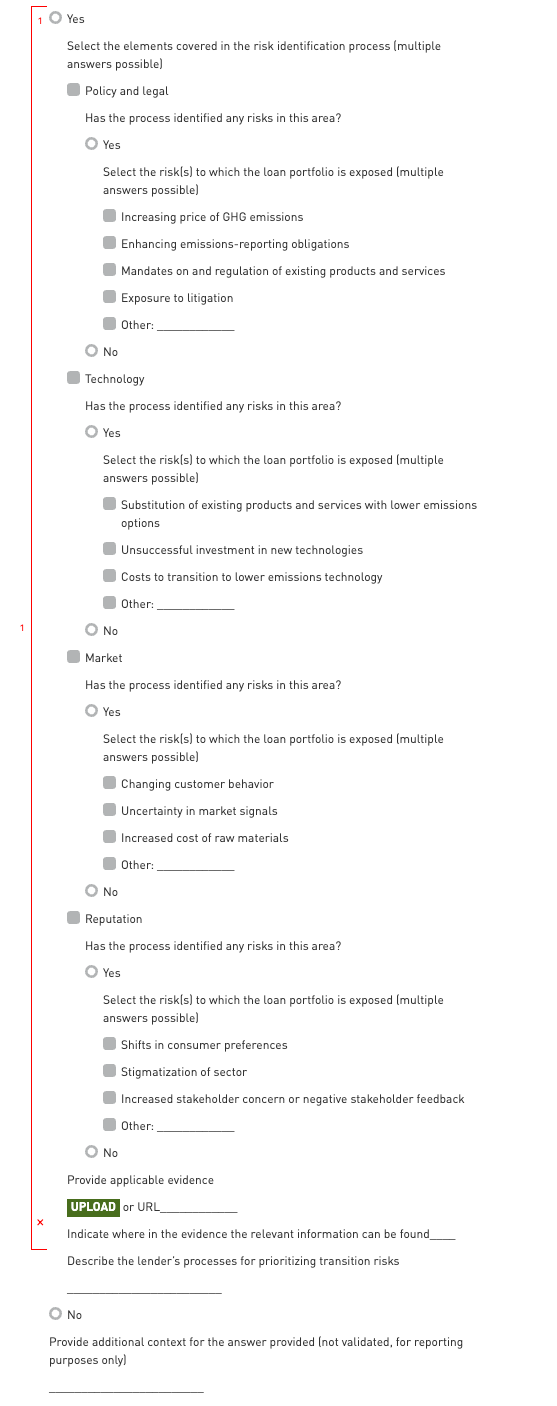
**Does the lender have a systematic process for identifying transition risks that could have a material financial impact on the loan portfolio?**
{% columns %}
{% column width="75%" %}
{% endcolumn %}
{% column width="25%" %}
{% endcolumn %}
{% endcolumns %}
## Assessment Instructions
Intent: What is the purpose of this indicator?
This indicator assesses whether and how the entity uses a systematic approach for identifying transition risks that could impact it in a financially material way.
A comprehensive system for managing transition risks begins with a systematic process for identifying risks that could have a material financial impact on the organization or entity. Such a process ensures that subsequent risk assessments and analyses are focused on the most relevant risks to which an entity is exposed.
Input: How do I complete this indicator?
Select yes or no. If yes, select all applicable sub-options.
### **Terminology**
**Changing customer behavior**
> Examples include, but are not limited to: accelerated demand for climate-resilient properties.
**Costs to transition to lower emissions technology**
> Examples include, but are not limited to: costs of the electrification of buildings (e.g., removing gas fired equipment), retrofits, installation of heat exchangers, substitution of facility services for alternatives with lower levels of embodied carbon, etc.
**Enhancing emissions-reporting obligations**
> Examples include, but are not limited to: TCFD reporting, the Regulation on sustainability-related disclosures in the financial services sector (SFDR), EU Taxonomy, Streamlined Energy & Carbon Reporting (SECR)
**Entity-level**
> Explicitly applicable to the reporting entity as identified in EC1. Note that references to the overarching fund and/or group of which the reporting entity is part do not imply entity-level applicability.
**Exposure to litigation**
> Examples include, but are not limited to: claims of breach of entity board members' duty to act in the best interests of the entity; claims by shareholders of failure to properly disclose in annual reports the risk of climate change resulting from possible investments.
**Increased cost of raw materials**
> Examples include, but are not limited to: increased energy prices, increase cost of facility services and retrofit materials.
**Increased stakeholder concern or negative stakeholder feedback**
> Such increased stakeholder concern or negative feedback might not be immediately financially material to an entity, but it signals that it could become so -- in the form of loss in financial loans or increase in cost of capital -- if action is not taken with regard to an entity’s identification, assessment, and management of climate-related issues. Examples include, but are not limited to: Stricter requirements to incorporate climate risk in investment decisions.
**Increasing price of GHG emissions**
> Examples include, but are not limited to: the implementation of a carbon tax, or cap and trade systems (e.g. EU ETS)
**Mandates on and regulation of existing products and services**
> The “existing products and services” as used here refers to the main function of the entity. Examples include, but are not limited to: Minimum Energy Efficiency Standard (MEES), Energy Performance of Buildings Directive (EPBD).
**Market risk**
> Involves changes in the supply and demand dynamics for specific commodities, products, or services driven by the global transition to a low-carbon economy. This includes factors such as shifts in consumer preferences, regulatory changes affecting production costs, or technological advancements altering market competitiveness. Conversely, opposing trends, such as anti-ESG legislation, can also impact market dynamics by influencing investment flows or altering the competitive landscape.
**Material financial impact**
> In the context of this indicator, material financial impact is used in accordance with its use by the TCFD to express information about impacts on an entity and its financial manifestations insofar as such information is deemed to be material. As per the TCFD, “in determining whether information is material ... organizations should determine materiality for climate-related issues consistent with how they determine the materiality of other information included in their financial filings.” Furthermore, “asset managers and asset owners should consider materiality in the context of their respective mandates and investment performance for clients and beneficiaries.”
**Policy and legal risk**
> Policy risk derives from policy action that either tries to constrain actions which contribute to climate change, or to promote adaptation to climate change. Legal risk arises from an increase in climate-related litigation, for instance due to failure of an organisation to properly communicate and account for its interactions with the climate.
**Reputation risk**
> Involves how an entity is perceived by customers, communities, or stakeholders in relation to its role in supporting or hindering the transition to a low-carbon economy. Negative perceptions, whether due to environmental practices, public commitments, or social responsibility, can impact brand value, customer loyalty, and stakeholder trust.
**Systematic risk identification process**
> A process for identifying risks that is structured, repeatable, undergone at regular intervals, and designed in such a way that it can capture the potential risks that could prove financial material to the entity. It may be a standalone process, or it may be a step within another larger risk assessment process. Furthermore, it may leverage quantitative methods (e.g., use of modeling, data analysis, quantitative thresholds) and/or qualitative methods (e.g., expert consultation, working groups).
**Substitution of existing products and services with lower emissions options**
> The “existing products and services” as used here refers to the main function of the entity. The risk of substitution for lower emissions options refers to a shift in the use of technologies that results in the reduction of the demand of such a function. For real estate, this refers to the provision of a building for its intended use.
>
> This does not refer to the substitution of lower emissions technologies in the provision of the same core function (see Costs to transition to lower emissions technologies). Examples include, but are not limited to: the risk that specific technological advancements make specific buildings or property types less desirable; remote working technologies leading to the substitution of office space for more distributed, lower-emitting remote or shared office alternatives.
**Shifts in consumer preferences**
> This option describes the shift of consumer preferences specifically around the provider of the good or service as a result of that provider’s treatment of climate-related issues. It does not describe an overall or provider-agnostic shift, which would be categorized as Changing customer behavior as described above.
**Stigmatization of sector**
> Loss in financial loans or increase in cost of capital due to hesitation about the sector’s general handling of climate-related issues.
**Transition risks**
> The risks associated with the transition to a lower-carbon global economy. These risks most commonly relate to policy and legal developments, technological changes, market responses, and reputational concerns. These risks are particularly relevant for actors with high GHG emissions within their value chain and are thus sensitive to policy and regulatory actions aimed at emissions reductions, energy efficiency, etc.
**Technology risk**
> New technologies may displace old systems and disrupt existing parts of the economic system. Therefore, technological improvements and innovations can affect competitiveness, production and distribution costs, and potentially the demand for certain products and services, thus resulting in considerable uncertainty.
**Uncertainty in market signals**
> Examples include, but are not limited to: energy price volatility; insufficient “pricing-in” of climate-related premiums; misguided assessment of industry and competition trends.
**Unsuccessful investment in new technologies**
> Examples include, but are not limited to: investment into new technology unsuccessful due to difficulty of adoption or more efficient substitutes; unanticipated costs of operation, installation, or permitting; incompatibility with existing building systems or local electric grid operations; underperformance of new technologies compared to expected performance, etc.
Validation: What evidence is required?
#### Evidence
The evidence and text box provided will be subject to manual validation.
The evidence should sufficiently support all the items selected for this question. If a hyperlink is provided, ensure that it is active and that the relevant page can be accessed within two steps.
The provided evidence must cover the following elements:
1. Demonstrate there is a systematic risk identification process for transition risks in place and not simply a generic “climate-related risk” assessment
2. Demonstrate outcomes of the transition risk identification assessment. It is expected that the document list/state which risks, or lack thereof, were identified as a consequence of the risk assessment having been carried out.
3. The outcome-based information must pertain to the entity/portfolio in question and not only to the manager/group/business-unit level. Note: For fund-of-funds, entity-level applicability must be explicitly established.
4. The risk assessments must be applicable to the reporting year, or two years prior (2025, 2024, 2023). For 2025, a grace period allows participants to use assessments up to four years old, if previously accepted in 2024.
**Text box:** Describe the lender's processes for prioritizing transition risks.
Examples of appropriate evidence include, but are not limited to:
* **For Process**: A document describing the entity’s approach or methodology towards transition risk assessments or other tangible proof of the entity's risk assessment activity. This process-based information can include information akin to materiality determination, scenario analysis, modeling or review of legislation.
* **For Outcomes**: An extract of the results of the assessment such as a risk register or matrix, checklists, scenario analysis or a section of a risk framework or risk management plan addressing transition risks. Such documents can help exhibit the outcomes of the risk.
* **For Entity-level Outcomes**: Entity-level documentation that highlights specific transition risks identified for the entity. If using group-level documentation, ensure the outcomes relevant to the entity are included in the evidence.
#### **Other Answer**
The other answer provided will not be subject to manual validation. It is used for reporting purposes only.
State the other transition risk issue.
Validation Basics
## Scoring
{% columns %}
{% column width="75%" %}
{% endcolumn %}
{% column width="25%" %}
{% endcolumn %}
{% endcolumns %}
Scoring: How does GRESB score this indicator?
Scoring for this indicator is based on the existence of a systematic process for identifying transition risks.
**Evidence:** The evidence is manually validated and assigned a multiplier, according to the table below. The evidence must support the validation requirements.
If any requirements are not met, the evidence may be partially accepted or not accepted depending on the level of alignment with the requirements.
| Validation status | Multiplier |
| ------------------ | ---------- |
| Accepted | 2/2 |
| Partially Accepted | 1/2 |
| Not Accepted | 0 |
Scoring Basics
***
References
[TCFD. (2017) “Final Report: Recommendations of the Task Force on Climate-related Financial Disclosures.”](https://assets.bbhub.io/company/sites/60/2020/10/FINAL-2017-TCFD-Report-11052018.pdf)
[TCFD. (2021) “2017 to 2021 TCFD Implementation Guidance (Annex) Summary of Changes”](https://assets.bbhub.io/company/sites/60/2021/10/2021-Summary-of-Annex-Changes.pdf)
[TCFD. (2023) “TCFD Report Index: Implementation Guidance”](https://assets.bbhub.io/company/sites/60/2023/03/TCFD_Report_Index.pdf)
---
# Agent Instructions
This documentation is published with GitBook. GitBook is the documentation platform designed so that both humans and AI agents can read, navigate, and reason over technical content effectively. Learn more at gitbook.com.
## Querying This Documentation
If you need additional information that is not directly available in this page, you can query the documentation by asking a question.
Perform an HTTP GET request on the following URL with the `ask` and `goal` query parameters:
```
GET https://guides.gresb.com/lender/completing-the-assessment/2026-lender-assessment/management-component/risk-management/lrm4-transition-risk-identification.md?ask=&goal=
```
`ask` is the immediate question: it should be specific, self-contained, and written in natural language.
`goal` is what the user is ultimately trying to achieve, the reason they need the answer. Sharing it helps GitBook give you a better, more relevant answer. A goal is most helpful when it describes the outcome the user wants rather than restating the question. For example, with `ask=how do I create an API token`, a goal like `automate deployments from our CI pipeline` lets GitBook tailor the answer to that use case.
The response will contain a direct answer to the question and relevant excerpts and sources from the documentation.
Use this mechanism when the answer is not explicitly present in the current page, you need clarification or additional context, or you want to retrieve related documentation sections.