> For the complete documentation index, see [llms.txt](https://guides.gresb.com/llms.txt). Markdown versions of documentation pages are available by appending `.md` to page URLs; this page is available as [Markdown](https://guides.gresb.com/lender/completing-the-assessment/2026-lender-assessment/management-component/stakeholder-engagement/lse2-employee-satisfaction-survey.md).
# LSE2: Employee Satisfaction Survey
Cover image
:bullseye: Maximum Score
2 points
:pen-to-square: Prefill
:check:Eligible
:shield-check: Validation
Evidence and Other Answer are manually validated
***
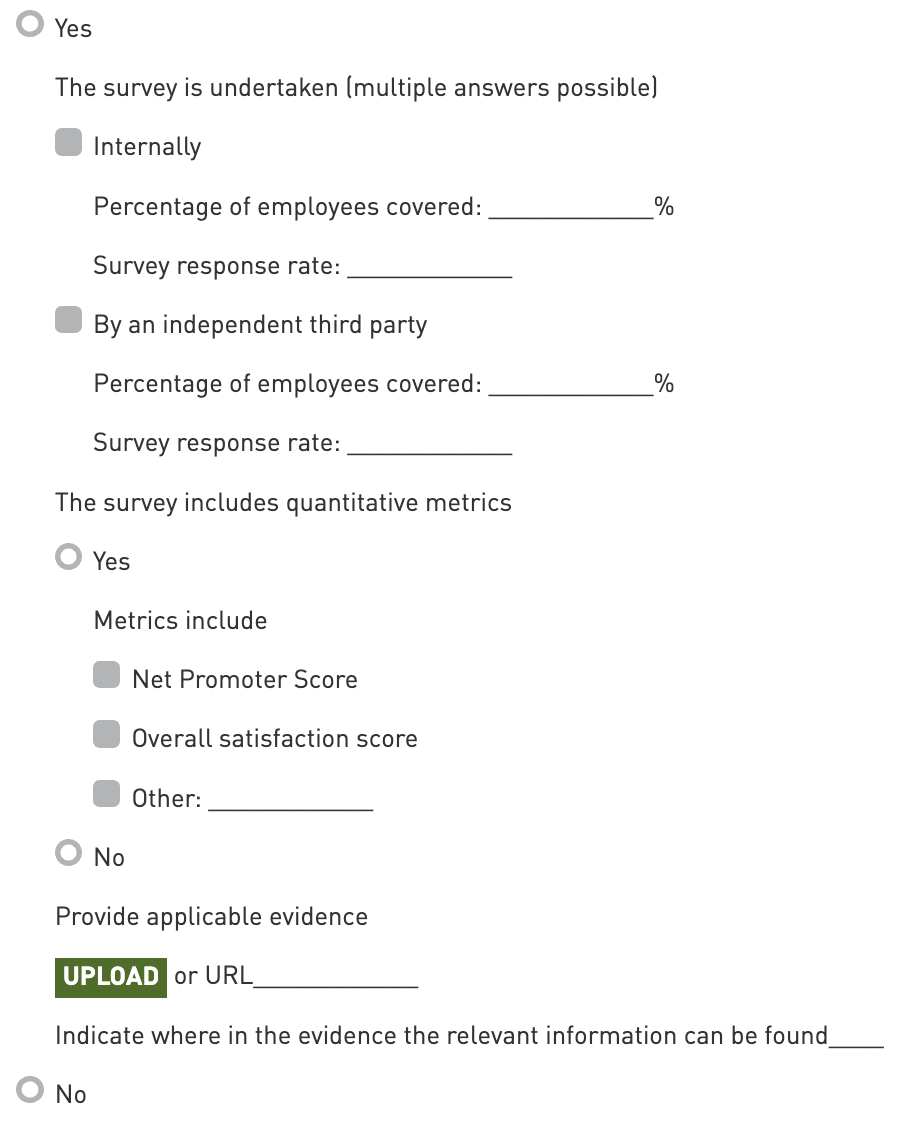
**Has the lender undertaken an employee satisfaction survey within the last three years?**
{% columns %}
{% column width="66.66666666666666%" %}
{% endcolumn %}
{% column width="33.33333333333334%" %}
{% endcolumn %}
{% endcolumns %}
## Assessment Instructions
Intent: What is the purpose of this indicator?
This indicator examines whether and to what extent the entity engages with employees regarding their satisfaction. Employee satisfaction surveys help entities understand critical issues within the business, engage with their staff and increase employee satisfaction, which may contribute to improving retention rates and overall productivity.
Using widely applied employee satisfaction surveys should be translated into easily interpretable metrics that can help analyze and compare outcomes, despite the many variations between departments and teams.
Input: How do I complete this indicator?
Select yes or no. If yes, select all applicable sub-options.
**Percentage of employees covered**
* The percentage of employees covered based on headcount for employees responsible for the entity. If the number of employees responsible for the entity changed during the reporting year, calculate the percentage based on the average number.
*Percentage of employees covered* = Number of employees receiving the satisfaction survey / Total number of employees x 100%
**Survey response rate**
* Report the proportion of employees who received and completed the survey, compared to the total number of employees who have received the survey, expressed as a percentage (see example).
*Survey response rate* = Number of individual survey responses / Number of employees receiving the satisfaction survey x 100%
### Terminology
**Employee(s)**
> The entity’s employees whose primary responsibilities include the operation or support of the entity.
**Employee satisfaction survey**
> Survey measuring overall and work-specific employee satisfaction at the individual and entity levels. The survey should directly address employee concerns and include the opportunity to provide recommendations for improvement.
**Independent third party**
> In the context of survey administration, an independent third party is an external organization that is financially and structurally independent from the reporting entity and is responsible for administering the survey in a matter that safeguards the impartiality, integrity, and quality of survey results.\
> \
> For a survey to be considered third-party administered:
>
> * The organization administering the survey must be a separate legal entity from the fund manager or reporting entity.
> * The administrator must ensure that the reporting entity cannot access, edit, or influence individual responses or aggregated survey results once the survey is launched.
> * Participant anonymity must be preserved, and the survey process must protect the integrity of the data and the resulting quantitative metrics.
>
> **The use of survey development tools, such as SurveyMonkey and SurveyGizmo, may not qualify as an independent third party** unless the tool’s service explicitly includes independent creation and administration. This must be clearly specified in the evidence provided.
**Net promoter score**
> The Net Promoter Score ® (NPS) is a customer loyalty metric developed by Bain & Company, Fred Reichheld, and Satmetrix. It divides customers, tenants or employees into three segments: passives, detractors and promoters, using the following question “On a scale of 0 to 10, how likely would you be to recommend this company (or this product) to friends and colleagues?” The Net Promoter Score ® (NPS) ratings of 9 or 10 indicate promoters; 7 and 8, passives; and 0 through 6, detractors. The NPS is the percentage of promoters minus the percentage detractors. NPS can be represented in surveys as a question asking a survey respondent about their likelihood to recommend the company.
**Overall employee satisfaction score**
> An overarching metric in a satisfaction survey, with no prescribed scale, that measures how happy an employee is with the entity. The industry best practice is a 1-5 scale - very poor, poor, average, good, and excellent, respectively. Overall engagement score is a separate metric from overall satisfaction score and can be reported as an other answer. While satisfied employees are happy with their current situation, engaged employees proactively help to improve the company and their working environment.
**Quantitative metric**
> Any measure or parameter in employee or tenant satisfaction that can be represented numerically.
**Survey response rate**
> The proportion of substantially complete survey responses received as a percentage of the total number of surveys administered.
**Understanding tenant needs**
> Understanding tenant expectations and priorities as they related to the property and/or the overall entity. Examples include satisfaction with amenities, programming, or initiatives.
Validation: What evidence is required?
#### Evidence
The evidence provided will be subject to manual validation.
The evidence must :
1. Confirm that the survey was **conducted***.*
2. Specify whether it was **undertaken** internally, by an \*independent third party, or both.
1. If both options are selected, the evidence must demonstrate that at least one of the surveys was conducted by an independent third party.
2. The relationship between the entity and the independent third party must be clearly explained either within the evidence itself or in the accompanying open text box.
1. **\*Third-party Independence:** Beginning in 2026, GRESB will request additional documentation from a random sample of participants to confirm the third-party independence of their survey provider (as defined in the [Terminology](#terminology) section above). GRESB may reject an entity's evidence if it cannot confirm third-party independence. Please note that this will **not** apply to participants who select 'Internally' as their survey administration method.
3. Confirm that the data collected through the survey corresponds to one of the **last three reporting years** (2025, 2024, or 2023).
1. The survey must have been distributed no later than the last day of the reporting year to ensure alignment with the reporting period. The aggregation and analysis of the survey data must be completed before the GRESB submission deadline.
2. If the survey results report is dated after the reporting year, the entity must provide the survey results report *and* the sample survey with dates that confirm the survey was conducted within the last three reporting years.
Appropriate evidence includes:
* A sample survey (completed questionnaire)
* Survey results reports containing aggregated feedback
* Blank survey template containing aggregated feedback
Blank survey templates unaccompanied by aggregated results are not acceptable as evidence. If applicable, the evidence must also include the quantitative metrics selected for the analysis.
#### **Other Answer**
The other answer(s) provided will be subject to manual validation.
State the other quantitative metric included in the employee satisfaction survey. The other answer must be a measure or parameter in employee satisfaction that can be represented numerically. This can include, but is not limited to, the overall satisfaction with the working conditions. A metric about the survey itself (i.e., user-friendliness) is not appropriate. It is possible to report multiple other answers. If multiple other answers are acceptable, only one will be counted towards scoring.
Validation Basics
## Scoring
{% columns %}
{% column width="66.66666666666666%" %}
{% endcolumn %}
{% column width="33.33333333333334%" %}
{% endcolumn %}
{% endcolumns %}
Scoring: How does GRESB score this indicator?
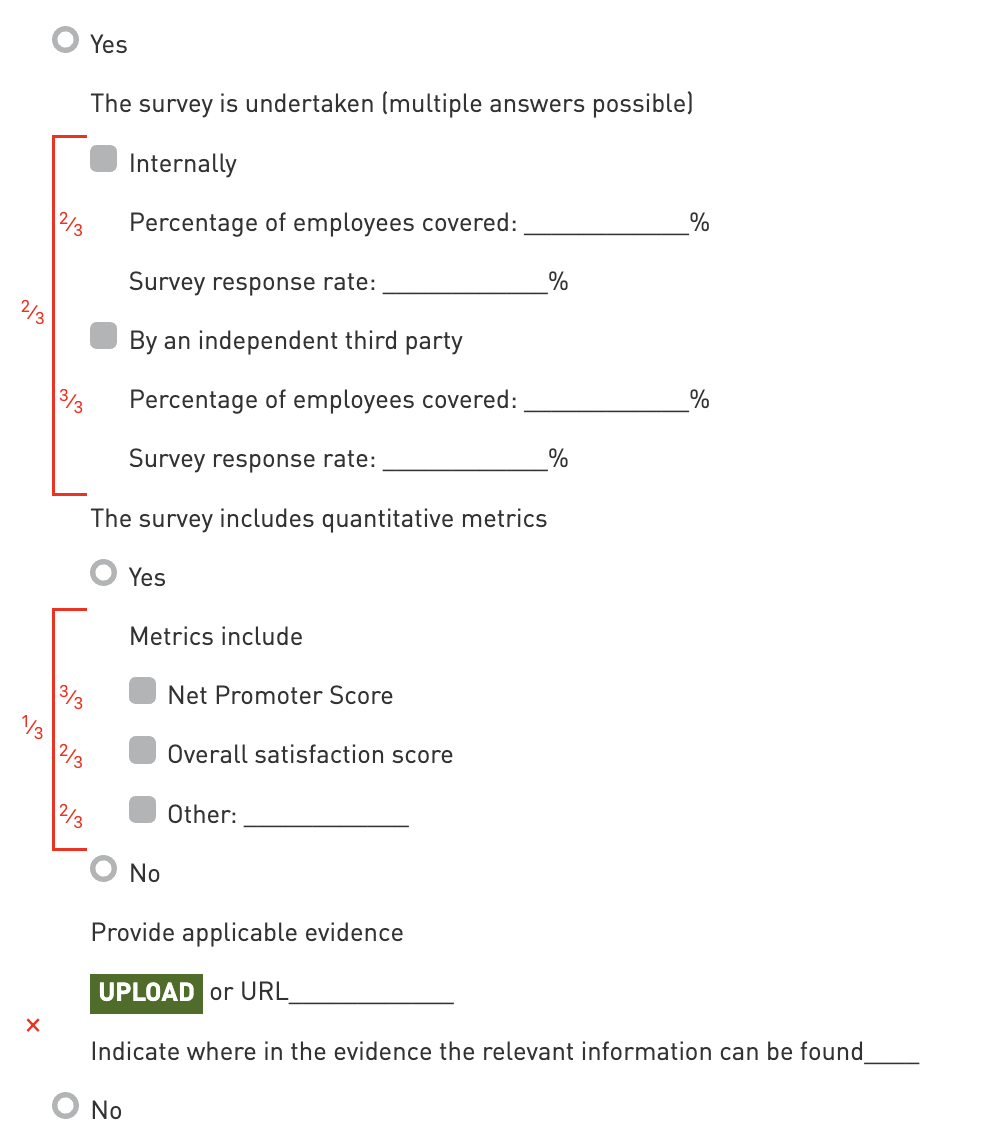
The scoring of this indicator is equal to the sum of the fractions assigned to the selected options and respective sub-options, multiplied by the total score of the indicator.
**Percentage number:** The coverage percentage reported is used as a multiplier to determine the assigned score. The survey response rate is not factored into the scoring and is only used for reporting purposes
**Evidence:** The evidence is manually validated and assigned a multiplier, according to the table below. The evidence must support the validation requirements.
If any requirements are not met, the evidence may be partially accepted or not accepted depending on the level of alignment with the requirements.
| Validation status | Multiplier |
| ------------------ | ---------- |
| Accepted | 2/2 |
| Partially Accepted | 1/2 |
| Not Accepted | 0 |
**Other:** The 'Other' answer is manually validated and assigned a score which is used as a multiplying factor, as per the table below:
| Validation status | Score |
| ----------------- | ----- |
| Accepted | 1/1 |
| Not Accepted | 0 |
| Duplicate | 0 |
Scoring Basics
***
References
GRI Sustainability Reporting Standards, 2016: 102-43, Approach to stakeholder engagement
Bain & Company, Introducing: The Net Promoter System®
---
# Agent Instructions
This documentation is published with GitBook. GitBook is the documentation platform designed so that both humans and AI agents can read, navigate, and reason over technical content effectively. Learn more at gitbook.com.
## Querying This Documentation
If you need additional information that is not directly available in this page, you can query the documentation by asking a question.
Perform an HTTP GET request on the following URL with the `ask` and `goal` query parameters:
```
GET https://guides.gresb.com/lender/completing-the-assessment/2026-lender-assessment/management-component/stakeholder-engagement/lse2-employee-satisfaction-survey.md?ask=&goal=
```
`ask` is the immediate question: it should be specific, self-contained, and written in natural language.
`goal` is what the user is ultimately trying to achieve, the reason they need the answer. Sharing it helps GitBook give you a better, more relevant answer. A goal is most helpful when it describes the outcome the user wants rather than restating the question. For example, with `ask=how do I create an API token`, a goal like `automate deployments from our CI pipeline` lets GitBook tailor the answer to that use case.
The response will contain a direct answer to the question and relevant excerpts and sources from the documentation.
Use this mechanism when the answer is not explicitly present in the current page, you need clarification or additional context, or you want to retrieve related documentation sections.