> For the complete documentation index, see [llms.txt](https://guides.gresb.com/llms.txt). Markdown versions of documentation pages are available by appending `.md` to page URLs; this page is available as [Markdown](https://guides.gresb.com/lender/completing-the-assessment/2026-lender-assessment/performance-component/building-certifications/lbc2-energy-ratings.md).
# LBC2: Energy Ratings
Cover image
:bullseye: Maximum Score
0 points
:pen-to-square: Prefill
:xmark:Not eligible
:shield-check: Validation
Automatic
***
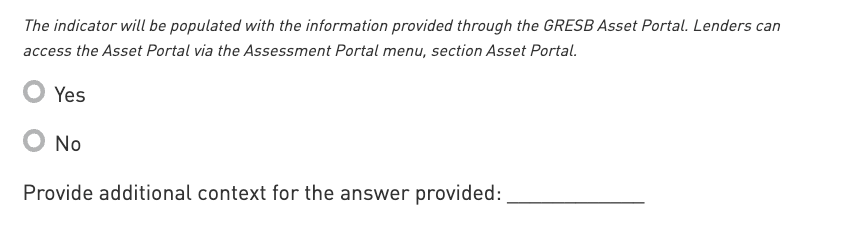
**Does the lender track Energy Rating data for standing assets in its loan portfolio?**
{% columns %}
{% column width="75%" %}
{% endcolumn %}
{% column width="25%" %}
{% endcolumn %}
{% endcolumns %}
## Assessment Instructions
Intent: What is the purpose of this indicator?
This indicator assesses the lender’s use of energy ratings and benchmarking. Energy ratings are often government mandated and provide a measure of the energy efficiency performance of buildings. Energy ratings enable tenants, investors, and lenders to identify buildings that are both environmentally-friendly and have lower utility costs.
Publicly disclosed asset-level building certifications and ratings provide third-party verified recognition of sustainability performance in new construction, refurbishment and operations. Typically, building certifications affirm that individual assets are designed and/or operated in ways that are consistent with independently developed sustainability criteria.
Input: How do I complete this metric?
Participants can **optionally** report their loan portfolio energy ratings at the asset-level through the GRESB Asset Portal.
Only include energy ratings that are in effect during the reporting year.
Ratings that are submitted for review, but not yet official are not valid.
**Pre-assessments** or **other forms of pre-certification** received prior to project completion or the end of the performance period (whichever is relevant) are not valid. These types of preliminary assessments provide an understanding of how a project is likely to perform against the criteria of a specific certification system. These can be undertaken by third parties, consultants, developers, or as part of a pre-certification process to indicate progress. However, are not equivalent to a final certified outcome.
Specific rules apply for certain Energy Ratings:
* **Energy Star Portfolio Manager**: If an asset’s performance is tracked using Energy Star Portfolio Manager, and is not eligible for a 1-100 ENERGY STAR score, it still qualifies for reporting in BC2 as long as it received a rating in the form of a % difference from the national median EUI. If an asset has received a 1-100 Energy Star Score, participants should select ‘Energy Star Portfolio Manager”.
* **Energy Star Certified**: If an asset has received a 1-100 Energy Star score and subsequently received an official Energy Star certification, meaning with a certificate issued by the US EPA, participants should select “Energy Star Certified” and the corresponding score threshold.
* **EU EPC**: The use of levels by EU EPC can vary significantly across European countries. Please make sure to select the relevant level for the country in which the asset is located. If specific regions in Europe do not use ratings, select the related option.
* **NABERS Energy**: Report the NABERS Energy Rating without Green Power as this is the proxy for the Energy efficiency of the asset. This will ensure comparability of ratings reported across entities with NABERS Energy Ratings.
Refer to the [Scheme Lists](/lender/completing-the-assessment/supporting-information/scheme-lists.md) page for the complete list of recognized building certification schemes, which will remain eligible for the 2026 and 2027 assessments.
{% hint style="info" %}
GRESB updated its building certification evaluation criteria in December 2024 and retired the existing criteria in June 2025. All certification schemes must meet the revised evaluation criteria to be recognized for the 2028 GRESB Standard.\
\
For more information about the scheme re-evaluation process and status, see [here](https://www.gresb.com/nl-en/building-certifications/).
{% endhint %}
#### Terminology
**Energy Rating**
> A scheme that measures the energy efficiency performance of buildings.
Validation: What evidence is required?
This indicator is subject to automatic validation. No evidence is required.\
\
Refer to the page below for guidance on how to resolve automatic validation errors and warnings.\
\ Validation Basics
***
## Scoring
This indicator is not currently scored, and is used to inform future benchmarking considerations.
***
References
SASB-Real Estate Owners, Developers & Investment Trusts, March 2016: IF0402-04
---
# Agent Instructions
This documentation is published with GitBook. GitBook is the documentation platform designed so that both humans and AI agents can read, navigate, and reason over technical content effectively. Learn more at gitbook.com.
## Querying This Documentation
If you need additional information that is not directly available in this page, you can query the documentation dynamically by asking a question.
Perform an HTTP GET request on the current page URL with the `ask` query parameter, and the optional `goal` query parameter:
```
GET https://guides.gresb.com/lender/completing-the-assessment/2026-lender-assessment/performance-component/building-certifications/lbc2-energy-ratings.md?ask=&goal=
```
`ask` is the immediate question: it should be specific, self-contained, and written in natural language.
`goal` is optional and describes the broader end goal you are ultimately trying to accomplish on behalf of the user. GitBook uses it to tailor the answer towards what is most useful for that goal.
The response will contain a direct answer to the question and relevant excerpts and sources from the documentation.
Use this mechanism when the answer is not explicitly present in the current page, you need clarification or additional context, or you want to retrieve related documentation sections.