# GRESB Guides
Welcome to GRESB's central hub of guidance for Participant, Partner, and Investor Members.
{% hint style="info" %}
See what's new in this year's guidance: ***About GRESB Guides*** [Real Estate](/completingassessments/whatsnew) and [Infrastructure](/completing-gresb-assessments/welcome/whatsnew).
{% endhint %}
{% columns %}
{% column %}
## Real Estate
{% endcolumn %}
{% column %}
## Infrastructure
{% endcolumn %}
{% endcolumns %}
# Welcome
**Welcome to GRESB Guides for the Real Estate Assessment.**
This resource is organized to mirror the assessment process, helping you navigate every stage of the GRESB cycle from preparation through results analysis. **Learn about why GRESB launched this resource and how guidance has improved in 2026** [**here**](/completingassessments/whatsnew)**.**
{% hint style="info" %}
Note: Users can translate GRESB Guides from English to other languages using the built-in page translation features available in most web browsers. For the best experience, GRESB recommends using Google Chrome or Microsoft Edge.
{% endhint %}
{% stepper %}
{% step %}
### *Prepare*
**Getting Started:** Understand initial setup and assessment basics, including portal access, portfolio scoping, scoring principles, and GRESB's governance and vision.
{% endstep %}
{% step %}
### *Engage*
**Leveraging your Data:** Learn about benchmarking, analytics, and data management tools to maximize insights engagement.
## Guidance Clarification Log
{% hint style="info" %}
GRESB periodically publishes guidance clarifications to help participants consistently interpret and apply the Standard without changing requirements.
his section summarizes the guidance clarifications for the Real Estate Assessment during the reporting period (April 1–July 1).
Refer to the updated pages for the latest clarifications. Hover over the updated guidance to view the original text.
{% endhint %}
* **Ownership period (**[**R1: Asset Characteristics**](/completingassessments/2026-real-estate-assessment/re/perf/prc/r1-asset-characteristics)**):** Clarified that the **Ownership From** and **Ownership To** fields must be completed when an asset was purchased and/or sold during the reporting year.
* To support consistent data entry, the Asset Spreadsheet column headers were updated and a confirmation step was added to the Asset Portal aggregation process, requiring participants to confirm that assets purchased or sold during the reporting year have been reported correctly.
{% columns %}
{% column %}
**Asset Spreadsheet Header Adjustments**
1. Asset Characteristics Tab
2. Reporting Characteristics Tab
{% endcolumn %}
{% column %}
**Asset Portal UI Adjustments**
1. Aggregation Confirmation Page
{% endcolumn %}
{% endcolumns %}
* **Data Availability (**[**EN1**](https://guides.gresb.com/completingassessments/2026-real-estate-assessment/re/perf/en/en1-reporting-level-and-data-availability)**,** [**WT1**](/completingassessments/2026-real-estate-assessment/re/perf/wt/wt1-data-availability)**,** [**WS1**](/completingassessments/2026-real-estate-assessment/re/perf/ws/ws1-data-availability)**):** Clarified that for assets purchased during the reporting year, participants must input a **Status** (i.e., Standing Investment) in the previous year if they wish to report data from the previous year prior to the purchase of the asset.
* **Independent third-party definition** **(**[**MR1-4**](https://guides.gresb.com/completingassessments/2026-real-estate-assessment/re/man/policies/po1-environmental-policies#exemption-criteria)**;** [**RP1**](https://guides.gresb.com/completingassessments/2026-real-estate-assessment/re/man/policies/po3-governance-policies#terminology)**)**: Positioned the definition as a set of exemplary characteristics underpinning 'independence,' rather than a set of hard restrictions, by removing the reference to "must."
* **Validation exemption criteria (**[**PO1-3**](https://guides.gresb.com/completingassessments/2026-real-estate-assessment/re/man/policies/po1-environmental-policies#exemption-criteria)**)**: Clarified that GRESB reapplies fully accepted validation decisions from the previous year, regardless of whether the entity changes its evidence or selections.
* **Reporting scope boundary:** Introduced conditionality to the reporting scope scenario in which a reporting entity has financial stake in a company that owns real estate (scenario #1 [here](https://guides.gresb.com/completingassessments/prepare/basics/reporting_scope#example-scenarios)).
* **Tenant fit-out & refurbishment program scoring** **(**[**TC3**](https://guides.gresb.com/completingassessments/2026-real-estate-assessment/re/perf/tenants-and-community/tc3-fit-out-and-refurbishment-program-for-tenants-on-sustainability#scoring-how-does-gresb-score-this-indicator)**)**: Removed an inapplicable sentence from the scoring explanation.
* **Sustainability senior decision-maker** **(**[**LE4**](https://guides.gresb.com/completingassessments/2026-real-estate-assessment/re/man/leadership/le4-sustainability-climate-related-and-or-human-capital-senior-decision-maker)**)**: Removed an inapplicable sentence from the instructions.
## Improved Reporting Experience
In direct response to member feedback, GRESB has introduced several enhancements to reduce workload, improve usability, and strengthen data quality:
#### Asset Analytics Improvements
{% stepper %}
{% step %}
**Live Data**
Available from April 1, the Live Data tab of Asset Analytics experience in the Asset Portal simplifies GRESB reporting by providing real-time asset-level insights, helping you understand, validate, and act on your data before submission.
* Real-time asset-level visibility using the GRESB methodology, enabling earlier validation of data coverage, like-for-like and energy efficiency eligibility, and intensities during the assessment cycle.
* Early identification of data gaps and quality issues before aggregation, helping streamline review, reduce corrections, and support a more controlled submission process.
{% hint style="info" %}
Launched in June, the [**Simulated Asset Scoring**](/completingassessments/data/asset-analysis/simulated-asset-scoring) tool will enable modeling of how asset performance may translate into potential GRESB scoring outcomes before submission, helping support year-round planning and decision-making. [Register interest here](https://www.gresb.com/products/live-asset-scoring-simulation/).
{% endhint %}
{% endstep %}
{% step %}
**Submitted Data**
Available from April 15, Submitted Data tab of Asset Analytics gives you access to asset-level records from previous submissions—so you can quickly reference historic Asset Spreadsheet data and review the analytics that were generated from it.
{% endstep %}
{% step %}
**Streamlined Output**
Whether you're exporting live or submitted data, the Portal now consolidates Energy, GHG, Water, and Waste metrics into a **single** **file**. This makes key performance data easier to access, review, and share.
{% endstep %}
{% endstepper %}
#### Additional Asset Portal Improvements
**Make asset level workflows more intuitive and easier to navigate**
Several improvements are focused on making the Asset Portal easier to use day-to-day. These include more consistent navigation, improved page naming, a permanent left-side navigation menu on the asset page, and clearer back button behavior. Together, these changes help participants move more confidently through asset level workflows.
**Improve visibility of asset status and validation issues**
GRESB understood a need from members to identify problems earlier and more clearly. Improvements such as a sortable Status column for sold and owned assets, year-level validation highlighting, and showing the number of errors in the left-side menu are designed to help users quickly spot what exactly needs attention and where the error is located.
\
**Strengthen data quality controls at source**
A major theme in the Asset Portal improvements is preventing avoidable errors before they flow through to the Assessment Portal, aggregation, and scoring. This includes blocking edits where an asset name is a duplicate, standardizing duplicate-name import error messages, flagging suspicious ownership percentages such as values at or below 1%, flagging assets with extremely low GFA, and distinguishing between days owned for calendar year and fiscal year logic.
\
**Make import workflows more reliable and easier to understand**
A number of changes aim to make Asset Spreadsheet imports reflect reality more closely and reduce confusion during the upload process. These include improved import statuses, better alignment between the import modal and portal behavior, aligned column names between the import error table and CSV export, and locking Asset Spreadsheet column formats in the template to reduce formatting related issues.
Learn More about the Asset Portal
#### Assessment Portal Improvements
**Make reporting scope workflows easier and less manual**
A key improvement area for users based on member feedback is that GRESB introduced a pre-filled **Reporting Scope Evidence Template** [exportable directly from the Portal](/completingassessments/2026-real-estate-assessment/re/perf/prc/r1-asset-characteristics#validation-what-evidence-is-required).
This directly reduces the amount of manual work needed to translate portfolio boundary decisions into assessment responses. This reduces copy paste effort and lowers the risk of errors. With country and property-type level aggregation having become more granular in years past, participants previously needed to re-enter this information into the R1 and DR1 Reporting Scope Evidence templates manually.
In addition, there is now a clearer interface with direct links between the R1 and DR1 tables in the response and the Asset Portal enhancing visibility and interoperability.
**Flag indicators with scoring changes**
Indicators with a scoring change due to Standards Updates will now be flagged with a 2026 Scoring Update label and linked to corresponding guidance.
***
## Standard Methodology Insights Report
Launched in late 2025 and available to Real Estate Participants in the GRESB Portal, [this report](/completingassessments/data/results-insights/standards-insights-methodology-report) enhances transparency around methodological changes and provides participants with early, illustrative insights into potential scoring impacts ahead of the 2026 Assessment cycle.
The analysis in the report applies the 2026 Standard to the data you submitted for the 2025 GRESB Real Estate Assessment. The insights in the report are **purely illustrative** and **not predictive**—they are designed to help participants anticipate the possible influence of the 2026 updates, particularly changes related to general Standard updates (embodied carbon and indicator retirement and weighting adjustments) and technical refinements (GHG Scope reclassification and ownership period). Results from 2026 will depend on new data submissions, shifts in relative benchmarking, broader market developments, and reporting behavior that cannot be modeled in advance.
All GRESB Members who participated in the 2025 Real Estate Standing Investment or Development Benchmark can now access their 2026 Standard Methodology Insights report directly in the Portal from the Reports section of each reporting entity.
Please note that the report is *not* available to Investor Members and cannot be shared with investors in the Portal.
***
## New Real Estate Lender Assessment
Building on a multiyear collaboration with real estate lenders and investors globally, the [GRESB Real Estate Lender Assessment](https://www.gresb.com/products/gresb-lender-assessment-for-real-estate/) is a structured, independently validated framework purpose-built for lenders. It evaluates how sustainability considerations are embedded across lending practices and delivers validated, comparable insights for credit and investment teams.
Explore the guidance and [watch an on-demand webinar](https://www.events.gresb.com/2026-gresbwebinar-assessingsustainabilityinrealestatelending_alender-focusedframework/begin?ref=newsletter\&sq_7424688%5B0%5D=3768737%C2%AE_type_id%3D1051866\&c_2023751%5B0%5D=10074926\&c_2023751%5B1%5D=30792802) to learn more.
Find Lender Assessment Guidance Here
***
## Real Estate Standard Development
#### Public Consultation: Road to Performance
{% columns %}
{% column width="33.33333333333333%" %}
From February to April the GRESB Foundation sought feedback on proposed updates to strengthen performance-based scoring in the future Real Estate Standard.
The public consultation is now closed.
[**Stay tuned for an analysis of key findings**](https://www.gresb.com/gresb-real-estate-standard-road-to-performance-public-consultation/)**.**
{% endcolumn %}
{% column width="66.66666666666667%" %}

{% endcolumn %}
{% endcolumns %}
#### 2026 Real Estate Standard Updates
The 2026 Real Estate Standard continues the multi-year trajectory toward a more transparent, predictable, and decision-useful framework. This year’s updates focus on strengthening data quality, increasing comparability, and rewarding measurable performance.
In addition, GRESB launched the **2026 Standard Methodology Insights report** in late 2025, available to Real Estate Participants in the GRESB Portal. The analysis in the report applies the 2026 Standard to the data you submitted for the 2025 GRESB Real Estate Assessment. Learn more [here](/completingassessments/data/results-insights/standards-insights-methodology-report).
**Key changes include:**
***Reward more credible, measurable performance***
* Embodied carbon: Now scored, recognizing upfront carbon measurement and transparency
* Net zero: Strengthened requirements to improve credibility and alignment with industry frameworks, including clearer target definition and asset coverage
***Reallocate points toward higher-priority topics***
* Retirement of select indicators (e.g., LE3, SE2.2) and weighting adjustments across key areas such as climate risk, human capital, tenant engagement, and target setting
* Continued focus on raising expectations without changing the overall structure of the Assessment
***Improve technical accuracy of performance data***
* GHG Scope reclassification to better align with leading frameworks
* Ownership period refinements in the aggregation model to more accurately reflect holding periods
***Clarify reporting and reduce inconsistencies***
* Enhanced guidance on estimation methodologies
* Additional renewable energy procurement options
* New non-binary gender identity option in human capital reporting
Find the full list of 2026 Real Estate Standard updates here
## GRESB Assessment Q\&A Webinar
On April 1st, the GRESB Member Success Team held a live webinar for participants to discuss and ask questions about the 2026 Real Estate Assessment.
Watch the session on-demand here:
{% embed url="" %}
***
## Resources & Support
#### GRESB Guides
GRESB launched the GRESB Guides platform in 2026 to streamline access to key information and create a more intuitive user learning experience.
* **Updated structure**: In response to Member feedback, each assessment now has its own dedicated space consolidating key guidance into an all-in-one platform.
* **AI-supported search feature (Beta)**: GRESB Guides now includes an enhanced search feature that provides short, AI-supported answers directly from the search box. This feature is currently in Beta (testing phase) while GRESB continues to refine it and collect user feedback. Always verify responses against the official guidance and review this disclaimer before use.
Read more about GRESB Guides here
#### GRESB Helpdesk
The GRESB Helpdesk is powered by the GRESB Member Success Team, dedicated to providing GRESB Members (Investors, Participants, and Partners) with timely and responsive support on the GRESB Assessment.
{% hint style="info" %}
Contact for support from the Member Success Team.
{% endhint %}
GRESB Participants requiring additional assistance with their submission can also refer to our network of contracted GRESB Partners. See our [Partner Directory](/completingassessments/other/assessment-partners).
## Strengthen Your Submission with GRESB
The GRESB Member Success team provides expert support and services to help strengthen your submission and improve outcomes.
Starting April 1, participants can request a [Pre-Submission Check](https://www.gresb.com/pre-submission-check/)—an evidence validation review which includes a one-hour call and a report outlining findings and feedback.
***New in 2026 - Premium Support:***
* [Technical Expert Touchpoint:](https://www.gresb.com/technical-expert-touchpoint/) Available year-round, this service provides focused, one-on-one face time engagement with a GRESB Member Success expert, offering tailored guidance at any stage of your GRESB journey.
* [Success Suite](https://www.gresb.com/assessment-services/#success-suite): A new bundled offering that brings together core premium support elements in the GRESB journey, including: one GRESB AP seat, one Technical Expert Touchpoint, one Pre-Submission Check, eligibility to opt in to Assessment Correction, and one Results Performance Review (formerly Results Consultation).
For any questions about the Assessments, services, or products, please contact the [GRESB Member Relations team](https://www.gresb.com/contact/).
***
## About GRESB Guides
This section will guide you through everything you need to know about the improvements GRESB made to its educational material in 2026. It categorizes these improvements as:
1. **Structural changes:** Understand how to find the content you're looking for.
2. **Guidance clarifications:** Learn about member-driven clarifications to GRESB guidance.
{% hint style="info" %}
Note that these improvements differ in scope from Standards-related updates, which the GRESB Foundation oversees. See [here](broken://spaces/31ovOsfsdlwYDiJclXFF/pages/9J9VKaZQEOs9wXW1Sk7M) for 2026 Standards Updates.
{% endhint %}
**Structural Changes**
GRESB Guides replaces the legacy resource areas (e.g., documents.gresb.com) with a more practical user experience that reflects how participants complete GRESB Assessments. The content remains completely aligned with the GRESB Standards; what changed is the accessibility and clarity of guidance.
{% hint style="info" %}
This section summarizes the location of legacy guidance materials in GRESB Guides. **To identify the exact location of key information,** GRESB strongly recommends using the **search bar at the top of the screen.**
**Tip:** Filter your search for "Only the current section" to generate more precise results.
{% endhint %}
Where can I find familiar resources in GRESB Guides?
Guidance
Legacy Location
GRESB Guides Location
Indicator reportinginstructions
Reference Guide
Completing GRESB Assessments > Indicator Page
Indicator validationrequirements
Reference Guide
Completing GRESB Assessments > Indicator Page
Indicator scoring
Scoring Document
Completing GRESB Assessments > Indicator Page
Reporting scope requirements
Reference Guide Introduction
Getting Started > Assessment Structure and Scope
Assessment structure
Reference Guide Introduction
Getting Started > Assessment Structure and Scope
Tecnical FAQs
Standalone PDF
Completing GRESB Assessments > Indicator Page
Asset SpreadsheetInstructions and Data Dictionary tabs
Asset Spreadsheet
Completing GRESB Assessments > Indicator Page
Estimation rules
Reference Guide Appendix
Completing GRESB Assessments > Supporting Information
Validation information
Reference Guide Appendix
Completing GRESB Assessments > Supporting Information
Indicator summary guide
Standalone PDF
Completing GRESB Assessments > Aspect and Indicator Pages
Modified content for grammatical correctness and consistency, and updated terminology where needed to improve clarity across the site
Indicator Intents
Refreshed indicator intent sections to ensure they remain aligned with the goals of the GRESB Standards
Performance Metric Scoring
Improved the read-ability of performance metric (e.g., data coverage, energy performance, like-for-like) scoring explanations
*Specific Indicator Clarifications*
{% hint style="info" %}
Note that the table below does not include editorial improvements.
{% endhint %}
Management Component
Topic
Location
Description
Verification/Assurance of Sustainability Data
RP1
Clarified that, while assurance/verification of sustainability disclosure should cover all sustainability information, GRESB will only seek to confirm that the third-party review covers a single sustainability topic.
Integrated Report Definition
RP1
Expanded the definition of an integrated report to include CSRD-aligned reports when conditions are met.
Third-Party Independence
RP1
Defined third-party independence in the context of data review, which will be manually validated for a random sample of participants.
Policy Evidence
PO1-3
Expanded upon evidence exemption criteria for scenarios in which policies remain unchanged.
Employee Training
SE1
Clarified that the percentage of employees should capture those who participatedin training.
Refined the definitions of professional and sustainability-related training.
Third-Party Surveys
SE2
Refined the "Independent third-party" definition in the context of satisfaction survey administration.
Survey Coverage
SE2
Amended the survey coverage calculation instructions to only consider individuals who could have received a survey (i.e., the number of potential recipients at the time of survey administration).
Employee Coverage
SE4
Clarified that the coverage percentage must reflect the number of checks carried out, regardless of whether an option was given for the workplace to be checked.
Embodied Carbon
RM4.2
Included explanations and examples to clarify the relevance of embodied carbon assessment across different contexts.
Climate-Related Risk Management
RM6.1-6.4
Clarified that the open text boxes are considered during manual evidence validation.
Performance Component
Topic
Location
Description
Ownership
R1
Clarified that ownership percentage should reflect the last day the asset was held during the reporting year.
Reporting Scope Evidence
R1
Clarified that R1 evidence only needs to display ownership-weighted floor area when participants use GRESB's provided template.
Reporting Characteristics
R1
Noted that participants must set an assets status as "Standing Investment" for the current and previous reporting year if the entity wishes to report performance data before acquisition.
Third-Party Independence
MR1-4
Defined third-party independence in the context of data review, which will be manually validated for a random sample of participants.
Third-Party Surveys
TC2.1
Refined the "Independent third-party" definition in the context of satisfaction survey administration.
Survey Coverage
TC2.1
Amended the survey coverage calculation instructions to only consider individuals who could have received a survey (i.e., the number of potential recipients at the time of survey administration).
Green Lease Portfolio Coverage
TC4
Specified that participants should calculate portfolio coverage based on floor area.
Technical Building Assessments
RA2
Highlighted that indicator RA2 does not require evidence, reducing uncertainty about documentation expectations.
Efficiency Measures
RA3-5
Clarified that, while efficiency measures implemented during development fall within the scope of RA3-5, they must relate to assets that are now operational.
Target Types
T1.1
Added definitions and examples to differentiate absolute, intensity-based, and like-for-like targets.
Target End Year
T1.1
Corrected the minimum allowable end year for long-term targets (i.e., reporting year +1 year).
Science-Based Targets
T1.2
Amended the "science-based target" definition to correct an inaccuracy that did not properly reflect the Paris agreement language (which is to aim to keep warming well below 2°C, pursuing 1.5°C).
Outdoor & Renewable Energy
EN1
Clarified that outdoor renewable energy contributes to total energy consumption and must be reported accordingly.
Energy Intensity Calculation
EN1
Outlined which energy values are included or excluded from energy intensity calculations.
Like-for-Like Scoring
EN1 / GH1 / WT1
Specified that GRESB assesses like-for-like eligibility at the sub-space level (i.e., only space(s) within assets that meet the criteria are eligible).
Waste Diversion
WS1
Elaborated upon waste diversion scoring methodology.
Noted that participants should report compost as "Recycling."
Building Certification
BC1
Clarified the scope of BC1.1 and BC1.2, noting that participants cannot report certifications that expired before the reporting year.
Development Component
Topic
Location
Description
New Construction Scope
DR1
Noted that participants should not report any performance data prior to an asset's New Construction start date, since the portal will not consider it.
Embodied Carbon
DMA2
Expanded upon evidence requirements and examples. Clarified which fields relate specifically to development projects completed during the reporting year.
Net Zero Code/Standard
DEN2.2
Clarified that participants should calculate the percentage of projects covered based on floor area.
Included examples of acceptable Net Zero standards.
Green Building Certifications - Development
DBC1.2
Clarified timing conditions for reporting certifications obtained or registered after project completion.
Clarified that the % coverage field is not scored.
Residential Component
Topic
Community Safety
RES3
Clarified that the indicator applies to implemented measures, not measures that were only identified.
Enabling Upgrade Works
RES6
Amended the "Enabling Upgrade Works" definition to capture lease agreements that allow landlords to carry out upgrade works.
Other
Topic
Locatoin
Description
Component Selection
RC5
Clarified that RC5 (Nature of Entity's Business) does not change component selection from a technical standpoint.
Component Scope
Reporting Scope & Boundaries
Clarified that once a component is selected, all owned assets within that component must be reported.
Outlined examples of what must be included and excluded from the reporting scope. (e.g., financial lease assets, manufactured homes)
Waste Estimation
Estimation Rules
Clarified treatment of waste data when shared bins prevent asset-level attribution.
# Assessment Portal Guide
{% stepper %}
{% step %}
## Get Started
Register and Log In
If you don’t have a GRESB account already, you can sign up to create one here:
> Create a GRESB Account
Select that you are interested in **Real Estate** Assessments.
Once you’ve created a user account, you can log in to the GRESB Portal
> Log InCreate a New Reporting Entity
Anyone with a user account can set up a reporting entity in the GRESB Portal.
{% hint style="info" %}
**What is a reporting entity?**
A reporting entity is the investible vehicle (i.e., real estate fund or company) that will complete a GRESB Assessment.
{% endhint %}
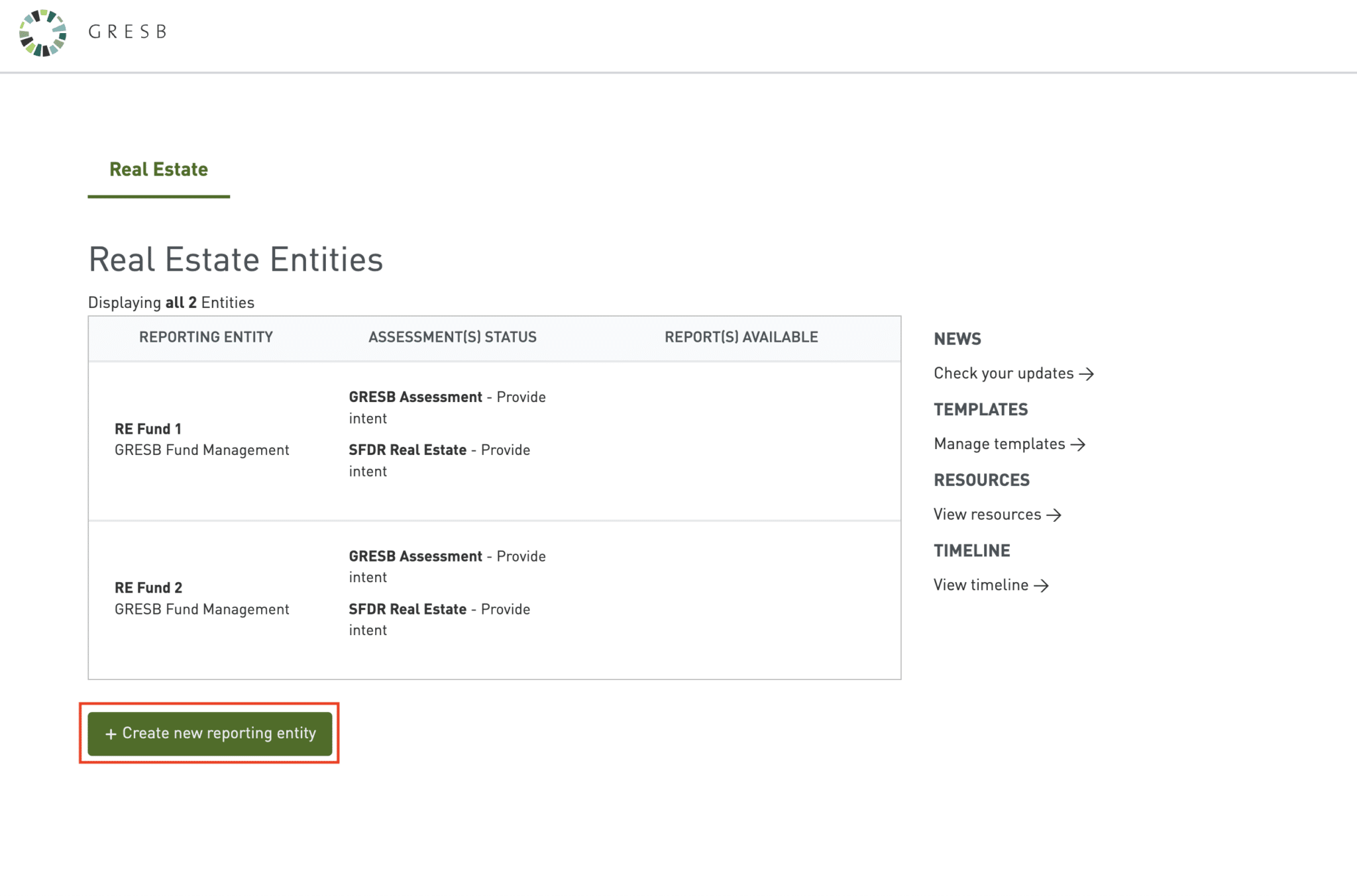
The first step in creating a new entity is to log into the GRESB Portal and navigate to the Assessment Portal.
Once logged in, you can create a new real estate entity by clicking on the button “Create new reporting entity” as indicated below.
You will then be asked to complete some information about the entity.
If you need to make any changes to the entity characteristics, you can do so by going to the assessment overview page for the entity and clicking on “Manage entity” in the menu on the right.
Add and Manage Users
You can add as many users as you need in the GRESB Portal.
{% hint style="info" %}
If you created a GRESB Portal account but do not see any entities, you have not yet been added as a user.
{% endhint %}
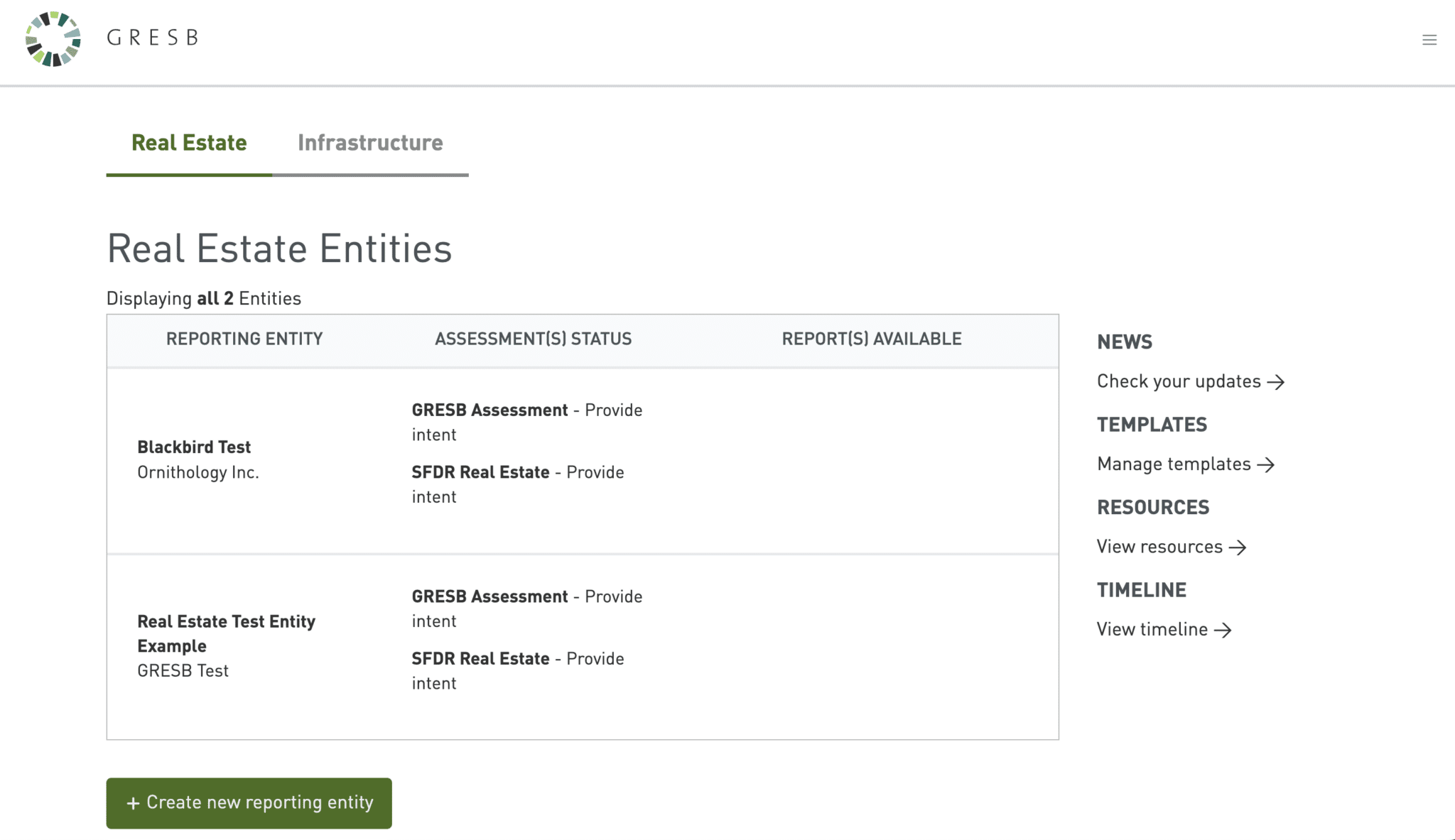
When you log into the GRESB Portal, you’ll see the Assessment Portal overview, as in the example screenshot below.
Next, click on the entity for which you want to change the users. You will see the view below.
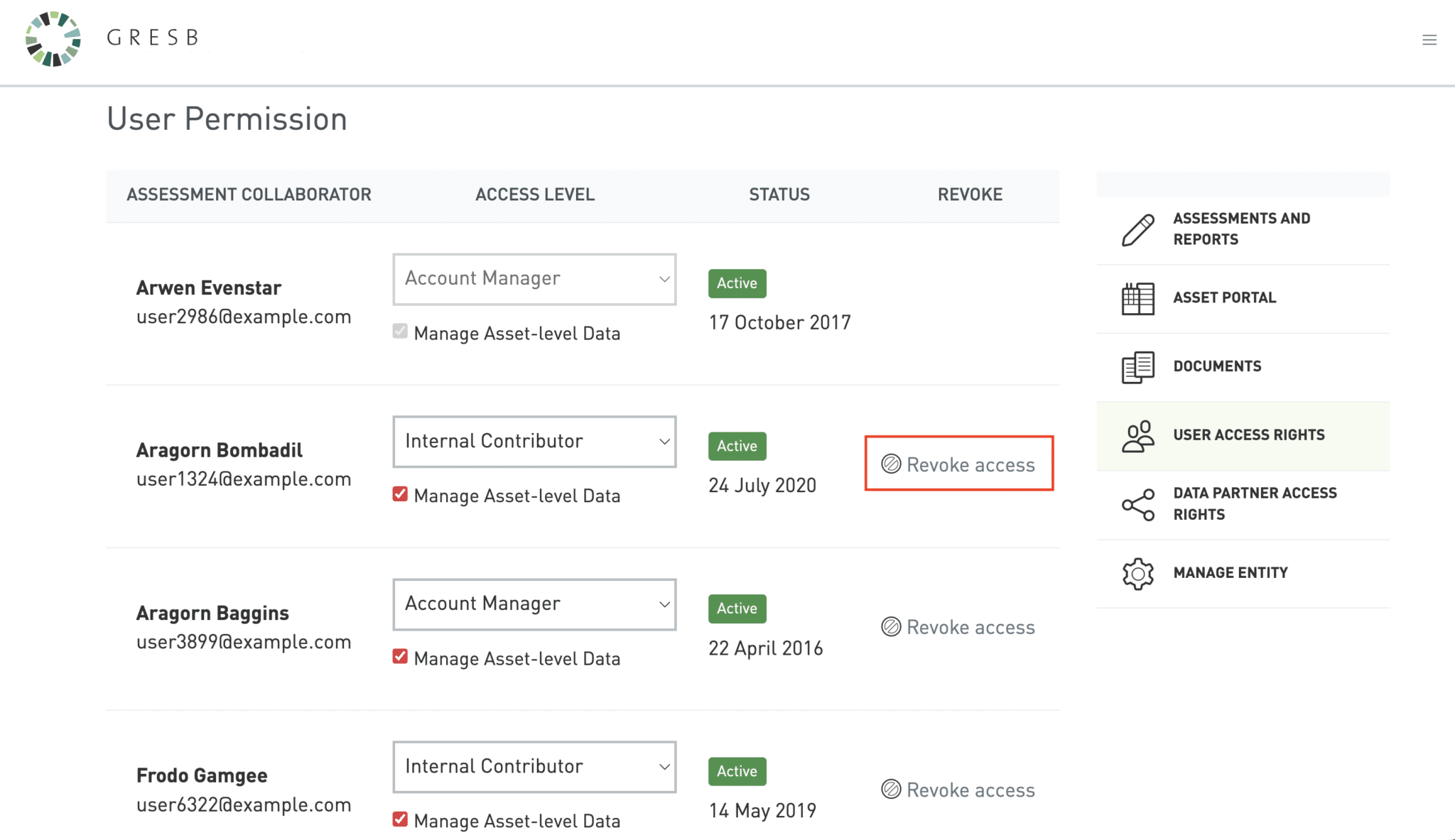
Click on “**User Access Rights**” in the menu on the right side to view the users with access to the entity. The screenshot outlines this in red.
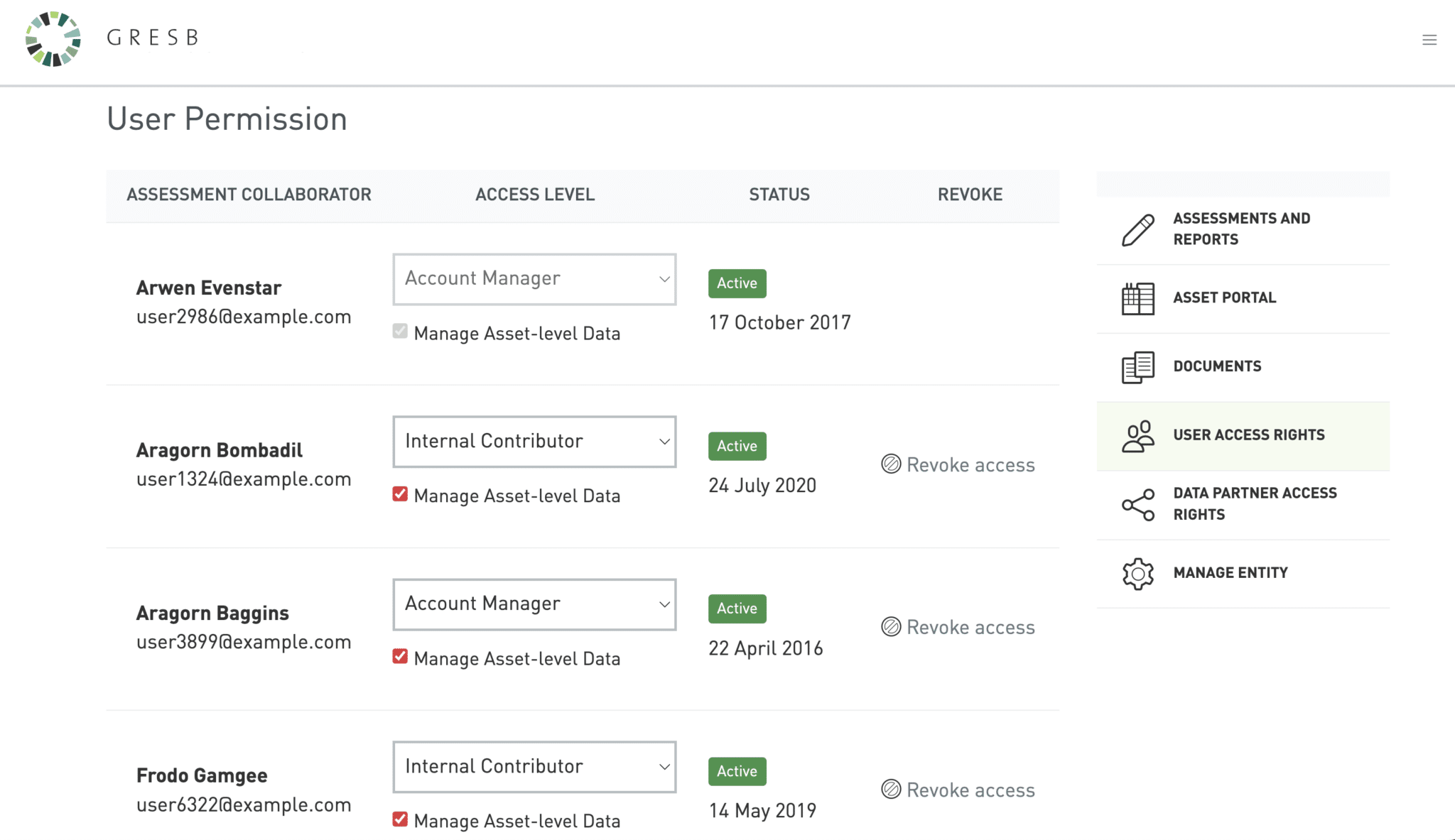
You will then see the users of the entity.
If you’re an Account Manager for the entity, you can change the access levels for other users, add users, and remove users.
#### **Adding Users**
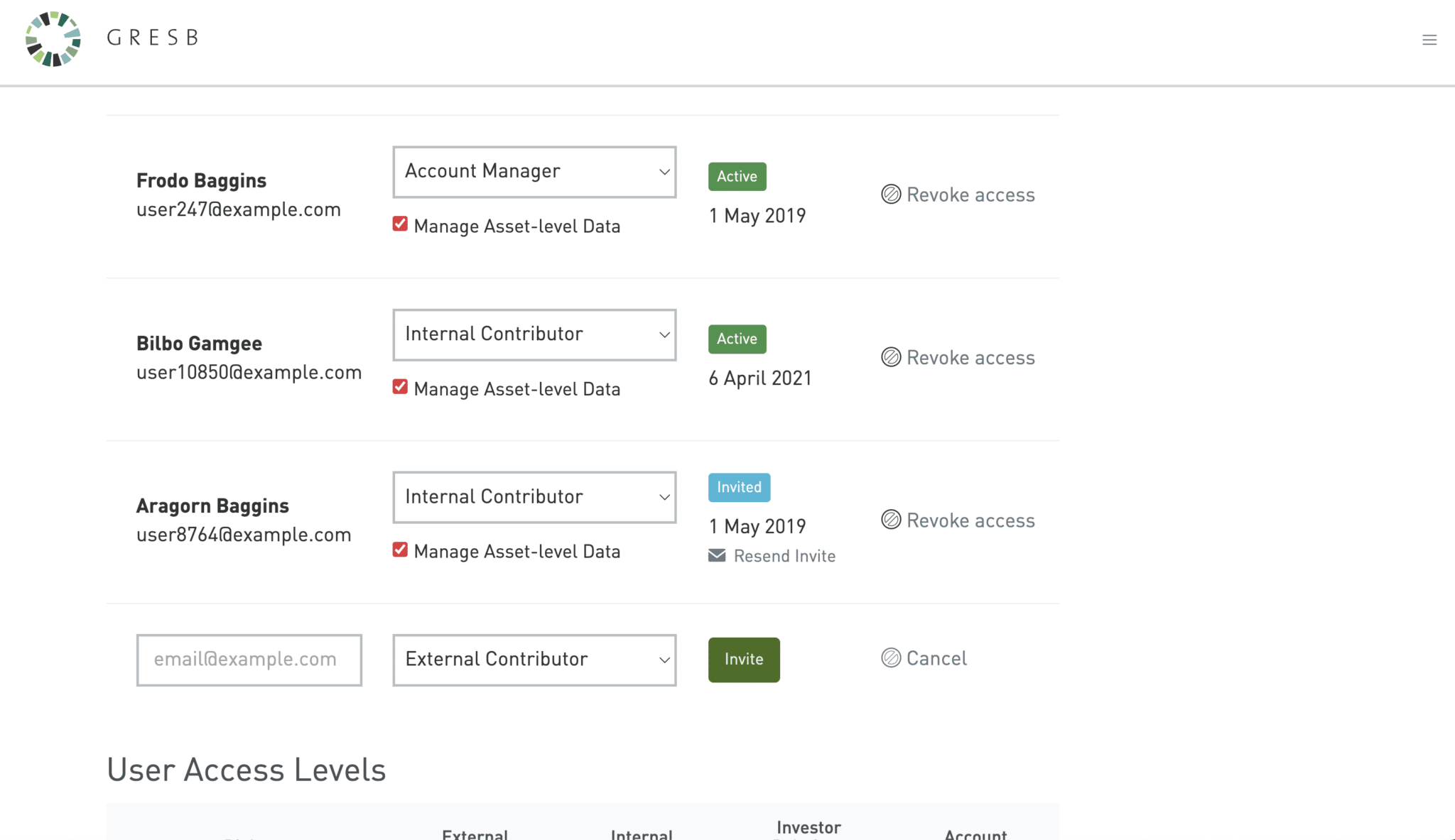
Within the list of users is an ‘Invite’ button. Click on this to start adding a new user.
You can enter the email address of the person you want to add and set their access level.
If the user has not yet set up an account on the GRESB Portal, they must do so first. Once they’ve activated their account, they can access your entity.
#### **Removing Users**
A user can be removed from a particular entity by clicking ‘Revoke access,’ highlighted in the screenshot below.
#### **Changing Access Levels**
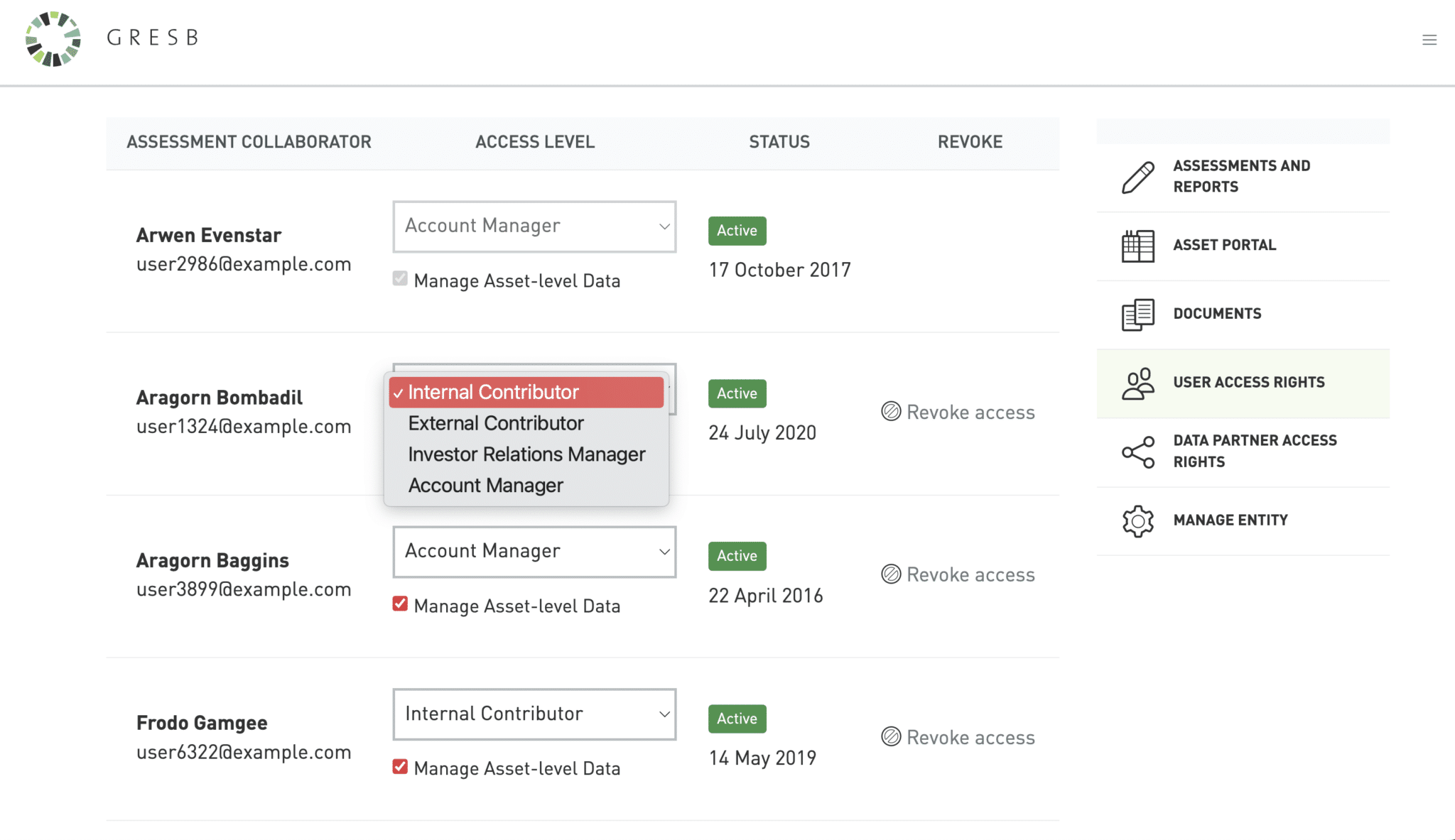
The user's access level can be selected from the dropdown menu, as shown in the screenshot below. For more details on each access level, see the "User Access Rights" section below.
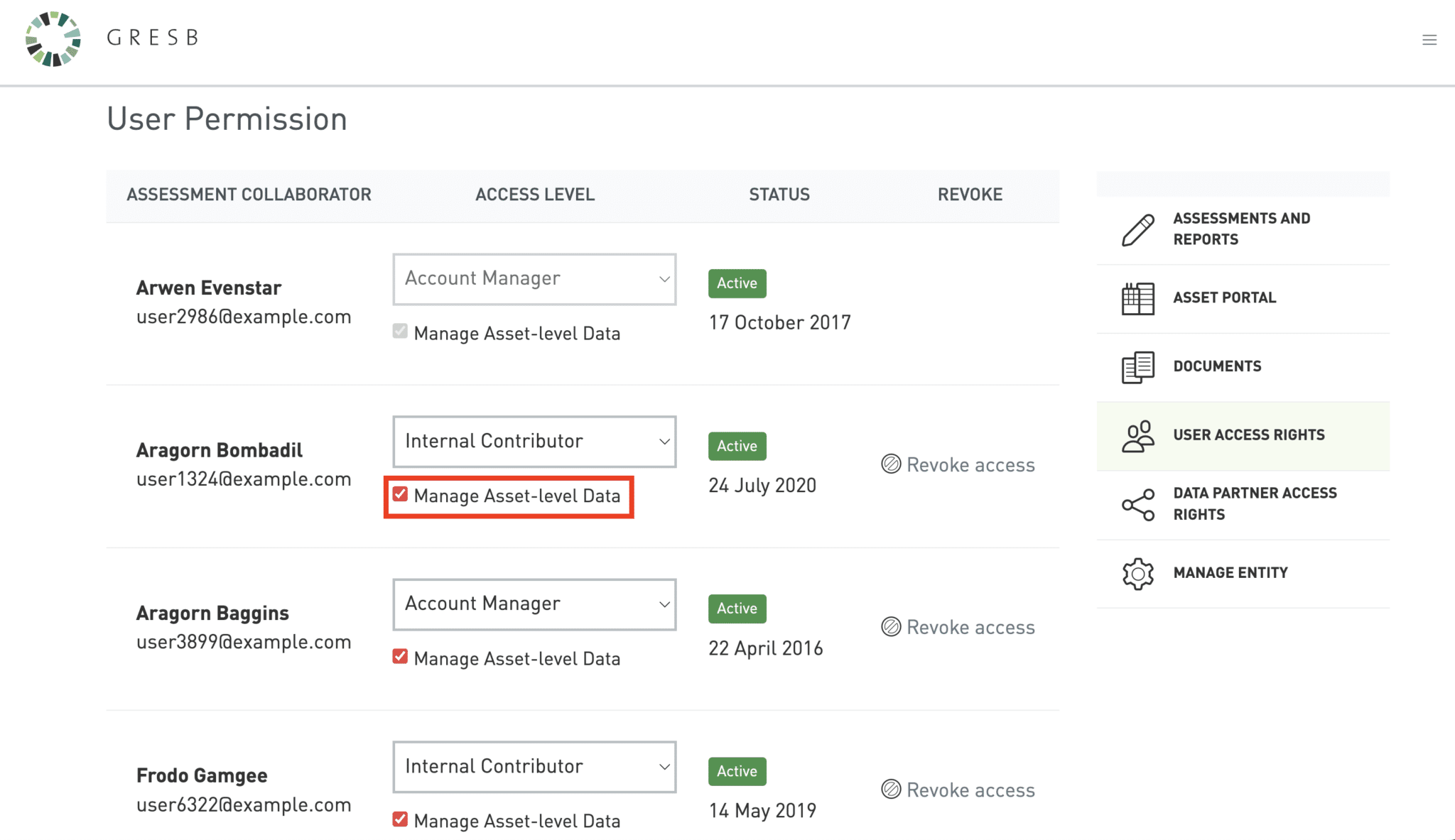
You can also separately indicate whether a user should be able to amend asset-level data, as shown in the screenshot below.
#### **User Access Rights**
{% endstep %}
{% step %}
### Manage Assessments
Assessment Summary Page
Click on the name of the entity to view its assessment summary page.
Intent to Submit:video:
Once you’ve created the entity, you can start an assessment by clicking on the one that you’d like to start.
You will first be asked to provide your intent to submit the assessment to GRESB.
* Select ‘Yes’ if you fully intend to submit. Otherwise, select ‘Maybe’ or ‘No.’
It is possible to edit the information later.
Note that this text box with clarification is shared with GRESB Investor Members.
Data Sharing Settings
#### Disclose Score to Peers
When a participant completes the Assessment, they will be prompted to indicate whether they intend to disclose scores to peers. By selecting “Yes,” participants agree to disclose their entity’s name and Component Scores to peer group participants who have also opted in to sharing this information. Any peers who have not opted in will not be able to see this data.
Peer group scores can be found in the GRESB Model when viewing the Benchmark Report in the GRESB Portal.
It is important to note that the decision to disclose to peers cannot be changed after the entity has submitted its assessment.
#### Share Data with Investors
Real estate non-listed participants can opt to share asset-level data with GRESB Investor Members. If so, Investor Members who have access to the entity’s results can also see the Analytics tab of their Asset Portal.
If asset-level data is shared with investors, it will be available to all GRESB Investor Members with an approved access request.
If a participant does not give consent in this section, individual asset data will not be disclosed to GRESB Investor Members but will be used only for aggregation purposes.
{% endstep %}
{% step %}
### Complete the Assessment
Start the Assessment
Participants can begin their GRESB Assessment(s) on **April 1st.**
After providing the "Intent to Submit" and selecting data sharing settings, the entity will be able to select the component(s) they'd like to assess.
It is possible to change the component selection at any time during the assessment period.
All selected components/modules will be included as part of the submission. Not sure which component(s) to select? See the [Assessment Structure & Scope](/completingassessments/prepare/basics/reporting_scope) page for more details.
Pre-filling:video:
Certain indicators can be prefilled in this year's assessment response for entities that previously participated in the Real Estate Assessment.
Indicators that have been subject to changes by GRESB will not be pre-filled.
Participants are encouraged to review prefilled responses and evidence before submitting the assessment.
The pre-filled evidence must have been true for the reporting year as selected in indicator EC4.
**The indicators subject to prefilling in 2026 are:**
* *Entity & Reporting Characteristics*: EC1, EC2, EC3, EC4, RC1, RC3, RC5
* *Leadership*: LE3
* *Policies*: PO1, PO2, PO3
* *Reporting*: RP2.1
* *Risk Management:* RM1, RM2, RM3.1, RM3.2, RM4.1
* *Stakeholder Engagement:* SE2, SE3.1, SE3.2, SE4, SE5, SE6, SE7.1, SE7.2, SE8
* *Risk Assessment:* RA1
* *Tenants & Community:* TC1, TC2.1, TC2.2, TC3, TC4, TC5.1, TC5.2, TC6.1, TC6.2
* *Development: Sustainability Requirements:* DRE1, DRE2, DRE3
* *Development: Materials:* DMA1
* *Development: Energy:* DEN1, DEN2.2
* *Development: Water:* DWT1
* *Development: Waste:* DWS1
* *Development: Stakeholder Engagement:* DSE1, DSE2.1, DSE2.2, DSE3.1, DSE3.2, DSE4, DSE5.1, DSE5.2
Template Tool:video:
The Template Tool provides an easy way to complete answers for sections of the Assessment that are applicable across several entities.
Note that indicators specific to the reporting entity’s portfolio environmental performance are not included in the Template Tool.
The complete list of indicators included in the Template Tool can be found below.
To generate a new template, you can either:
* Build a new template from scratch by selecting the option “Create template”; or
* Create a template based on an Assessment that has already been filled out by selecting the option “Create template from assessment”.
To edit a template, you can click on the template name and make amendments to the indicator answers. Indicators for which answers are not provided in the template will not be affected in the Assessments to which the template is applied.
To manage access to the template, you can click on the “Manage” menu and select “Access Rights”. There you can invite other users to collaborate on the content, manage access to the template, or use it for other users’ Assessments. Users who have been invited to use the template will be able to apply it to the Assessment(s) they are connected to.
**To apply a template to other Assessments:**
* Go to the Assessment Portal
* Click on the reporting entity
* Click on “More”
* Select “Apply a template” from the dropdown menu
**Real Estate Template Indicators:**
* LE1, LE2, LE3, LE4, LE5, LE6
* PO1, PO2, PO3
* RP1, RP2.1, RP2.2
* RM1, RM2, RM3.1, RM3.2, RM4.1, RM4.2, RM7
* SE1, SE2.1, SE2.2, SE3.1, SE3.2, SE4, SE5, SE6, SE7.1, SE7.2, SE8
* TC2.2, TC5.1, TC5.2, TC6.1, TC6.2
* DRE1, DRE2, DRE3
* DMA1
* DEN1
* DWT1
* DWS1
* DSE1, DSE2.1, DSE4, DSE5.1, DSE5.2
Editing the Response
Every indicator is identified by a short title (e.g., Sustainability Objectives) and a code (e.g., LE2).
All indicators include a primary question that can be answered with ‘Yes,’ ‘No,’ or 'Not Applicable,' except for indicators in the Performance Component that are responded to with asset-level data and must be reported through the Asset Portal.
* When selecting ‘Yes’, participants are required to provide further information by selecting one or more options.
* When selecting ‘No’ or 'Not Applicable,' participants may not select any additional sub‑options.
Participants should select all options that accurately describe the organizational activities.
Response types for each indicator may use one or more of the following elements:
Element
Description
'Yes' or 'No' radio buttons
Some indicators have additional mutually exclusive radio buttons. In all cases participants must select the one that is the most applicable.
Checkboxes
Most indicators contain a set of checkboxes that participants can select after answering ‘Yes’ to the overall indicator question. Participants may select multiple sub‑options that apply to their entity or fund manager.
'Other’ answers
Some indicators offer the opportunity to provide an alternative selection (‘Other’). Such ‘Other’ answers must be distinctly different to the options listed in the question. All answers are validated as part of the data validation process.
Percentages
Some indicators require the input of additional data points such as percentage of employees and tenants, percentage of portfolio and projects covered, etc.
Open text boxes
GRESB distinguishes between two kinds of open text boxes:
For reporting purposes only. These are displayed in the Benchmark Report but are not validated or scored.
Additional context for the answer provided. These are below the ‘Yes/No’ response and enable the participant to provide general comments that will appear on the Benchmark Report but are not validated or scored.
Evidence upload
Some indictors require participants to upload additional documentation to support their selections. A list of manually validated indicators can also be found here.
Review & Submit
The 'Review & Submit' button only appears once the assessment is at least 80% complete.
1. Before proceeding, ensure the response is **complete**. The Contents overview flags missing information.
2. Before an entity can submit its assessment, it needs to be linked to a participant member account. If you are uncertain whether the entity is linked, contact the GRESB Helpdesk.
3. If there are pending **errors** in the Asset Portal, these must be resolved before submitting.
A confirmation email will be sent to account manager users after submission.
{% endstep %}
{% endstepper %}
## Frequently Asked Questions
Where can I find my Fund ID?
The Fund ID is the first number that appears in the URL after "entities/" when you click on any of your entities in the GRESB Portal.
Users can also export fund IDs from within the **Data Exporter** tool. Users can access the Data Exporter via the GRESB Portal under the menu “Data Exports.” Any downloads from the Data Exporter have Fund ID as the third column.
What process does GRESB recommend when creating a new entity that includes assets already reported by another fund?
GRESB requires participants to report all assets held through joint ventures, joint operations, or joint ownership, which means the same physical asset may appear in multiple reporting portfolios.
Because the Asset Portal treats each asset as a unique record, participants must create a new asset entry for the new entity, even if another fund has already reported it.
To streamline this process, participants may export the existing entity’s asset data and import it into the new entity; however, the imported assets will receive new Asset IDs, and the new entity will not inherit the asset’s participation history or records from the original entity.
What process does GRESB recommend to transfer an existing fund from one manager to another manager?
Participants have two options to transfer an existing reporting entity from one manager to another.
**Option 1:** The manager that has historically reported to GRESB could essentially 'hand its keys' to the new manager. The acquiring manager would oversee the existing entity's account. In this case, please contact the GRESB Helpdesk to support legal/administrative considerations.
Benefits
The reporting burden is minimal. Pre-filling, participation records, and asset-level data will all be maintained in the Portal. The new manager wouldn't need to start anything from scratch.
Potential Limitations
Privacy risks. If you proceed with option 1, the previous owner would need to understand that the new manager will have access to everything in the Portal associated with the reporting entity. That includes a record of ALS imports, pre-submission check comments, evidence uploads, asset data, etc.
The investor members linked to the account would also maintain access unless the new fund revokes it.
**Option 2:** Create a new reporting entity.
Benefits
None of the privacy concerns outlined above apply.
Potential Limitations
The reporting burden is higher. The new manager could obtain an export of the entity's current Asset Portal data from the previous manager to reduce some of the effort required to populate asset-level data from scratch. Otherwise, the new manager would need to complete a new assessment.
Participation history would not be visible; the Benchmark Report will essentially look like the entity is a first-year participant. But, given it technically isn't a first-year participant, the entity couldn't use the Grace Period.
How can I edit my component selection once I've started the assessment?
Participants can add or remove a component (i.e., Performance, Residential, Development) to their assessment at any point up until their submission.
To do so, you must:
1. Go to the Assessment Portal and select the relevant entity
2. Click on “More” in the portal menu
3. Navigate to “Component Selection”
4. Check the box for the component you wish to add or remove.
This process allows participants to opt into certain assessment sections without needing to restart their assessment.
## Video Library :video:
{% embed url="" %}
{% embed url="" %}
# Asset Portal Guide
## Get Started
What is the GRESB Asset Portal?
Participants must report environmental data at the **asset leve**l to complete certain Performance Component indicators of the Real Estate Assessment.
The **GRESB Asset Portal** is where GRESB collects asset-level data from participants.
Data Input Methods
Participants have **three** options for reporting asset-level data:
1. Uploading the **Asset Spreadsheet**
1. *Suitable for most asset creation and data editing.*
2. Using the GRESB Asset **API**
1. *Suitable for particularly large portfolios (more than 2,000 assets).*
2. Learn more about API connections in our [API documentation](https://gresb.github.io/api-docs/).
3. Editing directly within the **Asset Portal**
1. *Suitable for checking uploaded data and making minor adjustments.*
## Edit, Import & Aggregate Data
{% stepper %}
{% step %}
#### **Complete the Asset Spreadsheet**
Uploading asset-level data using the **Asset Spreadsheet** is the most efficient way to submit or update asset information in bulk in the Asset Portal.
Export the Asset Spreadsheet
Download the Asset Spreadsheet **from the Asset Portal** by clicking "Export Asset Spreadsheet."
*If you're reporting for the **first** time, your export will be **blank**.*
*If you're a **returning*** ***participant**, your export will be **pre-populated** with the Asset Portal's existing data.*
* *Users can download an asset spreadsheet with data submitted to the previous assessment from the "Submitted Data" section of the Asset Analytics tab.*
{% hint style="info" %}
*If you'd like a blank copy of the Asset Spreadsheet for reference purposes, download the public version below. It is protected and **cannot** be imported to the Asset Portal.*
{% endhint %}
{% file src="/files/BhdbtHgBGmvNuUDGOuDM" %}
Populate the Asset Spreadsheet
Enter data into the Asset Spreadsheet. See the [Performance Component](/completingassessments/2026-real-estate-assessment/re/perf) section for technical reporting guidelines.
#### **To update existing asset level data:**
* Update the exported spreadsheet with information for the current reporting year. **Do not modify the Asset ID**. This will help avoid creating duplicate assets.
* Upon uploading the Asset Spreadsheet with the amended data, the Asset Portal will match the GRESB Asset IDs on the Spreadsheet to existing assets in the Portal and overwrite their information.
#### **To create a new asset:**
* Leave the field ‘GRESB Asset ID’ empty. GRESB will automatically assign the Asset ID after the upload. To update an existing asset, enter the Asset ID into the column ‘GRESB Asset ID.’ Assets with a duplicate or non-existent ID will be rejected.
#### **To mark assets as sold:**
GRESB requires participants to report all assets owned by the reporting entity, including assets purchased and sold during the reporting year.
However, once the entity sells an asset, the portal will no longer expect performance data from it (i.e., the entity is not required to provide performance data outside of the ownership period). GRESB's performance metric calculation and scoring models consider the length of ownership during the reporting year.
**Participants should not delete sold assets.** Instead, they must report the sell date in the "Ownership Until" field of the asset portal.
* If the entity sold the asset during the reporting year:
* The portal will automatically display the number of days the asset was owned during the reporting period.
* If the entity sold the asset before the reporting year:
* The portal will automatically classify the asset as "Sold."
**Sold assets remain visible but are excluded from assessment aggregation and validation checks.** Users can filter for sold/owned assets within the Asset Portal.
{% hint style="warning" %}
**Important**: It is not possible to modify the columns, sheet names, workbook structure, or data validation rules (i.e., dropdown, date formats, numeric formats) in the Asset Spreadsheet. Doing so would prevent the asset portal from being able to digest the spreadsheet's contents.
{% endhint %}
{% endstep %}
{% step %}
#### **Import the Data**
Click *Import* and select the intended file.
> Users can expect the upload to load for several moments, depending on the size of the portfolio.
>
> However, if load times exceed several minutes it is likely that the Asset Portal cannot process the spreadsheet. Please try removing the file, reviewing it against the list of common import disruptions below, and re-uploading it.
Import Summary & Common Disruptions
When the import is complete, the portal will summarize the number of:
Newly added assets
Were not previously included in the entity's asset portal and have been successfully imported as new entries
Updated assets
Previously existed in the entity's asset portal and have been updated with the latest information from your upload.
Failed assets
Could not be imported due to missing or invalid information (more details below).
:circle-info: Users can export a list of failed assets to make targeted corrections.
***
#### Failed Imports
When a new Asset Spreadsheet is uploaded to the Asset Portal, the Portal runs integrity checks on the file to identify and locate any invalid or incorrectly formatted data points and the location of such errors.
Some errors prevent assets from being imported. The "Asset Import Errors" table will summarize the reason for any failed imports.
**Common import disruptions include:**
* ***\[New in 2026]*** The spreadsheet contains **duplicate** assets *(i.e., an asset name in the file matches one that already exists in the portal)*.
* The numbers are **too** **precise** (e.g., 1234.7936273161439591593 for vacancy or energy consumption) > correct to 4-7 decimals.
* **Empty** spreadsheets
* Adding **units** to numerical value fields
* Incorrectly formatted **dates** or inputting Year instead of Date > should be (DD-MM-YYYY)
* Using **dashes** ( - ) to indicate '0' data
* Optional text boxes **exceeding** **255** **characters**
Reach out to the [GRESB Helpdesk](mailto:info@gresb.com) if the upload remains unsuccessful.
{% endstep %}
{% step %}
#### **Review the Data**
All asset-level data points included in the uploaded Asset Spreadsheet are subject to many validation rules to ensure that assessment submission is as complete and accurate as possible. This process generates **errors** and **outliers**.
Review Outliers & Correct Errors
**Errors *****prevent*** users from **aggregating** asset data.
**Outliers *****do*** ***not***** prevent** users from **aggregating** asset data.
> Click on the button below to learn more about errors and outliers in asset-level data and review outlier thresholds.
>
> Automatic Data Validation
#### **Resolving Errors & Outliers**
1. **Review** unresolved errors by clicking on each section in the left-hand navigation panel of the asset page.
2. **Download** the Asset Spreadsheet.
3. **Correct** the relevant data fields.
1. Review the [Performance Component completion instructions](/completingassessments/2026-real-estate-assessment/re/perf) and [Validation](/completingassessments/2026-real-estate-assessment/info/dqv/quantitative-approach) pages for more details on how to do so. Contact the GRESB Helpdesk if errors persist.
4. **Re-import** the corrected Asset Spreadsheet. This will automatically update the Asset Portal.
{% hint style="info" %}
The Asset Portal will detect errors across all reporting years for which data exists. Red error icons will appear next to each reporting year that contains validation error(s), which only disappear once all errors for that year are resolved.
{% endhint %}
Review Live Asset Analytics [New in 2026]
In 2026, GRESB introduced a **live** version of the Asset Analytics tab that displays asset-level performance metrics based exactly on the data in the asset portal at the time of review.
This on-demand analysis helps streamline users' data review process and ensure data is complete and correct before submission.
Read more about Asset Analytics
{% endstep %}
{% step %}
#### **Aggregate the Data**
The Performance Component does not automatically draw from the asset portal. **Aggregation is essential to ensuring that the entity's Performance Component reflects the most current asset-level data.**
Aggregate to Assessment Response
Once the entity's asset-level data is complete and free of errors, **users must aggregate it.**
To do so, click "Aggregate" within the "Asset Analytics" tab of the asset portal. This button is only active once all asset-level errors are resolved.
An aggregation page will then present two options:
1. **Update portfolio boundaries:** Click if you are aggregating for the first time. This updates indicators R1 and/or DR1 to ensure the assessment captures the complete portfolio of assets.
2. **Update all Indicators:** Click this if you have already updated the portfolio boundaries and have edited your asset-level data. This ensures your assessment response reflects data in the asset portal.
{% hint style="warning" %}
**Important**: GRESB strongly recommends re-aggregating your assessment response as the final step before assessment submission to ensure any edits within the Asset Portal are captured in your response.
If a user edits data in the asset portal without aggregating, the assessment response **will not** reflect those edits.
{% endhint %}
{% endstep %}
{% endstepper %}
## Frequently Asked Questions
Where can I find my asset IDs?
There are two ways in which participants can find the GRESB Asset ID for an asset:
1. In the Asset Portal, go to 'Assets' -> 'Manage' -> 'Edit' for each asset. From there, you will see the GRESB Asset ID under 'Asset Characteristics'.
2. Export your asset data to Excel; the IDs are in the 'asset characteristics' tab.
What process does GRESB recommend when creating a new entity that includes assets already reported by another fund?
GRESB requires participants to report all assets held through joint ventures, joint operations, or joint ownership, which means the same physical asset may appear in multiple reporting portfolios.
Because the Asset Portal treats each asset as a unique record, participants must create a new asset entry for the new entity, even if another fund has already reported it.
To streamline this process, participants may export the existing entity’s asset data and import it into the new entity; however, the imported assets will receive new Asset IDs, and the new entity will not inherit the asset’s participation history or records from the original entity.
# Assessment Basics
The **Assessment Basics** section covers fundamentals to help you prepare for a Real Estate Assessment submission.
# Assessment Structure & Scope
## About the Assessment
The GRESB Real Estate Assessment is the global standard for sustainability benchmarking and reporting for listed property companies, private property funds, developers, and investors that invest directly in real estate. Its methodology is consistent across different regions and investment vehicles, and it aligns with international reporting frameworks, such as the Task Force on Climate-Related Financial Disclosures (TCFD), Global Reporting Initiative (GRI), and Principles for Responsible Investment (PRI).
{% hint style="info" %}
The Real Estate Assessment output depends on a participant's component selection, which is entirely under their discretion. However, **once an entity chooses to complete a component, it must report 100% of owned assets within its scope.**
Please refer to the **"*****What are the participation requirements?"*** sections below for details on GRESB's reporting boundary requirements.
{% endhint %}
#### Which component(s) should I choose?
Best Practice
While most GRESB Participants complete two assessment components (for either the Standing Investments Benchmark or the Development Benchmark), some choose to only complete the Management Component in their first year of participation.
In cases where an entity has standing investments and development projects and considers itself both a building operator and involved in development activities, GRESB highly recommends participating in both benchmarks (Standing Investment & Development).
As a result, participants will receive two GRESB Scores, two GRESB Ratings, two Peer Groups, etc., capturing how an entity approaches its respective activities in both benchmarks.\
\
For more information on the results metrics in the Benchmark Report, refer to the [*Leveraging your Data*](/completingassessments/data/results-insights) page.
***
## Standing Investments Benchmark
What is the Standing Investments Benchmark?
The Standing Investments Benchmark is made of two components:
* Management Component (30 points)
* Performance Component (70 points)
Who should participate?
The Standing Investment Benchmark is suitable for any real estate company or fund that owns operational assets during the reporting period.
What are the participation requirements?
### Performance Component Scope
#### *In scope:* What are participants required to include?
Participants must report on **all standing investments** in their portfolio during the reporting year, **regardless of ownership or operational control** percentage. This **includes those sold or purchased** and/or assets that may not be recorded as physical assets on the entity’s balance sheet (e.g., assets structured as a financial lease).
> A standing investment is a **physical** real estate asset owned by the reporting entity that has completed construction and is not undergoing major renovation.
>
> To be considered a **standing investment,** the asset must either:
>
> * exist for the primary purpose of **income** generation, or,
> * actively **consume** **resources**.
>
> Examples of assets that consume resources without the primary goal of generating rental income include security and monitoring centers, water treatment or irrigation pump stations, boiler or chiller plants serving multiple buildings, playgrounds, fitness centers in residential or mixed-use buildings, and maintenance sheds.
#### *Excluded from scope:* What are participants required to **exclude**?
**Non-real estate** assets owned by the entity are **excluded** from the reporting boundary requirements. Participants must therefore exclude **vacant** land, **dormant** assets, **cash**, and **ground** **leases**. Assets owned for only **one** day during the reporting year should be **excluded** from the scope.
> A **non-real estate** asset is:
>
> * Any asset that does not constitute a physical property that consumes resources or generates income.
#### Example Scenarios
GRESB updated this section to provide additional clarity. For all guidance clarifications see [here](/completingassessments/whatsnew#guidance-clarification-log).
Scenario
Is it within scope?
Explanation
Financial stake in a company that owns real estate
In an FRI lease, the entity still owns the building, even if the tenant handles repairs and insurance. Because the entity owns a resource-consuming asset, it must report it.
Triple Net Lease
:check:Include
Triple Net leases shift certain costs and operational control to the tenant, but the entity continues to own the property. Since the asset remains part of the portfolio and consumes resources, the entity must include it in reporting.
Non-real estate asset structured as a financial lease
:check:Include
When an asset is structured as a financial lease, the entity effectively owns and controls the physical asset. Because the entity holds the economic benefits and operational risks, it must report the asset’s performance.
Physical real estate assets that do not consume any resources
:xmark-large:Exclude
A property that is entirely non-operational during the reporting period and, as such, neither consumes energy nor water nor generates emissions or waste, must be excluded.
This designation applies primarily to assets marked for major redevelopment or similar inactive status.
Physical real estate assets that consume residual resources
:check:Include
Assets consuming residual resources, such as standby energy for minimal operations, do not qualify as dormant and must be included in the Performance Component. The dormant classification applies strictly to assets without operational activity or resource use.
Manufactured Homes
:question:Depends
If the entity owns the land upon which manufactured homes are leased, this is considered a ground lease and must be excluded.
However, if the entity owns some physical buildings on the land, it is required to report them. In this scenario, the entity must consider the value of the land when calculating the Gross Asset Value of those physical buildings.
{% hint style="info" %}
Still unsure whether to include an asset? Contact the GRESB [Helpdesk](mailto:undefined).
{% endhint %}
### What if the entity lacks operational control?
GRESB distinguishes between landlord-controlled and tenant-controlled areas in the Energy, GHG Emissions, Water, and Waste aspects of the Performance Component. This is done to recognize the fact that landlords of tenant-controlled areas may have little or no control over the use or purchase of utilities for the asset or over waste management practices.
**How to determine operational control:**
* **Landlord-Controlled Areas:** The landlord has operational control if they can introduce and implement policies. If both the landlord and tenant share this authority, the area should be classified as Landlord-Controlled.
* **Tenant-Controlled Areas:** The tenant has operational control if they hold the primary authority to implement operating and environmental policies. For example, areas under a full repairing and insuring (FRI) lease in England and Wales are Tenant Controlled.
GRESB does not explicitly distinguish between landlord- and tenant-controlled areas outside the Energy, GHG Emissions, Water, and Waste aspects.
### What if the entity lacks complete ownership? (J*oint Ventures*)
Participants are required to report on all assets held as part of a joint venture, joint operation, or joint ownership, regardless of whether they have direct operational control over an asset.
There are two primary types of joint ventures, and each should be reported as follows:
* **Partial Ownership of Floor Area:** If the reporting entity owns only a portion of an asset’s floor area, the entity may report exclusively on the portion it owns and indicate 100% ownership for that portion in the submission.
* **Shared Financial Stake in the Entire Asset:** If the reporting entity owns the entire asset jointly with other funds but holds only a partial financial stake, the entire asset and its operational data must be included in the submission. Additionally, participants must report the percentage ownership that represents their financial stake in the asset.
In both cases, participants must report on any measures taken for these assets, even if the joint arrangement limits the participant’s direct operational control. This ensures that investors are aware of the associated risks and exposure.
If an asset is part of multiple portfolios managed by the same fund manager, it should be treated as a joint venture in each portfolio, following the rules outlined above.
### Residential Sector Insight
What is the Residential Sector Insight?
The Residential Sector Insight is a tailored output for entities that complete three components:
* Management Component
* Performance Component
* Residential Component
The Residential Component is a set of sector-specific indicators for real estate participants who invest predominantly in residential assets. The residential-specific indicators (RES1–RES6) address sector-relevant topics such as fair housing, infrastructure quality, and affordability.
Who should participate?
The Residential Component is suitable for any entity whose portfolio comprises 75% or more residential assets by Gross Asset Value (GAV).
All asset types that begin with “Residential” contribute to this threshold. This includes:
* Residential: Multi-Family: Low-Rise
* Residential: Multi-Family: Mid-Rise
* Residential: Multi-Family: High-Rise
* Residential: Family Homes
* Residential: Student Housing
* Residential: Retirement Living
* Residential: Other
Conversely, mixed-use asset types such as “Mixed use: Office/Residential” are **not** counted toward the residential GAV when evaluating the 75% threshold for participation in the Residential Component.
What are the participation requirements?
Participants' Standing Investment portfolio **must** comprise at least 75% residential assets by Gross Asset Value (GAV). Diversified portfolios with less than 75% residential GAV will not receive a Sector Insight: Residential Report even if they select the Residential Component within the Assessment Portal.
## Development Benchmark
What is the Development Benchmark?
The Development Benchmark is made of two components:
* Management Component (30 points)
* Development Component (70 points)
Who should participate?
The Development Benchmark is suitable for any entity involved in new construction (building design, site selection, or construction) or major renovation projects
What are the participation requirements?
### Development Component Scope
Participants must report on **all assets under design, new construction, and/or major renovation** that were in progress during the reporting year, **regardless of** [**ownership**](https://app.gitbook.com/o/Bveezar1nazy8275RL7l/s/31ovOsfsdlwYDiJclXFF/~/changes/14/publish-your-docs/structure-and-scope#what-if-the-entity-lacks-complete-ownership) percentage.
#### *In scope:* What is considered a development asset?
1. **New construction**
1. **What:** All activities to obtain or change building or land use permissions and financing, including:
1. Construction work for the project to enhance the property’s value.
2. The development of new buildings and additions to existing buildings that affect usable space.
2. **When:** Any time during the reporting year.
2. **Major renovations**
1. **What**: Alterations that affect more than 50 percent of the total building floor area or cause the relocation of more than 50 percent of regular building occupants.
2. **When:** Any time during the reporting year.
#### *Excluded from scope:* What is not considered a development asset?
Participants should exclude vacant land, cash, projects funded through forward funding or purchase funds, and other non–real estate assets owned by the entity.
### What if the entity lacks complete ownership?
Participants are required to report on all assets held as part of a joint venture, joint operation, or joint ownership, regardless of whether they have direct operational control over an asset. There are two primary types of joint ventures, and each should be reported as follows:
* **Partial Ownership of Floor Area:** If the reporting entity owns only a portion of an asset’s floor area, the entity may report exclusively on the portion it owns and indicate 100% ownership for that portion in the submission.
* **Shared Financial Stake in the Entire Asset:** If the reporting entity owns the entire asset jointly with other funds but holds only a partial financial stake, the entire asset and its operational data must be included in the submission. Additionally, participants must report the percentage ownership that represents their financial stake in the asset.
In both cases, participants must report on any measures taken for these assets, even if the joint arrangement limits the participant’s direct operational control. This ensures that investors are aware of the associated risks and exposure.
If an asset is part of multiple portfolios managed by the same fund manager, it should be treated as a joint venture in each portfolio, following the rules outlined above.
***
## Allocation of E, S, and G across the Assessment
Each indicator in the assessment is allocated to one of the three sustainability dimensions (E‑ environmental; S‑ social; G‑ governance):
* E - indicators related to actions and efficiency measures undertaken to monitor and decrease the environmental footprint of the asset
* S - indicators related to the entity’s relationship with and impact on its stakeholders and the direct social impact of its activities
* G - indicators related to the governance of sustainability, policies and procedures, and approach to sustainability at the entity or organization level
| | Environmental | Social | Governance |
| --------------- | ------------- | ------ | ---------- |
| **Management** | 0% | 34.2% | 65.8% |
| **Performance** | 88.6% | 11.4% | 0% |
| **Development** | 75.7% | 18.6% | 5.7% |
[^1]: This was updated. **Original text:** Holding shares in a company does not give the entity ownership of the underlying real estate. Since the entity does not directly own or operate those assets, it must exclude them from reporting.
# Scoring Basics
The GRESB assessment scoring process is fully automated based on the methodology outlined on this page. It includes several key principles:
{% hint style="info" %}
**It is not possible to estimate the GRESB Score due to the influence of validation decisions and dynamically benchmarked indicators.**
{% endhint %}
## Scoring Weights
How does weighted scoring work?
For some indicators, scoring is based solely on the cumulative sum of the scoring weights assigned to the indicator's elements. These weights, displayed in red on the left side of each indicator, represent the allocation of total available points per indicator according to the priorities established by the GRESB Foundation, aligning with market trends and sustainability best practices.
Oftentimes, not all elements within an indicator need to be selected to achieve full points. If the sum of weights exceeds the indicator's maximum score, the score will be capped at that maximum.
Formulas and Examples
***Example without sub-options:***
* Indicator score =
* \[ (Sum of scoring weights) ] × (Maximum score for the indicator)
**Indicator LE3 - Taskforce/Committee (1 point)**
Each task force member type contributes a specific scoring weight; governing bodies and leadership roles hold a scoring weight of 3/8, and investment and professional roles hold a scoring weight of 2/8.
If an entity chooses two governing bodies and one professional, the calculation will read as follows:
***Example with multiple sub-options:***
When indicators have options and sub-options, the scoring weight for each sub-option is first summed, and the resulting value is multiplied by the main fraction assigned to the main option. The final score is the cumulative sum of these weighted sub-options across all main options within the indicator, multiplied by the indicator's maximum points.
* Indicator score =
* \[ (Sum of the sub-option scoring weights for each main option) × (Main option weight for each option) ] × Maximum score for the indicator
**Indicator SE6 - Supply chain engagement program (1.5 points)**
The indicator consists of three main options, each carrying an equal weight of 1/3. Within each main option, there are several sub-options, each with its own assigned weight.
If an entity chooses four elements within the supply chain engagement program, four topics, and two external parties to whom the requirements apply, the calculation would read as:
$$\left{\left\[\left(\frac{1}{4}\times4\right)\times\frac{1}{3}\right] + \left\[\left(\frac{1}{4}\times4\right)\times\frac{1}{3}\right] + \left\[\left(\frac{1}{2}\times2\right)\times\frac{1}{3}\right]\right}\times1.5 = 1.5\ \text{points}$$
## Multipliers
How do scoring multipliers work?
The score of some indicators is further adjusted by applying multipliers that either increase or decrease the indicator’s score. Multipliers are classified into different categories:
### **Validation Status**
***Evidence***: If supporting evidence for indicators is fully accepted, it results in the application of the full multiplier (100%) to the indicator's score. If supporting evidence is partially accepted, it results in a reduced multiplier (50%). If the evidence is not accepted, the multiplier is set to 0, regardless of the original selection. Indicators and answers subject to manual validation are listed [here](broken://spaces/GXz9Z0rFp0i3rxrvupmM/pages/utxKQNLSUKyW8QMeUwEi#summary-of-indicator-specific-requirements).
***Building Certification Schemes:*** Each building certification is reviewed by GRESB and assigned a specific validation status: full points (100%), partial plus (60%) and partial minus (30%). Indicators subject to this multiplier are BC1.1, BC1.2, DBC1.1 and DBC1.2.
### **Coverage Percentages**
The coverage percentage reported is used as a multiplier to determine the assigned score. This multiplier applies to the scoring of the following indicators:
* Percentage of employees: SE1, SE2.1, SE3.2 and SE4
* Percentage of tenants: TC2.1
* Percentage of portfolio coverage: RA1, RA2 (aggregated to portfolio level), TC1 and TC3
* Percentage of projects covered: DBC1.1, DEN2.1, DEN2.2 and DSE3.1
Formulas and Examples
*Single Multiplier Example*
For indicators with a single multiplier, the final score is calculated using the following formula:
**Indicator score = \[ (Sum of scoring weights) × Multiplier ] × Maximum score for the indicator**
Example: Indicator LE5 - Personnel Sustainability Performance Targets (2 points). Each selected personnel group contributes a specific scoring weight. It is mandatory to upload evidence that supports the entity’s selections. The evidence’s validation status (i.e., accepted, partially accepted or not accepted) is associated with a scoring weight that is used as a multiplier to determine the final score. Similarly to LE3, governing bodies and leadership roles hold a scoring weight of 3/8, and investment and sustainability professional roles hold a scoring weight of 2/8.
If an entity chooses one governing body and two sustainability professionals, but its evidence is given a partially accepted validation status (multiplier: 0.5), the calculation would be as follows:
*Multiple multipliers example:*
The score of other indicators may be adjusted by several multipliers. The scoring formula can include an additional percentage multiplier before applying the validation status.
Example: Indicator and TC2.1 – Tenant satisfaction survey (1 point) is scored based on two main options: the type of survey, which contributes 2/3 of the total weight, and the metrics included in the survey, which contributes the remaining 1/3. Each of these main options contains several sub-options, such as the survey method and specific metrics, each with its own weight. The percentage of tenants covered in the survey type acts as a multiplier applied to the weight of the selected sub-option, while the weights of the sub-options within the metrics are cumulatively summed. The weighted contributions of both main options (survey type and metrics) are then added together, as explained above. The resulting score is then adjusted based on the validation status of the evidence. The final score is then multiplied by the maximum score for the indicator. In this case, the formula would read:
**Indicator score: { \[ ( % Multiplier \* sub-option weight \* Main option weight) + \[ ( Sum of the sub-option scoring weights) × (Main option weight) ] \* Validation status } \* Maximum score for the indicator**
Note that indicators with several multipliers may differ in structure, and therefore the same exact formula would not apply. For this specific case, if an entity chooses an independent third-party survey with 100% of tenants covered, which includes the Net Promoter Score metric, and whose evidence has been partially accepted (0.5), the calculation would be:
$$\left{\left\[\left(100%\times\frac{2}{3}\times\frac{2}{3}\right) + \left(\frac{3}{3}\times\frac{1}{3}\right)\right]\times 0.5\right}\times 1 = 0.5\ \text{points}$$
## Static Scoring
What is static scoring?
Some indicators are scored using static weights, meaning predefined values are used to assess a portfolio's performance.
In these cases, the points assigned to an indicator are fixed based on the number of selections chosen and the corresponding multipliers, where applicable.
The scoring outcome remains unaffected by the participant's relative performance compared to its benchmark group. Instead, these indicators are assessed based on whether the participant meets certain predefined criteria.
Which indicators are statically scored?
Static scoring applies to indicators that assess entity and/or group-level strategies and processes:
* Management Component: all indicators
* Performance Component: all indicators except EN1, GH1, WT1, WS1, BC1.1, BC1.2 and BC2, which may be scored using either a relative or linear approach, depending on the benchmark performance. For further details, refer to each individual indicator description.
* Development Component: all indicators except DBC1.2
These indicators can be answered with ‘Yes, ‘No’ and, in some cases, ‘Not applicable.’ From a scoring perspective, ‘Not applicable’ is treated the same way as ‘No’ and will yield 0 points.
The points per indicator subject to static scoring vary across the Real Estate Components:
* Management Component = 30 points
* Performance Component = 27.5 points (dependent upon materiality)
* Development Component = 61 points
## Relative Scoring
What is relative scoring?
### Introduction
GRESB uses a relative scoring methodology to evaluate portfolios fairly and encourage continual improvement.
With this approach, scores are determined not just by the portfolio's standalone performance but by how it compares against benchmark groups of comparable properties.
### Process
Benchmark groups are dynamic and change based on the portfolio's characteristics, such as property type and geographical location.
If a portfolio has two property sub-types, e.g., Office, Corporate: Low-Rise in Germany and Residential Multi-Family: Low-Rise Multi-Family in the Netherlands, each property type will be benchmarked and scored separately against other properties with the same sectoral and geographical characteristics.
Benchmark creation depends on availability; if there are not at least 20 assets from 5 distinct reporting entities, the Property Sub-Type classification and then the Country specificity will gradually decrease.
GRESB aggregates self-reported asset-level data to a single score for each property sub-type and country in the participant’s portfolio.
The final indicator score is calculated by weighing the property sub-type and country scores based on their % GAV within the portfolio.
This ensures that the contribution of each property sub-type and country to the final score is proportional to its significance in the portfolio.
* For example, if a portfolio has two property sub-types, e.g. Office, Corporate: Low-Rise in Germany (60%) and Residential Multi-Family: Low-Rise Multi-Family in the Netherlands (40%), the performance of properties in Germany will have a greater impact on the entity’s score compared to those in the Netherlands as Germany holds a higher % GAV in the overall portfolio.
Which indicators are relatively scored?
Relative scoring applies to indicators reported at the asset-level through the Asset Portal:
* EN1 (Energy)
* GH1 (GHG Emissions)
* WT1 (Water), WS1 (Waste)
* BC1.1 (Building Certifications at the time of design/construction and for interior)
* BC1.2 (Operational Building Certifications)
* BC2 (Energy Ratings)
The points per indicator subject to relative scoring vary across the Real Estate Components:
* Management Component = 0 points
* Performance Component = 42.5 points
* Development Component = 9 points
For indicator-specific scoring guidance, please refer to each individual indicator description.
# Data Sharing & Confidentiality
### Access to Submitted Data
Who can see my assessment response?
Data is submitted to GRESB through a secure online platform. It can only be seen by current GRESB staff and, to a more limited extent, authorized personnel from GRESB’s third-party validation provider, Sustainability Assurance Services (SAS).
Who can see my asset-level data?
Participants must report performance data at the asset-level for the Energy, GHG, Water, Waste, Building Certifications, Energy Ratings, and Efficiency Measures aspects of the Real Estate Assessment.
This asset-level data (*provided to GRESB via the Asset Portal*) is **strictly confidential** and will not be passed on to any external party, be it investors or others, in any way that allows the data to be traced back to the asset **without the participant's explicit consent**.
Asset-level data is visible in a **traceable**, **non**-**aggregated** way in:
* [Asset Analytics](/completingassessments/data/asset-analysis/asset-analytics), which displays performance metrics (e.g., data coverage) for each asset.
* Investor members can only **request** access to submitted asset-level data from **non-listed** entities.
* [Asset Benchmarking](/completingassessments/data/asset-analysis/asset-benchmarking) (formerly REAL Benchmarks), which provides asset-level energy and GHG emissions performance insights for each asset.
* Investor members **cannot** request access to Asset Benchmarking.
Asset-level data is visible in a **non**-**traceable**, **aggregated** way in:
* The [Benchmark Report](/completingassessments/data/results-insights/benchmark-report), which displays performance insights
* See [#who-can-see-my-assessment-results](#who-can-see-my-assessment-results "mention")below for more information on investor member access to Benchmark Report results.
* GRESB [public results](https://www.gresb.com/gresb-public-results/) insights
### Access to Assessment Results
Who can see my assessment results?
GRESB Scores are not made public. Results and data output of the GRESB Real Estate Assessment are only disclosed to the participants themselves and their investors.
* **Non-listed property companies and funds:** Must give explicit consent for GRESB Investor Members to see your data and GRESB Results. Non-listed Investor Members associated with the company/fund must request access to a non-listed participant’s Benchmark Report results. This gives the participant control over accepting or denying this request.
* **Listed property companies and funds:** All GRESB Investor Members with a listed subscription are granted automatic access to the Benchmark Report results of listed entities.
#### Access to Uploaded Evidence
Entities can disclose or withhold any documentation provided as evidence from GRESB Real Estate Investor Members. Each uploaded document has a checkbox, with the default set to ‘not available’. When opted into by the participant, this makes the evidence available to all investors with access to that entity. If the entity chooses to share its evidence with investors, it will appear in the Benchmark Report.
Note that it is impossible to share documents with investors on a case-by-case basis.
#### Access to Open Text Boxes
The open text boxes are included in the GRESB Benchmark Report.
Can I hide my GRESB results (Grace Period)?
First-year participants can submit the assessment without allowing GRESB Investor Members to request access to their results. This is referred to as a “Grace Period.”
The Grace Period allows participants a year to familiarize themselves with the GRESB reporting and assessment process. First-year participants who wish to report under the Grace Period can select the option on an entity-by-entity basis from the settings section in the Assessment Portal.
Historical trend sections of the Benchmark Report will not display results from the entity's Grace Period year.
#### When can I opt in or out of the Grace Period?
First-year participants may opt *in* or *out* of the Grace Period once, at any time. Opting in prevents the entity's Benchmark Report from being accessible to its Investor Members within the GRESB Portal.
Once the feature is disabled, it cannot be re-enabled.
The Grace Period is not available in the second year of participation, regardless of whether the participant used it in their first year or which components they completed.
GRESB still discloses the entity/fund’s participation *status* during its Grace Period (see *Disclosure of GRESB Participant Members section*).
### Participant Disclosure & Visibility
Who can see my participation status?
GRESB does not disclose a participant’s data to other participants as a default.
An entity’s participation status is disclosed in the following locations:
* **In the Benchmark Report**
* **Non-listed entities:** The Entity & Peer Group Characteristics Table discloses the fund manager's name and the names of its private peer constituents.
* **Listed entities:** The Entity & Peer Group Characteristics table discloses the entity name and the names of its listed peer group constituents.
* **In the** [**GRESB Participant Directory** ](https://www.gresb.com/nl-en/gresb-participant-members/)
* **Non-listed entities:** GRESB displays the fund manager's name.
* **Listed entities**: GRESB displays the entity name.
Can I see other participants' scores?
Before the start of the Real Estate Assessment, GRESB provides an opt-in option in the Portal that will disclose the entity’s name (public) or fund manager’s name (private), as well as the scores for the different components, to other participants in the GRESB Model of the Benchmark Report that also opted to disclose their name and component scores.
### Data Protection & Security
GDPR Compliance
GRESB is fully compliant with GDPR. The GRESB Privacy Statement can be found [here](https://www.gresb.com/nl-en/gresb-privacy-statement/). We also have specific internal policies, such as our Data Breach Policy and our Data Protection Policy, related to GDPR that we cannot share externally for security reasons. Please note that asset-level data does not fall under the incidence of GDPR because it does not contain any personal data.
Cybersecurity
GRESB’s data security measures and systems have been reviewed by an external expert and no issues were flagged. The GRESB website and the GRESB Portal are fully HTTPS/TLS encrypted. GRESB has strict and extensive policies on data security that cannot be shared externally for security reasons.
# GRESB Standards Origin & Evolution
## The GRESB Foundation
{% columns %}
{% column %}
#### GRESB
GRESB started in 2009 as a research project at Maastricht University. The academic effort evolved into GRESB B.V., headquartered in Amsterdam, and subsequently grew to become the preeminent global benchmark for real asset efficiency, resilience, and sustainability. In 2021, GRESB B.V. created the GRESB Foundation to guide the development of GRESB Standards and focus on stakeholder engagement. The Foundation embodies the spirit of “by industry, for industry” governance that has\
energized GRESB since its inception.
{% endcolumn %}
{% column %}
The Foundation independently governs the GRESB Standards. GRESB B.V. uses the Standards as the basis for Assessments used by GRESB Members around the world. The Foundation is led by volunteers and is supported by the GRESB Foundation Secretariat, which is composed of a group of GRESB B.V. employees, including the Chief Innovation Officer, Director of the Foundation, Director of Real Estate Standard, Director of Infrastructure Standards, Director of Real Asset Analytics, and Director of Climate Change.
{% endcolumn %}
{% endcolumns %}
### Mission & Vision
The Foundation and GRESB B.V. work together to facilitate communication between institutional investors and their real asset investments through the GRESB Standards, which provide a globally recognized and consistent means of assessing and benchmarking the efficiency, resilience, and sustainability of assets and portfolios. They allow asset managers, listed companies, developers, asset operators, and investors to take a central role in creating a more sustainable world through financial markets.
To facilitate an effective and efficient conversation between these stakeholders, GRESB must provide transparency about sustainability performance and compare this information to absolute and relative benchmarks. This is rooted in the belief that engaged, responsible investment drives positive change and superior risk-adjusted investment returns. Investors receive information needed to develop and apply informed investment strategies, while participating asset managers identify strengths and weaknesses relative to their peers. The result is a cycle of iterative engagement and continuous improvement.
### Structure & Function
The Foundation guides the development of the GRESB Standards, which underpin the GRESB Benchmarks for real estate and infrastructure. The Foundation acts to:
* Lead the evolution of GRESB Standards in support of the Foundation’s mission
* Facilitate industry engagement in Standards development
* Seek input from industry experts to inform and evaluate the significance of new and emerging issues
* Ensure that the GRESB Standards are feasible and can be practically implemented
The Foundation advances the GRESB Standards through a hierarchy of advisory groups, including the Foundation Board, Real Estate Standard Committee (RESC), Infrastructure Standards Committee (ISC), Technical Working Groups, and Expert Resource Groups (ERG). The Foundation can also solicit decision-useful information through independent market research and stakeholder\
feedback, such as expert interviews, survey responses, and thought leadership content. Volunteer leaders use this information to govern the structure and content of the Standards. The volunteers recommend, review, and approve annual changes to the Standards, along with setting long-term development priorities.
#### The Foundation Board
The Foundation Board was established in January 2022, and it has ultimate responsibility for the scope and content of each GRESB Standard. The Board acts to:
{% columns %}
{% column %}
* Advance the objectives of the GRESB Foundation
* Safeguard the GRESB Standards to ensure they remain independent, mission-driven, investor-led, and reflective of the industries and members
{% endcolumn %}
{% column %}
* Develop and maintain the vision for Standards Development
* Set, improve, review, and approve annual updates to the GRESB Standards.
* Oversee the activities of the Standards Committees
{% endcolumn %}
{% endcolumns %}
The Board comprises representatives of GRESB Investor and Participant Members and Partners, each of whom serves a three-year term with up to two one-year extensions (as long as they remain affiliated with a GRESB Member).
Any representative of a GRESB Member is eligible to join the Board via selection by the Foundation Board, based on multiple criteria, including their current role and previous work experience, and education. There is a concerted effort to ensure diversity within the Board’s membership, including geographic, gender, sector, and member type representation.
**The Board Members (as of September 2025) include:**
#### Standards Committees
The Foundation Board delegates authority to the RESC and ISC. These volunteer bodies serve the Foundation by acting to:
{% columns %}
{% column %}
* Promote widespread adoption and impact of the GRESB Standards
* Provide recommendations for improvements to the GRESB Standards
* Solicit and review stakeholder feedback
* Report on progress to the Foundation Board
{% endcolumn %}
{% column %}
* Promote research on sustainability topics relevant to real estate and infrastructure
* Provide input to the vision and strategy for the GRESB Standards
* Establish scopes of work and appoint members to Technical Working Groups
* Oversee the activity of the Expert Resource Group and Technical Working Groups
{% endcolumn %}
{% endcolumns %}
Like the Board, the RESC and ISC comprise representatives from GRESB Investor and Participant Members and Partners, each of whom serves a two-year term with three potential one-year extensions (as long as they remain affiliated with a GRESB Member). Any representative of a GRESB Member is eligible to join the Standards Committees via selection by the Board based on several criteria, including their current role and previous work experience and education. There is a similar effort to ensure diversity within the Committees, including geographic, gender, sector, and member type representation.
RESC Members
As of September 2025:
* Jorge Chapa, Green Building Council of Australia
* Abigail Dean, Nuveen Real Estate
* Helen Gurfel, CBRE Investment Management
* Ryuichi Horie, CSR Design
* Grace Kwok, AEC Group
* Juliette Lefébure, Observatoire de L’Immobilier Durable
* Olivia Muir, UBS (Deputy Chair)
* Darryl Neate, Real Property Association of Canada
* Georgie Nelson, Aberdeen
* Aleksandra (Sasha) Njagulj, DWS Group (Chair)
* Rob Simpson, Le Caisse
* Benjamin Thomas, Property Council of Australia
* Peter van den Tol, MN
* Nicole Wilson, KKR
ISC Members
As of September 2025:
* Madelaine Broad, TCorp (Deputy Chair)
* Lucinda Callow, DWS Group
* Olta Cibuku, Sosteneo Infrastructure Partners
* Jon Collinge, Morrison & Co
* Gerry Connelly, Amey Investments Management Services Limited
* Matthew Han, Macquarie Asset Management
* Sean Kahn, Rest Super
* Neil Krawitz, Arcus Infrastructure Partners (Chair)
* Jochen Krippner, IFM Investors
* Ruairi Revell, Aberdeen
* Manuel Rodríguez, AINDA Energia & Infraestructura
* Mitch Seider, PSP
* Gioia Torresi, CBRE Investment Management
* Cassie Winn, JP Morgan
{% hint style="info" %}
Learn more about the [Standards Committees](https://www.gresb.com/nl-en/gresb-seeks-nominations-for-standards-committees/) and apply to join the RESC or ISC via the [nomination form.](https://forms.monday.com/forms/6dd27870eb1733304135650c49e64e3d?r=use1)
{% endhint %}
#### Technical Working Groups
Technical Working Groups are formed to review and recommend improvements to the GRESB Standards in relation to a specific aspect of sectors, industries, and topics, including indicators and metrics. Working Groups comprise representatives of GRESB Investor and Participant Members and Partners, each of whom serves for the duration of the Working Group, which is usually a few months (as long as they remain affiliated with a GRESB Member). Any representative of a GRESB Member is eligible to join a Working Group and is selected by the Foundation Board based on several criteria, including their current role, previous work experience, and education. Like the other advisory groups, the GRESB Foundation makes a concerted effort to ensure diversity within Working Groups, including geographic, gender, sector, and member type representation.
View the list of Working Group members at [gresb.com/foundation](https://gresb.com/foundationhttp://gresb.com/foundation).
Highlight: Change Management Working Group
As the Foundation Board evaluates changes to the Standards each year, they understand that the Standards must respond to investors’ demands for improved performance while offering managers forward-looking information about these changes and their scoring impacts. In response to this need for progress and predictability, the Board commissioned the Change Management Working Group—comprised of members of the Foundation Board, Standards\
Committees, and Expert Resource Groups—to develop the Principles for Governing Standards Development as a critical step in formalizing a more transparent and effective Standards development process.
The Working Group met five times over the course of approximately six months, including one in-person meeting, which also included the RESC and ISC. Working Group members discussed the challenges contributing to and resulting from the 2024 results period to fully understand how to improve the Foundation’s grassroots governance. They also considered the need for GRESB to evolve in a way that provides stakeholders with confidence and predictability in the long-term direction of the Standards. Finally, the Working Group sought to ensure the Standards remain relevant in a changing marketplace so the Assessments can continue to serve as a market transformation tool.
Ultimately, the Working Group devised Principles for Governing the Standards Development, which are further discussed in the next section of the Roadmap.
#### Expert Resource Groups
The Expert Resource Groups (ERG) provide diverse industry perspectives and experience on a wide variety of material topics to support the development of the Standards. The Foundation aspires to engage ERG community members on a regular basis to solicit their input on the state of the industry, best practices, and other topics.
The ERG comprises GRESB Investor and Participant Members and Partners, each of whom serves for an indefinite period (as long as they remain employed by a GRESB Member). Any employee of a GRESB Member is eligible to join the ERG to contribute their specific area of expertise, with participation determined by the Foundation Board.
View the list of ERG members at [gresb.com/foundation](https://gresb.com/foundationhttp://gresb.com/foundation).
Highlight: Expert Resource Group Survey
To gain insight into global sustainability sentiment, the Foundation solicited input from nearly 50 Foundation Board and ERG members, as well as GRESB Accredited Professionals from around the world in 2025. Members with both regional and international mandates provided feedback.
A strong consensus emerged on the prevailing uncertainty of sustainability across markets. Agreement also centered on the lack of certainty and clarity concerning both public and private sector priorities, as well as a collective desire to avoid greenwashing and politicalization. Perceptions about specific sustainability issues, however, varied significantly between regions.
For example, members highlighted enthusiasm for biodiversity restoration in Australia and a greater focus on transition risk across EMEA.
**Perception of Sustainability Sentiment Today**
Future sentiment was consistent across survey participants, with most members expecting investors’ focus on sustainability efforts to remain unchanged over the next year. Members recognized the crucial role of investors, citing investor demand as a key driver of future sustainability, along with due diligence, risk management, and mitigation, and emerging issues such as resilience and embodied carbon.
**Perception of Sustainability Sentiment in the Future**
Environmental issues emerged as the most critical for sustainability engagement, while fiduciary responsibility and due diligence are key drivers of sustainability decisions.
**Primary Motivation for Investors to Engage on Sustainability-Related Topics**
Lastly, the respondents encouraged the Foundation to continue empowering investors by:
* Supporting fiduciary responsibility: Identify material issues and demonstrate sustainable value creation and risk mitigation through case studies
* Reducing reporting burden: Align with and help managers navigate regulatory requirements.
* Providing decision-useful information for investment: Further increase standardization and comparability for investors to make capital allocations.
* Informing transition finance decision-making: Engage, educate, and enable investors to have meaningful discussions with asset managers
The Foundation intends to use these insights to guide further development of the Standards to continue reflecting investor demand and enabling investment decisions that drive real-world outcomes.
We are grateful for the feedback offered by members and welcome further input from our global stakeholders via .
### GRESB Foundation at a Glance
# 2026 Foundation Roadmap
{% hint style="info" %}
This page includes the 2026 Foundation Roadmap.
See the [Standard Origin & Evolution ](/completingassessments/prepare/basics/gresb-standards-origin-and-evolution)page for more details about the Foundation membership, vision, and responsibilities. See the [2026 Standard Updates](/completingassessments/prepare/basics/gresb-standards-origin-and-evolution/2026-standard-updates) page for more details about the most recent developments to the Real Estate Standard.
{% endhint %}
Preface
*November 2025*
Dear GRESB stakeholders,
The Foundation Board is proud to continue leading the GRESB Foundation and promoting sustainability across the global real asset industry. This updated Roadmap celebrates our collective progress toward a shared vision—an investment community working together to build a more sustainable and resilient world. As we look to the future, the Foundation is focused on amplifying our impact and empowering real change.
Our mission is simple but powerful: to bring investors and managers together to create sustainable assets that deliver lasting value. The GRESB Standards define the information real asset investors and managers need to understand, benchmark, and improve performance—recognizing and rewarding assets that are clean, efficient, and resilient. These assets set the standard for better investments and a better world.
The Standards continue to drive real asset performance. Guided by the recently established Principles for Governing Standards Development, the continued evolution of the Standards will reduce reporting burden, improve transparency and predictability, increase alignment with emerging regulations, and address urgent social and environmental challenges.
The 2026 Standards offer multi-year implementation plans for key issues, including energy efficiency, decarbonization planning and net-zero alignment, physical climate risk and resilience, and embodied carbon. The Foundation is confident these topics will help shape a more sustainable future for the entire real asset industry.
The Foundation is deeply grateful to our dedicated volunteers who share our mission to drive positive, sustainable change in the built environment. Together, we will continue strengthening the GRESB Standards and supporting investors and managers worldwide as they turn sustainability ambition into lasting impact.
Thank you.
\
Sincerely,
Katie Jowett\
Board Chair, GRESB Foundation\
Barbara Strozzilaan 374,\
1083 HN Amsterdam, The Netherlands
Executive Summary
The GRESB Foundation is an independent, mission-based, non-profit organization dedicated to the development and operation of the GRESB Standards. The Standards provide the basis for the systematic assessment of the management and performance of real asset companies and funds around the world. The Foundation exists to ensure that GRESB Standards continue to meet the needs and priorities of real asset investors and managers. Foundation volunteers share a commitment to positive market transformation powered by effective communication between investors and managers.
The Foundation Roadmap provides a snapshot of the work of the Foundation at the end of 2025 and a high-level plan for the development of the GRESB Standards in 2026 and beyond.
* Mission and vision
* Theory of change
* Membership
* Roles and responsibilities
* Standard development priorities
* Plan of action for 2026 through 2028
High-profile activities that support the continued enhancement and relevance of the Standards are highlighted throughout the Roadmap.
In brief, the GRESB Foundation works to govern the GRESB Standards to meet the needs and priorities of real asset investors and managers. The Foundation’s work is based on a long-standing theory of change: Engaged investors-- empowered with timely, relevant, high-quality information—can drive positive change in the management and operation of real asset companies. The result is better, more valuable companies that benefit people and the environment. This basic theory has helped transform the real asset industry over the last fifteen years, with demonstrable improvements in the scope and quality of management and measured, real-world performance. Independent research has repeatedly shown that companies and funds with high GRESB Scores outperform their peers as investments, while simultaneously reducing negative social and environmental impacts.
The Foundation’s community of volunteers and stakeholders is justifiably proud of these achievements. However, they are also acutely aware of changing market conditions and differing priorities around the world, as well as the need for the GRESB Standards to adapt to meet emerging and evolving challenges and opportunities.
{% hint style="info" %}
The Foundation’s work is based on a long-standing theory of change:
Engaged investors—empowered with timely, relevant, high-quality information--can drive positive change in the management and operation of real asset companies.
{% endhint %}
Today, Foundation volunteers recognize the need to balance the urgency of climate change and the cost of inaction against the challenges managers and investors face around the world. This balancing act means the Foundation must continue to investigate sustainability challenges and opportunities, while providing investors and managers with stability and predictability.
The Foundation recognizes 2026 as a year of transition. It maintains relative stability in both the Real Estate and Infrastructure Standards, in parallel with developing the updates needed to execute on the Foundation’s longer-term vision toward rewarding measured, real-world performance. The 2026 Standards follow through on the plan released by the Foundation in 2024 and published in detail in 2025.
The 2026 Standards development process will incorporate the following robust enhancements for both real estate and infrastructure:
* :house: **Real Estate Standard** development will focus on the longer-term vision toward rewarding measured, real-world performance, including reflecting industry views and feedback from the public consultation in future updates, and refining absolute and improvement scoring strategies for GHG emissions and energy, extending the work done in 2025 on energy efficiency. The Secretariat will continue active communication efforts across 2026 to ensure updates are predictable, transparent, and responsive to industry feedback.
* :wind-turbine:**Infrastructure Standard** development will share the focus on streamlining and technical improvements. It will pursue a complementary path to prioritize performance, emphasizing improvement over time. In parallel, the Secretariat will continue existing work to implement and integrate the Investor Group on Climate Change’s Net Zero Investment Framework into the GRESB Infrastructure Asset Assessment.
The Roadmap outlines how these objectives will be accomplished and provides greater detail on implementation priorities. The bottom line for investors and managers is clear: GRESB Standards can and will meet the needs of this moment, while evolving to meet the challenges of the future.
:video: To better understand the fundamentals that drive performance in real assets, along with today’s market dynamics and the broader context in which the Foundation develops the Standards, watch: GRESB [2025 Global Results & Insights.](https://www.gresb.com/nl-en/gresb-2025-global-results-insights/)
{% embed url="" %}
#### Previous Roadmaps
{% file src="/files/ngXAjw3cdIwjuJaKQxiV" %}
{% file src="/files/aN3NoUEBRnWGokCSOFcO" %}
# 2026 Standard Updates
## Introduction
Following the [GRESB Standards Development Process](https://gresb-prd-public.s3.amazonaws.com/2022/2023+Standards/GRESB+Standards+Development+Process), the GRESB Foundation has reviewed and approved updates to the GRESB Real Estate Standard for 2026. This year’s process was carried out in accordance with the [Principles for Governing Standards Development](https://www.gresb.com/nl-en/insights/principles-for-governing-standards-development/), published in July 2025, reinforcing a transparent and predictable multi-year approach to Standards development.
In line with these principles, most of the 2026 Standard updates were already published in the 2025 Standard Updates page. This approach gives the industry an extended timeline to anticipate changes and prepare for potential impacts on GRESB Scores—enhancing predictability and planning\
certainty.
Exceptions to this approach are limited to updates with minimal or no scoring impact, or to cases where clarifications were necessary to resolve interpretation issues or ensure methodological consistency.
Delivering on the commitment announced in last year’s document, GRESB provides all participants with a 2026 Standards Methodology Insights report, offering illustrative insights into the potential impact of the 2026 Standard updates based on previously reported information. This report helps participants assess and plan for future performance outcomes.
Beyond the 2026 updates presented here, the GRESB Foundation has also advanced several workstreams focused on the future evolution of the Real Estate Standard. In particular, extensive development work has been undertaken this year to define a clear roadmap for transitioning toward a\
performance-based scoring framework. This work will be introduced in the GRESB Foundation Roadmap ([here](https://cdn.svc.gresb.com/gresb-prd-public/2025/Foundation/2026_GRESB_Foundation_Roadmap.pdf)) and will be subject to a public consultation in early 2026. **It is expected that the 2027 Standard will remain largely stable and comparable to the 2026 Standard.**
As an industry-led initiative, GRESB is committed to listening and responding to industry feedback. If you would like to provide feedback on the 2026 Standard updates or beyond, please contact us at gresb.com/contact.
#### Summary of Updates
Click on each indicator code for detailed information about the summarized updates below.
Refinement of existing fields and introduction of asset-level flagging to strengthen credibility and interoperability of net-zero targets. Removed ability to report multiple targets per entity.
Participants must complete new fields and flag which asset(s) are captured by the target.
Clarified estimation rules regarding energy utility type to ensure consistent application.
Participants must correct previously non-compliant estimation practices
(if needed).
:xmark-large:
:xmark-large:
*\*In select cases*
***
## Embodied Carbon
#### *TC3, TC4, DMA2, and DWS1*
Background & Purpose
Embodied carbon represents a very significant portion of a building’s whole life cycle footprint. As a result, this topic has been a key focus for the GRESB Foundation in recent years, leading to a series of developments for the Standard across multiple years.
Description
The 2025 Standard saw several non-scored developments aiming to make embodied carbon more prominent in the Standard across all three Components. Updates included a review of existing indicators, the introduction of new indicators, and the addition of new validation requirements. As [announced](https://gresb-prd-public.s3.us-east-1.amazonaws.com/2024/Real_Estate_Documents/GRESB_Real_Estate_Standards_2025_Updates.pdf) in November 2024, these developments are now scored in the 2026 Standard, impacting both the Performance and Development Components (see [overview table](#overview-table) and [indicator designs](#indicator-designs) below).
In line with the Standard’s strategic direction towards performance-based scoring, the GRESB Foundation approved a shift from portfolio-level to asset-level reporting for upfront carbon emissions from 2027 onwards. This change is intended to ensure that quantitative measurements are assessed within their appropriate context (e.g., sector, location), enabling more accurate performance evaluation and reward in subsequent versions of the Standard. This shift is intended to be implemented through the introduction of four new data entry fields at the asset level, including:
* Scope of upfront carbon measurement
* Upfront carbon emission value
* Percentage of EPDs coverage (or equivalent)
* Any upfront carbon offsets (optional)
Reporting Impact
No reporting impact in 2026. From 2027, there will be a requirement for participants to report upfront carbon measurement values of their development projects at the asset level (Development Component).
Scoring Impact
In 2026, the expected impact on participants’ scores in the Standing Investments\
Benchmark ranges between -2p and 2p, with an average increase of \~0.1p. Similar impact analysis was conducted for the Development Benchmark, where the expected impact on participants’ scores ranges between -8p and 0p, with an average decrease of \~5.3p. The scoring impact analysis does not indicate a significant difference between predominant regions and sectors.\
\
No scoring impact is expected in 2027.
Future Development
Plans beyond 2027 include a further increase in the scoring weight of upfront\
carbon to strengthen incentives for measurement, together with a refinement of the scoring logic to introduce a reward mechanism for demonstrating measured (as opposed to estimated) upfront carbon values.
Overview of All Embodied Carbon Updates
## Net Zero
#### *TC1.2*
Background & Purpose
Net zero continues to be the highest priority topic for development in the
\
GRESB Standard. The GRESB Foundation has identified opportunities for enhancing the credibility of netzero targets set by participants along with the usability of the indicator data for investors
Description
The 2026 Standard includes three targeted updates:
1. Indicator T1.2 no longer allows multiple net-zero targets to be reported per entity, aligning with the reporting behavior of the vast majority of participants.
2. Participants can now flag which assets within their portfolios are included in their entity-level net zero targets, resulting in new output insight plotting targets against actual portfolio performance.
3. Refinement of existing fields in T1.2 to promote interoperability with evolving frameworks used by investors to contextualize progress toward net zero. For details on indicator design, see [below](#indicator-designs).
Reporting Impact
In addition to the new fields available in indicator T1.2, participants are now required to
flag which assets within their portfolios are included in their entity-level target reported.
Scoring Impact
No scoring impact in 2026 (aside from a weighting adjustment for indicator T1.2—see
next section).
Future Development
Considering the importance of this topic for the GRESB Foundation, further
\
refinements to this indicator are anticipated in the future.
## Indicator Retirement & Weighting Shifts
#### *LE3, SE2.2, RM6.1-4, SE5, RA2-5, T1.2. RES6*
Background & Purpose
The GRESB Standard is continuously reviewed to ensure the materiality and
relevance of its indicators. These reviews aim to reduce the reporting burden for participants and
streamline the reporting process over time, while enabling the reallocation of points to higher-priority
issues.
Description
As [announced](https://gresb-prd-public.s3.us-east-1.amazonaws.com/2024/Real_Estate_Documents/GRESB_Real_Estate_Standards_2025_Updates.pdf) in November 2024, the 2026 Standard includes several
adjustments, including the retirement of existing indicators no longer deemed relevant, and the
adjustment of scoring weights to elevate performance expectations. These updates are as follows:
* **Indicators retired:** LE3, SE2.2
* **Indicators with adjusted weights:** RM6.1-4, SE5, RA2-5, T1.2, RES6
See the Overview Table & Impact analysis for a complete overview.
Reporting Impact
Small reduction in reporting burden through the complete retirement of two
indicators.
Scoring Impact
In 2026, the expected impact on participants’ scores in the Standing Investments
Benchmark ranges between -4p and 2.85p, with an average decrease of \~0.6p. The scoring impact
analysis does not indicate a significant difference between predominant regions and sectors.
Future Development
The GRESB Foundation undertakes annual reviews of the Standard to further refine
the reporting scope and enhance the efficiency of the process for participants. There are no indicator
retirement or weighting adjustments for the 2027 Standard known to date. However, similar updates are
targeted for the 2028 Standard (subject to the GRESB Real Estate Public Consultation).
See the [Overview Table](#overview-table) for a complete overview.
## Building Certifications
#### *BC1*
Background & Purpose
Building certifications are considered by the GRESB Foundation to be an
\
important area for development within the Standard. Given the topic’s breadth and complexity, it has
been developed through a multi-year plan initiated in 2022.
In early 2024, the GRESB Foundation requested an assessment of the criteria used to evaluate
certification schemes for recognition within the GRESB Standard. Following this review and a public
consultation process held in mid-2024, revised criteria were developed to enhance the quality of
certification schemes recognized in the Standard. The final [Building Certification Evaluation Criteria](https://gresb-prd-public.s3.us-east-1.amazonaws.com/2024/Real_Estate_Documents/GRESB_Building_Certification_Evaluation_Criteria.pdf) were
approved by the GRESB Foundation and published in December 2024.
From early 2025, the revised criteria have been applied to reassess building certifications recognized in
the Standard, initially focusing on brand-related requirements. A rolling list of recognized brands is
publicly available and updated monthly.
Description
To remain consistent with other significant updates targeted for implementation
in the 2028 Standard, the timeline for updating the quality criteria applied to the reporting and scoring of
building certifications has been revised to 2028.
Reporting Impact
No reporting impact in 2026 or 2027.
Scoring Impact
No scoring impact in 2026 or 2027.
Future Development
No additional developments relating to building certifications are known to date.
However, this topic has been identified by the GRESB Foundation as an area for longer-term evolution of
the Standard (subject to the GRESB Real Estate Public Consultation).
## Technical Refinements
#### *Reclassification of GHG Scope (GH1)*
Background & Purpose
The 2025 Standard classifies GHG emissions from energy used in landlord-controlled tenant spaces as Scope 3. This classification is based on the *location* of energy consumption
(within tenant-dedicated areas). This diverges from the GHG Protocol’s operational control approach,
which attributes emissions based on who has the *authority* to introduce and implement operating
policies.
This misalignment has caused confusion among members and required participants to reconcile
differing scope treatments across frameworks.
Description
The 2026 Standard reclassifies GHG emissions from landlord-controlled tenant
\
spaces as Scopes 1–2 and updates the reporting guidance and validation checks accordingly.
This update improves alignment with the GHG Protocol, restores appropriate incentives, and removes the
need for reconciliation work across frameworks.
Reporting Impact
The vast majority of assets are not impacted by this update, as they do not include
\
any energy consumption within landlord-controlled tenant spaces. A small proportion of operational
assets (\~3.1%) will be required to reclassify relevant GHG emissions from Scope 3 to Scopes 1–2 as part
of their 2026 reporting, for both the current and previous reporting years. Going forward, this
reclassification removes the need for unnecessary reconciliation work across frameworks (e.g., CDP,
PCAF, EPRA).
Given the specific and limited scope of this update, GRESB plans targeted outreach to the relevant
stakeholders as part of its external communication, as follows:
* Q4 2025: Participant Members affected by this reclassification, to help them prepare for their
\
2026 GRESB reporting.
* Q2 2026: Investor Members with access to the affected entities, to inform them of the
reclassification reflected in the 2026 GRESB outputs.
Scoring Impact
The expected impact on participants’ scores in the Standing Investments Benchmark
ranges between -2p and 2p, with an average increase of \~0.2p. The scoring impact is confined to a small
portion of all assets reported (see above). No scoring impact in 2026 or 2027.
Future Development
None identified to date.
#### *Ownership Period in Aggregation (All Performance Indicators)*
Background & Purpose
The 2024 Standard made asset-level assessment a key criterion for
performance indicators, enabling a more detailed and rigorous evaluation of sustainability practices.
As part of this update, the aggregation model was overhauled, resulting in limitations identified in specific
scenarios where an asset was owned for less than a full reporting year.
Description
The 2026 Standard addresses this limitation by incorporating asset-specific
ownership periods—along with several other factors—into the calculation of the weighting factor used in
the aggregation model.
Reporting Impact
No reporting impact in 2026.
Scoring Impact
The scope of this inaccuracy is limited, since the vast majority of assets in the
\
benchmark are held for most of the reporting year and therefore would not require adjustment. Overall,
only about 2% of all assets are expected to be materially affected, highlighting the limited practical
impact of this issue. The 2026 scoring impact will be restricted to those assets—owned for less than a
full reporting year—and will be proportional to actual ownership duration.
Given the specific and limited scope of this update, GRESB plans targeted outreach to the relevant
stakeholders as part of its external communication, as follows:
* Q2 2026: Participants and Investor Members with access to the affected entities, to inform them
of the adjustment reflected in the 2026 GRESB outputs.
Future Development
None identified to date.
## Estimation Guidelines
#### *All Performance Indicators*
Background & Purpose
The 2025 Standard provides general estimation guidelines to be followed
when performance data is partially unavailable, ensuring consistent, credible, and fair reporting among
participants (see [here](broken://spaces/GXz9Z0rFp0i3rxrvupmM/pages/PTymeFAEMqC3nYf0KrfS))
Member feedback indicated a potential risk of confusion in interpreting one condition in these
guidelines—specifically regarding the requirement that estimated data must be of the same scope as the
actual performance data used as a basis for estimation.
Description
Without changing their original intent, the estimation guidelines have been
clarified in the 2026 Standard to ensure consistent application at the utility level.
* Old guidance: *Estimation of asset-level data is only allowed when the available data covers the
same performance aspect (Energy, GHG, Water, or Waste) and area type (Base Building, Tenant
Spaces, or Whole Building).*
* Revised guidance: *Estimation of asset-level data is only allowed when the available data covers the
same performance aspect (Energy, GHG, Water, or Waste), area type (Base Building, Tenant Spaces,
or Whole Building), and **utility type** (for energy, this means fuels, electricity, and district heating and
cooling).*
Reporting Impact
Minimal reporting impact, if any, is expected in 2026. GRESB engaged with several
managers and partners involved in asset-level data reporting and confirmed consistent application of the
guidelines across the board. Any reporting impact would only occur where participants had not properly
applied the previous estimation guidelines.
Scoring Impact
Limited to no scoring impact in 2026 (see above).
Future Development
None identified to date.
## Additional Options in Renewable Energy Procurement Types
#### *EN1*
Background & Purpose
The 2025 Standard introduced asset-level data points necessary to capture
the quality of renewable energy procurement: Procurement Type, Market-Based Claim, and two key
dimensions of market-based electricity procurement—Proximity and Vintage.
Member feedback indicated that certain renewable energy procurement scenarios were not fully
accommodated by the current list of options, leading to confusion for some participants and the need for
workarounds during reporting (e.g., selecting “Mixed”).
Description
The 2026 Standard introduces two additional procurement types to the dropdown list in the GRESB Asset Spreadsheet and the GRESB Asset Portal (Energy section):
1. Financial Power Purchase Agreement (financial/virtual PPA)
2. Unbundled procurement of Energy Attribute Certificates (EACs) Reporting guidance has been updated accordingly.
Reporting Impact
Improved usability and more accurate reporting for participants. No additional
reporting burden in 2026.
Scoring Impact
No scoring impact in 2026
Future Development
Data collected in 2026 on this indicator will be reviewed to assess market
readiness and inform future updates to the Standard. Any confirmed updates will be communicated to
the industry in advance of implementation through future Standard Updates documents.
## “Other” Gender Field
#### *SE5*
Background & Purpose
Indicator SE5 (Human Capital) collects data on gender ratios within an entity’s
governance bodies and across all employees, along with the underlying percentages of personnel
identifying as women and men.
Member feedback indicated that some organizations monitor gender identities beyond the traditional
binary categories and wish to report these to GRESB.
Description
The 2026 Standard introduces an additional “Other” option under the gender ratio in indicator SE5, representing the percentage of personnel identifying as a gender other than women or
men, for both governance bodies and the organization’s employees.
Reporting Impact
Participants who monitor additional gender identities are now able to report these
accordingly.
Scoring Impact
No scoring impact in 2026
Future Development
None identified to date.
## Update to Climate Scenarios
#### *RM5*
Background & Purpose
Indicator RM5 (Climate Resilience) lists climate scenarios available for
participants to use in their assessment of transition and physical climate risks.
Description
The list of climate scenarios available in RM5 has been updated in the 2026
Standard, including:
* NGFS: The latest release now incorporates the most recent climate and economic data for both
\
short-term and long-term climate scenarios
* CRREM: The CRREM Foundation has discontinued the provision of the 2°C scenario, citing an
\
inability to guarantee full scientific quality. CRREM may reinstate or add new scenarios over time.
Reporting Impact
Participants are now able to select the latest climate scenarios available as part of
their reporting.
Scoring Impact
No scoring impact in 2026
Future Development
None identified to date.
## Local Infrastructure
#### *RES2*
Background & Purpose
Indicator RES2 (Local Infrastructure) collects quantitative data on livability
and walkability scores of residential assets at the portfolio level.
The current indicator design does not allow participants to report on either livability or walkability
separately when only one of the two is monitored.
Description
The 2026 Standard addresses this constraint by introducing separate tick boxes
to each option.
Reporting Impact
Participants monitoring only one of the two options are now able to report
appropriately.
Scoring Impact
No scoring impact in 2026
Future Development
None identified to date.
## Lease Contracts
#### *RES6*
Background & Purpose
Indicator RES6 (Lease Contracts) collects information on sustainability
elements incorporated into lease contracts and related appendices.
Member feedback indicated confusion regarding the scope of inclusion for such clauses, particularly
around whether they are expected to appear in both the lease contracts and related appendices.
Description
Without changing its original intent, the indicator statement has been revised to
clarify that such clauses are expected to be included in either the contract or related appendices. This
distinction is intentional, as including such clauses in the contract itself is not permitted in some
jurisdictions.
* *Old statement: Does the entity include ESG-specific elements in its standard lease contracts and
related appendices?*
* *Revised statement: Does the entity include sustainability elements in its standard lease contracts
and/**or** related appendices?*
Reporting Impact
No reporting impact in 2026.
Scoring Impact
No scoring impact in 2026
Future Development
None identified to date.
## Impact Analysis
The table below provides an aggregated impact analysis, broken down by topic, covering the approved updates to the 2026 Real Estate Standard.
*\*Maximum Potential Impact refers to the theoretical maximum drop in score that a participant may experience as per the corresponding Standard*\
*update.*
## Overview Table
The table below provides an overview of all updates to the 2026 Standard. No updates are currently planned for the 2027 Standard (see [Introduction](#introduction)); however, this may be subject to change prior to the publication of the final 2027 Standard Updates document (\~Q4 2026).
#### Management Component
#### Performance Component
#### Development Component
#### Residential Component
# 2026 Real Estate Assessment
This page summarizes the full list of questions within the GRESB Real Estate Assessment.
What are Components, Aspects, and Indicators?
The **GRESB Real Estate Assessment** framework breaks down portfolio evaluation into increasingly detailed levels:
Level
Description
Component
The highest-level category in the assessment. Each component represents a broad area of sustainability evaluation (e.g., Management, Performance, Development, and *Residential).
Choosing the assessment component(s) to submit is at the participant’s discretion.
An entity's component selection determines which benchmark(s) and/or sector insight it participates in.
Aspect
Each component is made up of several aspects, which group together related themes. For example, within the Management component, there are aspects such as Policies, Reporting, and Risk Management.
Indicator
The most detailed level of the hierarchy. Indicators are specific, measurable questions used to assess performance within an aspect (e.g., “Has the entity set GHG reduction targets aligned with Net Zero?”).
{% hint style="info" %}
Download the Excel version of the assessment below.
{% file src="/files/61L1yz2xQ7ricsyg3ET2" %}
{% endhint %}
## **Entity & Reporting Characteristics**
*All indicators in the Entity & Reporting Characteristics Aspect are un-scored and none require evidence.*
## **Residential Component**
The [**Residential** **Component**](/completingassessments/2026-real-estate-assessment/re/residential) assesses sector-specific updates, including fair housing, infrastructure quality, safety, affordability, and affordable housing access, while requiring reporting on sustainability elements in lease contracts.
***
{% hint style="info" %}
\*GRESB ‘pre-validates’ certain evidence if the participant’s response and supporting documentation remains consistent year-over-year. When applicable, this means previous year’s validation decision is carried over to the current submission.
For the 2026 assessment, this applies to: PO1-3, DRE1, DMA1, DSE5.2. Note that PO1-3 have unique pre-validation criteria, described [here](https://guides.gresb.com/completingassessments/2026-real-estate-assessment/re/man/policies/po1-environmental-policies#exemption-criteria).
{% endhint %}
# Entity & Reporting Characteristics
Not scored
Information provided in the **Entity and Reporting Characteristics** aspect identifies the reporting entity's characteristics that remain constant across different reporting years.
***
>
# Entity Characteristics
Not scored
The **Entity Characteristics** aspect identifies the reporting entity's attributes that remain constant across different reporting periods (year-on-year).
***
{% endcolumn %}
{% column width="25%" %}
{% endcolumn %}
{% endcolumns %}
## Assessment Instructions
Intent: What is the purpose of this indicator?
Identify the participating entity. This information will be displayed in the GRESB Portal and in the entity’s Benchmark Report.
Input: How do I complete this indicator?
Complete all applicable fields.
#### Terminology
**Entity manager (organization) name**
> Legal name of the organization that manages the entity (typically applicable for non-listed entities only).
**Entity name**
> Fund or company name of the investable entity for which the Assessment is submitted. In the case of listed companies, the entity name is the legal name of the organization, also used for identification on international stock exchanges. In the case of non-listed entities, the entity name identifies the investable portfolio for which the Assessment is submitted.
Validation: What evidence is required?
Evidence not required.
## Scoring
This indicator is not scored.
***
# EC2: Nature of Ownership
Cover image
:bullseye: Maximum Score
Not scored
:input-pipe: Input Method
Assessment Portal
:pen-to-square: Prefill
:check:Eligible
:calculator: Scoring method
Not scored
:shield-check: Validation
None
:arrow-trend-up: 2026 Updates
None
***
**Nature of ownership**
{% columns %}
{% column width="50%" %}
{% endcolumn %}
{% column width="50%" %}
{% endcolumn %}
{% endcolumns %}
## Assessment Instructions
Intent: What is the purpose of this indicator?
Describe the ownership status and characteristics of the participating entity.
Input: How do I complete this indicator?
Select one of the options and select all applicable sub-options. Entities reporting to GRESB are expected to represent investable vehicles, and these entities are expected to represent all real estate assets held by the vehicle (i.e., the whole portfolio).
If two or more listed companies merge into one entity during the reporting year, report on the structure, policies and procedures of the newly formed entity as of the end of the reporting year.
***Note:** GRESB Real Estate Investor Members that invest in listed real estate securities have access to the results of all listed entities that participate in the GRESB Real Estate Assessment. Publicly traded closed-end funds should be considered as non-listed entities given their level of disclosure requirements.*
#### Terminology
**Closed end fund**
> An investment vehicle with a fixed amount of capital. Limited liquidity, with the redemption of units provided for at the end of the life of the vehicle.
**Club deal**
> An investment vehicle or structure with generally a limited number of investors investing in a common strategy. Typically, investors have more discretion and control than in a typical fund, and have veto rights over major decisions.
**Core**
> An entity that includes a preponderance of core attributes; the entity as a whole will have low leasing exposure and low leverage. A low percentage of non-core assets is acceptable. As a result, such portfolios should achieve relatively high-income returns and exhibit relatively low volatility. Low-risk entities that invest in stabilized, income producing property, which is typically held for 5 to 10 years and have limited acquisition/disposal activity after the fund has been invested. Assets in core funds are characterized by stable income returns with less capital growth.
>
> A Core Plus fund invests in similar style assets but adopts a more aggressive management style. Core Plus entities are considered Core for the purposes of the GRESB Assessment.
**Debt**
> A fund or similar entity that has been set up for the purposes of issuing or investing in loans or bonds.
**Direct investment**
> The purchase of a controlling interest or a minority interest of such size and influence that active control is a feasible objective.
**Fund or vehicle**
> Terms used to describe a structure where at least three investors’ capital is pooled together and managed as a single entity with a common investment aim. For the purposes of these definitions, these terms can be used interchangeably.
**Government entity**
> A real estate portfolio managed by a government agency (e.g. U.S. General Services Administration, GSA). Government portfolios are formed of publicly owned, publicly managed and publicly leased properties.
**ISIN**
> International Securities Identification Number. ISINs are assigned to securities to facilitate unambiguous clearing and settlement procedures. They are composed of a 12-digit alphanumeric code and act to unify different ticker symbols, which can vary by exchange and currency for the same security. In the United States, ISINs are extended versions of 9-character CUSIP codes.
**Joint venture**
> A vehicle where at least two parties share a common investment objective. Control over significant risk management decisions is not transferred to an external manager, but is exercised by members in the venture.
**Legal Entity Identifier (LEI)**
> The Legal Entity Identifier (LEI) is a unique global identifier for legal entities participating in financial transactions. Also known as an LEI code or LEI number, its purpose is to help identify legal entities on a globally accessible database.
**Open-end fund**
> An investment vehicle with a variable and unlimited amount of capital. Investors may purchase or redeem units or shares from the vehicle as outlined in contractual agreements.
**Opportunistic**
> An entity of preponderantly non-core investments that is expected to derive most of its return from appreciation/ depreciation and/ or which is expected to and may exhibit significant volatility in returns. This volatility may be due to a variety of characteristics, such as exposure to development, significant leasing risk, high leverage, or a combination of moderate risk factors. High-risk entities that invest in greater yielding assets; for example, developments without pre-leasing, properties involving significant repositioning or that are distressed, and large portfolio acquisitions, purchased to be re-packaged and sold in smaller lot sizes. Opportunity funds generally maintain higher leverage limits and have shorter holding periods for assets.
**Private entity**
> An entity of preponderantly non-core investments that is expected to derive most of its return from appreciation/ depreciation and/ or which is expected to and may exhibit significant volatility in returns. This volatility may be due to a variety of characteristics, such as exposure to development, significant leasing risk, high leverage, or a combination of moderate risk factors. High-risk entities that invest in greater yielding assets; for example, developments without pre-leasing, properties involving significant repositioning or that are distressed, and large portfolio acquisitions, purchased to be re-packaged and sold in smaller lot sizes. Opportunity funds generally maintain higher leverage limits and have shorter holding periods for assets.
**Public entity**
> A company that is publicly listed and traded on a recognized stock exchange, such as Nasdaq or NYSE. Also known as "listed entities”.
**REIT**
> A Real Estate Investment Trust is an investment vehicle for real estate that is comparable to a mutual fund. Listed REITs are traded on a stock exchange.
**Separate Account**
> SMAs, also referred to as managed accounts, wrap accounts or individually managed accounts, are portfolios managed exclusively for the investor according to their investing and tax preferences and requirements. The investor owns the underlying assets directly, unlike a mutual fund.
**Social/Affordable Housing**
> An entity that generally focuses on the social/affordable housing sector for its investments. Affordable housing refers to housing units that are affordable to buy or rent by the low-income section of a society (for example, whose income is below median household income). Affordability is defined with a maximum percentage of gross income which may differ from country to country and depending on whether this is a percentage of net, gross, individual or household income.
**Special Purpose Vehicle**
> Subsidiary created by a parent company to isolate financial risk. Its legal status is of a separate company, with its own balance sheet.
**Value-added**
> An entity that generally includes a mix of core investments and non-core investments that will have less stable income streams. The entity as a whole is likely to have moderate lease exposure and moderate leverage. As a result, such entities should achieve a significant portion of the return from appreciation/ depreciation and are expected to exhibit moderate volatility.
>
> Moderately higher-risk entities that typically engage in “forms of active management, such as tenant lease-up, repositioning or redevelopment, to generate returns through adding value to the investment properties”.
Validation: What evidence is required?
Evidence not required.
## Scoring
This indicator is not scored.
***
References
[INREV Global Definitions Database](https://www.inrev.org/definitions/EN/all), 2018
# EC3: Entity Commencement Date
{% endcolumn %}
{% column width="75%" %}
{% endcolumn %}
{% endcolumns %}
## Assessment Instructions
Intent: What is the purpose of this indicator?
Describe the activity year of commencement or the establishment date of the entity.
Input: How do I complete this indicator?
Provide the year of commencement/establishment.
#### Terminology
**Year of commencement**
> The year in which the reporting entity began investing in the market. If a listed entity is delisted (i.e., taken private) but remains under the same management, the date of original commencement can be used for “date of first closing” for the new non-listed entity. If the entity is taken private by a new management company, the first day of closing should be the date of privatization. This information is not used for scoring and used for context only; portfolio vintage may affect the ability to implement ESG policies and strategies.
**Year of establishment**
> A date specified by the manager on which the vehicle is launched, the initial capital subscription is completed, and the commitment period commences.
Validation: What evidence is required?
Evidence not required.
## Scoring
This indicator is not scored.
***
# EC4: Reporting Year
Cover image
:bullseye: Maximum Score
Not scored
:input-pipe: Input Method
Assessment Portal
:pen-to-square: Prefill
:check:Eligible
:calculator: Scoring method
Not scored
:shield-check: Validation
None
:arrow-trend-up: 2026 Updates
None
***
**Reporting year**
{% columns %}
{% column width="50%" %}
{% endcolumn %}
{% column width="50%" %}
{% endcolumn %}
{% endcolumns %}
## Assessment Instructions
Intent: What is the purpose of this indicator?
Set the entity’s annual reporting year.
Input: How do I complete this indicator?
Select one of the options.
Participants must specify the starting month of their fiscal year. If participants select fiscal year, starting months between February and June must correspond to calendar years 2025/2026.
* For example, an entity reporting from April to March will be considered covering the period of April 2025 - March 2026.
On the other hand, starting months between July and December must correspond to calendar years 2024/2025.
* For example, an entity reporting from October to September will be considered as covering the period of October 2024 - September 2025.
The table below details the period for which information throughout the Assessment would be expected, should a given starting month be selected:
| Starting month | Reporting Year |
| -------------- | ---------------------- |
| January | Select "Calendar Year" |
| February | Feb 2025 - Jan 2026 |
| March | Mar 2025 - Feb 2026 |
| April | Apr 2025 - Mar 2026 |
| May | May 2025 - Apr 2026 |
| June | Jun 2025 - May 2026 |
| July | Jul 2024 - Jun 2025 |
| August | Aug 2024 - Jul 2025 |
| September | Sept 2024 - Aug 2025 |
| October | Oct 2024 - Sept 2025 |
| November | Nov 2024 - Oct 2025 |
| December | Dec 2024 - Nov 2025 |
#### Terminology
**Calendar year**
> January 1 – December 31.
**Fiscal year**
> The period used to calculate annual financial statements. Depending on the jurisdiction, the fiscal year can start on April 1, July 1, October 1, etc.
**Reporting year**
> Responses provided in the Assessment must refer to the reporting year identified in this indicator and should correspond to the most recently closed calendar year / fiscal year, as applicable. A response to an indicator must be true at the close of the reporting year; however, the response does not need to have been true for the entire reporting year. GRESB does not favor the use of calendar year over fiscal year or vice versa, as long as the chosen reporting year is used consistently throughout the assessment.
Validation: What evidence is required?
Evidence not required.
## Scoring
This indicator is not scored.
***
# Reporting Characteristics
Not Scored
The **Reporting Characteristics** aspect defines the scope for the current reporting year and determines the structure of the assessment submission.
***
***
**What currency are the values being reported in?**
{% columns %}
{% column width="50%" %}
{% endcolumn %}
{% column width="50%" %}
{% endcolumn %}
{% endcolumns %}
## Assessment Instructions
Intent: What is the purpose of this indicator?
Set the currency for which the entity’s real estate portfolio of assets is denominated.
Input: How do I complete this indicator?
State the currency used by the entity for Assessment indicators that require a monetary value as a response.
**Other:** State the other currency form.
### Currency
|
Australian Dollar (AUD)
Brazilian Real (BRL)
Canadian Dollar (CAD)
Chilean Peso (CLP)
Chinese Yuan (CNY)
Columbian Peso (COP)
Danish Krone (DKK)
Euro (EUR)
Hong Kong Dollar (HKD)
Indian Rupee (INR)
Japanese Yen (JPY)
Malaysian Ringgit (MYR)
|
Mexican Peso (MXN)
New Zealand Dollar (NZD)
Norwegian Krone (NOK)
Philippine Peso (PHP)
Pound Sterling (GBP)
Singapore Dollar (SGD)
South African Rand (ZAR)
South Korean Won (KRW)
Swedish Krona (SEK)
Swiss Franc (CHF)
United States Dollar (USD)
Other: \_\_\_\_\_\_\_\_\_\_\_\_
|
| ---------------------------------------------------------------------------------------------------------------------------------------------------------------------------------------------------------------------------------------------------------------------------------------------------------------------------------------------------------- | ---------------------------------------------------------------------------------------------------------------------------------------------------------------------------------------------------------------------------------------------------------------------------------------------------------------------------------------------------------------------------------------------- |
Validation: What evidence is required?
No evidence required.
## Scoring
This indicator is not scored.
***
# RC2: Economic Size
Cover image
:bullseye: Maximum Score
Not scored
:input-pipe: Input Method
Assessment Portal
:pen-to-square: Prefill
:check:Eligible
:calculator: Scoring method
Not scored
:shield-check: Validation
None
:arrow-trend-up: 2026 Updates
None
***
**What was the gross asset value (GAV) of the portfolio at the end of the reporting year in millions?**
## Assessment Instructions
Intent: What is the purpose of this indicator?
Gross Asset Value (“GAV”) is a metric used in GRESB data analysis to identify the size of the portfolio.
Input: How do I complete this indicator?
Complete the GAV field **in millions** (e.g., a GAV of $75,000,000 must be reported as 75).
Do not include a currency, as this has been reported in indicator RC1 above, but make sure the currency applied for GAV reporting is consistent with indicator RC1.
The value provided should be the GAV of the real estate portfolio at the end of the reporting year, and should include Development projects(if any) and need to reflect the percentage of financial ownership the entity has for each asset when calculating the economic size. Do not include the GAV of assets sold before the end of year.
As an alternative to GAV, you may report using the market value, the fair value or Net Asset Value (NAV) of the portfolio, at the end of the reporting year.
### Terminology
**GAV**
> Gross Asset Value
Validation: What evidence is required?
No evidence required.
## Scoring
This indicator is not scored.
***
# RC3: Floor Area Metrics
{% endcolumn %}
{% column width="66.66666666666667%" %}
{% endcolumn %}
{% endcolumns %}
## Assessment Instructions
Intent: What is the purpose of this indicator?
Set the reporting units used by the entity. Metrics are needed to ensure comparability for benchmarking and reporting purposes.
Input: How do I complete this indicator?
Select one of the options, and use it consistently when reporting the floor area of the portfolio.
Validation: What evidence is required?
No evidence required.
## Scoring
This indicator is not scored.
***
# RC4: Property Type and Geography
Cover image
:bullseye: Maximum Score
Not scored
:input-pipe: Input Method
Assessment Portal
:pen-to-square: Prefill
:xmark:Not eligible
:calculator: Scoring method
Not scored
:shield-check: Validation
None
:arrow-trend-up: 2026 Updates
None
***
**What is the portfolio's predominant location and property type?**
{% columns %}
{% column width="58.333333333333336%" %}
{% endcolumn %}
{% column width="41.666666666666664%" %}
{% endcolumn %}
{% endcolumns %}
## Assessment Instructions
Intent: What is the purpose of this indicator?
Provide information on the entity's portfolio location and property type composition.
This indicator is used for reporting purposes only. For participants who submit the Performance Component, GRESB uses the portfolio composition reported in indicator **R1 to determine the entity's predominant location and property type** as shown in its final results, not indicator RC4.
Input: How do I complete this indicator?
Select the predominant location in which the entity’s investments are located and the predominant property type of the portfolio using the fraction of total GAV or net operating income (NOI).
* An entity’s primary property type is based on the most specific category that accounts for at least 75% of its Gross Asset Value (GAV).
* An entity's primary location is based on the most specific category that accounts for at least 60% of its GAV.
For more details, click the button below.
Entity Classification: Property Type & LocationValidation: What evidence is required?
No evidence required.
## Scoring
This indicator is not scored.
***
## Frequently Asked Questions
Does 'Student Housing' fall under Real Estate or Infrastructure?
It depends on the ownership and revenue model of the asset. If students are the primary tenants and rent is the primary source of income, it falls under the scope of the Real Estate Assessment. However, if a university or government contracts a company to build or manage the housing and revenue is generated through a long-term service or concession agreement, it falls under the scope of the Infrastructure Asset Assessment.
# RC5: Nature of Entity's Business
Cover image
:bullseye: Maximum Score
Not scored
:input-pipe: Input Method
Assessment Portal
:pen-to-square: Prefill
:check:Eligible
:calculator: Scoring method
Not scored
:shield-check: Validation
None
:arrow-trend-up: 2026 Updates
None
***
**The entity's core business is:**
{% columns %}
{% column width="91.66666666666666%" %}
{% endcolumn %}
{% column width="8.333333333333343%" %}
{% endcolumn %}
{% endcolumns %}
## Assessment Instructions
Intent: What is the purpose of this indicator?
The entity’s primary business activities during the reporting year correspond to the Real Estate Assessment components that are most relevant to it.
Input: How do I complete this indicator?
Select the option applicable to the reporting entity.
**Note**: This indicator is used for reporting purposes only. Participants must select the component(s) they wish to complete within the 'Response Settings' page of the assessment portal. An entity's RC5 selection does not activate the associated component(s) in the portal.
*Click below for more information on the assessment components:*
Assessment Structure & Scope
#### Terminology
**Major Renovations**
> Alterations that affect more than 50 percent of the total building floor area or cause relocation of more than 50 percent of regular building occupants. Major renovation projects refer to buildings that were under construction at any time during the reporting year.
**New Construction**
> Includes all activities to obtain or change building or land use permissions and financing. Includes construction work for the project with the intention of enhancing the property’s value. Development of new buildings and additions to existing buildings that affect usable space can be treated as new constructions. New construction projects refer to buildings that were under construction at any time during the reporting year.
**Standing Investments**
> Real estate properties where construction work has been completed and which are owned for the purpose of leasing and producing rental income. The level of occupancy is not relevant for this definition. Also known as operating buildings.
Validation: What evidence is required?
No evidence required.
## Scoring
This indicator is not scored.
***
# Management Component
30 Points
**The Management Component** measures strategy and leadership management, policies and processes, risk management, and stakeholder engagement approaches.
***
>
# Leadership
5 Points
The **Leadership** aspect evaluates how the entity embeds sustainability and resilience within its overall business strategy. This section identifies (1) the entity’s public commitments and strategic objectives, (2) the individuals or teams responsible for driving sustainability performance and decision-making, (3) how sustainability management is structured and communicated to investors, and (4) the extent to which these considerations are integrated throughout the organization.
***
**Has the entity made a public commitment to sustainability leadership standards and/or principles?**
{% columns %}
{% column width="75%" %}
{% endcolumn %}
{% column width="25%" %}
{% endcolumn %}
{% endcolumns %}
## Assessment Instructions
Intent: What is the purpose of this indicator?
This indicator evaluates the entity’s commitment to recognized sustainability leadership standards or principles. By aligning with these frameworks, the entity publicly demonstrates its strategic commitment to sustainability and resilience, applies widely accepted standards to guide performance, and acknowledges the associated expectations for accountability and continuous improvement.
Input: How do I complete this indicator?
Select yes or no. If yes, select all applicable sub-options.
**URL:** Including a hyperlink is **mandatory** for this indicator, but it is used for reporting purposes only. Ensure that the hyperlink is not outdated and that the relevant page can be accessed within two steps. The URL should demonstrate the existence of publicly available commitments to Sustainability/Net Zero leadership relating to each of the standards and/or principles selected.
**Other:** State the other public commitment. Ensure that the other answer provided is not a duplicate of a selected option above. It is possible to report multiple other answers.
#### Terminology
**BBP Climate Commitment**
> The BBP Climate Commitment requires signatories to publish net zero carbon pathways and delivery plans, disclose the energy performance of their assets and develop comprehensive climate resilience strategies.
**Sustainability leadership standards and/or principles**
> International governmental or organizational standards, principles, frameworks, and/or initiatives that are universally accepted and include a public commitment (i.e., via a public register). These standards are governed independently from commercial interests of one or multiple groups. They are defined in alignment with international frameworks of advancing sustainability with accountability and obligations to comply with the standards.
**Global Investor Coalition on Climate Change (GICCC)**
> A collaboration among four regional partner organisations around the world to increase investor education and engagement on climate change and climate-related policies. Launched in 2012, the coalition provides a global platform for dialogue between and among investors and world governments to accelerate low-carbon investment practices, corporate actions on climate risk and opportunities, and international policies that support the goals of the Paris Agreement.
**International Labour Organization (ILO) Standards**
> A collaboration among four regional partner organisations around the world to increase investor education and engagement on climate change and climate-related policies. Launched in 2012, the coalition provides a global platform for dialogue between and among investors and world governments to accelerate low-carbon investment practices, corporate actions on climate risk and opportunities, and international policies that support the goals of the Paris Agreement.
**Montreal Pledge**
> Supported by the Principles for Responsible Investment (PRI) and the United Nations Environment Programme Finance Initiative (UNEP FI), the pledge is a commitment by investors to annually measure and publicly disclose their portfolios carbon footprint.
**Net Zero leadership standards and/or principles**
> International governmental or organizational standards, principles, frameworks, and/or initiatives that are universally accepted and include a public commitment (i.e., via a public register). These standards are governed independently from commercial interests of one or multiple groups. They are defined in alignment with international frameworks on Net Zero with accountability and obligations to comply with the standards.
**OECD - Guidelines for multinational enterprises**
> The OECD Guidelines for Multinational Enterprises are recommendations addressed by governments to multinational enterprises operating in or from adhering countries. They provide non-binding principles and standards for responsible business conduct in a global context consistent with applicable laws and internationally recognised standards.
**PAII Net Zero Asset Owner Commitment**
> IIGCC’s Paris Aligned Investment Initiative (PAII) looks at how investors can align their portfolios to the goals of the Paris Agreement.
**PRI**
> The PRI works with its international network of signatories to put the six Principles for Responsible Investment into practice. Its goals are to understand the investment implications of environmental, social and governance issues and to support signatories in integrating these issues into investment and ownership decisions.
**RE 100**
> RE100 is a global initiative uniting businesses committed to 100% renewable electricity, working to massively increase demand for and delivery of renewable energy. RE100 is convened by The Climate Group in partnership with CDP.
**Science-Based Targets Initiative**
> The initiative is a collaboration between CDP, the United Nations Global Compact, World Resources Institute, and the World Wide Fund for Nature (WWF) which has a goal of enabling companies setting science based targets to reduce GHG emissions.
**Science-Based Targets Initiative - Net Zero Standard commitment**
> The SBTi’s Corporate Net-Zero Standard is a framework for corporate net-zero target setting in line with climate science. It includes the guidance, criteria, and recommendations companies need to set science-based net-zero targets consistent with limiting global temperature rise to 1.5°C.
**Task Force on Climate-related Financial Disclosures (TCFD)**
> The Task Force on Climate-related Financial Disclosures will develop voluntary, consistent climate-related financial risk disclosures for use by companies in providing information to investors, lenders, insurers, and other stakeholders.
**The Climate Pledge**
> The Climate Pledge is a commitment to reach net-zero carbon emissions by 2040—10 years ahead of the Paris Agreement.
**Transform to Net Zero**
> Transform to Net Zero aims to deliver guidance and business plans to enable a transformation to net zero emissions, as well as research, advocacy, and best practices to make it easier for the private sector to not only set ambitious goals–but also deliver meaningful emissions reductions and economic success.
**ULI Greenprint Net Zero Carbon Operations Goal**
> The ULI Greenprint goal is to reduce the carbon emissions of its members' collective buildings under operational control to net zero by the year 2050.
**UN Environment Programme Finance Initiative**
> The UNEP FI is a partnership between United Nations Environment and the global financial sector with a mission to promote sustainable finance.
**UN Global Compact**
> The UN Global Compact is a voluntary initiative based on CEO commitments to implement universal sustainability principles and to take steps to support UN goals.
**UN Sustainable Development Goals**
> The Sustainable Development Goals are a universal call to action to end poverty, protect the planet and improve the lives and prospects of everyone, everywhere. The 17 Goals were adopted by all UN Member States in 2015, as part of the 2030 Agenda for Sustainable Development which set out a 15-year plan to achieve the Goals.
**UN-convened Net-Zero Asset Owner Alliance**
> The UN-convened Net-Zero Asset Owner Alliance (NZAOA) is a member-led initiative of institutional investors committed to transitioning their investment portfolios to net-zero GHG emissions by 2050 – consistent with a maximum temperature rise of 1.5°C.
**UNFCCC Climate Neutral Now Pledge**
> Climate Neutral Now encourages and supports organizations and other interested stakeholders to act now in order to achieve a climate neutral world by 2050 as enshrined in the Paris Agreement.
**WorldGBC’s Net Zero Carbon Buildings Commitment**
> The Net Zero Carbon Buildings Commitment (the Commitment) challenges companies, cities, states and regions to reach Net Zero operating emissions in their portfolios by 2030, and to advocate for all buildings to be Net Zero in operation by 2050.
Validation: What evidence is required?
Evidence not validated.
## Scoring
This indicator is not scored.
***
References
[BBP Climate Commitment](https://www.betterbuildingspartnership.co.uk/member-climate-change-commitment)
[International Labour Organization, International Labour Organization Standards, 2014](https://www.ilo.org/global/standards/introduction-to-international-labour-standards/lang--en/index.htm)
[Net Zero Asset Managers initiative](https://www.netzeroassetmanagers.org/)
[OECD Guidelines for Multinational Enterprises](https://www.oecd.org/daf/inv/mne/48004323.pdf)
[PAII Net Zero Asset Owner Commitment](https://www.iigcc.org/our-work/paris-aligned-investment-initiative/)
[Science Based Targets initiative](https://sciencebasedtargets.org/net-zero)
[Task Force on Climate-related Financial Disclosures, 2015](https://www.fsb-tcfd.org/)
[The Climate Pledge](https://www.theclimatepledge.com/)
[Transform to Net Zero](https://theindexproject.org/award/nominees/6642)
[ULI Greenprint Net Zero Carbon Operations Goal](https://americas.uli.org/research/centers-initiatives/greenprint-center/membership/uli-greenprint-goals)
[UN Global Compact Principles, 2000](https://www.unglobalcompact.org/what-is-gc/mission/principles)
[UN Sustainable Development Goals](https://www.un.org/sustainabledevelopment/development-agenda/)
[UN-convened Net-Zero Asset Owner Alliance](https://www.unepfi.org/net-zero-alliance/)
[UNEP Finance Initiative Statement, 1992](https://www.unep.org/explore-topics/green-economy/what-we-do/finance-initiative/)
[UNFCCC Climate Neutral Now Pledge](https://unfccc.int/climate-neutral-now)
[UNPRI, PRI Reporting Framework, 2018](https://www.unpri.org/Uploads/e/n/z/2.-SG-2018---final.pdf)
## Get Support: Solution Providers
**GRESB Solution Providers** are independent, third-party organizations within the GRESB Partner network that offer specialized products, tools, and services to support sustainability performance outside the GRESB Assessment process.
The organizations below deliver commercially available solutions designed to help drive improvement for this indicator. Engagement is managed directly between the reporting entity and the Solution Provider.
GRESB will continue to update this section as the GRESB Solution Provider network grows. Please check back regularly to find GRESB Solution Providers who can support your sustainability performance.
***
**Does the entity have sustainability objectives?**
{% columns %}
{% column width="83.33333333333334%" %}
{% endcolumn %}
{% column width="16.666666666666657%" %}
{% endcolumn %}
{% endcolumns %}
## Assessment Instructions
Intent: What is the purpose of this indicator?
This indicator evaluates how the entity sets clear, measurable objectives to advance sustainability performance. Defining these objectives helps organizations identify their most material issues and integrate sustainability, resilience, and efficiency considerations into everyday management and long-term strategic planning.
Input: How do I complete this indicator?
Select yes or no. If yes, select all applicable sub-options.
**URL:** When selecting "Publicly available," it is mandatory to include a hyperlink. The link will only be used for reporting purposes. Ensure that the hyperlink is not outdated and that the relevant page can be accessed within two steps. The URL should demonstrate the existence of publicly available sustainability objectives for each of the objectives selected.
**Open text box:** The content of this open text box is not used for scoring, but will be included in the Benchmark Report. Participants should use this open text box to communicate on the following:
1. The scope of the objectives. The text should identify key sustainability priorities and issues relevant to the entity. If applicable, explain how these objectives relate to specific elements of the entity’s overall business strategy. Sustainability objectives can relate to quantifiable goals or to strategic developments.
2. Defined timeframes for objectives. The text should include a description indicating whether the objectives are short-term (one to two years), medium-term (two to three years), or long-term (more than three years).
3. Explanation of the extent of integration of sustainability objectives with business strategy and next steps to foster further alignment.
### Terminology
**Environmental objectives**
> Overall goals arising from policies that an entity sets itself to achieve regarding relevant environmental issues, such as greenhouse gas emissions, renewable energy, or sustainable procurement. These objectives should be quantifiable and correlated with the entity's ambitions. The objectives should be quantifiable and correlated with the entity's ambitions. In turn, they determine targets, which are detailed performance requirements necessary to achieve the environmental objectives.
**Governance objectives**
> Overall goals arising from policies that an entity sets itself to achieve regarding relevant governance issues, such as bribery and corruption, cybersecurity, or board composition. These objectives should be quantifiable and correlated with the entity's ambitions.
**Health and well-being**
> “Health is a complete state of physical, mental and social well-being, not merely the absence of disease or infirmity” (WHO). Health & well-being is impacted by genetics and individual behavior as well as environmental conditions. Particularly relevant to GRESB stakeholders are the social determinants of health, which are the “conditions in which people are born, grow, work, live and age, and the wider set of forces and systems shaping the conditions of daily life.” These are the conditions that enable or discourage healthy living. This could include issues such as physical activity, healthy eating, equitable workplaces, maternity and paternity leave, access to healthcare, reduction in toxic exposures, etc.
**Human capital**
> Human capital refers to the knowledge, culture, skills, experience, and overall contributions of an organization’s workforce. It encompasses strategies for fairly attracting, developing, and retaining talent, fostering a productive and engaged workplace, and ensuring fair and effective workforce management. Many organizational approaches can contribute to human capital objectives, including talent development & advancement; skills-based hiring & development; and diversity, equity, and inclusion.
**Social objectives**
> Overall goals arising from policies that an entity sets itself to achieve regarding relevant social issues, such as customer satisfaction, employee engagement, or stakeholder relations. These objectives should be quantifiable and correlated with the entity's ambitions.
**Sustainability objectives**
> Strategic priorities and key topics for the management and/or improvement of sustainability, resilience, and efficiency issues.
Validation: What evidence is required?
Evidence not validated.
## Scoring
Scoring: How does GRESB score this indicator?
The scoring of this indicator is equal to the sum of the fractions assigned to the selected options and respective sub-options, multiplied by the total score of the indicator.
**Open text box:** The open text box is not scored and is for reporting purposes only.
Scoring Basics
## Frequently Asked Questions
I don't have documented human capital objectives to report in indicator LE2. Does this mean I can't answer LE4?
No. While LE2 asks about formal objectives, LE4 (*Sustainability, Climate-related, and/or Human Capital Senior Decision Maker*) asks about responsibility. You can still answer LE4 if you have individuals or senior leaders responsible for human capital matters, even if those responsibilities aren't tied to specific objectives.
***
References
EPRA Best Practices Recommendations on Sustainability Reporting, 3rd version, September 2017: 5.7, Analysis
SASB (March 2016)-Real Estate Owners, Developers & Investment Trusts: IF0402-05
## Get Support: Solution Providers
**GRESB Solution Providers** are independent, third-party organizations within the GRESB Partner network that offer specialized products, tools, and services to support sustainability performance outside the GRESB Assessment process.
The organizations below deliver commercially available solutions designed to help drive improvement for this indicator. Engagement is managed directly between the reporting entity and the Solution Provider.
GRESB will continue to update this section as the GRESB Solution Provider network grows. Please check back regularly to find GRESB Solution Providers who can support your sustainability performance.
***
**Does the entity have a sustainability taskforce or committee?**
{% columns %}
{% column width="75%" %}
{% endcolumn %}
{% column width="25%" %}
{% endcolumn %}
{% endcolumns %}
## Assessment Instructions
Intent: What is the purpose of this indicator?
This indicator identifies whether the entity has an internal task force or committee dedicated to sustainability. Such a group demonstrates a structured approach to embedding sustainability, resilience, and efficiency considerations across the organization and supports coordinated action toward achieving strategic objectives.
Input: How do I complete this indicator?
Select yes or no. If yes, select all applicable sub-options.
### Terminology
**Asset manager**
> A person or group of people responsible for developing and overseeing financial and strategic developments of real estate investments at asset level.
**Board of Directors**
> A body of elected or appointed members who jointly oversee the activities of a company or organization as detailed in the corporate charter. Boards normally comprise both executive and non-executive directors.
**C-suite level staff/Senior management**
> A team of individuals who have the day-to-day responsibility of managing the entity. C-suite level staff are sometimes referred to, within corporations, as senior management, executive management, executive leadership team, top management, upper management, higher management, or simply seniors.
**Dedicated staff on sustainability issues**
> Individuals whose core responsibility is to address sustainability issues.
**Sustainability portfolio manager**
> A person or a group who manages the sustainability strategy and implementation of a portfolio of real estate investments.
**Sustainability taskforce/committee**
> A group of individuals who meet, at least four times per year, to discuss and monitor the implementation of the entity’s sustainability objectives.
**External managers or service providers**
> Organizations, businesses or individuals that offer services to others in exchange for payment. These include, but are not limited to, consultants, agents and brokers.
**Fund/portfolio manager**
> A person or a group who manages a portfolio of real estate investments, and the deployment of investor capital, by creating and implementing asset level strategies, across the entire portfolio.
**Investment analysts**
> A person or group with expertise in evaluating financial and investment information, typically for the purpose of making buy, sell and hold recommendations for securities.
**Investment committee**
> A group of selected people who establish a formal process to manage the plan’s investment strategy.
**Investor relations**
> A person or a group that provides investors with an accurate account of company affairs so investors can make better informed decisions.
Validation: What evidence is required?
No evidence required. Only the 'Other' answer is manually validated.
#### **Other Answer**
State the other type of member included in the task force. Other answers can include individuals (e.g., HR representative) or groups of individuals (e.g., Product innovation team). Ensure that the other answer provided is not a duplicate of a selected option above (e.g., sustainability team when ‘dedicated staff on sustainability issues’ is selected). It is possible to report on multiple other answers. If multiple other answers are acceptable, only one will be counted towards scoring.
Validation Basics
## Scoring
Scoring: How does GRESB score this indicator?
The scoring of this indicator is equal to the fraction assigned to the selected option, multiplied by the total score of the indicator.
**Other:** The 'Other' answer is manually validated and assigned a score which is used as a multiplying factor, as per the table below:
| Validation status | Score |
| ----------------- | ----- |
| Accepted | 1/1 |
| Not Accepted | 0 |
| Duplicate | 0 |
Scoring Basics
***
References
GRI Sustainability Reporting Standards (2016): 103-32
RobecoSAM Corporate Sustainability Assessment 2017: 3.1.5, Responsibilities & Committees
Recommendations of the Task Force on Climate-Related Financial Disclosures June 2017: Governance A\&B
## Get Support: Solution Providers
**GRESB Solution Providers** are independent, third-party organizations within the GRESB Partner network that offer specialized products, tools, and services to support sustainability performance outside the GRESB Assessment process.
Currently, there are no GRESB Solution Providers associated with this indicator.
GRESB will continue to update this section as the GRESB Solution Provider network grows. Please check back regularly to find GRESB Solution Providers who can support your sustainability performance.
# LE4: Sustainability, Climate-related and/or Human Capital Senior Decision Maker
Cover image
:bullseye: Maximum Score
1 point
:input-pipe: Input Method
Assessment Portal
:pen-to-square: Prefill
:xmark:Not eligible
:calculator: Scoring method
Static
:shield-check: Validation
Other answer is manually validated
:arrow-trend-up: 2026 Updates
None
***
**Does the entity have a senior decision-maker accountable for sustainability, climate-related, and/or human capital issues?**
{% columns %}
{% column width="83.33333333333334%" %}
{% endcolumn %}
{% column width="16.666666666666657%" %}
{% endcolumn %}
{% endcolumns %}
## Assessment Instructions
Intent: What is the purpose of this indicator?
This indicator evaluates whether senior leadership is directly responsible for sustainability, climate-related, and human capital matters. Assigning these responsibilities at the executive level strengthens accountability, ensures informed decision-making, and reinforces the organization’s capacity to deliver on its strategic objectives and drive continuous improvement.
Input: How do I complete this indicator?
GRESB updated this section to provide additional clarity. For all guidance clarifications see [here](/completingassessments/whatsnew#guidance-clarification-log).
Select yes or no. If yes, select all applicable sub-options.
[**Senior decision-maker:** The entity’s most senior decision-maker on sustainability, climate, and human capital is expected to be actively involved in the process of defining the sustainability, climate-related, and human capital objectives, and should approve associated strategic decisions regarding these themes. ](#user-content-fn-1)[^1]
**Details of employee:** Participants must provide the name and job title of the relevant employee. This information will be used for reporting purposes only.
**Open text box:** The content of this open text box is not used for scoring, but will be included in the Benchmark Report. Participants should use this open text box to communicate on the following:
1. Means of communication. Examples can include, but are not limited to: written memos, formal reports, presentations, or meeting minutes.
2. Frequency of reporting. Examples can include, but are not limited to: monthly, quarterly, or annually.
3. Contents of reporting. Examples can include, but are not limited to: (i) an overview of asset performance (quantitative), (ii) realized sustainability performance against objectives, (iii) updates regarding long-term strategic objectives, (iv) updates/notifications regarding regulatory changes, or (v) updates regarding proposed actions to improve the performance of the assets.
### Terminology
**Asset manager**
> A person or group of people responsible for developing and overseeing financial and strategic developments of real estate investments at asset level.
**Board of Directors**
> A body of elected or appointed members who jointly oversee the activities of a company or organization as detailed in the corporate charter. Boards normally comprise both executive and non-executive directors.
**C-suite level staff/Senior management**
> A team of individuals who have the day-to-day responsibility of managing the entity. C-suite level staff are sometimes referred to, within corporations, as senior management, executive management, executive leadership team, top management, upper management, higher management, or simply seniors.
**Investment committee**
> A group of selected people who establish a formal process to manage the plan’s investment strategy.
**Person accountable**
> A person with sign off (approval) authority over the deliverable task, project or strategy. The accountable person can delegate the work to other responsible people who will work on the implementation and completion of the task, project or strategy.
**Senior decision-maker accountable for climate-related issues**
> A senior individual with sign off (approval) authority for approving strategic climate-related objectives and steps undertaken to achieve these objectives. The accountable person can delegate the work to other responsible people who will work on the implementation and completion of the task, project or strategy.
**Senior decision-maker accountable for human capital**
> A senior individual with sign off (approval) authority for approving strategic human capital objectives and steps undertaken to achieve these objectives. The accountable person can delegate the work to other responsible people who will work on the implementation and completion of the task, project or strategy.
**Senior decision-maker accountable for sustainability**
> A senior individual with sign off (approval) authority for approving strategic sustainability objectives and steps undertaken to achieve these objectives. The accountable person can delegate the work to other responsible people who will work on the implementation and completion of the task, project or strategy.
Validation: What evidence is required?
No evidence required. Only the 'Other' answer is manually validated.
#### **Other Answer**
State the other senior decision-maker on sustainability issues. The answer should only refer to the department or governance structure of which the senior decision maker is part of. Ensure that the other answer provided is not a duplicate of a selected option above. Report only one other answer. Note that Fund/Portfolio manager cannot be used as an ‘Other’ answer unless a written statement is included in the open text box confirming that the individual is a senior member.
Validation Basics
## Scoring
Scoring: How does GRESB score this indicator?
Scoring of this indicator is equal to the fraction assigned to the selected option, multiplied by the total score of the indicator.
**Other:** The 'Other' answer is manually validated and assigned a score which is used as a multiplying factor, as per the table below:
| Validation status | Score |
| ----------------- | ----- |
| Accepted | 1/1 |
| Not Accepted | 0 |
| Duplicate | 0 |
**Open text box:** The open text box is not scored and is for reporting purposes only.
Scoring Basics
## Frequently Asked Questions
I don't have documented human capital objectives to report in indicator LE2. Does this mean I can't answer LE4?
No. While LE2 asks about formal objectives, LE4 (*Sustainability, Climate-related, and/or Human Capital Senior Decision Maker*) asks about responsibility. You can still answer LE4 if you have individuals or senior leaders responsible for human capital matters, even if those responsibilities aren't tied to specific objectives.
***
References
CDP, CC1.1
GRI Sustainability Reporting Standards (2016): 103-32
RobecoSAM Corporate Sustainability Assessment 2017: 3.1.5, Responsibilities & Committees
Recommendations of the Task Force on Climate-Related Financial Disclosures June 2017: Governance A\&B
## Get Support: Solution Providers
**GRESB Solution Providers** are independent, third-party organizations within the GRESB Partner network that offer specialized products, tools, and services to support sustainability performance outside the GRESB Assessment process.
Currently, there are no GRESB Solution Providers associated with this indicator.
GRESB will continue to update this section as the GRESB Solution Provider network grows. Please check back regularly to find GRESB Solution Providers who can support your sustainability performance.
[^1]: This was updated. \
**Original text: Senior decision-maker:** The entity’s most senior decision-maker on sustainability, climate, and human capital is expected to be actively involved in the process of defining the sustainability, climate-related, and human capital objectives, and should approve associated strategic decisions regarding these themes. This person **cannot** be the same as the individual identified in LE3.
# LE5: Personnel Sustainability Performance Targets
Cover image
:bullseye: Maximum Score
2 points
:input-pipe: Input Method
Assessment Portal
:pen-to-square: Prefill
:xmark:Not eligible
:calculator: Scoring method
Static
:shield-check: Validation
Evidence and other answer are manually validated
:arrow-trend-up: 2026 Updates
None
***
**Does the entity include sustainability factors in the annual performance targets of personnel?**
{% columns %}
{% column width="75%" %}
{% endcolumn %}
{% column width="25%" %}
{% endcolumn %}
{% endcolumns %}
## Assessment Instructions
Intent: What is the purpose of this indicator?
This indicator assesses whether sustainability objectives (as outlined in LE2) are incorporated into employee performance targets and how these objectives are embedded within the organization’s structure. Integrating sustainability considerations into performance management can strengthen accountability, align individual actions with strategic goals, and enhance the entity’s capacity to drive measurable improvements over time.
Input: How do I complete this indicator?
Select yes or no. If yes, select all applicable sub-options.
If the targets and consequences apply to all employees of the entity, select all relevant personnel types in the indicator.
### Terminology
**Annual performance targets**
> Targets set in annual performance reviews, which are assessments of employee performance.
**Asset manager**
> A person or group of people responsible for developing and overseeing financial and strategic developments of real estate investments at asset level.
**Board of Directors**
> A body of elected or appointed members who jointly oversee the activities of a company or organization as detailed in the corporate charter. Boards normally comprise both executive and non-executive directors.
**C-suite level staff/Senior management**
> A team of individuals who have the day-to-day responsibility of managing the entity. C-suite level staff are sometimes referred to, within corporations, as senior management, executive management, executive leadership team, top management, upper management, higher management, or simply seniors.
**Dedicated staff on sustainability issues**
> Individuals whose core responsibility is to address sustainability issues.
**Sustainability portfolio manager**
> A person or a group who manages the sustainability strategy and implementation of a portfolio of real estate investments.
**Sustainability factors**
> Criteria associated with the entity’s sustainability objectives.
**External managers or service providers**
> Organizations, businesses or individuals that offer services to others in exchange for payment. These include, but are not limited to, consultants, agents and brokers.
**Financial consequences**
> Predetermined monetary benefits (or detriments) incorporated into the employee compensation structures. Examples include bonuses, raises, profit-sharing, financial rewards, and financial incentives. The financial consequences are contingent upon the achievement of the annual performance targets.
**Fund/portfolio manager**
> A person or a group who manages a portfolio of real estate investments, and the deployment of investor capital, by creating and implementing asset level strategies, across the entire portfolio.
**Investment analysts**
> A person or group with expertise in evaluating financial and investment information, typically for the purpose of making buy, sell and hold recommendations for securities.
**Investment committee**
> A group of selected people who establish a formal process to manage the plan’s investment strategy.
**Investor relations**
> A person or a group that provides investors with an accurate account of company affairs so investors can make better informed decisions.
Validation: What evidence is required?
#### Evidence
The evidence provided will be subject to manual validation.
The provided evidence must cover all the following elements:
1. **Existence of sustainability-related performance targets**: the evidence must demonstrate that annual sustainability performance targets are explicitly tied to the selected personnel groups.
* If sustainability objectives apply to all employees, the evidence must clearly state that. Note that language that references all employees will support all personnel groups **except the Board of Directors**. For example, a policy document stating that sustainability goals are mandatory for all employees during performance reviews would suffice.
* If sustainability objectives are specific to certain personnel groups, the evidence must clearly link the targets to only those groups. For example, a performance review template that explicitly requires asset managers to meet carbon emission reduction targets for client travel would suffice.
2. **Personnel group applicability**: targets must relate to all members within the selected personnel groups.
* If the sustainability target applies to only one individual within a broader personnel group, this must be reported under the "Other" answer.
* For personnel groups consisting of a single individual, the evidence must explicitly clarify this in the provided documentation or the open text box.
* If an entity provides evidence showing how a sustainability target has a financial consequence for a specific employee within a personnel group and clearly states that the same target and consequence apply to the remaining employees in the group, this evidence will be considered sufficient to support the applicability of the target for the entire group.
3. **Financial consequences tied to sustainability performance**: the evidence must explain the financial implications (positive or negative) for meeting or failing to meet sustainability targets **for each selected personnel group**. This includes clearly linking the financial consequences (e.g., bonuses, pay adjustments, penalties, promotion or demotion, etc.) to the sustainability targets of each selected personnel group. The connection must be clearly defined within the provided documents, open text box, or cover page.
* If a promotion/demotion consequence is listed as having financial consequences, it will be accepted.
* Consequences can be negative.
***Examples of Acceptable Evidence:***
Policy documents, process guidelines, employee performance reviews for the reporting year, employment contracts, or documentation describing financial consequences (e.g., bonus schemes, web pages). Note that sensitive information may be redacted from the documents as long as the requirements outlined above are clearly met. If the consequences are not clearly defined and connected to the sustainability targets within the provided evidence, then a sufficient explanation must be provided within the evidence open text box.
#### **Other Answer**
The other answer(s) provided will be subject to manual validation.
State the specific employee type and ensure the following:
* Other answers should relate to groups of employees, such as acquisition, development, or facilities teams, or specific personnel who have sustainability targets assigned to them.
* If a target relates to a single employee within a personnel group, this must be reported as an "Other" answer. The submission must include the employee's name, title, and personnel group in the open text box.
* Other answers cannot be a duplicate of a previously selected option. For example, ‘sustainability team’ should not be used if ‘dedicated staff on sustainability issues’ is already selected.
* Multiple Other answers are acceptable, but only one will count toward the score.
Validation Basics
## Scoring
Scoring: How does GRESB score this indicator?
The scoring of this indicator is equal to the sum of the fractions assigned to the selected options and respective sub-options, multiplied by the total score of the indicator.
**Evidence:** The evidence is manually validated and assigned a multiplier, according to the table below. The evidence must support the validation requirements.
If any requirements are not met, the evidence may be partially accepted or not accepted depending on the level of alignment with the requirements.
| Validation status | Multiplier |
| ------------------ | ---------- |
| Accepted | 2/2 |
| Partially Accepted | 1/2 |
| Not Accepted | 0 |
**Other:** The 'Other' answer is manually validated and assigned a score which is used as a multiplying factor, as per the table below:
| Validation status | Score |
| ----------------- | ----- |
| Accepted | 1/1 |
| Not Accepted | 0 |
| Duplicate | 0 |
Scoring Basics
***
References
RobecoSAM Corporate Sustainability Assessment 2017: 3.1.7, Executive Compensation-Success Metrics and Vesting
## Get Support: Solution Providers
**GRESB Solution Providers** are independent, third-party organizations within the GRESB Partner network that offer specialized products, tools, and services to support sustainability performance outside the GRESB Assessment process.
Currently, there are no GRESB Solution Providers associated with this indicator.
GRESB will continue to update this section as the GRESB Solution Provider network grows. Please check back regularly to find GRESB Solution Providers who can support your sustainability performance.
# Policies
4.5 Points
The **Policy** Aspect confirms the existence and scope of the entity’s policies that address environmental, social, and governance issues.
***
**Does the entity have a policy/policies on environmental issues?**
{% columns %}
{% column width="75%" %}
{% endcolumn %}
{% column width="25%" %}
{% endcolumn %}
{% endcolumns %}
## Assessment Instructions
Intent: What is the purpose of this indicator?
This indicator describes the existence and scope of policies that address environmental issues. Policies on environmental issues help entities incorporate sustainability criteria into daily business practices.
Input: How do I complete this indicator?
Select yes or no. If yes, select all applicable sub-options.
#### Terminology
**Biodiversity and habitat**
> Issues related to wildlife, endangered species, ecosystem services, habitat management, and relevant topics. Biodiversity refers to the variety of all plant and animal species. Habitat refers to the natural environment in which these plant and animal species live and function.
**Climate change adaptation**
> Preparation for long-term change in climatic conditions or climate related events. Examples of climate change adaptation measures can include, but are not limited to: building flood defenses, xeriscaping and using tree species resistant to storms and fires, adapting building codes to extreme weather events.
**Energy consumption**
> The use of energy by the entity.
**Feedback sessions**
> Meetings with individual stakeholders to gather feedback about ESG-specific issues.
**Greenhouse gas emissions**
> GHGs refers to the seven gases listed in the GHG Protocol Corporate Standard: carbon dioxide (CO2); methane (CH4); nitrous oxide (N2O); hydrofluorocarbons (HFCs); perfluorocarbons (PFCs); nitrogen trifluoride (NF3) and sulfur hexafluoride (SF6). They are expressed in CO2 equivalents (CO2e).
**Indoor environmental quality**
> Refers to the conditions inside the building. It includes air quality, access to daylight and views, pleasant acoustic conditions and occupant control over lighting and thermal comfort.
**Material sourcing**
> Responsible sourcing of materials considers the environmental, social and economic impacts of the procurement and production of products and materials.
**Net Zero**
> Net zero means cutting greenhouse gas emissions to as close to zero as possible, with any remaining emissions re-absorbed from the atmosphere.
**Policy**
> Defines a commitment, direction or intention as formally adopted by the entity.
**Pollution prevention**
> Any practice that reduces, eliminates, or prevents pollution. Pollution includes air pollution, noise pollution, light pollution, thermal pollution, land/soil pollution, and water/marine pollution (including groundwater, wastewater, and stormwater). Smoking and/tobacco policy is not a pollution prevention policy/strategy.
**Resilience to catastrophe/disaster**
> Preparedness of the built environment towards existing and future threats of natural disaster (e.g., the ability to absorb disturbances such as increased precipitation or flooding while maintaining its structure). This can be achieved by management policies, informational technologies, educating tenants, communities, suppliers and physical measures at the asset level.
**Sustainable procurement**
> Encourage, facilitate or require the reduction of consumption of goods within the building or premises and/or the sourcing of sustainable or ethical goods. Clauses can relate to reduction of paper consumption, supply of biodegradable materials, use of recycled paper, building materials, etc.
**Waste management**
> Issues associated with hazardous and non-hazardous waste generation, reuse, recycling, composting, recovery, incineration, landfill and on-site storage.
**Water consumption**
> The use of water resources by the entity.
Validation: What evidence is required?
#### Evidence
The evidence provided will be subject to manual validation.
The provided evidence must demonstrate the existence of **formal** policy document(s) that address(es) each of the selected environmental issues and not simply a list of general goals and/or commitments.
A policy is a guide for action that can serve the purpose of:
* Outlining rules and procedures
* Providing principles that guide action
* Setting roles and responsibilities
* Describing values and beliefs
* Stating an intention to act or achieve defined goals and/or company vision
Acceptable evidence may include, but is not limited to, an environmental policy document, official documents, or links to online resources describing the entity's environmental policy(ies). References such as bullet points or passages within a policy can be provided to describe the goals or ambitions for each issue.
The evidence should support each of the selected issues with a relevant document, such as an energy consumption policy or a waste management policy. Note that overarching environmental policy documents covering multiple issues must have separate sections/clauses relevant to each of the selected issues.
#### Net Zero Policy
Evidence provided for the Net Zero policy is subject to the same reporting requirements as policies on other environmental issues. The same document can be used to support the existence of a policy addressing Net Zero as well as all other selected environmental issues.
#### Exemption Criteria
GRESB updated this section to provide additional clarity. For all guidance clarifications see [here](/completingassessments/whatsnew#guidance-clarification-log).
For PO1–3, GRESB recognizes that an entity’s policies typically remain consistent from year to year and across multiple reporting periods.
[Therefore, GRESB will automatically reapply the previous year's validation decision for entities with **fully accepted evidence in the previous submission.**](#user-content-fn-1)[^1]
* In this scenario, changing any selections or evidence will **not** affect the validation decision. However, an entity **cannot**:
* Remove the previously provided links and supply no evidence this year. Once an entity selects 'Yes’ for PO1–3, the portal will continue requiring supporting documentation.
[**For entities that previously earned partial acceptance:** changing the indicator response and/or documentation *will* prompt GRESB to re-validate the indicator. ](#user-content-fn-2)[^2]
Please note that GRESB encourages participants to update their evidence if there have been any material changes to the policy that the entity wishes to present to investors.
#### **Other Answer**
The other answer(s) provided will be subject to manual validation.
List applicable environmental issues that apply to the entity but are not already listed. Ensure that the ‘Other’ answer provided is not a duplicate or subset of another option (e.g. “Recycling” when “‘Waste” is selected). It is possible to report multiple ‘Other’ answers. If multiple ‘Other’ answers are acceptable, only one will be counted towards scoring.
Validation Basics
## Scoring
Scoring: How does GRESB score this indicator?
The scoring of this indicator is equal to the fraction assigned to the selected option, multiplied by the total score of the indicator.
**Evidence:** The evidence is manually validated and assigned a multiplier, according to the table below. The evidence must support the validation requirements.
If any requirements are not met, the evidence may be partially accepted or not accepted depending on the level of alignment with the requirements.
| Validation status | Multiplier |
| ------------------ | ---------- |
| Accepted | 2/2 |
| Partially Accepted | 1/2 |
| Not Accepted | 0 |
**Other:** The 'Other' answer is manually validated and assigned a score which is used as a multiplying factor, as per the table below:
| Validation status | Score |
| ----------------- | ----- |
| Accepted | 1/1 |
| Not Accepted | 0 |
| Duplicate | 0 |
Scoring Basics
## Frequently Asked Questions
Can a policy that addresses emissions reduction qualify as a Net Zero Policy?
No. A policy solely on reducing emissions would not qualify as a Net Zero Policy. GRESB requires a Net Zero Policy to explicitly address Net Zero or Carbon Neutrality.
I have the relevant policies, but they are not on our website. Can I still answer "Yes"
to these indicators for PO1-3?
Yes. Public disclosure is not required. If you have the policies documented and
implemented within your organization you can answer "Yes" regardless of whether they are
publicly available.
My company rebranded during the reporting year. Which version of policies should we submit for PO1-3?
GRESB recommends uploading the most recent (post-rebranding) versions of your documents, as these will be used to pre-fill some indicators in your next assessment. However, GRESB accepts policies that were in effect at any time during the reporting year (Fiscal year or Calendar year, as selected in indicator EC4). This means you can upload either the pre-rebranding policy, the post-rebranding policy, or both. Please use the open text box to explain that the rebranding occurred, and the entity name changed during the year.
My entity recently updated our internal policies. Can I submit these as evidence?
Yes, as long as the policy was in place at some point during the reporting year (Fiscal year or Calendar year, as selected in indicator EC4).
However, if a policy update was released *after* the reporting year ended, it will not be accepted, since the policy was not applicable at any point during the reporting year.
For the PO1-3 'Exemption Criteria' to apply, do I need to pre-fill my indicator response, or will GRESB do this automatically?
If participants wish to use the PO1-3 [exemption](#exemption-criteria), they must select the pre-filling option to carry the previous year's responses to PO1-3 into the current assessment. GRESB will not pre-populate anything on an entity's behalf.
***
References
The United Nations Framework Convention on Climate Change, 1994 Global Reporting Initiative
EPRA Best Practices Recommendations on Sustainability Reporting, 3rd version, September 2017: 7.9, Narrative on performance
GRI Sustainability Reporting Standards (2016): GRI, 301, 302, 303, 304, 305, 306, 307; GRI, 416
[United Nations Net Zero Coalition](https://www.un.org/en/climatechange/net-zero-coalition), 2022
## Get Support: Solution Providers
**GRESB Solution Providers** are independent, third-party organizations within the GRESB Partner network that offer specialized products, tools, and services to support sustainability performance outside the GRESB Assessment process.
The organizations below deliver commercially available solutions designed to help drive improvement for this indicator. Engagement is managed directly between the reporting entity and the Solution Provider.
GRESB will continue to update this section as the GRESB Solution Provider network grows. Please check back regularly to find GRESB Solution Providers who can support your sustainability performance.
[^1]: This was updated. \
\
**Original text:** Therefore, entities that either (1) achieved full points in the previous submission or (2) achieved partial points but do not wish to modify their responses or supporting evidence can pre-fill this indicator and leave it unchanged in the current assessment cycle.
So long as the indicator response and documentation remain consistent (i.e.,\
the entity does not modify its selections or evidence), GRESB will\
automatically reapply the previous year's validation decision. GRESB\
recommends that participants simply note that the documents apply to the current reporting year to ensure the evidence remains year-agnostic.
[^2]: This was updated.
**Original text:** Scenario (2) - Entities that previously earned partial points: changing the\
indicator response and/or documentation will prompt GRESB to re-validate\
the indicator.
# PO2: Social Policies
Cover image
:bullseye: Maximum Score
1.5 points
:input-pipe: Input Method
Assessment Portal
:pen-to-square: Prefill
:check:Eligible
:calculator: Scoring method
Static
:shield-check: Validation
Evidence and other answer are manually validated
:arrow-trend-up: 2026 Updates
None
***
**Does the entity have a policy/policies on social issues?**
{% columns %}
{% column width="75%" %}
{% endcolumn %}
{% column width="25%" %}
{% endcolumn %}
{% endcolumns %}
## Assessment Instructions
Intent: What is the purpose of this indicator?
This indicator evaluates whether the entity has policies that address key social issues and the breadth of those policies. Clear social policies help organizations integrate sustainability considerations into their operations and support responsible business practices.
Input: How do I complete this indicator?
Select yes or no. If yes, select all applicable sub-options.
### **Terminology**
**Child labor**
> Work that children should not be doing because they are too young, or, if they have reached the minimum age, because it is dangerous or otherwise unsuitable for them.
**Community development**
> Actions to minimize, mitigate, or compensate for adverse social and/or economic impacts, and/or to identify opportunities or actions to enhance positive impacts on individuals/groups living or working in areas that are affected/could be affected by the organization's activities.
**Customer satisfaction**
> Customer satisfaction is one measure of an entity's sensitivity to its customers’ needs and preferences and, from an organizational perspective, is essential for long-term success. In the context of sustainability, customer satisfaction provides insight into how the entity approaches its relationship with one stakeholder group (customers).
**Human capital**
> Human capital refers to the knowledge, culture, skills, experience, and overall contributions of an organization’s workforce. It encompasses strategies for fairly attracting, developing, and retaining talent, fostering a productive and engaged workplace, and ensuring fair and effective workforce management. Many organizational approaches can contribute to human capital objectives, including talent development & advancement; skills-based hiring & development; and diversity, equity, and inclusion.
**Employee engagement**
> An employee's involvement with, commitment to, and satisfaction with the entity.
**Employee health & well-being**
> The health & well-being of employees responsible for the entity.
**Employee remuneration**
> Remuneration is payment or compensation received for services or employment. This includes a basic salary plus additional amounts such as those based on years of service, bonuses including cash and equity such as stocks and shares, benefit payments, overtime, time owed, and any additional allowances (such as transportation, living and childcare allowances).
**Forced or compulsory labor**
> All work or service which is expected from any person under the menace of any penalty and for which the said person has not offered himself voluntarily.
**Freedom of association**
> Right of employers and workers to form, to join and to run their own organizations without prior authorization or interference by the state or any other entity.
**Health & safety: community**
> The health & safety of the community surrounding the entity.
**Health and safety: contractors**
> The health and safety of the entity's contractors.
**Health and safety: employees**
> The health and safety of employees responsible for the entity.
**Health & safety: tenant/customer**
> The health & safety of tenants and customers of the entity.
**Human rights**
> Human rights are rights inherent to all human beings, whatever their nationality, place of residence, sex, national or ethnic origin, color, religion, language or any other status.
**Labor standards and working conditions**
> Labor standards and working conditions are at the core of paid work and employment relationships. Working conditions cover a broad range of topics and issues, from working time (hours of work, rest periods, and work schedules) to remuneration, as well as the physical conditions and mental demands that exist in the workplace.
**Policy**
> Defines a commitment, direction or intention as formally adopted by the entity.
**Social enterprise partnering**
> Entity’s partnerships with organizations that have social objectives which serve as the primary purpose of the organization.
**Stakeholder relations**
> Stakeholder relations is the practice of forging mutually beneficial connections with third-party groups and individuals that have a stake in common interest.
Validation: What evidence is required?
#### Evidence
The evidence provided will be subject to manual validation.
The provided evidence must demonstrate the existence of **formal** policy document(s) that address(es) each of the selected social issues and not simply a list of general goals and/or commitments.
A policy is a guide for action which can serve the purpose of:
* Outlining rules and procedures
* Providing principles that guide action
* Setting roles and responsibilities
* Describing values and beliefs
* Stating an intention to act or achieve defined goals and/or company vision
Acceptable evidence may include, but is not limited to, a social policy document, official documents or links to online resources describing the entity's social policy(ies). References such as bullet points or passages within a policy, can be provided to describe the goals or ambition for each issue.
The evidence should support each of the selected issues with a relevant document such as an employee health & wellbeing policy, human rights policy, code of conduct, or community investment statement. Note that overarching social policy documents covering multiple issues must have separate sections/clauses relevant to each of the selected issues
#### Exemption criteria
GRESB updated this section to provide additional clarity. For all guidance clarifications see [here](/completingassessments/whatsnew#guidance-clarification-log).
For PO1–3, GRESB recognizes that an entity’s policies typically remain consistent from year to year and across multiple reporting periods.
[Therefore, GRESB will automatically reapply the previous year's validation decision for entities with **fully accepted evidence in the previous submission.**](#user-content-fn-1)[^1]
* In this scenario, changing any selections or evidence will **not** affect the validation decision. However, an entity **cannot**:
* Remove the previously provided links and supply no evidence this year. Once an entity selects 'Yes’ for PO1–3, the portal will continue requiring supporting documentation.
[**For entities that previously earned partial acceptance:** changing the indicator response and/or documentation *will* prompt GRESB to re-validate the indicator. ](#user-content-fn-2)[^2]
Please note that GRESB encourages participants to update their evidence if there have been any material changes to the policy that the entity wishes to present to investors.
#### **Other Answer**
The other answer(s) provided will be subject to manual validation.
List applicable social issues that apply to the entity but are not already listed. Ensure that the ‘Other’ answer provided is not a duplicate or subset of another option (e.g. “Collective bargaining agreements” when “‘Freedom of association” is selected). It is possible to report multiple ‘Other’ answers. If multiple ‘Other’ answers are acceptable, only one will be counted in scoring.
Validation BasicsValidation: What evidence is required?
#### Evidence
The evidence provided will be subject to manual validation.
The provided evidence must demonstrate the existence of **formal** policy document(s) that address(es) each of the selected social issues and not simply a list of general goals and/or commitments.
A policy is a guide for action which can serve the purpose of:
* Outlining rules and procedures
* Providing principles that guide action
* Setting roles and responsibilities
* Describing values and beliefs
* Stating an intention to act or achieve defined goals and/or company vision
Acceptable evidence may include, but is not limited to, a social policy document, official documents or links to online resources describing the entity's social policy(ies). References such as bullet points or passages within a policy, can be provided to describe the goals or ambition for each issue.
The evidence should support each of the selected issues with a relevant document such as an employee health & wellbeing policy, human rights policy, code of conduct, or community investment statement. Note that overarching social policy documents covering multiple issues must have separate sections/clauses relevant to each of the selected issues
#### Exemption criteria
For PO1–3, GRESB recognizes that an entity’s policies typically remain consistent from year to year and across multiple reporting periods.
[Therefore, GRESB will automatically reapply the previous year's validation decision for entities with **fully accepted evidence in the previous submission.**](#user-content-fn-1)[^1]
* In this scenario, changing any selections or evidence will **not** affect the validation decision. However, an entity **cannot**:
* Remove the previously provided links and supply no evidence this year. Once an entity selects 'Yes’ for PO1–3, the portal will continue requiring supporting documentation.
[**For entities that previously earned partial acceptance:** changing the indicator response and/or documentation *will* prompt GRESB to re-validate the indicator. ](#user-content-fn-2)[^2]
Please note that GRESB encourages participants to update their evidence if there have been any material changes to the policy that the entity wishes to present to investors.
#### **Other Answer**
The other answer(s) provided will be subject to manual validation.
List applicable social issues that apply to the entity but are not already listed. Ensure that the ‘Other’ answer provided is not a duplicate or subset of another option (e.g. “Collective bargaining agreements” when “‘Freedom of association” is selected). It is possible to report multiple ‘Other’ answers. If multiple ‘Other’ answers are acceptable, only one will be counted in scoring.
Validation Basics
***
## Scoring
Scoring: How does GRESB score this indicator?
The scoring of this indicator is equal to the fraction assigned to the selected option, multiplied by the total score of the indicator.
**Evidence:** The evidence is manually validated and assigned a multiplier, according to the table below. The evidence must support the validation requirements.
If any requirements are not met, the evidence may be partially accepted or not accepted depending on the level of alignment with the requirements.
| Validation status | Multiplier |
| ------------------ | ---------- |
| Accepted | 2/2 |
| Partially Accepted | 1/2 |
| Not Accepted | 0 |
**Other:** The 'Other' answer is manually validated and assigned a score which is used as a multiplying factor, as per the table below:
| Validation status | Score |
| ----------------- | ----- |
| Accepted | 1/1 |
| Not Accepted | 0 |
| Duplicate | 0 |
Scoring Basics
## Frequently Asked Questions
I have the relevant policies, but they are not on our website. Can I still answer "Yes"
to these indicators for PO1-3?
Yes. Public disclosure is not required. If you have the policies documented and
implemented within your organization you can answer "Yes" regardless of whether they are
publicly available.
My company rebranded during the reporting year. Which version of policies should we submit for PO1-3?
GRESB recommends uploading the most recent (post-rebranding) versions of your documents, as these will be used to pre-fill some indicators in your next assessment. However, GRESB accepts policies that were in effect at any time during the reporting year (Fiscal year or Calendar year, as selected in indicator EC4). This means you can upload either the pre-rebranding policy, the post-rebranding policy, or both. Please use the open text box to explain that the rebranding occurred, and the entity name changed during the year.
My entity recently updated our internal policies. Can I submit these as evidence?
Yes, as long as the policy was in place at some point during the reporting year (Fiscal year or Calendar year, as selected in indicator EC4).
However, if a policy update was released *after* the reporting year ended, it will not be accepted, since the policy was not applicable at any point during the reporting year.
For the PO1-3 'Exemption Criteria' to apply, do I need to pre-fill my indicator response, or will GRESB do this automatically?
If participants wish to use the PO1-3 [exemption](#exemption-criteria), they must select the pre-filling option to carry the previous year's responses to PO1-3 into the current assessment. GRESB will not pre-populate anything on an entity's behalf.
***
References
EPRA Best Practices Recommendations on Sustainability Reporting, 3rd version, September 2017: 7.9, Narrative on performance
GRI Sustainability Reporting Standards (2016): GRI, 301, 302, 303, 304, 305, 306, 307; GRI, 416
ILO Declaration on Fundamental Principles and Rights at Work
[World Health Organization](https://www.who.int/topics/occupational_health/en/)
## Get Support: Solution Providers
**GRESB Solution Providers** are independent, third-party organizations within the GRESB Partner network that offer specialized products, tools, and services to support sustainability performance outside the GRESB Assessment process.
The organizations below deliver commercially available solutions designed to help drive improvement for this indicator. Engagement is managed directly between the reporting entity and the Solution Provider.
GRESB will continue to update this section as the GRESB Solution Provider network grows. Please check back regularly to find GRESB Solution Providers who can support your sustainability performance.
[^1]: This was updated. \
\
**Original text:** Therefore, entities that either (1) achieved full points in the previous submission or (2) achieved partial points but do not wish to modify their responses or supporting evidence can pre-fill this indicator and leave it unchanged in the current assessment cycle.
So long as the indicator response and documentation remain consistent (i.e.,\
the entity does not modify its selections or evidence), GRESB will\
automatically reapply the previous year's validation decision. GRESB\
recommends that participants simply note that the documents apply to the current reporting year to ensure the evidence remains year-agnostic.
[^2]: This was updated.
**Original text:** Scenario (2) - Entities that previously earned partial points: changing the\
indicator response and/or documentation will prompt GRESB to re-validate\
the indicator.
# PO3: Governance Policies
Cover image
:bullseye: Maximum Score
1.5 points
:input-pipe: Input Method
Assessment Portal
:pen-to-square: Prefill
:check:Eligible
:calculator: Scoring method
Static
:shield-check: Validation
Evidence and other answer are manually validated
:arrow-trend-up: 2026 Updates
None
***
**Does the entity have a policy/policies on governance issues?**
{% columns %}
{% column width="75%" %}
{% endcolumn %}
{% column width="25%" %}
{% endcolumn %}
{% endcolumns %}
## Assessment Instructions
Intent: What is the purpose of this indicator?
This indicator evaluates whether the entity has policies that address key governance issues and the scope of those policies. Strong governance policies help embed sustainability considerations into business practices, support effective oversight, and reinforce accountability across the organization.
Input: How do I complete this indicator?
Select yes or no. If yes, select all applicable sub-options.
#### Terminology
**Bribery**
> The offering, giving, receiving or soliciting an item of value to influence the actions of an official or other person in charge of a public or legal fiduciary duty.
**Corruption**
> Abuse of entrusted power for private gain.
**Cyber security**
> Protection from an assault by a third party via a computer against another computer or computer system, which is intended to compromise the integrity, availability or confidentiality of that computer or computer system.
**Data protection and privacy**
> Customer privacy includes matters such as the protection of data; the use of information or data for their original intended purpose only, unless specifically agreed otherwise; the obligation to observe confidentiality; and the protection of information or data from misuse or theft.
**Executive compensation**
> The financial payments and non-monetary benefits provided to high-level management in exchange for their work on behalf of an entity.
**Fiduciary duty**
> Refers to the obligations of loyalty and care in regard to the responsibility of managing someone else’s assets. A fiduciary duty is a position of trust and examples include a duty of confidentiality, a duty of no conflict, and a duty not to profit from his position.
**Forced or compulsory labor**
> All work or service which is expected from any person under the menace of any penalty and for which the said person has not offered himself voluntarily.
**Fraud**
> Wrongful deception intended to result in financial or personal gain.
**Governance issues**
> Governance structure and composition of the entity. This includes how the highest governance body is established and structured in support of the entity’s purpose, and how this purpose relates to economic, environmental and social dimensions.
**Political contributions**
> Financial or in-kind support given directly or indirectly to political parties, their elected representatives, or persons seeking political office.
**Shareholder rights**
> Can include the right to share in the company's profitability, income, and assets; a proxy statement; a degree of control and influence over company management selection; preemptive rights to newly issued shares; and general meeting voting rights.
Validation: What evidence is required?
#### Evidence
The evidence provided will be subject to manual validation.
The provided evidence must demonstrate the existence of **formal** policy document(s) that address(es) each of the selected governance issues and not simply a list of general goals and/or commitments.
A policy is a guide for action that can serve the purpose of:
* Outlining rules and procedures
* Providing principles that guide action
* Setting roles and responsibilities
* Describing values and beliefs
* Stating an intention to act or achieve defined goals and/or company vision
Acceptable evidence may include, but is not limited to, a governance policy document, official documents or links to online resources describing the entity's governance policy(ies). References such as bullet points or passages within a policy can be provided to describe the goals or ambition for each issue.
The evidence should support each of the selected issues with a relevant document, such as a cybersecurity policy, board charter, code of conduct or shareholder rights policy/agreement. Note that overarching governance policy documents covering multiple issues must have separate sections/clauses relevant to each of the selected issues.
#### Exemption criteria
GRESB updated this section to provide additional clarity. For all guidance clarifications see [here](/completingassessments/whatsnew#guidance-clarification-log).
For PO1–3, GRESB recognizes that an entity’s policies typically remain consistent from year to year and across multiple reporting periods.
[Therefore, GRESB will automatically reapply the previous year's validation decision for entities with **fully accepted evidence in the previous submission.**](#user-content-fn-1)[^1]
* In this scenario, changing any selections or evidence will **not** affect the validation decision. However, an entity **cannot**:
* Remove the previously provided links and supply no evidence this year. Once an entity selects 'Yes’ for PO1–3, the portal will continue requiring supporting documentation.
[**For entities that previously earned partial acceptance:** changing the indicator response and/or documentation *will* prompt GRESB to re-validate the indicator. ](#user-content-fn-2)[^2]
Please note that GRESB encourages participants to update their evidence if there have been any material changes to the policy that the entity wishes to present to investors.
#### **Other Answer**
The other answer(s) provided will be subject to manual validation.
List applicable governance issues that apply to the entity but are not already listed. Ensure that the ‘Other’ answer provided is not a duplicate or subset of another option (e.g. “Solicitation” when “‘Bribery” is selected). It is possible to report multiple ‘Other’ answers. If multiple ‘Other’ answers are acceptable, only one will be counted in scoring.
Validation Basics
## Scoring
Scoring: How does GRESB score this indicator?
The scoring of this indicator is equal to the fraction assigned to the selected option, multiplied by the total score of the indicator.
**Evidence:** The evidence is manually validated and assigned a multiplier, according to the table below. The evidence must support the validation requirements.
If any requirements are not met, the evidence may be partially accepted or not accepted depending on the level of alignment with the requirements.
| Validation status | Multiplier |
| ------------------ | ---------- |
| Accepted | 2/2 |
| Partially Accepted | 1/2 |
| Not Accepted | 0 |
**Other:** The 'Other' answer is manually validated and assigned a score which is used as a multiplying factor, as per the table below:
| Validation status | Score |
| ----------------- | ----- |
| Accepted | 1/1 |
| Not Accepted | 0 |
| Duplicate | 0 |
Scoring Basics
## Frequently Asked Questions
I have the relevant policies, but they are not on our website. Can I still answer "Yes"
to these indicators for PO1-3?
Yes. Public disclosure is not required. If you have the policies documented and
implemented within your organization you can answer "Yes" regardless of whether they are
publicly available.
My company rebranded during the reporting year. Which version of policies should we submit for PO1-3?
GRESB recommends uploading the most recent (post-rebranding) versions of your documents, as these will be used to pre-fill some indicators in your next assessment. However, GRESB accepts policies that were in effect at any time during the reporting year (Fiscal year or Calendar year, as selected in indicator EC4). This means you can upload either the pre-rebranding policy, the post-rebranding policy, or both. Please use the open text box to explain that the rebranding occurred, and the entity name changed during the year.
My entity recently updated our internal policies. Can I submit these as evidence?
Yes, as long as the policy was in place at some point during the reporting year (Fiscal year or Calendar year, as selected in indicator EC4).
However, if a policy update was released *after* the reporting year ended, it will not be accepted, since the policy was not applicable at any point during the reporting year.
For the PO1-3 'Exemption Criteria' to apply, do I need to pre-fill my indicator response, or will GRESB do this automatically?
If participants wish to use the PO1-3 [exemption](#exemption-criteria), they must select the pre-filling option to carry the previous year's responses to PO1-3 into the current assessment. GRESB will not pre-populate anything on an entity's behalf.
***
References
EPRA Best Practices Recommendations on Sustainability Reporting, 3rd version, September 2017: 7.9, Narrative on performance
GRI Sustainability Reporting Standards (2016): 102-35; 102-37; GRI 205
RobecoSAM Corporate Sustainability Assessment 2017: 3.1.7
## Get Support: Solution Providers
**GRESB Solution Providers** are independent, third-party organizations within the GRESB Partner network that offer specialized products, tools, and services to support sustainability performance outside the GRESB Assessment process.
The organizations below deliver commercially available solutions designed to help drive improvement for this indicator. Engagement is managed directly between the reporting entity and the Solution Provider.
GRESB will continue to update this section as the GRESB Solution Provider network grows. Please check back regularly to find GRESB Solution Providers who can support your sustainability performance.
[^1]: This was updated. \
\
**Original text:** Therefore, entities that either (1) achieved full points in the previous submission or (2) achieved partial points but do not wish to modify their responses or supporting evidence can pre-fill this indicator and leave it unchanged in the current assessment cycle.
So long as the indicator response and documentation remain consistent (i.e.,\
the entity does not modify its selections or evidence), GRESB will\
automatically reapply the previous year's validation decision. GRESB\
recommends that participants simply note that the documents apply to the current reporting year to ensure the evidence remains year-agnostic.
[^2]: This was updated.
**Original text:** Scenario (2) - Entities that previously earned partial points: changing the\
indicator response and/or documentation will prompt GRESB to re-validate\
the indicator.
# Reporting
3.75 Points
The **Reporting** aspect evaluates how the entity communicates its sustainability actions, performance, and progress. Clear, decision-useful reporting strengthens transparency, supports meaningful engagement with stakeholders, and demonstrates accountability for long-term outcomes.
**Does the entity disclose its sustainability actions and/or performance?**
## Assessment Instructions
Intent: What is the purpose of this indicator?
This indicator assesses the level of sustainability disclosure undertaken by the entity. It also evaluates the entity’s use of third-party sustainability reporting review to ensure the reliability, integrity, and accuracy of disclosure.
Input: How do I complete this indicator?
Select yes or no. If yes, select all applicable sub-options.
In all cases:
1. Select the applicable reporting level. If the entity reports at multiple levels, the most detailed reporting level should be selected.
2. If applicable, select alignment from the dropdown lists to confirm that your method of reporting is aligned with an external standard or guideline. The list is based on leading international best practice guides for sustainability reporting. If reporting is aligned with more than one standard, select the standard with which there is the most alignment.
1. The guidelines available for selection are:
1. ANREV Sustainability Reporting Guidelines
2. EPRA Best Practice Recommendations in Sustainability Reporting
3. ESRS-aligned reporting
4. GRI Standards
5. IFRS Integrated Reporting Framework
6. INREV Sustainability Guidelines
7. PRI Reporting Framework
8. ISSB standards (IFRS S1, IFRS S2)
9. Other: \_\_\_\_\_\_\_\_\_\_\_\_
3. State whether the methods of reporting are checked, verified, or assured (select one option; the most detailed level of scrutiny to which the disclosure was subject).
4. Select the assurance/verification standard (if applicable) from the dropdown menu. If reporting is aligned to more than one standard, select the standard with which there is the most alignment.
5. Provide a document upload or URL.
*The* [*Scheme Lists*](/completingassessments/2026-real-estate-assessment/info/scheme-lists) *page contains the complete list of accepted assurance and verification standards.*
{% hint style="info" %}
*Additional schemes may also receive recognition if they meet GRESB’s criteria. To submit a new scheme for review, please contact the* [*GRESB team*](mailto:info@gresb.com)*.*
*The final deadline for submitting a new assurance/verification scheme for review by the GRESB team is **March 15th.** Schemes submitted for review after March 15th will not be reviewed until the subsequent reporting year.*
{% endhint %}
#### Terminology
**Alignment**
> To agree and match with a recognized sustainability standard (either voluntary or mandatory).
**Annual report**
> A yearly record of an entity’s financial performance that is distributed to investors under applicable financial reporting regulations.
**Externally checked**
> Applies to instances when a third party has reviewed the data in a structured and consistent process, but no official certification has been awarded.
**Externally verified**
> Applies to instances where a third party has reviewed the reporting against an existing scheme. When this checkbox is ticked, participants must select the scheme name from the dropdown.
>
> * *Note that GRESB treats verification and assurance equally in the context of the assessment.*
**Externally assured**
> Applies to instances where a third party has reviewed the data against an existing scheme. When this checkbox is ticked, participants should select the scheme name from the dropdown.
>
> * *Note that GRESB treats verification and assurance equally in the context of the assessment.*
**Dedicated section on the corporate website**
> A section of the entity’s website that explicitly addresses sustainability performance.
**Disclosure**
> The act of making information or data readily accessible and available to all interested individuals and institutions. Disclosure must be external and cannot be an internal and/or ad hoc communication within the participating entity.
**Sustainability actions**
> Specific activities performed to improve management of environmental, social and governance issues within the entity.
**Sustainability performance**
> Reporting of material indicators that reflect implementation of environmental, social, or governance management.
**Entity**
> Select this reporting level if the disclosure (e.g., Annual Report) directly references the entity being assessed. This includes disclosures that provide specific and detailed actions or performance data for the investable portfolio submitted in the GRESB Assessment, even if the report also covers other entities.
**Group**
> Select this reporting level if the report (e.g., Annual Report) includes the entity being assessed but presents data aggregated for the broader group of companies to which the entity belongs, without detailed performance data specific to the entity itself.
**Independent third party**
GRESB updated this section to provide additional clarity. For all guidance clarifications see [here](/completingassessments/whatsnew#guidance-clarification-log).
> In the context of data review, an independent third party is any entity free from conflicts of interest and undue influence from the organization whose data is being assessed. [Examples of traits which make a third-party independent include, but are not limited to:](#user-content-fn-1)[^1]
>
> * Lacking corporate affiliations and financial ties
> * Not being exposed to conflicts of interest (i.e., lacks incentive to bias outcomes)
> * Being accredited to impartiality standards (e.g., ISO 17029 for verification/assurance or ISO 14065 for GHG verifiers, and ISO 17020)
> * Upholding internal impartiality policies and/or oversight
> * Formalizing impartiality within the review's contractual engagements
> * Working completely outside of the organization being assessed (i.e., cannot be contracted to produce the data). However, if the data reviewer *does* consult the organization on sustainability-related activity, it should:
> * Firmly separate data review and sustainability consultancy roles
> * Firmly separate data collection and verification roles
**Integrated Report**
> A report that is aligned with the requirements of the International Financial Reporting Standards Foundation (IFRS) Integrated Reporting Framework (formerly the International Integrated Reporting Council (IIRC) Integrated Reporting Framework). Integrated reporting joins relevant information about both the entity's financial and non-financial strategy, governance, performance, and prospects in a manner that conveys the holistic commercial, social, and environmental context in which it operates.
>
> Note that a CSRD-compliant annual report can be considered an integrated report if:
>
> * The CSRD sustainability disclosures are embedded within the management report (annual report) rather than presented solely in a separate document.
> * The narrative in the document aligns sustainability impacts with financial reporting, following principles from the Integrated Reporting Framework.
**Investment Manager**
> Select this reporting level if the disclosure (e.g., Annual Report) includes the entity being assessed but does not provide specific or detailed performance data for it. Instead, the disclosure focuses on aggregated information about the investment management entity or company overseeing the participating entity.
**Standalone sustainability report**
> A report solely dedicated to sustainability or performance.
**Reporting Level**
> 1. **Entity:** related specifically to the named entity, where entity is defined as the investable portfolio for which you are submitting an Assessment response.
> 2. **Investment Manager:** related to the investment management entity or company of which the participating entity forms a part.
> 3. **Group:** related to the group of companies of which the participating entity forms a part.
Validation: What evidence is required?
#### Evidence
The evidence provided will be subject to manual validation.
The evidence should sufficiently support all the items selected for this question. If a hyperlink is provided, ensure that it is active and that the relevant page can be accessed within two steps. It is possible to upload multiple documents, as long as it’s clear where information can be found. A piece of supporting evidence cannot be uploaded for more than one disclosure method selected, i.e., identical documents will not be accepted for more than one disclosure type.
#### **General evidence requirements**
1. **Content requirements:** All evidence must explicitly address sustainability and include actions and/or performance undertaken by the entity; a list of general goals and/or commitments is not sufficient. In order for evidence to be accepted, it should cover at least two of the three pillars of sustainability (i.e., environmental, social, and/or governance). If it meets all other requirements but only one pillar is referenced, the evidence will be ‘partially accepted’.
1. An exception to this requirement is given for ‘Dedicated Section on Corporate Website.’ If the website covers actions and/or performance for at least one of the three pillars and details about the sustainability program, strategy, and/or objectives, it will be fully accepted.
2. **Reporting level requirements:** Answers must clearly reference the applicable reporting level. If entity-level is chosen, then the sustainability actions and/or performance must be directly associated with the entity by name. For example, a fund manager or corporate group can only select entity-level reporting if there is a specific section of the disclosure dedicated to the entity that fully meets validation requirements. Group-level disclosures that do not have sustainability actions and/or performance specific to the reporting entity are not entity-level reports.
3. **Alignment requirements:** The evidence provided must support the alignment chosen (if applicable). If listing an alignment that is not predefined, the external standard or guideline must be specified in full (i.e., avoid using acronyms). The evidence should clearly specify the standard to which the disclosure is aligned.
4. **Third-party review requirements:**
1. The evidence provided must support the selected level of third-party review (if applicable).
2. The assurance and/or verification statement and selected scheme (if applicable) must be included within the evidence uploaded for the chosen disclosure method. Supplementary evidence, such as a letter, can be provided if the disclosure itself does not include confirmation of review.
3. The evidence relating to the check, verification, and/or assurance must be in reference to the uploaded disclosure method provided (i.e., Annual Report). If submitting an assurance and/or verification letter externally to the report, it must be made clear that the letter applies to the respective evidence.
4. The assurance and/or verification of sustainability disclosure is separate from the assurance and/or verification of performance data reported in the Performance Component. The scope of assurance/verification of the selected option should cover all sustainability-related information contained in the report and not only the environmental data.
1. However, note that for evidence validation purposes in 2026, GRESB will only seek to confirm that the third-party review covers a single sustainability topic (e.g., all GHG emissions data). Verification/assurance covering only a single *data point* (e.g., Scope I emissions) will not be accepted. GRESB will consider more stringent validation requirements regarding the scope of verification/assurance in the future.
5. The evidence should demonstrate that the assurer/verifier is an independent third party to the reporting entity.
5. Disclosure of GRESB results alone (i.e., without any additional analysis or sustainability performance disclosure) is not sufficient for any disclosure type.
#### **Specific evidence requirements per disclosure type**
1. **Integrated Report:** The document upload or URL provided must contain clear evidence of alignment with the IFRS Integrated Reporting Framework (formerly the International Integrated Reporting Council (IIRC) Integrated Reporting Framework (December 2013)) within the report itself. Note that references to the IFRS accounting standards, IFRS S1 or S2, and SASB are not equivalent. Integrated reports can reference 2025, 2024, or 2023 performance and/or actions.
2. **Annual Report:** Annual Reports should cover the reporting year as described in EC4. Annual Reports from the prior reporting year detailing actions and/or performance are acceptable if it is explicitly stated that the Annual Report for the current reporting year has not yet been published. If an entity reports on a semi-annual basis, both semi-annual reports must be uploaded to cover the 12 months of reporting identified in EC4. Similarly, if an entity reports quarterly, all 4 quarterly reports must be uploaded to cover the 12 months of reporting identified in EC4.
3. **Standalone sustainability report:** Sustainability reports referencing the current or previous reporting year, as described in EC4, are accepted.
4. **Dedicated section on corporate website:** The webpage(s) must include sustainability actions and/or performance undertaken by the entity during the reporting year, as given in EC4, explicitly addressing at least one pillar of sustainability (but can address all three sustainability pillars: environmental, social, governance). A hyperlink to the Annual Report, Sustainability Report, or any other document is not valid. A list of general goals and/or commitments on the website is insufficient.
5. **Evidence requirements ‘Other’:** An additional disclosure method, such as third-party forms of disclosure like CDP Questionnaires or UN PRI Transparency Reports, is considered valid. Disclosure methods with a different reporting level can also be provided (i.e., if an entity-level report is provided for a standalone sustainability report, a group-level sustainability report can be provided for ‘Other’). Quarterly updates, Board reports, investor presentations, newsletters, or press releases disclosing sustainability actions and/or performance are considered valid. Ensure applicability to the reporting year as provided in EC4 based on the actions and/or performance disclosed.
#### Other Answer
The other answer(s) provided will be subject to manual validation.
Add a disclosure method that applies to the entity but is not already listed. Ensure that the ‘Other’ answer provided is not a duplicate or subset of another option selected. It is possible to report multiple ‘Other’ answers. If multiple ‘Other’ answers are acceptable, only one will be counted towards scoring.
Validation Basics
## Scoring
Scoring: How does GRESB score this indicator?
The scoring of this indicator is equal to the sum of the fractions assigned to the selected options and respective sub-options, multiplied by the total score of the indicator.
**Evidence:** The evidence is manually validated and assigned a multiplier, according to the table below. The evidence must support the validation requirements.
If any requirements are not met, the evidence may be partially accepted or not accepted depending on the level of alignment with the requirements.
| Validation status | Multiplier |
| ------------------ | ---------- |
| Accepted | 2/2 |
| Partially Accepted | 1/2 |
| Not Accepted | 0 |
**Other:** The 'Other' answer is manually validated and assigned a score which is used as a multiplying factor, as per the table below:
| Validation status | Score |
| ----------------- | ----- |
| Accepted | 1/1 |
| Not Accepted | 0 |
| Duplicate | 0 |
Scoring Basics
## Frequently Asked Questions
Can I use Annex 4 SFDR Periodic disclosure in RP1 as an "Other" accepted disclosure?
Yes. While SFDR would not be sufficient on its own to fulfill the function of a standalone sustainability report, it still contributes to the disclosure of sustainability-related information and can therefore be reported as "Other" ESG disclosure.
***
## Get Support: Solution Providers
**GRESB Solution Providers** are independent, third-party organizations within the GRESB Partner network that offer specialized products, tools, and services to support sustainability performance outside the GRESB Assessment process.
The organizations below deliver commercially available solutions designed to help drive improvement for this indicator. Engagement is managed directly between the reporting entity and the Solution Provider.
GRESB will continue to update this section as the GRESB Solution Provider network grows. Please check back regularly to find GRESB Solution Providers who can support your sustainability performance.
References
ANREV Sustainability Reporting Guidelines, 2016
EPRA Best Practices Recommendations on Sustainability Reporting, 3rd version, September 2017
GRI Sustainability Reporting Guidelines, 2016: 202-1; 205-3; 308-2
308-2 IIRC Integrated Reporting Framework, 2013
[INREV Sustainability Reporting Guidelines, 2023](https://www.inrev.org/guidelines/module/reporting#inrev-guidelines)
[^1]: This was updated. \
**Original text:** To be considered independent, the third party must:
# RP2.1: Incident Monitoring
Cover image
:bullseye: Maximum Score
0.25 points
:input-pipe: Input Method
Assessment Portal
:pen-to-square: Prefill
:check:Eligible
:calculator: Scoring method
Static
:shield-check: Validation
Evidence not required
:arrow-trend-up: 2026 Updates
None
**Does the entity have a process to monitor controversies, misconduct, penalties, incidents, accidents, or breaches against the codes of conduct/ethics?**
{% columns %}
{% column width="75%" %}
{% endcolumn %}
{% column width="25%" %}
{% endcolumn %}
{% endcolumns %}
## Assessment Instructions
Intent: What is the purpose of this indicator?
This indicator intends to identify whether the reporting entity has a defined process in place to communicate any misconduct to its stakeholders if the entity has incurred any environmental, social, or governance fines and/or penalties at its investment properties or elsewhere.
Input: How do I complete this indicator?
Select yes or no. If yes, select all applicable sub-options.
**Open text box:** The content of this open text box is not used for scoring, but will be included in the Benchmark Report. Participants should use this open text box to communicate on the process the reporting entity intends to follow in order to communicate any misconduct to its stakeholders.
**Other:** State the other stakeholder groups. Ensure that the other answer provided is not a duplicate of a selected option above. It is possible to add multiple other answers.
{% hint style="warning" %}
The information in RP2.1 and RP2.2 may be used as criteria for the recognition of Sector Leaders.
{% endhint %}
#### Terminology
**Accident**
> An unplanned, undesired event that results in damage or injury.
**Clients/customers**
> A customer is understood to include end-customers (consumer) as well as business-to-business customers.
**Community/public**
> Persons or groups of people living and/or working in any areas that are economically, socially or environmentally impacted (positively or negatively) by the entity’s operations.
**Contractors**
> Organizations or persons working on-site or off-site on behalf of an entity with a relationship determined by a contract, including property managers. A contractor may hire their own staff directly or hire subcontractors or independent contractors.
**Controversy**
> A prolonged public disagreement or heated discussion.
**Employee(s)**
> The entity’s employees whose primary responsibilities include the operation or support of the entity.
**Sustainability fines and/or penalties**
> Sanctions resulting from an illegal act or non-compliant behavior, which directly harms the environment and/or stakeholders of the entity.
**Incident**
> An unplanned, undesired event with actual or potential adverse impacts.
**Investors/shareholders**
> The entity’s current investors and/or equity stake owners in the entity.
**Misconduct**
> Unethical behavior, and more specifically, poor stewardship of environmental, social or governance issues, which may or may not result in legal action.
**Penalty**
> A punishment imposed for breaking a law, rule, or contract.
**Special interest groups**
> Organization with a shared interest or characteristic (e.g. trade unions, non-governmental organizations).
**Suppliers**
> Organization upstream from the reporting entity (i.e., in the entity’s supply chain), which provides a product or service that is used in the development of the entity’s own products or services. Note that for the purposes of this assessment, 'suppliers' only refers to tier 1 suppliers with whom the entity has a direct commercial relationship.
Validation: What evidence is required?
Evidence not required.
## Scoring
Scoring: How does GRESB score this indicator?
The scoring of this indicator is equal to the fraction assigned to the selected option, multiplied by the total score of the indicator. It is not necessary to select all options to achieve the maximum score.
**Other:** The 'Other' answer is automatically validated and assigned a score which is used as a multiplying factor, as per the table below:
| Validation status | Score |
| ----------------- | ----- |
| Accepted | 1/1 |
| Not Accepted | 0 |
| Duplicate | 0 |
**Open text box:** The open text box is not scored and is for reporting purposes only.
Scoring BasicsReferences
GRI Sustainability Reporting Standards, 2016: 102-17, Mechanisms for advice and concerns about ethics
CDP Reporting Guidelines, Compliance
RobecoSAM Corporate Sustainability Assessment, 2017: 3.3.6, Report on breaches
## Get Support: Solution Providers
**GRESB Solution Providers** are independent, third-party organizations within the GRESB Partner network that offer specialized products, tools, and services to support sustainability performance outside the GRESB Assessment process.
The organizations below deliver commercially available solutions designed to help drive improvement for this indicator. Engagement is managed directly between the reporting entity and the Solution Provider.
GRESB will continue to update this section as the GRESB Solution Provider network grows. Please check back regularly to find GRESB Solution Providers who can support your sustainability performance.
**Has the entity been involved in any sustainability-related breaches that resulted in fines or penalties during the reporting year?**
{% columns %}
{% column width="75%" %}
{% endcolumn %}
{% column width="25%" %}
{% endcolumn %}
{% endcolumns %}
## Assessment Instructions
Intent: What is the purpose of this indicator?
This indicator assesses whether the entity communicates any sustainability-related fines or regulatory penalties to its investors. Transparent disclosure of such issues helps investors understand potential operational, financial, and regulatory risks, and supports more informed decision-making about the resilience and long-term performance of the portfolio.
Input: How do I complete this indicator?
Select yes or no. If yes, select all applicable sub-options.
**Open text box:** The content of this open text box is not used for scoring, but will be included in the Benchmark Report. Participants may use this open text box to communicate on how the entity has resolved or intends to resolve the above issue(s).
{% hint style="warning" %}
The information in RP2.1 and RP2.2 may be used as criteria for the recognition of Sector Leaders.
{% endhint %}
#### Terminology
**Sustainability fines and/or penalties**
> Sanctions resulting from an illegal act or non-compliant behavior, which directly harms the environment and/or stakeholders of the entity.
**Incident**
> An unplanned, undesired event with actual or potential adverse impacts.
Validation: What evidence is required?
Evidence not required.
## Scoring
This indicator is not scored.
***
References
GRI Sustainability Reporting Standards, 2016: 205-3; 419-1
EPRA Best Practices Recommendations on Sustainability Reporting, 3rd version, September 2017: 5.8, H\&S
## Get Support: Solution Providers
**GRESB Solution Providers** are independent, third-party organizations within the GRESB Partner network that offer specialized products, tools, and services to support sustainability performance outside the GRESB Assessment process.
The organizations below deliver commercially available solutions designed to help drive improvement for this indicator. Engagement is managed directly between the reporting entity and the Solution Provider.
GRESB will continue to update this section as the GRESB Solution Provider network grows. Please check back regularly to find GRESB Solution Providers who can support your sustainability performance.
# Risk Management
6.75 Points
The **Risk Management** aspect evaluates how the entity identifies, manages, and mitigates material sustainability-related risks. It examines the processes in place to support effective implementation, strengthen resilience, and prevent issues that could affect long-term performance.
***
**Does the entity have an Environmental Management System (EMS)?**
{% columns %}
{% column width="75%" %}
{% endcolumn %}
{% column width="25%" %}
{% endcolumn %}
{% endcolumns %}
## Assessment Instructions
Intent: What is the purpose of this indicator?
This indicator assesses the entity’s use of a systematic process to manage environmental impacts, risks and opportunities.
An Environmental Management System (EMS) is an internal framework that structures all procedures, projects and tactics into a cohesive program which aligns the sustainability efforts at entity level. An EMS can assist entities in managing and improving their environmental performance, complying with environmental laws and regulations, identifying financial savings through more efficient operating practices, and improving the standing of the business with staff, client companies, partner organizations and other stakeholders.
Use of an aligned or certified EMS framework provides assurance to both the business and external stakeholders that environmental impacts are measured and acted upon using a recognized and proven methodology. Periodic reviews of the EMS ensure its continuing suitability and effectiveness for the entity.
Input: How do I complete this indicator?
Select yes or no. If yes, select all applicable sub-options.
#### Terminology
**Alignment**
> To agree and match with a recognized sustainability standard (either voluntary or mandatory).
**Certified**
> Third-party recognition of meeting the requirements of a recognized standard.
**Environmental Management System (EMS)**
> A framework for managing an entity’s environmental impact based on its sustainability and related objectives. An EMS provides a practical framework for the assessment of environmental impacts, establishment of impact reduction targets, and the development of plans to achieve targeted reductions. An EMS enables an entity to take a structured approach to planning and implementing environmental protection measures.
>
> An effective EMS is analogous to a financial management system that monitors expenditure and income to support analysis of financial performance. An EMS can cover a wide range of environmental topics, including, but not limited to: energy, GHG emissions, water, waste, transportation, climate change, resilience, risks, and materials. It can also refer to a wide variety of internal procedures, targets, persons responsible for implementing these procedures and working towards achieving the entity’s objectives. In summary, an EMS is used to formalize the strategic approach of the entity towards sustainability. It outlines the structure used to monitor and manage environmental topics.
**ISO 14001 Alignment**
> ISO 14001 defines a complete EMS to include four stages:
>
> 1. Plan
> * Define the scope of the entity’s environmental policy (the most important areas of impact and relationship with primary stakeholders)
> * Define and maintain environmental objectives and targets (short-term and long-term)
> * Define the materiality matrix, based on priority sustainability issues
> * Identify relevant legal requirements and environmental legislation
> * Define emergency procedures
> 2. Do
> * Ensure the implementation of the action plan established in stage one and the maintenance of the systems in place
> * Assign responsibility for the overall development and maintenance of the system
> * Offer training and/or support to the people in charge to ensure conformity with the policy
> 3. Check
> * Establish appropriate communication channels with the people in charge
> * Monitor and document progress
> * Ensure compliance with applicable legal requirements
> * Identify and correct non-conformity
> 4. Act
> * Schedule periodic management reviews on results and next steps
> * Evaluate performance against targets
> * Determine corrective and preventative actions
> * Provide feedback and suggestions for improvement
> * Prepare and/or update procedures and supporting documentation
>
> The process above provides an example of an EMS outline with the stages and elements included. The EMS, and therefore the supporting evidence, does not necessarily have to be structured according to the ISO recommendations. While adherence to ISO 14001 is not required, the reported EMS should support the purpose identified in ISO 14001 and provide comparable functionality.
Validation: What evidence is required?
#### Evidence
The evidence provided will be subject to manual validation.
Note that only aligning or certifying individual sections of the EMS does not comply with the requirements of this indicator and does not constitute a valid answer. A fully aligned or certified EMS that is implemented at a subset of assets within the portfolio complies with the requirements of this indicator.
To qualify as valid, the evidence provided must include:
1. A clear framework for managing an entity’s environmental impact.
2. A high-level outline or diagram of the implemented EMS.
3. The stages, elements, and/or processes currently covered by the EMS.
**Aligned with a standard**: If the EMS is aligned with a standard, the evidence must include the name of the standard used and define the degree of alignment. Elements of the EMS that align with the standard can be summarized, called out, highlighted, or shown in a diagram.
**Externally certified**: If the entity’s EMS is externally certified by an independent third party to a **recognized** standard, the evidence must include signed proof of the certification. This proof must explicitly confirm:
* Its validity within the reporting year. Certifications must have been valid at some point during the reporting year.
* The name of the standard
* The contact information of the independent third party
* The date of the most recent accreditation (certification) and explicitly state the expiration date of the certification.
GRESB requires certifications to be undertaken by a third party and not by the participant. Third-party statements, audit reports, or letters of conformity are not sufficient proof of evidence.
**Not certified or aligned**: If the entity’s management system is not accredited to or aligned with a selected standard, the evidence must include a high-level summary, outline or diagram of the implemented management system and/or evidence of implementation into the entity’s operations.
#### Other Answer
The Other answer(s) provided will be subject to manual validation.
Provide the name of the 'Other' recognized standard that the entity’s EMS has been certified to or aligned with that is not already listed. Standards that are not recognized will be subject to validation. It is possible to report multiple ‘other’ answers. If multiple ‘other’ answers are acceptable, only one will be counted towards scoring.
Validation Basics
## Scoring
Scoring: How does GRESB score this indicator?
Scoring of this indicator is equal to the fraction assigned to the selected option, multiplied by the total score of the indicator.
**Evidence:** The evidence is manually validated and assigned a multiplier, according to the table below. The evidence must support the validation requirements.
If any requirements are not met, the evidence may be partially accepted or not accepted depending on the level of alignment with the requirements.
| Validation status | Multiplier |
| ------------------ | ---------- |
| Accepted | 2/2 |
| Partially Accepted | 1/2 |
| Not Accepted | 0 |
**Other:** The 'Other' answer is manually validated and assigned a score which is used as a multiplying factor, as per the table below:
| Validation status | Score |
| ----------------- | ----- |
| Accepted | 1/1 |
| Not Accepted | 0 |
| Duplicate | 0 |
Scoring Basics
## Frequently Asked Questions
Does my EMS certification (e.g., ISO 14001) need to be from an accredited body for GRESB?
Not currently. However, GRESB requires a full, formal certification audit resulting in a certificate, not just a statement of alignment.
If my entity is in the process of obtaining the EMS certification before the end of the reporting year, can the EMS be reported as ‘externally certified’?
If the EMS certification application was still under review at the time of an entity’s GRESB Assessment submission, the EMS should be reported as 'aligned with a standard' for the GRESB 2026 submission. If the EMS certification application has been accepted by the time an entity submits its GRESB Assessment, it can select 'externally certified by an independent third party' under RM1.
***
References
LEED BD+C: Core and Shell, v4, Sustainable Sites; Water Efficiency; Energy & Atmosphere; Material & Resources; and Indoor Environmental Quality
BREEAM In-Use International, Asset Performance; and Building Management
ISO 14001:2015 Environmental management systems – Requirements with guidance for use
ISO 14004:2015 Environmental management systems – general guidelines on principles, systems and support techniques
## Get Support: Solution Providers
GRESB Solution Providers deliver specialized products, tools, and services to improve sustainability performance outside the Assessment process.
The organizations below deliver solutions that help drive improvement for this indicator.
GRESB will continue to update this section as the GRESB Solution Provider network grows. Please check back regularly to find GRESB Solution Providers who can support your sustainability performance.
**Does the entity have processes to implement governance policy/policies?**
{% columns %}
{% column width="75%" %}
{% endcolumn %}
{% column width="25%" %}
{% endcolumn %}
{% endcolumns %}
## Assessment Instructions
Intent: What is the purpose of this indicator?
This indicator examines specific actions taken to limit exposure to governance-related risks. It is linked to [PO3](/completingassessments/2026-real-estate-assessment/re/man/policies/po3-governance-policies) in the Policy Aspect, and refers to the implementation of the policy that addresses risks from exposure to governance issues (as defined in PO3).
Input: How do I complete this indicator?
Select yes or no. If yes, select all applicable sub-options.
#### Terminology
**Governance risks for employees**
> Examples can include, but are not limited to: bribery and corruption risks, insider trading, sharing of confidential information.
**Investment due diligence process**
> A systematic process to collect and interpret information about a prospective investment.
**Regular follow-ups**
> Training offered at least once a year to employees, starting from their second year of employment.
**Training related to governance risks for employees**
> Employee training ensures that employees understand and adhere to the laws, regulations and internal corporate policies that apply to their daily roles is essential to ensuring that compliance regulations are met in the workplace.
**Whistle-blower mechanism**
> A process that offers protection for individuals that want to reveal illegal, unethical or dangerous practices. An efficient whistle-blower mechanism prescribes clear procedures and channels to facilitate the reporting of wrongdoing and corruption, defines the protected disclosures, outlines the remedies and sanctions for retaliation.
Validation: What evidence is required?
No evidence required. Only the 'Other' answer is manually validated.
#### Other Answer
State the other system or procedure in place. Ensure that the other answer provided is not a duplicate of a selected option above (e.g., Anti-bribery training when 'Training related to governance risks for employees' is selected). It is possible to report multiple other answers. If multiple other answers are acceptable, only one will be counted towards scoring
Validation Basics
## Scoring
Scoring: How does GRESB score this indicator?
The scoring of this indicator is equal to the fraction assigned to the selected option, multiplied by the total score of the indicator.
**Other:** The 'Other' answer is manually validated and assigned a score which is used as a multiplying factor, as per the table below:
| Validation status | Score |
| ----------------- | ----- |
| Accepted | 1/1 |
| Not Accepted | 0 |
| Duplicate | 0 |
Scoring Basics
***
References
OECD Cleangovbiz, “Whistleblower protection: encouraging reporting”, 2012
## Get Support: Solution Providers
**GRESB Solution Providers** are independent, third-party organizations within the GRESB Partner network that offer specialized products, tools, and services to support sustainability performance outside the GRESB Assessment process.
The organizations below deliver commercially available solutions designed to help drive improvement for this indicator. Engagement is managed directly between the reporting entity and the Solution Provider.
GRESB will continue to update this section as the GRESB Solution Provider network grows. Please check back regularly to find GRESB Solution Providers who can support your sustainability performance.
***
**Has the entity performed social risk assessments within the last three years?**
{% columns %}
{% column width="66.66666666666666%" %}
{% endcolumn %}
{% column width="33.33333333333334%" %}
{% endcolumn %}
{% endcolumns %}
## Assessment Instructions
Intent: What is the purpose of this indicator?
This indicator identifies the variables included in the entity’s social risk assessments. Risk assessments refer to the identification and quantification of processes, systems and/or scenarios that could potentially cause harm to the entity and its underlying investors. It is important that entities monitor their exposure to social-related risks, as these can negatively impact reputation and expose the entity to civil and criminal penalties.
RM3.1 asks whether certain social issues are assessed in a risk assessment by the entity, which is different from the existence of social policies ([PO2](/completingassessments/2026-real-estate-assessment/re/man/policies/po2-social-policies)).
Input: How do I complete this indicator?
Select yes or no. If yes, select all applicable sub-options.
### **Terminology**
**Child labor**
> Work that children should not be doing because they are too young, or, if they have reached the minimum age, because it is dangerous or otherwise unsuitable for them.
**Community development**
> Actions to minimize, mitigate, or compensate for adverse social and/or economic impacts, and/or to identify opportunities or actions to enhance positive impacts on individuals/groups living or working in areas that are affected/could be affected by the organization's activities.
**Controversy**
> A prolonged public disagreement or heated discussion.
**Customer satisfaction**
> Customer satisfaction is one measure of an entity's sensitivity to its customers’ needs and preferences and, from an organizational perspective, is essential for long-term success. In the context of sustainability, customer satisfaction provides insight into how the entity approaches its relationship with one stakeholder group (customers).
**Human capital**
> Human capital refers to the knowledge, culture, skills, experience, and overall contributions of an organization’s workforce. It encompasses strategies for fairly attracting, developing, and retaining talent, fostering a productive and engaged workplace, and ensuring fair and effective workforce management. Many organizational approaches can contribute to human capital objectives, including talent development & advancement; skills-based hiring & development; and diversity, equity, and inclusion.
**Employee engagement**
> An employee's involvement with, commitment to, and satisfaction with the entity.
**Employee health & well-being**
> The health & well-being of employees responsible for the entity.
**Forced or compulsory labor**
> All work or service which is expected from any person under the menace of any penalty and for which the said person has not offered himself voluntarily.
**Freedom of association**
> Right of employers and workers to form, to join and to run their own organizations without prior authorization or interference by the state or any other entity.
**Health & safety: community**
> The health & safety of the community surrounding the entity.
**Health and safety: contractors**
> The health and safety of the entity's contractors.
**Health and safety: employees**
> The health and safety of employees responsible for the entity.
**Health & safety: tenant/customer**
> The health & safety of tenants and customers of the entity.
**Human rights**
> Human rights are rights inherent to all human beings, whatever their nationality, place of residence, sex, national or ethnic origin, color, religion, language or any other status.
**Labor standards and working conditions**
> Labor standards and working conditions are at the core of paid work and employment relationships. Working conditions cover a broad range of topics and issues, from working time (hours of work, rest periods, and work schedules) to remuneration, as well as the physical conditions and mental demands that exist in the workplace.
**Policy**
> Defines a commitment, direction or intention as formally adopted by the entity.
**Social enterprise partnering**
> Entity’s partnerships with organizations that have social objectives which serve as the primary purpose of the organization.
**Stakeholder relations**
> Stakeholder relations is the practice of forging mutually beneficial connections with third-party groups and individuals that have a stake in common interest.
Validation: What evidence is required?
No evidence required. Only the 'Other' answer is manually validated.
#### **Other Answer**
State the other system or procedure in place. Ensure that the other answer provided is not a duplicate of a selected option above (e.g., Anti-bribery training when 'Training related to governance risks for employees' is selected). It is possible to report multiple other answers. If multiple other answers are acceptable, only one will be counted towards scoring
Validation Basics
## Scoring
Scoring: How does GRESB score this indicator?
The scoring of this indicator is equal to the fraction assigned to the selected option, multiplied by the total score of the indicator.
**Other:** The 'Other' answer is manually validated and assigned a score which is used as a multiplying factor, as per the table below:
| Validation status | Score |
| ----------------- | ----- |
| Accepted | 1/1 |
| Not Accepted | 0 |
| Duplicate | 0 |
Scoring Basics
***
References
RobecoSAM Corporate Sustainability Assessment 2017: 5.2.3, Human rights-assessment
## Get Support: Solution Providers
GRESB Solution Providers deliver specialized products, tools, and services to improve sustainability performance outside the Assessment process.
The organizations below deliver solutions that help drive improvement for this indicator.
GRESB will continue to update this section as the GRESB Solution Provider network grows. Please check back regularly to find GRESB Solution Providers who can support your sustainability performance.
***
**Has the entity performed governance risk assessments within the last three years?**
{% columns %}
{% column width="58.33333333333333%" %}
{% endcolumn %}
{% column width="41.66666666666667%" %}
{% endcolumn %}
{% endcolumns %}
## Assessment Instructions
Intent: What is the purpose of this indicator?
This indicator identifies the variables included in the entity’s governance risk assessments. Risk assessments refer to the identification and quantification of processes, systems, and/or scenarios that could potentially cause harm to the entity and its underlying investors.
It is important that entities monitor their exposure to governance-related risks, as these can negatively impact reputation and expose the entity to civil and criminal penalties. RM3.2 asks whether certain governance issues are assessed in a risk assessment by the entity, which is different from the existence of governance policies ([PO3](/completingassessments/2026-real-estate-assessment/re/man/policies/po3-governance-policies)).
Input: How do I complete this indicator?
Select yes or no. If yes, select all applicable sub-options.
#### Terminology
**Bribery**
> The offering, giving, receiving or soliciting an item of value to influence the actions of an official or other person in charge of a public or legal fiduciary duty.
**Corruption**
> Abuse of entrusted power for private gain.
**Cyber security**
> Protection from an assault by a third party via a computer against another computer or computer system, which is intended to compromise the integrity, availability or confidentiality of that computer or computer system.
**Data protection and privacy**
> Customer privacy includes matters such as the protection of data; the use of information or data for their original intended purpose only, unless specifically agreed otherwise; the obligation to observe confidentiality; and the protection of information or data from misuse or theft.
**Executive compensation**
> The financial payments and non-monetary benefits provided to high-level management in exchange for their work on behalf of an entity.
**Fiduciary duty**
> Refers to the obligations of loyalty and care in regard to the responsibility of managing someone else’s assets. A fiduciary duty is a position of trust and examples include a duty of confidentiality, a duty of no conflict, and a duty not to profit from his position.
**Forced or compulsory labor**
> All work or service which is expected from any person under the menace of any penalty and for which the said person has not offered himself voluntarily.
**Fraud**
> Wrongful deception intended to result in financial or personal gain.
**Governance issues**
> Governance structure and composition of the entity. This includes how the highest governance body is established and structured in support of the entity’s purpose, and how this purpose relates to economic, environmental and social dimensions.
**Political contributions**
> Financial or in-kind support given directly or indirectly to political parties, their elected representatives, or persons seeking political office.
**Shareholder rights**
> Can include the right to share in the company's profitability, income, and assets; a proxy statement; a degree of control and influence over company management selection; preemptive rights to newly issued shares; and general meeting voting rights.
Validation: What evidence is required?
No evidence required. Only the 'Other' answer is manually validated.
#### **Other Answer**
State the other governance issue. Ensure that the other answer provided is not a duplicate of a selected option above (e.g., data confidentiality when ‘data protection and privacy is selected). It is possible to report multiple other answers. If multiple other answers are acceptable, only one will be counted towards scoring.
Validation Basics
## Scoring
Scoring: How does GRESB score this indicator?
The scoring of this indicator is equal to the fraction assigned to the selected option, multiplied by the total score of the indicator.
**Other:** The 'Other' answer is manually validated and assigned a score which is used as a multiplying factor, as per the table below:
| Validation status | Score |
| ----------------- | ----- |
| Accepted | 1/1 |
| Not Accepted | 0 |
| Duplicate | 0 |
Scoring Basics
***
References
RobecoSAM Corporate Sustainability Assessment 2017: 5.2.3, Human rights-assessment
## Get Support: Solution Providers
**GRESB Solution Providers** are independent, third-party organizations within the GRESB Partner network that offer specialized products, tools, and services to support sustainability performance outside the GRESB Assessment process.
The organizations below deliver commercially available solutions designed to help drive improvement for this indicator. Engagement is managed directly between the reporting entity and the Solution Provider.
GRESB will continue to update this section as the GRESB Solution Provider network grows. Please check back regularly to find GRESB Solution Providers who can support your sustainability performance.
# RM4.1: Sustainability Due Diligence for New Acquisitions
Cover image
:bullseye: Maximum Score
0.25 points
:input-pipe: Input Method
Assessment Portal
:pen-to-square: Prefill
:check:Eligible
:calculator: Scoring method
Static
:shield-check: Validation
Other answer is manually validated
:arrow-trend-up: 2026 Updates
None
***
**Does the entity perform asset-level environmental and/or social risk assessments as a standard part of its due diligence process for new acquisitions?**
{% columns %}
{% column width="58.33333333333333%" %}
{% endcolumn %}
{% column width="41.66666666666667%" %}
{% endcolumn %}
{% endcolumns %}
## Assessment Instructions
Intent: What is the purpose of this indicator?
This indicator assesses whether the entity conducts environmental or social risk assessments at the asset level as a standard part of due diligence for new acquisitions. These assessments help reduce exposure to long-term sustainability risks and demonstrate a proactive approach to identifying issues that may affect asset performance, returns, and the overall quality of the portfolio.
Input: How do I complete this indicator?
Select yes or no. If yes, select all applicable sub-options.
#### Terminology
**Biodiversity and habitat**
> Issues related to wildlife, endangered species, ecosystem services, habitat management, and relevant topics. Biodiversity refers to the variety of all plant and animal species. Habitat refers to the natural environment in which these plant and animal species live and function.
**Building Safety**
> Environmental issues with the potential to create or exacerbate risks to human safety. Examples of building safety topics include fire safety, structural safety, and electrical and gas safety during development. Building safety strategies can include, but are not limited to, having site inspections at key construction milestones, having a reporting system in place for recording building safety observations, and having designated personnel to oversee building safety compliance during development.
**Climate change adaptation**
> Preparation for long-term change in climatic conditions or climate related events. Examples of climate change adaptation measures can include, but are not limited to: building flood defenses, xeriscaping and using tree species resistant to storms and fires, adapting building codes to extreme weather events.
**Compliance with regulatory requirements**
> Examples include, but are not limited to: mandatory energy/carbon disclosure schemes, changes in taxes e.g. carbon tax, extreme volatility in energy prices due to regulation, zoning.
**Contaminated land**
> Land pollution which may require action to reduce risk to people or the environment. As an example, contamination can be assessed through a Phase I or II Environmental Site Assessment.
**Due diligence process**
> The process through which a potential acquirer evaluates a target asset for an acquisition, contributing to well-informed investment decision-making.
**Energy efficiency**
> Refers to the works resulting in products or systems using less energy to provide the same consumer benefit.
**Energy supply**
> Availability of conventional power (generated by the combustion of fuels: coal, natural gas, oil) or renewable energy (e.g. sun, wind, water, organic plant and waste material).
**Environmental risks**
> Impact on living and non-living natural systems, including land, air, water and ecosystems. This includes, but is not limited to biodiversity, transport and product and service-related impacts, as well as environmental compliance and expenditures.
**Greenhouse gas emissions**
> GHGs refers to the seven gases listed in the GHG Protocol Corporate Standard: carbon dioxide (CO2); methane (CH4); nitrous oxide (N2O); hydrofluorocarbons (HFCs); perfluorocarbons (PFCs); nitrogen trifluoride (NF3) and sulfur hexafluoride (SF6). They are expressed in CO2 equivalents (CO2e).
**Employee health & well-being**
> The health & well-being of employees responsible for the entity.
**Indoor environmental quality**
> Refers to the conditions inside the building. It includes air quality, access to daylight and views, pleasant acoustic conditions and occupant control over lighting and thermal comfort.
**Natural hazards**
> Naturally occuring physical phenomena that have the potential to cause serious disruptions to the functioning of a community. Natural hazards can be geophysical, hydrological, climatological, meteorological, or biological. Examples include but are not limited to earthquakes, wildfires, hurricanes, and droughts.
**Risk assessment**
> Careful examination of the factors that could potentially adversely impact the value or longevity of a real estate asset. The results of the assessment assist in identifying measures that have to be implemented in order to prevent and mitigate the risks.
**Socio-economic risks**
> Impact on social well-being, livelihoods and prosperity of local communities and individuals. Examples include: economic/political instability, social housing, vulnerability to pandemics and epidemics, crime and vandalism, and the displacement of people.
**Transportation risks**
> Risks associated with transportation around the location of a building in relation to pedestrian, bicycle and mass-transit networks, in context of the existing infrastructure and amenities in the surrounding area.
**Waste management**
> Issues associated with hazardous and non-hazardous waste generation, reuse, recycling, composting, recovery, incineration, landfill and on-site storage.
**Water efficiency**
> Refers to the conservative use of water resources through water-saving technologies to reduce consumption.
**Water supply**
> Provision of surface water, groundwater, rainwater collected directly or stored by the entity, waste water from another organization, municipal water supplies or other water utilities, usually via a system of pumps and pipes.
Validation: What evidence is required?
No evidence required. Only the 'Other' answer is manually validated.
#### **Other Answer**
State the other risk factor assessed. Ensure that the other answer provided is not a duplicate of a selected option above (e.g., seismic assessments when ‘Natural hazards’ is selected). It is possible to report multiple other answers. If multiple other answers are acceptable, only one will be counted towards scoring
Validation Basics
## Scoring
Scoring: How does GRESB score this indicator?
The scoring of this indicator is equal to the fraction assigned to the selected option, multiplied by the total score of the indicator.
**Other:** The 'Other' answer is manually validated and assigned a score, which is used as a multiplying factor, as per the table below:
| Validation status | Score |
| ----------------- | ----- |
| Accepted | 1/1 |
| Not Accepted | 0 |
| Duplicate | 0 |
Scoring Basics
***
References
World Economic Forum, Global Risks, 2014 Environment Agency, Groundwater protection: Principles and practice, 2013
World Health Organization
SASB-Real Estate Owners, Developers & Investment Trusts (March 2016): IF0402-05; IF0402-09; IF0402-14
RobecoSAM Corporate Sustainability Assessment 2017: 3.2.2 Risk Correlation
Recommendations of the Task Force on Climate-Related Financial Disclosures June 2017: Strategy A\&B; Risk Management A\&B
## Get Support: Solution Providers
**GRESB Solution Providers** are independent, third-party organizations within the GRESB Partner network that offer specialized products, tools, and services to support sustainability performance outside the GRESB Assessment process.
The organizations below deliver commercially available solutions designed to help drive improvement for this indicator. Engagement is managed directly between the reporting entity and the Solution Provider.
GRESB will continue to update this section as the GRESB Solution Provider network grows. Please check back regularly to find GRESB Solution Providers who can support your sustainability performance.
***
**Does the entity perform asset-level risk assessment of embodied carbon emissions for new acquisitions?**
{% columns %}
{% column width="75%" %}
{% endcolumn %}
{% column width="25%" %}
{% endcolumn %}
{% endcolumns %}
## Assessment Instructions
Intent: What is the purpose of this indicator?
This indicator identifies whether the entity performs an asset-level embodied carbon risk assessment for new acquisitions.
Embodied carbon is an emerging topic rapidly gaining prominence within the real estate industry. This underscores the need for building purchasers and developers to assess and potentially mitigate upfront and/or future embodied carbon emissions.
This is an exploratory indicator designed to gain intelligence on how participants are including embodied carbon in their process for acquiring new properties.
Input: How do I complete this indicator?
Select yes or no. If yes, select all applicable sub-options.
GRESB does not prescribe specific processes for evaluating asset-level embodied carbon risks. Below are several examples illustrating when and how building purchasers and/or developers might assess embodied carbon:
* **GHG Protocol guidelines and Scope 3 reporting:** When an asset's ownership is transferred, the new owner may report its carbon footprint as part of their Scope 3 emissions for the year.
* This aligns with the option: *Actual embodied carbon from construction activities.*
* **Brown-to-green strategies:** When value-add and opportunistic funds buy brown assets, invest in renovations, and upsell them, they may evaluate the potential embodied carbon they will emit with this work.
* This aligns with the option: *Expected embodied carbon from retrofit activities.*
* **Whole life carbon impact for the remaining lifespan of the building:** Although a building's embodied carbon value is already determined, it may be possible to evaluate (or extrapolate) future embodied carbon emissions of (1) replacement cycles, (2) repair & refurbishment works needed, (3) minor renovations, and/or (4) disassembling the building in the future (end-of-life considerations).
* Potential '*Other*:\_\_\_\_\_' option
#### Terminology
**Embodied carbon**
> Refers to emissions that arise from producing, procuring and installing the materials and components that make up a structure. It may also include the lifetime emissions from maintenance, repair, replacement and ultimately demolition and disposal.
**Risk assessment**
> Careful examination of the factors that could potentially adversely impact the value or longevity of a real estate asset. The results of the assessment assist in identifying measures that have to be implemented in order to prevent and mitigate the risks.
Validation: What evidence is required?
No evidence required.
## Scoring
This indicator is not scored.
## Get Support: Solution Providers
**GRESB Solution Providers** are independent, third-party organizations within the GRESB Partner network that offer specialized products, tools, and services to support sustainability performance outside the GRESB Assessment process.
Currently, there are no GRESB Solution Providers associated with this indicator.
GRESB will continue to update this section as the GRESB Solution Provider network grows. Please check back regularly to find GRESB Solution Providers who can support your sustainability performance.
# RM5: Climate Resilience
***
**Does the entity’s climate strategy incorporate resilience?**
{% columns %}
{% column width="75%" %}
{% endcolumn %}
{% column width="25%" %}
{% endcolumn %}
{% endcolumns %}
## Assessment Instructions
Intent: What is the purpose of this indicator?
This indicator assesses how clearly the entity articulates its strategy for managing climate-related risks and opportunities. A well-defined strategy helps fund managers respond to shifting conditions, align resilience considerations with broader business objectives, and evaluate how a transition to a lower-carbon economy may affect the entity.
Communicating and disclosing how the strategy may need to adapt over time also provides insight into the entity’s preparedness for future climate-related impacts, including how it would handle the transition to a lower-carbon global economy.
Input: How do I complete this indicator?
Select yes or no. If yes, select all applicable sub-options.
**Open text box:** The content entered in this open text box is not scored but will appear in the Benchmark Report. Participants should use this space to describe:
1. How **resilient** the entity’s strategy is to climate-related risks and opportunities.
1. The response should define what “resilience” means for the entity. If applicable, it should explain how the strategy is implemented through policies and management actions, and identify how the strategy might change to address potential climate-related risks and opportunities.
2. The consideration of the **transition** to a lower-carbon economy consistent with a 2°C or lower scenario and, where relevant to the organization, scenarios consistent with increased physical climate-related risks;
3. The associated **time horizon(s)** used in their analysis.
**Note:** The NGFS scenarios included as options in the 2026 GRESB Assessment refer to the 2024 version. Please report any 2025 NGFS scenarios under ‘Other.'
### **Terminology**
**Climate-related opportunities**
> The opportunities produced by efforts to mitigate and adapt to climate change, such as through resource efficiency and cost savings, the adoption and utilization of low-emission energy sources, the development of new products and services, and building resilience along the supply chain. Climate-related opportunities will vary depending on the region, market, and industry in which an organization operates
**Climate-related risks**
> The risks associated with the potential negative impacts of climate change on an organization. These are generally categorized as either transition risks or physical risks. See *Transition risks* and *Physical climate-related risks* below.
**Overall business strategy**
> The entity’s long-term strategy for meeting its objectives.
**Physical climate-related risks**
> The risks associated with the potential negative direct and/or indirect impacts of event-driven (acute) or driven by longer-term shifts in climatic patterns (chronic). Physical risks emanating from climate change can be event-driven (acute) such as increased severity of extreme weather events (e.g., cyclones, droughts, floods, and fires). They can also relate to longer-term shifts (chronic) in climatic patterns such as precipitation and temperature that affect entities. Participants who possess long-lived or fixed assets, operate in climate-sensitive regions, rely on water availability, or have value chains exposed to the aforementioned hazards, are likely to be exposed to physical climate-related risk.
**Physical (climate) scenarios**
> Scenarios used in the exploration and assessment of physical climate risks. These scenarios can include projections of a host of climatic variables, including the frequency and severity of particular extreme weather events. Generally, these scenarios are linked to one of the Representative Concentration Pathways (RCPs). The RCPs, adopted by the IPCC \[Intergovernmental Panel on Climate Change], have been used for analysis by ensembles of climate models and have become associated with particular climate targets. RCP2.6, which represents an atmospheric concentration profile ending at a radiative forcing of 2.6 watts per square meter at the year 2100, is associated with an atmospheric limit of 450 parts per million CO2‑equivalent, and is taken as satisfying a 2°C goal.
**Transition risks**
> The risks associated with the transition to a lower-carbon global economy. These risks most commonly relate to policy and legal developments, technological changes, market responses, and reputational concerns. These risks are particularly relevant for actors with high GHG emissions within their value chain and are thus sensitive to policy and regulatory actions aimed at emissions reductions, energy efficiency, etc.
**Transition scenarios**
> Scenarios that describe the evolution of the global economy to a lower-carbon state. These scenarios often describe the interactions between various sectors of the economy and link such interactions to wider narratives around the relative aggression of the transition to lower carbon economics. Commonly used transition risk scenarios include those produced by the IEA \[International Energy Agency] including its Sustainable Development Scenario (SDS), Beyond 2 Degrees Scenario (B2DS), and Net Zero Emissions by 2050 scenario (NZE2050), the NGFS \[Network for Greening the Financial System], and the Inevitable Policy Response’s Forecast Policy Scenario (FPS). Real Estate Participants might also use the CRREM decarbonization pathways. Infrastructure Participants might also use pathways from TPI \[Transition Pathway Initiative] or those in line with the SBTi \[Science Based Targets initiative].
**2°C or lower scenario**
> A 2°C scenario is one in which the world is able to hold the increase in global average temperature to 2°C above pre-industrial levels. Such a scenario often entails a moderate to aggressive shift in the economy to a lower-carbon state and includes the associated severity of transition risks. A “lower” scenario in this context is one in which the global economy changes in such a way that the temperature rise is held to lower than a 2°C global average temperature rise above pre-industrial levels. A 1.5°C scenario is an example of a lower scenario.
**Scenario analysis**
> Scenario analysis refers to the systematic use of scenarios in order to better understand the relevant impacts on an organization, and facilitate the creation of robust strategies under probable and potential future developments. It can help the participant to inform their financial planning process and provide insights into their strategies’ resilience to different climate-related scenarios.
Validation: What evidence is required?
Evidence not required.
## Scoring
Scoring: How does GRESB score this indicator?
Scoring for this indicator is based on the integration of resilience into the climate strategy.
Scoring Basics
***
References
[Carbon Risk Real Estate Monitor](https://www.crrem.org/)
[International Energy Agency. Achieving Net Zero Emissions by 2050.](https://www.iea.org/reports/world-energy-outlook-2020/achieving-net-zero-emissions-by-2050)
[IPCC. Climate Change 2021 The Physical Science Basis](https://www.ipcc.ch/report/ar6/wg1/downloads/report/IPCC_AR6_WGI_Full_Report.pdf)
[UNPRI, Inevitable Policy Response](https://www.unpri.org/inevitable-policy-response/forecast-policy-scenario-macroeconomic-results/4879.article)
[NGFS Scenarios Portal](https://www.ngfs.net/ngfs-scenarios-portal/explore/)
[Science Based Targets initiative](https://sciencebasedtargets.org/)
[TCFD. (2017) “Final Report: Recommendations of the Task Force on Climate-related Financial Disclosures.”](https://assets.bbhub.io/company/sites/60/2020/10/FINAL-2017-TCFD-Report-11052018.pdf)
[Transition Pathway Initiative](https://www.transitionpathwayinitiative.org/)
[Van Vuuren, D.P., Edmonds, J., Kainuma, M., et al. (2011) “The Representative Concentration Pathways: An Overview.” Climatic Change 109: 5.](https://link.springer.com/article/10.1007/s10584-011-0148-z)
## Get Support: Solution Providers
**GRESB Solution Providers** are independent, third-party organizations within the GRESB Partner network that offer specialized products, tools, and services to support sustainability performance outside the GRESB Assessment process.
The organizations below deliver commercially available solutions designed to help drive improvement for this indicator. Engagement is managed directly between the reporting entity and the Solution Provider.
GRESB will continue to update this section as the GRESB Solution Provider network grows. Please check back regularly to find GRESB Solution Providers who can support your sustainability performance.
***
**Does the entity have a systematic process for identifying transition risks that could have a material financial impact on the entity?**
{% columns %}
{% column width="75%" %}
{% endcolumn %}
{% column width="25%" %}
{% endcolumn %}
{% endcolumns %}
## Assessment Instructions
Intent: What is the purpose of this indicator?
This indicator assesses whether and how the entity uses a systematic approach for identifying transition risks that could impact it in a financially material way.
A comprehensive system for managing transition risks begins with a systematic process for identifying risks that could have a material financial impact on the organization or entity. Such a process ensures that subsequent risk assessments and analyses are focused on the most relevant risks to which an entity is exposed.
Input: How do I complete this indicator?
Select yes or no. If yes, select all applicable sub-options.
### **Terminology**
**Entity-level**
> Explicitly applicable to the reporting entity as identified in EC1. Note that references to the overarching fund and/or group of which the reporting entity is part do not imply entity-level applicability.
**Fund-of-Funds (FoF)**
> An investment fund that allocates capital across multiple underlying investment funds rather than directly investing in individual assets, securities, or properties. In the context of GRESB, a FoF entity will use the practices of it’s underlying funds to report and be measured on sustainability performance.
**Material financial impact**
> In the context of this indicator, material financial impact is used in accordance with its use by the TCFD to express information about impacts on an entity and its financial manifestations insofar as such information is deemed to be material. As per the TCFD, “in determining whether information is material ... organizations should determine materiality for climate-related issues consistent with how they determine the materiality of other information included in their financial filings.” Furthermore, “asset managers and asset owners should consider materiality in the context of their respective mandates and investment performance for clients and beneficiaries.”
**Systematic risk identification process**
> A process for identifying risks that is structured, repeatable, undergone at regular intervals, and designed in such a way that it can capture the potential risks that could prove financial material to the entity. It may be a standalone process, or it may be a step within another larger risk assessment process. Furthermore, it may leverage quantitative methods (e.g., use of modeling, data analysis, quantitative thresholds) and/or qualitative methods (e.g., expert consultation, working groups).
**Transition risks**
> The risks associated with the transition to a lower-carbon global economy. These risks most commonly relate to policy and legal developments, technological changes, market responses, and reputational concerns. These risks are particularly relevant for actors with high GHG emissions within their value chain and are thus sensitive to policy and regulatory actions aimed at emissions reductions, energy efficiency, etc.
**Policy and legal risk**
> Policy risk derives from policy action that either tries to constrain actions which contribute to climate change, or to promote adaptation to climate change. Legal risk arises from an increase in climate-related litigation, for instance due to failure of an organisation to properly communicate and account for its interactions with the climate.
**Increasing price of GHG emissions**
> Examples include, but are not limited to: the implementation of a carbon tax, or cap and trade systems (e.g. EU ETS)
**Enhancing emissions-reporting obligations**
> Examples include, but are not limited to: TCFD reporting, the Regulation on sustainability-related disclosures in the financial services sector (SFDR), EU Taxonomy, Streamlined Energy & Carbon Reporting (SECR)
**Mandates on and regulation of existing products and services**
> The “existing products and services” as used here refers to the main function of the entity. Examples include, but are not limited to: Minimum Energy Efficiency Standard (MEES), Energy Performance of Buildings Directive (EPBD).
**Exposure to litigation**
> Examples include, but are not limited to: claims of breach of entity board members' duty to act in the best interests of the entity; claims by shareholders of failure to properly disclose in annual reports the risk of climate change resulting from possible investments.
**Technology risk**
> New technologies may displace old systems and disrupt existing parts of the economic system. Therefore, technological improvements and innovations can affect competitiveness, production and distribution costs, and potentially the demand for certain products and services, thus resulting in considerable uncertainty.
**Substitution of existing products and services with lower emissions options**
> The “existing products and services” as used here refers to the main function of the entity. The risk of substitution for lower emissions options refers to a shift in the use of technologies that results in the reduction of the demand of such a function. For real estate, this refers to the provision of a building for its intended use.
>
> This does not refer to the substitution of lower emissions technologies in the provision of the same core function (see Costs to transition to lower emissions technologies). Examples include, but are not limited to: the risk that specific technological advancements make specific buildings or property types less desirable; remote working technologies leading to the substitution of office space for more distributed, lower-emitting remote or shared office alternatives.
**Unsuccessful investment in new technologies**
> Examples include, but are not limited to: investment into new technology unsuccessful due to difficulty of adoption or more efficient substitutes; unanticipated costs of operation, installation, or permitting; incompatibility with existing building systems or local electric grid operations; underperformance of new technologies compared to expected performance, etc.
**Costs to transition to lower emissions technology**
> Examples include, but are not limited to: costs of the electrification of buildings (e.g., removing gas fired equipment), retrofits, installation of heat exchangers, substitution of facility services for alternatives with lower levels of embodied carbon, etc.
**Market risk**
> Involves changes in the supply and demand dynamics for specific commodities, products, or services driven by the global transition to a low-carbon economy. This includes factors such as shifts in consumer preferences, regulatory changes affecting production costs, or technological advancements altering market competitiveness. Conversely, opposing trends, such as anti-ESG legislation, can also impact market dynamics by influencing investment flows or altering the competitive landscape.
**Changing customer behavior**
> Examples include, but are not limited to: accelerated demand for climate-resilient properties.
**Uncertainty in market signals**
> Examples include, but are not limited to: energy price volatility; insufficient “pricing-in” of climate-related premiums; misguided assessment of industry and competition trends.
**Increased cost of raw materials**
> Examples include, but are not limited to: increased energy prices, increase cost of facility services and retrofit materials.
**Reputation risk**
> Involves how an entity is perceived by customers, communities, or stakeholders in relation to its role in supporting or hindering the transition to a low-carbon economy. Negative perceptions, whether due to environmental practices, public commitments, or social responsibility, can impact brand value, customer loyalty, and stakeholder trust.
**Shifts in consumer preferences**
> This option describes the shift of consumer preferences specifically around the provider of the good or service as a result of that provider’s treatment of climate-related issues. It does not describe an overall or provider-agnostic shift, which would be categorized as Changing customer behavior as described above.
**Stigmatization of sector**
> Loss in financial loans or increase in cost of capital due to hesitation about the sector’s general handling of climate-related issues.
**Increased stakeholder concern or negative stakeholder feedback**
> Such increased stakeholder concern or negative feedback might not be immediately financially material to an entity, but it signals that it could become so -- in the form of loss in financial loans or increase in cost of capital -- if action is not taken with regard to an entity’s identification, assessment, and management of climate-related issues. Examples include, but are not limited to: Stricter requirements to incorporate climate risk in investment decisions.
Validation: What evidence is required?
#### Evidence
The evidence provided will be subject to manual validation.
The evidence should sufficiently support all the items selected for this question. If a hyperlink is provided, ensure that it is active and that the relevant page can be accessed within two steps.
The provided evidence must cover the following elements:
1. Demonstrate that there is a systematic risk identification process for transition risks in place and not simply a generic “climate-related risk” assessment
2. Demonstrate outcomes of the transition risk identification assessment. It is expected that the document list/state which risks, or lack thereof, were identified as a consequence of the risk assessment having been carried out.
3. The outcome-based information must pertain to the entity/portfolio in question and not only to the manager/group/business-unit level. Note: For fund-of-funds, entity-level applicability must be explicitly established.
4. The risk assessments must apply to the reporting year, or two years prior (2025, 2024, or 2023).
Examples of appropriate evidence include, but are not limited to:
* **For Process**: A document describing the entity’s approach or methodology towards transition risk assessments or other tangible proof of the entity's risk assessment activity. This process-based information can include information akin to materiality determination, scenario analysis, modeling, or review of legislation.
* **For Outcomes**: An extract of the results of the assessment such as a risk register or matrix, checklists, scenario analysis or a section of a risk framework or risk management plan addressing transition risks. Such documents can help exhibit the outcomes of the risk.
* **For Entity-level Outcomes**: Entity-level documentation that highlights specific transition risks identified for the entity. If using group-level documentation, ensure the outcomes relevant to the entity are included in the evidence.
#### **Other Answer**
The other answer provided will not be subject to manual validation. It is used for reporting purposes only.
State the other transition risk issue.
Validation Basics
## Scoring
Scoring: How does GRESB score this indicator?
Scoring for this indicator is based on the existence of a systematic process for identifying transition risks, the outcomes of that process, and whether those outcomes are at the entity level.
**Evidence:** The evidence is manually validated and assigned a multiplier, according to the table below. The evidence must support the validation requirements.
If any requirements are not met, the evidence may be partially accepted or not accepted, depending on the level of alignment with the requirements.
| Validation status | Multiplier |
| ------------------ | ---------- |
| Accepted | 2/2 |
| Partially Accepted | 1/2 |
| Not Accepted | 0 |
Scoring Basics
***
References
[Carbon](https://www.crrem.org/)[TCFD. (2017) “Final Report: Recommendations of the Task Force on Climate-related Financial Disclosures.”](https://assets.bbhub.io/company/sites/60/2020/10/FINAL-2017-TCFD-Report-11052018.pdf)
[TCFD. (2021) “2017 to 2021 TCFD Implementation Guidance (Annex) Summary of Changes”](https://assets.bbhub.io/company/sites/60/2021/10/2021-Summary-of-Annex-Changes.pdf)
[TCFD. (2023) “TCFD Report Index: Implementation Guidance”](https://assets.bbhub.io/company/sites/60/2023/03/TCFD_Report_Index.pdf)
## Get Support: Solution Providers
**GRESB Solution Providers** are independent, third-party organizations within the GRESB Partner network that offer specialized products, tools, and services to support sustainability performance outside the GRESB Assessment process.
The organizations below deliver commercially available solutions designed to help drive improvement for this indicator. Engagement is managed directly between the reporting entity and the Solution Provider.
GRESB will continue to update this section as the GRESB Solution Provider network grows. Please check back regularly to find GRESB Solution Providers who can support your sustainability performance.
***
**Does the entity have a systematic process to assess the material financial impact of transition risks on the business and/or financial planning of the entity?**
{% columns %}
{% column width="83.33333333333334%" %}
{% endcolumn %}
{% column width="16.666666666666657%" %}
{% endcolumn %}
{% endcolumns %}
## Assessment Instructions
Intent: What is the purpose of this indicator?
This indicator assesses whether and how the entity uses a systematic approach for assessing the impact of transition risks on the business, operations, and/or financial planning of an entity.
Impact assessments are critical to understanding how specific risks manifest themselves on business, operations, and/or financial planning of an entity. The most sophisticated of these assessments address elements of probability and uncertainty, and translate them into financial outcomes that may then be used to inform strategic and tactical decision making.
Input: How do I complete this indicator?
Select yes or no. If yes, select all applicable sub-options.
### **Terminology**
**Entity-level**
> Explicitly applicable to the reporting entity as identified in EC1. Note that references to the overarching fund and/or group of which the reporting entity is part do not imply entity-level applicability.
**Fund-of-Funds (FoF)**
> An investment fund that allocates capital across multiple underlying investment funds rather than directly investing in individual assets, securities, or properties. In the context of GRESB, a FoF entity will use the practices of it’s underlying funds to report and be measured on sustainability performance.
**Material financial impact**:
> In the context of this indicator, material financial impact is used in accordance with its use by the TCFD to express information about impacts on an entity and its financial manifestations insofar as such information is deemed to be material. As per the TCFD, “in determining whether information is material ... organizations should determine materiality for climate-related issues consistent with how they determine the materiality of other information included in their financial filings.” Furthermore, “asset managers and asset owners should consider materiality in the context of their respective mandates and investment performance for clients and beneficiaries.”
**Systematic impact assessment process**
> A process for assessing the impacts on the business, strategy, financial performance, and/or financial planning of an entity in a way that is structured, repeatable, undergone at regular intervals, and designed in such a way that it can delineate between the magnitude of various impacts. The results of such a process assist in understanding the mechanisms and severity of the potential impacts on the entity, as well as serve as a critical input to the identification and implementation of measures meant to manage risks. It may be a standalone process, or it may be a step within another larger risk assessment process. Furthermore, it may leverage quantitative methods (e.g., use of modeling, data analysis, quantitative thresholds) and/or qualitative methods (e.g., expert consultation, working groups).
**Transition risks**
> The risks associated with the transition to a lower-carbon global economy. These risks most commonly relate to policy and legal developments, technological changes, market responses, and reputational concerns. These risks are particularly relevant for actors with high GHG emissions within their value chain and are thus sensitive to policy and regulatory actions aimed at emissions reductions, energy efficiency, etc.
**Policy and legal risk**
> Policy risk derives from policy action that either tries to constrain actions which contribute to climate change, or to promote adaptation to climate change. Legal risk arises from an increase in climate-related litigation, for instance due to failure of an organisation to properly communicate and account for its interactions with the climate.
**Technology risk**
> New technologies may displace old systems and disrupt existing parts of the economic system. Therefore, technological improvements and innovations can affect competitiveness, production and distribution costs, and potentially the demand for certain products and services, thus resulting in considerable uncertainty.
**Market risk**
> Involves changes in the supply and demand dynamics for specific commodities, products, or services driven by the global transition to a low-carbon economy. This includes factors such as shifts in consumer preferences, regulatory changes affecting production costs, or technological advancements altering market competitiveness. Conversely, opposing trends, such as anti-ESG legislation, can also impact market dynamics by influencing investment flows or altering the competitive landscape.
**Reputation risk**
> Involves how an entity is perceived by customers, communities, or stakeholders in relation to its role in supporting or hindering the transition to a low-carbon economy. Negative perceptions, whether due to environmental practices, public commitments, or social responsibility, can impact brand value, customer loyalty, and stakeholder trust.
Validation: What evidence is required?
#### Evidence
The evidence provided will be subject to manual validation.
The provided evidence must cover the following elements:
1. Demonstrate that there is a systematic risk impact assessment process for transition risks in place and not simply a generic “climate-related risk” assessment.
2. Demonstrate financial outcomes of the transition risk impact assessment. It is expected that the document list/state which risks, or lack thereof, were identified as a consequence of the risk assessment having been carried out.
3. The outcome-based information must pertain to the entity/portfolio in question and not only to the manager/group/business-unit level. Note: For fund-of-funds, entity-level applicability must be explicitly established.
4. The risk assessments must apply to the reporting year or two years prior (2025, 2024, 2023).
Examples of appropriate evidence include, but are not limited to:
* **For Process**: A document describing the entity’s process towards transition risk assessments or other tangible proof of the entity's risk assessment activity. This process-based information can include information akin to materiality determination, scenario analysis, modeling, or review of legislation.
* **For Outcomes**: An extract of a procedure undertaken, such as a risk register or matrix, checklists, scenario analysis, or a section of a risk framework or risk management plan addressing transition risks. Such documents can help exhibit the outcomes of the risk assessments, such as the financial costs of the risks found in the reports
* **For Entity-level Outcomes**: Entity-level documentation that highlights specific transition risk impacts identified for the entity. If using group-level documentation, ensure the outcomes relevant to the entity are explicitly highlighted within the broader assessment.
#### **Other Answer**
The other answer provided will not be subject to manual validation. It is used for reporting purposes only.
State the other material financial impact resulting from transition risk.
Validation Basics
## Scoring
Scoring: How does GRESB score this indicator?
Scoring for this indicator is based on the existence of a systematic process for identifying transition risk impact, the outcomes of that process, and whether those outcomes are at the entity level
**Evidence:** The evidence is manually validated and assigned a multiplier, according to the table below. The evidence must support the validation requirements.
If any requirements are not met, the evidence may be partially accepted or not accepted depending on the level of alignment with the requirements.
| Validation status | Multiplier |
| ------------------ | ---------- |
| Accepted | 2/2 |
| Partially Accepted | 1/2 |
| Not Accepted | 0 |
Scoring Basics
***
References
[Carbon](https://www.crrem.org/)[TCFD. (2017) “Final Report: Recommendations of the Task Force on Climate-related Financial Disclosures.”](https://assets.bbhub.io/company/sites/60/2020/10/FINAL-2017-TCFD-Report-11052018.pdf)
[TCFD. (2021) “2017 to 2021 TCFD Implementation Guidance (Annex) Summary of Changes”](https://assets.bbhub.io/company/sites/60/2021/10/2021-Summary-of-Annex-Changes.pdf)
[TCFD. (2023) “TCFD Report Index: Implementation Guidance”](https://assets.bbhub.io/company/sites/60/2023/03/TCFD_Report_Index.pdf)
## Get Support: Solution Providers
**GRESB Solution Providers** are independent, third-party organizations within the GRESB Partner network that offer specialized products, tools, and services to support sustainability performance outside the GRESB Assessment process.
The organizations below deliver commercially available solutions designed to help drive improvement for this indicator. Engagement is managed directly between the reporting entity and the Solution Provider.
GRESB will continue to update this section as the GRESB Solution Provider network grows. Please check back regularly to find GRESB Solution Providers who can support your sustainability performance.
***
**Does the entity have a systematic process for identifying physical risks that could have a material financial impact on the entity?**
{% columns %}
{% column width="66.66666666666666%" %}
{% endcolumn %}
{% column width="33.33333333333334%" %}
{% endcolumn %}
{% endcolumns %}
## Assessment Instructions
Intent: What is the purpose of this indicator?
This indicator assesses whether and how the entity uses a systematic approach for identifying physical risks that could be financially material.
A comprehensive system for managing physical risks begins with a systematic process for identifying risks that could be financially material to an entity. Such a process ensures that subsequent risk assessments and analyses are focused on the most relevant risks to which an entity is exposed.
While many traditional physical risk assessments utilize re-analysis methods, it is becoming increasingly important to make use of forward-looking climate-driven models.
Input: How do I complete this indicator?
Select yes or no. If yes, select all applicable sub-options.
### **Terminology**
**Entity-level**
> Explicitly applicable to the reporting entity as identified in EC1. Note that references to the overarching fund and/or group of which the reporting entity is part do not imply entity-level applicability.
**Fund-of-Funds (FoF)**
> An investment fund that allocates capital across multiple underlying investment funds rather than directly investing in individual assets, securities, or properties. In the context of GRESB, a FoF entity will use the practices of it’s underlying funds to report and be measured on sustainability performance.
**Material financial impact**:
> In the context of this indicator, material financial impact is used in accordance with its use by the TCFD to express information about impacts on an entity and its financial manifestations insofar as such information is deemed to be material. As per the TCFD, “in determining whether information is material ... organizations should determine materiality for climate-related issues consistent with how they determine the materiality of other information included in their financial filings.” Furthermore, “asset managers and asset owners should consider materiality in the context of their respective mandates and investment performance for clients and beneficiaries.”
**Systematic risk identification process**
> A process for identifying risks that is structured, repeatable, undergone at regular intervals, and designed in such a way that it can capture the potential risks that could prove financial material to the entity. It may be a standalone process, or it may be a step within another larger risk assessment process. Furthermore, it may leverage quantitative methods (e.g., use of modeling, data analysis, quantitative thresholds) and/or qualitative methods (e.g., expert consultation, working groups).
**Acute hazards**
> Acute hazards are physical events, such as extreme weather events, that could damage a real asset. They include cyclones, hurricanes, wildfires, and floods. Non-climate-related acute hazards include tsunamis, earthquakes, and volcanic activity.
**Chronic stressors**
> Chronic stressors are longer-term physical shifts, such as sea level rise or changes in precipitation patterns, that can affect the operations and costs associated therein of an entity and its assets. While such stressors may not have as noticeable impacts as acute hazards within any given year, such longer-term shifts in climate patterns (e.g., sustained higher temperatures) can impact the cost of operations, availability of resources, accessibility of assets, availability of upstream or downstream suppliers, etc.
Validation: What evidence is required?
#### Evidence
The evidence provided will be subject to manual validation.
The provided evidence must cover the following elements:
1. Demonstrate that there is a systematic risk identification process for physical risks in place and not simply a generic “climate-related risk” assessment.
2. Demonstrate outcomes of the physical risk identification assessment. It is expected that the document list/state which risks, or lack thereof, were identified as a consequence of the risk assessment having been carried out.
3. The outcome-based information must pertain to the entity/portfolio in question and not only to the manager/group/business-unit level. Note: For fund-of-funds, entity-level applicability must be explicitly established.
4. The risk assessments must apply to the reporting year or two years prior (2025, 2024, 2023).
Examples of appropriate evidence include, but are not limited to:
* **For Process:** A document describing the entity’s process towards physical risk assessments or other tangible proof of the entity's risk assessment activity. This process-based information can include information akin to materiality determination, scenario analysis, modeling, or review of legislation.
* **For Outcomes:** An extract of a procedure undertaken, such as a risk register or matrix, checklists, scenario analysis, or a section of a risk framework or risk management plan addressing physical risks. Such documents can help exhibit the outcomes of the risk assessments.
* **For Entity-level outcomes:** Entity-level documentation that highlights specific physical risks identified for the entity. If using group-level documentation, ensure the outcomes relevant to the entity are explicitly highlighted within the broader assessment.
#### **Other Answer**
The other answer provided will not be subject to manual validation. It is used for reporting purposes only.
State the other physical risk issue.
Validation Basics
## Scoring
{% columns %}
{% column width="75%" %}
{% endcolumn %}
{% column width="25%" %}
{% endcolumn %}
{% endcolumns %}
Scoring: How does GRESB score this indicator?
Scoring for this indicator is based on the existence of a systematic process for identifying physical risk, the outcomes of that process, and whether those outcomes are at the entity level.
**Evidence:** The evidence is manually validated and assigned a multiplier, according to the table below. The evidence must support the validation requirements.
If any requirements are not met, the evidence may be partially accepted or not accepted, depending on the level of alignment with the requirements.
| Validation status | Multiplier |
| ------------------ | ---------- |
| Accepted | 2/2 |
| Partially Accepted | 1/2 |
| Not Accepted | 0 |
Scoring Basics
***
References
[Carbon](https://www.crrem.org/)[TCFD. (2017) “Final Report: Recommendations of the Task Force on Climate-related Financial Disclosures.”](https://assets.bbhub.io/company/sites/60/2020/10/FINAL-2017-TCFD-Report-11052018.pdf)
[TCFD. (2021) “2017 to 2021 TCFD Implementation Guidance (Annex) Summary of Changes”](https://assets.bbhub.io/company/sites/60/2021/10/2021-Summary-of-Annex-Changes.pdf)
[TCFD. (2023) “TCFD Report Index: Implementation Guidance”](https://assets.bbhub.io/company/sites/60/2023/03/TCFD_Report_Index.pdf)
## Get Support: Solution Providers
**GRESB Solution Providers** are independent, third-party organizations within the GRESB Partner network that offer specialized products, tools, and services to support sustainability performance outside the GRESB Assessment process.
The organizations below deliver commercially available solutions designed to help drive improvement for this indicator. Engagement is managed directly between the reporting entity and the Solution Provider.
GRESB will continue to update this section as the GRESB Solution Provider network grows. Please check back regularly to find GRESB Solution Providers who can support your sustainability performance.
***
**Does the entity have a systematic process for the assessment of material financial impact from physical climate risks on the business and/or financial planning of the entity?**
{% columns %}
{% column width="8.333333333333343%" %}
{% endcolumn %}
{% column width="91.66666666666666%" %}
{% endcolumn %}
{% endcolumns %}
## Assessment Instructions
Intent: What is the purpose of this indicator?
The intent of this indicator is to assess whether and how the entity uses a systematic approach for assessing the impact of physical risks on the business, operations, and/or financial planning of an entity.
Impact assessments are critical to understanding how specific risks manifest themselves on business, operations, and/or financial planning of an entity. The most sophisticated of these assessments address elements of probability and uncertainty, and translate them into financial outcomes that may then be used to inform strategic and tactical decision making.
Input: How do I complete this indicator?
Select yes or no. If yes, select all applicable sub-options.
### **Terminology**
**Entity-level**
> Explicitly applicable to the reporting entity as identified in EC1. Note that references to the overarching fund and/or group of which the reporting entity is part do not imply entity-level applicability.
**Fund-of-Funds (FoF)**
> An investment fund that allocates capital across multiple underlying investment funds rather than directly investing in individual assets, securities, or properties. In the context of GRESB, a FoF entity will use the practices of it’s underlying funds to report and be measured on sustainability performance.
**Material financial impact**:
> In the context of this indicator, material financial impact is used in accordance with its use by the TCFD to express information about impacts on an entity and its financial manifestations insofar as such information is deemed to be material. As per the TCFD, “in determining whether information is material ... organizations should determine materiality for climate-related issues consistent with how they determine the materiality of other information included in their financial filings.” Furthermore, “asset managers and asset owners should consider materiality in the context of their respective mandates and investment performance for clients and beneficiaries.”
**Systematic risk identification process**
> A process for identifying risks that is structured, repeatable, undergone at regular intervals, and designed in such a way that it can capture the potential risks that could prove financial material to the entity. It may be a standalone process, or it may be a step within another larger risk assessment process. Furthermore, it may leverage quantitative methods (e.g., use of modeling, data analysis, quantitative thresholds) and/or qualitative methods (e.g., expert consultation, working groups).
**Direct impacts**
> Direct damages to assets.
**Indirect impacts**
> Impacts from supply chain disruption, or impacts on the entity’s financial performance based on changes in availability, sourcing and quality of water; food security; and extreme temperature affecting premises, operations, supply chain, transport needs and employee safety.
Validation: What evidence is required?
#### Evidence
The evidence provided will be subject to manual validation.
The provided evidence must cover the following elements:
1. Demonstrates there is a systematic risk impact assessment process for physical risks in place and not simply a generic “climate-related risk” assessment.
2. Demonstrate financial outcomes of the physical risk impact assessment. It is expected that the document list/state which risks, or lack thereof, were identified as a consequence of the risk assessment having been carried out.
3. The outcome-based information must pertain to the entity/portfolio in question and not only to the manager/group/business-unit level. Note: For fund-of-funds, entity-level applicability must be explicitly established.
4. The risk assessments must apply to the reporting year or two years prior (2025, 2024, 2023).
Examples of appropriate evidence include, but are not limited to:
* **For Process**: A document describing the entity’s process towards physical risk assessments or other tangible proof of the entity's risk assessment activity. This process-based information can include information akin to materiality determination, scenario analysis, modeling, or review of legislation.
* **For Outcomes**: Acceptable evidence may include an extract of a procedure undertaken, such as a register or matrix, checklists, scenario analysis, or a section of a risk framework or risk management plan addressing physical risks. Such documents can help exhibit the outcomes of the risk assessments, such as the financial costs of the risks found in the reports.
* **For Entity-level Outcomes**: Entity-level documentation that highlights specific physical risk impacts identified for the entity. If using group-level documentation, ensure the outcomes relevant to the entity are explicitly highlighted within the broader assessment.
#### **Other Answer**
The other answer provided will not be subject to manual validation. It is used for reporting purposes only.
State the other material financial impact resulting from physical risk.
Validation Basics
## Scoring
Scoring: How does GRESB score this indicator?
Scoring for this indicator is based on the existence of a systematic process for identifying physical risk impact, the outcomes of that process, and whether those outcomes are at the entity level.
**Evidence:** The evidence is manually validated and assigned a multiplier, according to the table below. The evidence must support the validation requirements.
If any requirements are not met, the evidence may be partially accepted or not accepted, depending on the level of alignment with the requirements.
| Validation status | Multiplier |
| ------------------ | ---------- |
| Accepted | 2/2 |
| Partially Accepted | 1/2 |
| Not Accepted | 0 |
Scoring Basics
***
References
[Carbon](https://www.crrem.org/)[TCFD. (2017) “Final Report: Recommendations of the Task Force on Climate-related Financial Disclosures.”](https://assets.bbhub.io/company/sites/60/2020/10/FINAL-2017-TCFD-Report-11052018.pdf)
[TCFD. (2021) “2017 to 2021 TCFD Implementation Guidance (Annex) Summary of Changes”](https://assets.bbhub.io/company/sites/60/2021/10/2021-Summary-of-Annex-Changes.pdf)
[TCFD. (2023) “TCFD Report Index: Implementation Guidance”](https://assets.bbhub.io/company/sites/60/2023/03/TCFD_Report_Index.pdf)
## Get Support: Solution Providers
**GRESB Solution Providers** are independent, third-party organizations within the GRESB Partner network that offer specialized products, tools, and services to support sustainability performance outside the GRESB Assessment process.
The organizations below deliver commercially available solutions designed to help drive improvement for this indicator. Engagement is managed directly between the reporting entity and the Solution Provider.
GRESB will continue to update this section as the GRESB Solution Provider network grows. Please check back regularly to find GRESB Solution Providers who can support your sustainability performance.
***
**Does the entity have a strategy that addresses biodiversity and nature-related issues?**
{% columns %}
{% column width="83.33333333333334%" %}
{% endcolumn %}
{% column width="16.666666666666657%" %}
{% endcolumn %}
{% endcolumns %}
## Assessment Instructions
Intent: What is the purpose of this indicator?
The intent of this indicator is to assess whether an entity has a strategy to address biodiversity and nature-related issues. Given the release of the Taskforce for Nature-related Financial Disclosure (TNFD) recommendations in September 2023, biodiversity and nature-related considerations are growing in importance in the real estate industry.
This is an exploratory indicator to gain intelligence on whether and how participants consider biodiversity and nature-related issues in their strategy.
Input: How do I complete this indicator?
Select yes or no.
If selecting yes, describe the entity’s strategy for addressing biodiversity and/or nature-related issues and how it considers nature-related dependencies, impacts, risks, and opportunities in the open text box. If biodiversity and nature-related issues are addressed as part of a wider sustainability/environmental, or other strategy, please specify where and how.
### Terminology
**Nature**
> The natural world, including ecosystems, species, land, water, and atmosphere, with an emphasis on living organisms (including people) and their interactions among themselves and with their environment.
**Nature-related issues**
> Include nature-related impacts, dependencies, risks and opportunities.
**Biodiversity**
> The variability among living organisms from all sources including terrestrial, marine and other aquatic ecosystems and the ecological complexes of which they are part; this includes diversity within species, between species and of ecosystems.
Validation: What evidence is required?
No evidence required.
## Scoring
This indicator is not scored.
***
References
[The Taskforce on Nature-related Financial Disclosures (TNFD)](https://tnfd.global/) Convention on Biological Diversity (CBD) [TNFD Additional sector guidance – Engineering, construction and real estate](https://tnfd.global/publication/additional-sector-guidance-engineering-construction-and-real-estate/#publication-content)
## Get Support: Solution Providers
**GRESB Solution Providers** are independent, third-party organizations within the GRESB Partner network that offer specialized products, tools, and services to support sustainability performance outside the GRESB Assessment process.
The organizations below deliver commercially available solutions designed to help drive improvement for this indicator. Engagement is managed directly between the reporting entity and the Solution Provider.
GRESB will continue to update this section as the GRESB Solution Provider network grows. Please check back regularly to find GRESB Solution Providers who can support your sustainability performance.
# Stakeholder Engagement
10 Points
The **Stakeholder Engagement** aspect identifies how the entity engages with its stakeholders and the nature of those interactions.
***
**Does the entity provide training and development for employees?**
{% columns %}
{% column width="75%" %}
{% endcolumn %}
{% column width="25%" %}
{% endcolumn %}
{% endcolumns %}
## Assessment Instructions
Intent: What is the purpose of this indicator?
This indicator examines the types and content of training received by employees responsible for this entity. A more skilled and aware workforce enhances the entity's human capital and may help to improve employee satisfaction. Employee training and development contribute to improved business performance.
Input: How do I complete this indicator?
Select yes or no. If yes, select all applicable sub-options.
**Percentage of employees covered**
* Both percentages should be calculated based on the following formulas:
* Number of employees participating in professional training / Total number of employees at the time of training administration x 100%
* Number of employees participating in sustainability-specific training / Total number of employees at the time of training administration x 100%
**Training topics:** Select the applicable training topics included in the training series during the reporting year.
### Terminology
**Employee(s)**
> The entity’s employees whose primary responsibilities include the operation or support of the entity.
**Environmental issues**
> The impact on living and non-living natural systems, including land, air, water and ecosystems. This includes, but is not limited to biodiversity, transport, contamination, GHG emissions, energy, water, waste, natural hazards, supply chain environmental standards, and product and service-related impacts, as well as environmental compliance and expenditures.
**Sustainability-specific training**
> Training related to environmental, social and governance issues. Examples of sustainability-specific training topics include, but are not limited to: sexual harassment prevention, workplace discrimination and inclusivity, cybersecurity, health and safety, resources and waste management.
>
> Training can be delivered in person, online or in other formats.
**Governance issues**
> Governance structure and composition of the entity. This includes how the highest governance body is established and structured in support of the entity’s purpose, and how this purpose relates to economic, environmental and social dimensions.
**Professional training**
> Training that supports employees in advancing their careers and/or handling day-to-day work responsibilities. Examples of professional training topics include, but are not limited to: information security, annual compliance, leadership and project management, effective communication, technical tools and software, remote work best practice, customer service.
>
> Training can be delivered in person, online or in other formats.
**Social issues**
> Concerns the impacts the entity has on the social systems within which it operates. This includes, but is not limited to community social and economic impacts, safety, health & well-being.
Validation: What evidence is required?
Evidence not required.
## Scoring
Scoring: How does GRESB score this indicator?
**Percentage number:** The coverage percentage reported is used as a multiplier to determine the assigned score.
Scoring Basics
***
References
EPRA Best Practices Recommendations on Sustainability Reporting, 3rd version, September 2017: 5.3, Employee Training and development
RobecoSAM Corporate Sustainability Assessment 2017: 3.3.2, Coverage
## Get Support: Solution Providers
GRESB Solution Providers deliver specialized products, tools, and services to improve sustainability performance outside the Assessment process.
The organizations below deliver solutions that help drive improvement for this indicator.
GRESB will continue to update this section as the GRESB Solution Provider network grows. Please check back regularly to find GRESB Solution Providers who can support your sustainability performance.
***
**Has the entity undertaken an employee satisfaction survey within the last three years?**
{% columns %}
{% column width="66.66666666666666%" %}
{% endcolumn %}
{% column width="33.33333333333334%" %}
{% endcolumn %}
{% endcolumns %}
## Assessment Instructions
Intent: What is the purpose of this indicator?
This indicator examines whether and to what extent the entity engages with employees regarding their satisfaction. Employee satisfaction surveys help entities understand critical issues within the business, engage with their staff and increase employee satisfaction, which may contribute to improving retention rates and overall productivity.
Using widely applied employee satisfaction surveys should be translated into easily interpretable metrics that can help analyze and compare outcomes, despite the many variations between departments and teams.
Input: How do I complete this indicator?
Select yes or no. If yes, select all applicable sub-options.
**Percentage of employees covered =** Number of employees who received the satisfaction survey / Total number of employees at the time of survey administration x 100%
**Survey response rate =** Number of individual survey responses / Number of employees who received the satisfaction survey x 100%
### Terminology
**Employee(s)**
> The entity’s employees whose primary responsibilities include the operation or support of the entity.
**Employee satisfaction survey**
> Survey measuring overall and work-specific employee satisfaction at the individual and entity levels. The survey should directly address employee concerns and include the opportunity to provide recommendations for improvement.
**Independent third party (*****survey-specific*****)**
> In the context of survey administration, an independent third party is an external organization that is financially and structurally independent from the reporting entity and is responsible for administering the survey in a matter that safeguards the impartiality, integrity, and quality of survey results.\
> \
> For a survey to be considered third-party administered:
>
> * The organization administering the survey must be a separate legal entity from the fund manager or reporting entity.
> * The administrator must ensure that the reporting entity cannot access, edit, or influence individual responses or aggregated survey results once the survey is launched.
> * Participant anonymity must be preserved, and the survey process must protect the integrity of the data and the resulting quantitative metrics.
>
> **The use of survey development tools, such as SurveyMonkey and SurveyGizmo, may not qualify as an independent third party** unless the tool’s service explicitly includes independent creation and administration. This must be clearly specified in the evidence provided.
**Net promoter score**
> The Net Promoter Score ® (NPS) is a customer loyalty metric developed by Bain & Company, Fred Reichheld, and Satmetrix. It divides customers, tenants or employees into three segments: passives, detractors and promoters, using the following question “On a scale of 0 to 10, how likely would you be to recommend this company (or this product) to friends and colleagues?” The Net Promoter Score ® (NPS) ratings of 9 or 10 indicate promoters; 7 and 8, passives; and 0 through 6, detractors. The NPS is the percentage of promoters minus the percentage detractors. NPS can be represented in surveys as a question asking a survey respondent about their likelihood to recommend the company.
**Overall employee satisfaction score**
> An overarching metric in a satisfaction survey, with no prescribed scale, that measures how happy an employee is with the entity. The industry best practice is a 1-5 scale - very poor, poor, average, good, and excellent, respectively. Overall engagement score is a separate metric from overall satisfaction score and can be reported as an other answer. While satisfied employees are happy with their current situation, engaged employees proactively help to improve the company and their working environment.
**Quantitative metric**
> Any measure or parameter in employee or tenant satisfaction that can be represented numerically.
Validation: What evidence is required?
#### Evidence
The evidence provided will be subject to manual validation.
The evidence must :
1. Confirm that the survey was **conducted***.*
2. Specify whether it was **undertaken** internally, by an \*independent third party, or both.
1. If both options are selected, the evidence must demonstrate that at least one of the surveys was conducted by an independent third party.
2. The relationship between the entity and the independent third party must be clearly explained either within the evidence itself or in the accompanying open text box.
1. **\*Third-party Independence:** Beginning in 2026, GRESB will request additional documentation from a random sample of participants to confirm the third-party independence of their survey provider (as defined in the [Terminology](#terminology) section above). GRESB may reject an entity's evidence if it cannot confirm third-party independence. Please note that this will **not** apply to participants who select 'Internally' as their survey administration method.
3. Confirm that the data collected through the survey corresponds to one of the **last three reporting years** (2025, 2024, or 2023).
1. The survey must have been distributed no later than the last day of the reporting year to ensure alignment with the reporting period. The aggregation and analysis of the survey data must be completed before the GRESB submission deadline.
2. If the survey results report is dated after the reporting year, the entity must provide the survey results report *and* the sample survey with dates that confirm the survey was conducted within the last three reporting years.
Appropriate evidence includes:
* A sample survey (completed questionnaire)
* Survey results reports containing aggregated feedback
* Blank survey template containing aggregated feedback
Blank survey templates unaccompanied by aggregated results are not acceptable as evidence. If applicable, the evidence must also include the quantitative metrics selected for the analysis.
#### **Other Answer**
The other answer(s) provided will be subject to manual validation.
State the other quantitative metric included in the employee satisfaction survey. The other answer must be a measure or parameter in employee satisfaction that can be represented numerically. This can include, but is not limited to, the overall satisfaction with the working conditions. A metric about the survey itself (i.e., user-friendliness) is not appropriate. It is possible to report multiple other answers. If multiple other answers are acceptable, only one will be counted towards scoring.
Validation Basics
## Scoring
Scoring: How does GRESB score this indicator?
The scoring of this indicator is equal to the sum of the fractions assigned to the selected options and respective sub-options, multiplied by the total score of the indicator.
**Percentage number:** The coverage percentage reported is used as a multiplier to determine the assigned score. The survey response rate is not factored into the scoring and is only used for reporting purposes
**Evidence:** The evidence is manually validated and assigned a multiplier, according to the table below. The evidence must support the validation requirements.
If any requirements are not met, the evidence may be partially accepted or not accepted depending on the level of alignment with the requirements.
| Validation status | Multiplier |
| ------------------ | ---------- |
| Accepted | 2/2 |
| Partially Accepted | 1/2 |
| Not Accepted | 0 |
**Other:** The 'Other' answer is manually validated and assigned a score which is used as a multiplying factor, as per the table below:
| Validation status | Score |
| ----------------- | ----- |
| Accepted | 1/1 |
| Not Accepted | 0 |
| Duplicate | 0 |
Scoring Basics
## Frequently Asked Questions
Can I conduct my employee satisfaction survey after the reporting year ends?
You can analyze survey data after the reporting year, but the survey must have been
\
distributed before the end of the reporting year. The analysis must be finalized before the
\
GRESB submission deadline.
Can GRESB recommend any reliable third-party company for the employee
satisfaction survey?
Participants have historically used many different third parties to conduct the satisfaction
\
survey. GRESB does not have a particular recommendation for a third-party company.
\
However, it is important to note that the third party is overseeing the creation of the content
\
and the analysis of the results of the survey independently from the participant. Therefore,
\
survey development tools, such as SurveyMonkey, are not accepted as third parties.
***
References
GRI Sustainability Reporting Standards, 2016: 102-43, Approach to stakeholder engagement
Bain & Company, Introducing: The Net Promoter System®
## Get Support: Solution Providers
**GRESB Solution Providers** are independent, third-party organizations within the GRESB Partner network that offer specialized products, tools, and services to support sustainability performance outside the GRESB Assessment process.
The organizations below deliver commercially available solutions designed to help drive improvement for this indicator. Engagement is managed directly between the reporting entity and the Solution Provider.
GRESB will continue to update this section as the GRESB Solution Provider network grows. Please check back regularly to find GRESB Solution Providers who can support your sustainability performance.
***
**Does the entity have a program in place for promoting health & well-being of employees?**
{% columns %}
{% column width="66.66666666666666%" %}
{% endcolumn %}
{% column width="33.33333333333334%" %}
{% endcolumn %}
{% endcolumns %}
## Assessment Instructions
Intent: What is the purpose of this indicator?
This indicator evaluates whether the entity has a structured program to support employee health and well-being. A complete approach includes assessing needs, setting goals, taking action, and monitoring progress—helping the organization create value, strengthen resilience, and manage people-related risks.
Input: How do I complete this indicator?
Select yes or no. If yes, select all applicable sub-options.
### Terminology
**Employee(s)**
> The entity’s employees whose primary responsibilities include the operation or support of the entity.
**Employee surveys on health and well-being**
> Written documents containing questions covering health and well being indicators or physical inspections on health and well-being issues. Topics covered can include, but are not limited to: personal health and well being, medical assistance at the workplace and housekeeping.
**Health and well-being action**
> Action to promote the health and well-being of a specific population and meet the established health and well-being goals. Actions can be taken through the design, construction and operation of buildings as well as through health programs.
**Health and well-being goal setting**
> The establishment of goals to promote the health and well-being of a specific population. Goals should be informed by the health and well-being needs assessment. Health and well-being goals might be focused on improving specific health determinants (environmental, social) and/or on improving population health outcomes.
**Health and well-being monitoring**
> Mechanism to observe progress made towards achieving the established health and well-being goals for a specific population. This involves monitoring the operational outcomes of an entity’s actions to promote health & well- being of a specific population. Monitoring performance and outcomes provides feedback to understand, implement, and improve the effectiveness of interventions in order to progress towards health and well-being goals.
**Health and well-being needs assessment**
> Process to identify and understand the health and well-being needs of a specific population. The purpose of a needs assessment is to assess the health & well-being status of the relevant population, including both risks and opportunities for improvement, and use this information to prioritize interventions to promote employee health & well-being. The absence of this information increases the likelihood of inefficient or non-targeted actions.
**Physical and/or mental health checks**
> Physical and/or mental assessments of employees by a medical professional. Examples can include, but are not limited to: eye checks, cholesterol and blood pressure monitoring.
Validation: What evidence is required?
Evidence not required.
## Scoring
Scoring: How does GRESB score this indicator?
The scoring of this indicator is equal to the fraction assigned to the selected option, multiplied by the total score of the indicator.
Scoring Basics
## Get Support: Solution Providers
**GRESB Solution Providers** are independent, third-party organizations within the GRESB Partner network that offer specialized products, tools, and services to support sustainability performance outside the GRESB Assessment process.
The organizations below deliver commercially available solutions designed to help drive improvement for this indicator. Engagement is managed directly between the reporting entity and the Solution Provider.
GRESB will continue to update this section as the GRESB Solution Provider network grows. Please check back regularly to find GRESB Solution Providers who can support your sustainability performance.
***
**Does the entity take measures to incorporate the health & well-being program for employees described in SE3.1?**
{% columns %}
{% column width="83.33333333333334%" %}
{% endcolumn %}
{% column width="16.666666666666657%" %}
{% endcolumn %}
{% endcolumns %}
## Assessment Instructions
Intent: What is the purpose of this indicator?
This indicator evaluates the scope and quality of the entity’s employee health and well-being program.
Input: How do I complete this indicator?
Select yes or no. If yes, select all applicable sub-options.
**Percentage of employees**: Enter the percentage of employees offered to do a check or participate in a survey, etc.
### Terminology
**Acoustic comfort**
> Minimizing sound to promote mental well-being and in some instances, physical ear health. This could include building design and materials selection to promote acoustic comfort for users and efforts to protect the ear health of construction and industrial workers as well as mechanisms to limit noise disturbances in communities surrounding the entity’s assets during both construction and operations.
**Biophilic design**
> Design that draws upon the innate connection between humans and nature. This includes direct connections with nature, access to views, place-based design and interior design that includes plants, water and/or symbolic connections to nature through images, colors, and shapes.
**Childcare facilities contributions**
> Any method by which an employer facilitates employees' childcare, e.g., through operation of an on-site child care facility, partnership with a third-party care provider, subsidies to defray employees' child care costs, etc.
**Flexible working hours**
> Allowing employees an alternative to the traditional work schedule by varying their arrival and/or departure times.
**Humidity**
> A measure of the concentration of water vapor present in the air.
**Illumination**
> Light falling on a surface per unit area, measured in lux.
**Inclusive design**
> Design that accommodates individuals of different religions, genders and gender identities, ages, ethnicities and ability levels. This could include the provision of multi-faith space, lactation room, age-friendly design and/or accessible design.
**Indoor air quality**
> The physical or biological characteristics of air within buildings. Indoor air quality (IAQ) is typically the product of outdoor quality mediated by the design and operation of building systems.
**Indoor environmental quality metrics**
> Measures of indoor environmental quality including measures of air quality, thermal comfort, acoustics, and lighting.
**Mental health and well-being**
> Mental health is defined as a state of well-being in which every individual realizes his or her own potential, can cope with the normal stresses of life, can work productively and fruitfully, and is able to make a contribution to her or his community.
**Operational performance**
> Elements of health & well-being observed during the day-to-day operations of a company, fund or asset (e.g., productivity, absenteeism, etc.).
**Physical activity**
> Promotion of health-focused physical activity events and access to spaces designated for recreation, including but not limited to green spaces, picnic areas, sport facilities, or children’s playgrounds.
**Physical and/or mental healthcare access**
> Access to health services including preventative services such as disease screenings and vaccinations, as well as mental health services such as depression screenings and counseling services. This could include the provision of such services in or around the workplace and/or access to such services through employer-provided or government-provided healthcare programs; as well as, preferentially selecting tenants based on the needs of the surrounding community and/or allowing the entity's assets to be used for health fairs or expos open to the surrounding community.
>
> Note: offering health insurance to employees can be considered as a form of providing access to physical/mental health care.
**Persons responsible**
> Measures of employee/tenant engagement and satisfaction with the health & wellbeing program, as indicated through follow-up survey results, reviews, verbal feedback, or other methods.
**Program performance**
> Monitoring the success of the implemented Health & Well-being measures.
**Social and economic determinants of health**
> Social and economic determinants of health are the conditions in which people are born, grow, live, work and age. Relevant examples of social determinants of health include access to healthy foods and opportunities for physical activity. Relevant examples of economic determinants of health include opportunities for employment and education status.
**Social health and well-being**
> Social health and well-being relates to feelings of belonging and social engagement in the community. Determinants of social health and well-being within the built environment include design features meant to promote social cohesion such as common spaces.
**Social interaction**
> The provision of common spaces to promote social cohesion such as a café area, courtyard, garden, and/or activities that promote social interaction such as employee appreciation days, lunchtime policies, community events etc.
**Thermal comfort**
> The thermal environment including air temperature, speed and humidity can impact employee thermal comfort. Research suggests that thermal comfort contributes to employee productivity and well-being.
**Water quality**
> Reduction of water contamination risk and provision of clean fresh sources of water.
Validation: What evidence is required?
No evidence required. Only the 'Other' answer is manually validated.
#### **Other Answer**
1. Other: State the type of needs assessment.
2. Other: State the health and wellbeing topic.
3. Other: State the action to promote health.
4. Other: State the outcome tracking method.
It is possible to report multiple other answers.
Validation Basics
## Scoring
Scoring: How does GRESB score this indicator?
This indicator is linked to SE3.1. In order to achieve points for this indicator, the number of points received in SE3.1 must be higher than 0.
The scoring of this indicator is equal to the sum of the fractions assigned to the selected options and respective sub-options, multiplied by the total score of the indicator.
**Percentage number:** The coverage percentage reported is used as a multiplier to determine the assigned score.
**Other:** The 'Other' answer is manually validated and assigned a score which is used as a multiplying factor, as per the table below:
| Validation status | Score |
| ----------------- | ----- |
| Accepted | 1/1 |
| Not Accepted | 0 |
| Duplicate | 0 |
Scoring Basics
## Get Support: Solution Providers
**GRESB Solution Providers** are independent, third-party organizations within the GRESB Partner network that offer specialized products, tools, and services to support sustainability performance outside the GRESB Assessment process.
The organizations below deliver commercially available solutions designed to help drive improvement for this indicator. Engagement is managed directly between the reporting entity and the Solution Provider.
GRESB will continue to update this section as the GRESB Solution Provider network grows. Please check back regularly to find GRESB Solution Providers who can support your sustainability performance.
***
**Has the entity monitored conditions for and / or tracked indicators of employee safety during the last three years?**
{% columns %}
{% column width="83.33333333333334%" %}
{% endcolumn %}
{% column width="16.666666666666657%" %}
{% endcolumn %}
{% endcolumns %}
## Assessment Instructions
Intent: What is the purpose of this indicator?
This indicator is intended to describe metrics collected by the entity to understand health, safety and productivity of employees. Monitoring and reporting on occupational health and safety is an indicator of good management and allows for a continuous understanding of entity health and safety issues. Maintaining records of the number of incidents among employees over time helps to analyze incidents and to identify areas where improvements are necessary.
Input: How do I complete this indicator?
Select yes or no. If yes, select all applicable sub-options.
**Percentage of employees covered by workplace/station checks =**
* Number of workplace/station checks carried out / Total number of workplaces/stations
* The denominator should reflect the number of workplaces for which a check *could have been* carried out at the time of assessment. It should **not** reflect the number of workplaces for which the employee requested a check (i.e., participants cannot exclude workplaces for employees that did not request a check).
**Open text box:** It is mandatory to use the open text box to explain the applied calculation method/formula and monitoring scope of each of the selected metrics. The calculations should cover events arising from on-site operations, building maintenance and employees commuting to and from their workplace.
**Construction works related metrics:** Injuries and fatalities (including third-party workers, visitors, members of the public) that occur during construction or major renovation projects should be reported in the Development Component DSE2.2, if applicable.
### Terminology
**Absentee rate**
> A measure of absenteeism that is defined as the total number of absentee days, expressed as a percentage of total days scheduled to be worked by the workforce during the reporting year.
**Construction works-related metrics**
> Injuries and fatalities (including third-party workers, visitors, members of the public) that occur during construction or major renovation projects should be reported in the Development Component DSE2.2, if applicable.
**Employee(s)**
> The entity’s employees whose primary responsibilities include the operation or support of the entity.
**Injury rate**
> A measure of the total number of instances of being injured, (including occupational diseases and occupational disabilities, and fatalities) arising from operations expressed as a percentage of total number of employees.
**Lost day rate**
> A measure of the impact of occupational accidents and diseases as reflected in time off work by the affected workers. It is expressed by comparing the total workdays lost due to occupational injury to the total days scheduled to be worked by the workforce during the reporting year.
**Workstation checks**
> Assessment of employee workstations (immediate working environment including desks, IT and other office equipment) performed to monitor compliance with health and safety requirements. The checks can either be performed internally or by independent third parties.
Validation: What evidence is required?
No evidence required. Only the 'Other' answer is manually validated.
**Other metrics:** State the other indicator monitored. It is possible to report multiple other answers. Other indicators can include the occupational disease rate (ODR), near miss rate, presenteeism rate, and fatalities. It is possible to report multiple other answers. If multiple other answers are acceptable, only one will be counted towards scoring.
Validation Basics
## Scoring
Scoring: How does GRESB score this indicator?
The scoring of this indicator is equal to the fraction assigned to the selected option, multiplied by the total score of the indicator.
**Percentage number:** The coverage percentage reported is used as a multiplier to determine the assigned score.
**Other:** The 'Other' answer is manually validated and assigned a score which is used as a multiplying factor, as per the table below:
| Validation status | Score |
| ----------------- | ----- |
| Accepted | 1/1 |
| Not Accepted | 0 |
| Duplicate | 0 |
**Open text box:** The open text box is not scored and is for reporting purposes only.
Scoring Basics
## Frequently Asked Questions
***
Does tracking employee presence in the office per year vs. working from home to
confirm employee whereabouts be acceptable evidence under the "Other"
section?
No. SE4 is intended to describe metrics collected by the entity to understand health, safety
\
and productivity of employees.
***
References
RobecoSAM Corporate Sustainability Assessment, 2017: 3.5.2, Risk Culture
GRI Sustainability Reporting Standards, 2016: 403-2
EPRA Best Practices Recommendations on Sustainability Reporting, 3rd version, September 2017: 5.6 H\&S-Employee Health and Safety
## Get Support: Solution Providers
**GRESB Solution Providers** are independent, third-party organizations within the GRESB Partner network that offer specialized products, tools, and services to support sustainability performance outside the GRESB Assessment process.
Currently, there are no GRESB Solution Providers associated with this indicator.
GRESB will continue to update this section as the GRESB Solution Provider network grows. Please check back regularly to find GRESB Solution Providers who can support your sustainability performance.
# SE5: Human Capital
***
**Does the entity monitor human capital metrics?**
{% columns %}
{% column width="66.66666666666666%" %}
{% endcolumn %}
{% column width="33.33333333333334%" %}
{% endcolumn %}
{% endcolumns %}
## Assessment Instructions
Intent: What is the purpose of this indicator?
This indicator identifies the metrics the entity uses to monitor human capital at both the governance and workforce levels. Strong human capital performance is increasingly important to investors, supporting better decision-making and enhancing the entity’s long-term competitiveness.
Input: How do I complete this indicator?
Select yes or no. If yes, select all applicable sub-options.
GRESB does not require the gender ratio of personnel to total 100%.
**Open text box:** The content of this open text box is not used for scoring, but will be included in the Benchmark Report. Participants should use this open text box to communicate on the following:
* Supporting narrative to add context to the information provided;
* Challenges the entity faces in addressing human capital gaps;
* Policies and targets to strengthen human capital in the long-term;
* Any other relevant information, monitoring processes, and/or calculation methods.
### Terminology
**Age group distribution**
> Percentage of a population, at each age.
**Board tenure**
> Refers to the period or term of an entity’s board of directors.
**Human Capital**
> Human capital refers to the knowledge, culture, skills, experience, and overall contributions of an organization’s workforce. It encompasses strategies for fairly attracting, developing, and retaining talent, fostering a productive and engaged workplace, and ensuring fair and effective workforce management. Many organizational approaches can contribute to human capital objectives, including talent development & advancement; skills-based hiring & development; and diversity, equity, and inclusion.
**Gender pay gap**
> A calculated measure of differences in average hourly earnings between gender groups. Disclosing gender and pay data without calculating the gap is not equivalent.
**Gender ratio**
> Proportion of one gender to another in a given population.
**Governance body**
> Committee or board responsible for the strategic guidance of the entity, the effective monitoring of management, and the accountability of management to the broader organization and its stakeholders. Examples of governance bodies may include Board of Directors and Non-Executive Directors.
**International background**
> The breakdown of nationalities of an organizations' workforce. GRESB primarily considers nationality to refer to an individual’s country of origin.
**Socioeconomic background**
> Combined measure of sociological and economic background of a person. Examples of relevant metrics include, but are not limited to, income, education, employment, community safety, and social support.
Validation: What evidence is required?
#### Evidence
The evidence provided will be subject to manual validation.
The provided evidence must indicate that the entity monitored human capital metrics for the selected parties. Acceptable evidence includes data visuals, excerpts from sustainability reports, internal tracking tools, or internal data summaries. Entities may also provide a formal narrative on corporate letterhead describing how the selected metrics are monitored. Sensitive information may be redacted, provided the submitted materials clearly demonstrate that the requirements have been met.
Validation Basics
## Scoring
Scoring: How does GRESB score this indicator?
The scoring of this indicator is equal to the sum of the fractions assigned to the selected options and respective sub-options, multiplied by the total score of the indicator.
**Evidence:** The evidence is manually validated and assigned a multiplier, according to the table below. The evidence must support the validation requirements.
If any requirements are not met, the evidence may be partially accepted or not accepted depending on the level of alignment with the requirements.
| Validation status | Multiplier |
| ------------------ | ---------- |
| Accepted | 2/2 |
| Partially Accepted | 1/2 |
| Not Accepted | 0 |
**Open text box:** The open text box is not scored and is for reporting purposes only.
Scoring Basics
***
References
EPRA Best Practices Recommendations on Sustainability Reporting, 3rd version, September 2017: 5.1
GRI Sustainability Reporting Standards (2016): 102-22
RobecoSAM Corporate Sustainability Assessment 2017: 3.1.3
## Get Support: Solution Providers
**GRESB Solution Providers** are independent, third-party organizations within the GRESB Partner network that offer specialized products, tools, and services to support sustainability performance outside the GRESB Assessment process.
Currently, there are no GRESB Solution Providers associated with this indicator.
GRESB will continue to update this section as the GRESB Solution Provider network grows. Please check back regularly to find GRESB Solution Providers who can support your sustainability performance.
# SE6: Supply Chain Engagement Program
Cover image
:bullseye: Maximum Score
1.5 points
:input-pipe: Input Method
Assessment Portal
:pen-to-square: Prefill
:check:Eligible
:calculator: Scoring method
Static
:shield-check: Validation
Other answer is manually validated
:arrow-trend-up: 2026 Updates
None
***
**Does the entity include sustainability-specific requirements in its procurement processes?**
{% columns %}
{% column width="83.33333333333334%" %}
{% endcolumn %}
{% column width="16.666666666666657%" %}
{% endcolumn %}
{% endcolumns %}
## Assessment Instructions
Intent: What is the purpose of this indicator?
This indicator evaluates the management practices and requirements the entity uses to address supply chain risks. Procurement is a key lever for embedding sustainability expectations into the supply chain, and this indicator considers how those requirements are applied across both existing and new contracts.
Input: How do I complete this indicator?
Select yes or no. If yes, select all applicable sub-options.
### Terminology
**Action Plan**
> A detailed plan outlining actions needed to enhance stakeholder satisfaction. An action plan has four major elements: (1) Specific tasks: what will be done and by whom; (2) Time horizon: when will it be done; (3) Resource allocation: what specific funds are available for specific activities, and (4) Measurable outcomes.
**Business Ethics**
> Basic moral and legal principles used to address issues such as corporate governance, insider trading, bribery, discrimination, corporate social responsibility and fiduciary responsibilities.
**Child Labor**
> Work that children should not be doing because they are too young, or, if they have reached the minimum age, because it is dangerous or otherwise unsuitable for them.
**Contractors**
> Organizations or persons working on-site or off-site on behalf of an entity with a relationship determined by a contract, including property managers. A contractor may hire their own staff directly or hire subcontractors or independent contractors.
**Environmental process standards**
> Minimum standards required during the procurement process in relation to environmental processes, such as requirements for disposal of waste generated by contractors.
**Environmental product standards**
> Minimum standards required during the procurement process in relation to environmental products, such as requiring a certain percentage of products to be locally sourced or contain recycled content.
**Sustainability-specific requirements**
> Includes specification and use of sustainable and energy efficient materials, systems, equipment and onsite operating practices. Requirements can address site access, environmental impact, community impact, health and safety, etc.
**Health and safety: employees**
> The health and safety of employees responsible for the entity.
**Health and well-being**
> “Health is a complete state of physical, mental and social well-being, not merely the absence of disease or infirmity” (WHO). Health & well-being is impacted by genetics and individual behavior as well as environmental conditions. Particularly relevant to GRESB stakeholders are the social determinants of health, which are the “conditions in which people are born, grow, work, live and age, and the wider set of forces and systems shaping the conditions of daily life.” These are the conditions that enable or discourage healthy living. This could include issues such as physical activity, healthy eating, equitable workplaces, maternity and paternity leave, access to healthcare, reduction in toxic exposures, etc.
**Human health-based product standards**
> Minimum standards for the health-related attributes of products, such as lists of prohibited chemicals.
**Human rights**
> Human rights are rights inherent to all human beings, whatever their nationality, place of residence, sex, national or ethnic origin, color, religion, language or any other status.
**Labor standards and working conditions**
> Labor standards and working conditions are at the core of paid work and employment relationships. Working conditions cover a broad range of topics and issues, from working time (hours of work, rest periods, and work schedules) to remuneration, as well as the physical conditions and mental demands that exist in the workplace.
**Suppliers**
> Organization upstream from the reporting entity (i.e., in the entity’s supply chain), which provides a product or service that is used in the development of the entity’s own products or services. Note that for the purposes of this assessment, 'suppliers' only refers to tier 1 suppliers with whom the entity has a direct commercial relationship.
**Supply chain**
> Range of activities carried out by organizations upstream from the reporting entity (i.e., with whom the entity has an indirect commercial relationship), which provide products or services that are used in the development of the entity's own products or services.
Validation: What evidence is required?
No evidence required. Only the 'Other' answer is manually validated.
#### **Other Answer**
1. Other: State the other element of the supply chain engagement program.
2. Other: State the other topic included in requirements, and/or;
3. Other: State the other party to whom the requirements apply. Tenants will not be considered a valid other answer.
It is possible to report multiple other answers for the above sub-options. If multiple answers are acceptable, only one per sub-option will be counted towards scoring.
Validation Basics
## Scoring
Scoring: How does GRESB score this indicator?
The scoring of this indicator is equal to the sum of the fractions assigned to the selected options and respective sub-options, multiplied by the total score of the indicator.
**Other:** The 'Other' answer is manually validated and assigned a score which is used as a multiplying factor, as per the table below:
| Validation status | Score |
| ----------------- | ----- |
| Accepted | 1/1 |
| Not Accepted | 0 |
| Duplicate | 0 |
Scoring Basics
***
References
GRI Sustainability Reporting Standards, 2016: 204-1; 308, Supplier environmental assessment; GRI 414, Supplier social Assessment
RobecoSAM Corporate Sustainability Assessment, 2017: 3.5.2 Risk Exposure
## Get Support: Solution Providers
**GRESB Solution Providers** are independent, third-party organizations within the GRESB Partner network that offer specialized products, tools, and services to support sustainability performance outside the GRESB Assessment process.
The organizations below deliver commercially available solutions designed to help drive improvement for this indicator. Engagement is managed directly between the reporting entity and the Solution Provider.
GRESB will continue to update this section as the GRESB Solution Provider network grows. Please check back regularly to find GRESB Solution Providers who can support your sustainability performance.
***
**Does the entity monitor property/asset managers’ compliance with the sustainability-specific requirements in place for this entity?**
{% columns %}
{% column width="83.33333333333334%" %}
{% endcolumn %}
{% column width="16.666666666666657%" %}
{% endcolumn %}
{% endcolumns %}
## Assessment Instructions
Intent: What is the purpose of this indicator?
This indicator evaluates how the participant monitors property/asset managers’ compliance with its sustainability requirements. Effective oversight helps ensure manager accountability and supports consistent implementation of the entity’s sustainability requirements across its portfolio.
Input: How do I complete this indicator?
Select yes or no. If yes, select all applicable sub-options.
### Terminology
**Checks performed by an independent third party or the entity's employees**
> Formal, structured checks that assess the compliance with sustainability-specific requirements in place for property/asset managers.
**External property/asset managers**
> Organizations or persons to which participants outsource some or all of their property and asset management functions.
**Internal property/asset managers**
> The part of the entity or persons that is/are responsible for the entity’s property and asset management functions.
**Monitoring of property managers**
> Performance evaluation and incentives put in place for property managers to employ sustainable processes in their day-to-day work.
**Property/asset manager sustainability training**
> A formal and structured training program addressing sustainability-related issues and opportunities for action.
**Regular meetings with property/asset managers**
> Meetings with property/asset managers that take place at least four times per year, addressing sustainability-specific requirements in place.
Validation: What evidence is required?
No evidence required. Only the 'Other' answer is manually validated.
#### **Other Answer**
State the other method used for monitoring. It is possible to report multiple other answers. If multiple other answers are acceptable, only one will be counted towards scoring.
**Professional standard:** If ‘require alignment with a professional standard’ is selected, state the professional standard. It is possible to report multiple standards.
Validation Basics
## Scoring
Scoring: How does GRESB score this indicator?
The scoring of this indicator is equal to the fraction assigned to the selected option, multiplied by the total score of the indicator.
**Other:** The 'Other' answer is manually validated and assigned a score which is used as a multiplying factor, as per the table below:
| Validation status | Score |
| ----------------- | ----- |
| Accepted | 1/1 |
| Not Accepted | 0 |
| Duplicate | 0 |
Scoring Basics
***
References
GRI Sustainability Reporting Standards, 2016: GRI 308; GRI 414; 414-1; 412-1
## Get Support: Solution Providers
**GRESB Solution Providers** are independent, third-party organizations within the GRESB Partner network that offer specialized products, tools, and services to support sustainability performance outside the GRESB Assessment process.
Currently, there are no GRESB Solution Providers associated with this indicator.
GRESB will continue to update this section as the GRESB Solution Provider network grows. Please check back regularly to find GRESB Solution Providers who can support your sustainability performance.
# SE7.2: Monitoring External Suppliers/Service Providers
Cover image
:bullseye: Maximum Score
1 point
:input-pipe: Input Method
Assessment Portal
:pen-to-square: Prefill
:check:Eligible
:calculator: Scoring method
Static
:shield-check: Validation
Other answer is manually validated
:arrow-trend-up: 2026 Updates
None
***
**Does the entity monitor other direct external suppliers’ and/or service providers’ compliance with the sustainability-specific requirements in place for this entity?**
{% columns %}
{% column width="75%" %}
{% endcolumn %}
{% column width="25%" %}
{% endcolumn %}
{% endcolumns %}
## Assessment Instructions
Intent: What is the purpose of this indicator?
This indicator examines the methods used by a participant to monitor the compliance of external suppliers and/or service providers with the participant's sustainability-specific requirements. This indicator refers to stakeholders *other* than property/asset managers, who are covered by indicator SE7.1.
Input: How do I complete this indicator?
Select yes or no. If yes, select all applicable sub-options.
### Terminology
**Checks by the entity’s employees or by external property/asset managers**
> Formal, structured checks that assess the compliance with sustainability-specific requirements in place for that supplier.
**Sustainability-specific requirements**
> Includes specification and use of sustainable and energy efficient materials, systems, equipment and onsite operating practices. Requirements can address site access, environmental impact, community impact, health and safety, etc.
**Monitoring of external suppliers and/or service providers**
> Performance evaluation and incentives in place for direct external suppliers and/or service providers to employ sustainability related processes in their day-to-day work.
**Regular meetings with suppliers**
> Meetings with suppliers that take place at least four times per year, addressing sustainability-specific requirements in place for that supplier.
**Update reports**
> Written reports received from contractors that address compliance with the sustainability-specific requirements in place for that contractor.
Validation: What evidence is required?
No evidence required. Only the 'Other' answer is manually validated.
#### **Other Answer**
State the other method used for monitoring. It is possible to report multiple other answers. If multiple other answers are acceptable, only one will be counted towards scoring.
**Professional standard:** If ‘require alignment with a professional standard’ is selected, state the professional standard. It is possible to report multiple standards.
Validation Basics
## Scoring
Scoring: How does GRESB score this indicator?
The scoring of this indicator is equal to the fraction assigned to the selected option, multiplied by the total score of the indicator.
**Other:** The 'Other' answer is manually validated and assigned a score which is used as a multiplying factor, as per the table below:
| Validation status | Score |
| ----------------- | ----- |
| Accepted | 1/1 |
| Not Accepted | 0 |
| Duplicate | 0 |
Scoring Basics
***
References
GRI Sustainability Reporting Standards, 2016: GRI 308; GRI 414; 414-1; 412-1
RobecoSAM Corporate Sustainability Assessment, 2017: 3.5.2, Risk Exposure
## Get Support: Solution Providers
**GRESB Solution Providers** are independent, third-party organizations within the GRESB Partner network that offer specialized products, tools, and services to support sustainability performance outside the GRESB Assessment process.
The organizations below deliver commercially available solutions designed to help drive improvement for this indicator. Engagement is managed directly between the reporting entity and the Solution Provider.
GRESB will continue to update this section as the GRESB Solution Provider network grows. Please check back regularly to find GRESB Solution Providers who can support your sustainability performance.
***
**Is there a formal process for stakeholders to communicate grievances?**
{% columns %}
{% column width="75%" %}
{% endcolumn %}
{% column width="25%" %}
{% endcolumn %}
{% endcolumns %}
## Assessment Instructions
Intent: What is the purpose of this indicator?
This indicator evaluates whether the entity provides a grievance mechanism for its stakeholders. Even when procurement practices are well managed, supply chain activities can create sustainability risks or contribute to human rights violations. A formal grievance mechanism enables stakeholders within the supply chain to raise concerns and seek remedies, and reinforces the entity’s commitment to responsible and transparent supply chain management.
Input: How do I complete this indicator?
Select yes or no. If yes, select all applicable sub-options.
### Terminology
**Accessible and easy to understand**
> Known to all stakeholder groups and providing adequate assistance for those who may face particular barriers to access (e.g. 24/7 availability, simple language).
**Anonymous**
> Made or done by someone whose name is not known or not made public.
**Clients/customers**
> A customer is understood to include end-customers (consumer) as well as business-to-business customers.
**Contractors**
> Organizations or persons working on-site or off-site on behalf of an entity with a relationship determined by a contract, including property managers. A contractor may hire their own staff directly or hire subcontractors or independent contractors.
**Dialogue based**
> Looks for mutually agreed solutions through engagement between parties.
**Equitable & rights compatible**
> Ensure that parties have reasonable access to sources of information, advice and expertise necessary to engage in a grievance process on fair, informed and respectful terms (e.g. independent review). In addition, ensure that outcomes accord with international norms of behavior.
**Grievance mechanism**
> Formal, legal or non-legal (or ‘judicial/non-judicial’) complaint process that can be used by individuals, communities and/or civil society entities that are being negatively affected by certain business activities and operations. The process enables the complaining party to flag an issue, seek redress and remedy.
**Improvement based**
> Drawing on relevant measures to identify lessons for improving the mechanism and preventing future harms.
**Legitimate & safe**
> Enable trust from stakeholder groups and protect stakeholders from potential threats and retaliations through a secure, anonymous, independent and two-way communication system.
**Predictable**
> Provide a clear procedure with an indicative time frame for each stage, and clarity on the types of process and outcome available.
**Special interest groups**
> Organization with a shared interest or characteristic (e.g. trade unions, non-governmental organizations).
**Stakeholder group(s) involved**
> State all the stakeholder group(s) addressed by this action. Examples of applicable stakeholder groups include: Employees, Contractors, Clients/Customers, Community/Public, Suppliers, Investors, Regulators/Government, Representative and Special Interest groups (e.g. NGOs, Trade Unions, etc), Industry and professional associations, etc.
**Suppliers**
> Organization upstream from the reporting entity (i.e., in the entity’s supply chain), which provides a product or service that is used in the development of the entity’s own products or services. Note that for the purposes of this assessment, 'suppliers' only refers to tier 1 suppliers with whom the entity has a direct commercial relationship.
**Supply chain**
> Range of activities carried out by organizations upstream from the reporting entity (i.e., with whom the entity has an indirect commercial relationship), which provide products or services that are used in the development of the entity's own products or services.
**Transparent**
> Keep parties informed about the progress.
Validation: What evidence is required?
No evidence required. Only the 'Other' answer is manually validated.
#### **Other Answer**
1. **Other:** State the other method used for the grievance process. It is possible to report multiple other answers. If multiple other answers are acceptable, only one will be counted towards scoring.
2. **Other:** State the other stakeholder group that the grievance process applies to. It is possible to report multiple other answers. If multiple other answers are acceptable, only one will be counted towards scoring.
Validation Basics
## Scoring
Scoring: How does GRESB score this indicator?
The scoring of this indicator is equal to the sum of the fractions assigned to the selected options and respective sub-options, multiplied by the total score of the indicator.
**Other:** The 'Other' answer is manually validated and assigned a score which is used as a multiplying factor, as per the table below:
| Validation status | Score |
| ----------------- | ----- |
| Accepted | 1/1 |
| Not Accepted | 0 |
| Duplicate | 0 |
Scoring Basics
***
References
ISO 20400, 2017: Sustainable Procurement
UN Guiding Principles on Business and Human Rights
Human Rights and Grievance Mechanism
GRI Sustainability Reporting Standards, 2016: 103-2, The management approach and its components
## Get Support: Solution Providers
**GRESB Solution Providers** are independent, third-party organizations within the GRESB Partner network that offer specialized products, tools, and services to support sustainability performance outside the GRESB Assessment process.
Currently, there are no GRESB Solution Providers associated with this indicator.
GRESB will continue to update this section as the GRESB Solution Provider network grows. Please check back regularly to find GRESB Solution Providers who can support your sustainability performance.
# Performance Component
70 Points
**The Performance Component** measures a real estate entity's risk management, tenant engagement, target setting, and asset performance across energy, GHG, water, waste, and building certifications.
***
>
# Reporting Characteristics
Not Scored
The **Reporting Characteristics** aspect identifies the scope and boundaries of the entity’s standing investment portfolio for the current reporting year. This defines the scope of the Performance Component and serves as the foundation for benchmarking classification of indicators subject to relative scoring, and peer group allocation.
***
\**While not directly scored, property sub-type and country, ownership %, and Gross Asset Value (Asset Characteristics) influence relative scoring and asset-level score aggregation.*
# R1: Asset Characteristics
## Assessment Instructions
{% hint style="info" %}
Participants must report this metric at the asset level.
GRESB automatically populates this indicator in the assessment response once participants have aggregated asset-level data from the Asset Portal.
When using the Asset Spreadsheet to upload asset-level data, GRESB recommends reviewing the instructions below in conjunction with the corresponding spreadsheet tab. The Cell Code column in the Input section indicates where to report each metric in the spreadsheet.
Clickhereto download a read-only version of the Asset Spreadsheet.
{% endhint %}
***
**The entity’s standing investment portfolio during the reporting year**
Input: How do I complete this indicator?
#### :triangle-exclamation: Warning: Review the Reporting Scope Requirements
> GRESB requires property companies and funds to report on their whole portfolio; this includes all operational real estate assets owned during the reporting year. See the [Assessment Structure & Scope](/completingassessments/prepare/basics/reporting_scope#what-are-the-participation-requirements) page for more information.
GRESB Asset ID
B4
This ID is used to identify and update the data from existing assets.
Important: Do NOT provide your own Asset ID. This field is populated by GRESB only.
To view GRESB Asset IDs for existing assets, download your data in Excel from the Asset Portal or click on the assets in the Asset Portal. Handling Asset IDs in the Asset Spreadsheet:
For new assets: To add new assets (not uploaded onto the GRESB Asset Portal in the past), leave this field blank. The GRESB Asset Portal will create a new asset and will generate a new Asset ID.
For existing assets: To update an existing asset in the GRESB Asset Portal, leave the same GRESB Asset ID as the one allocated by the Portal when exporting and re-importing your data.
To delete assets: To delete an asset (and corresponding Asset ID), go to the individual asset in the GRESB Asset Portal, click on 'Manage' and 'Delete'. Once deleted, the asset cannot be recovered.
Asset Name
Mandatory
C4
Input the name of the asset as displayed to the users with access to this portfolio in the Asset Portal.
Optional Information
D4
Enter any supplementary text for internal use. GRESB does not use or share this information.
Property Type
Mandatory
E4
Select the appropriate Property Sub-Type representing the asset. All Property Sub-Type definitions are available here.
Guidance for mixed-use assets (if an asset is composed of two or more property sub-types):
If it is possible to identify separate floor area, consumption data, and Gross Asset Value (GAV) for each sub-type within the asset, participants can report the asset as two separate rows (e.g., one row for office, another row for retail). This type of reporting will generate two asset IDs and will allow a more granular benchmark group classification.
If it is not possible to identify separate floor area, consumption data, and GAV for each sub-type within the asset, participants have the following choices, depending on the asset composition:
Choice 1: 75% (or more) of the asset floor area is Office; 25% (or less) is Retail - two options exist:
Report the asset as Office (and include the entire asset’s floor area)
Report the asset as mixed-use: Office/Retail
Choice 2:74% (or less) of the asset floor area is Office; 25% (or more) is Retail - one option exists:
Report the asset as mixed-use: Office/Retail
When reporting assets as Mixed-Use, use the specific mixed-use category that best reflects the asset composition (e.g., "Mixed Use, Office/Residential," "Mixed Use, Office/Industrial," or "Mixed Use, Other").
:house:Guidance for unit consolidation - applicable to Residential Portfolios
Note that this guidance applies to participants in the Residential sector (particularly “Multi-Family” and “Family Homes”). Other assets or portfolios must report their asset data individually.
Reporting entities with Residential assets can consolidate multiple units into a single asset sharing similar characteristics as appropriate.
Consolidating multiple units into one asset has an impact on the following mandatory elements: Location, Construction Year, Building Certifications, Energy Ratings, Vacancy Rate, GFA and Data Availability. Refer to the corresponding sections for guidance on each aspect.
Note: If the consolidation of multiple units creates discrepancies between the period of data availability and performance data reported, units must be reported separately.
:city:Guidance for financial assets consisting of multiple properties - applicable to Business Parks and Industrial Parks
Note that this guidance applies to participants reporting financial assets that consist of multiple properties (particularly Business Parks and Industrial Parks). Other assets or portfolios must report their asset data individually.
Reporting entities with financial assets that consist of multiple properties, for which individual property-level data cannot be obtained, can report the entire financial asset as one.
Note: If the consolidation of multiple properties creates discrepancies between the period of data availability and the performance data reported, those properties must be reported separately.
Location: Country
Mandatory
F5
The country where the asset is located, using the ISO 3166 country code.
:house:Guidance for unit consolidation - applicable to Residential Portfolios
The unit or asset location should be provided as specifically as possible, ideally based on street address. However, since only “Country”, “State/Province” and “City” are mandatory fields, multiple units from the same Property Sub-Type. (e.g. “Residential: Multi-Family: Low-Rise Multi-Family”; “Residential: Family Homes”, etc.) sharing the same city can be grouped together.
Location: State/Province
Mandatory
G5
The state, province, or region where the asset is located.
Location: City
Mandatory
H5
The city, town, or village where the asset is located.
Location: Street Address
Optional
I5
The physical or postal address of the asset. While optional, GRESB encourages participants to report the specific street address for all assets. Doing so allows GRESB to geolocate assets with higher precision, improving the quality of asset-based insights we are able to provide. Such additional analysis will be limited to the accuracy of the geographical information provided by the GRESB participants.
Construction Year
Optional
J4
Report the year in which the building was completed and ready for occupancy (regardless of whether the asset has been under major renovation since then).
:house:Guidance for unit consolidation - applicable to Residential Portfolios
To calculate the consolidated construction year of the group of units, participants can calculate the weighted average construction year using the unit's floor area as a weighting factor:
Asset 1
Unit 1
Construction Year: 2000
Unit Floor Area: 100m2
Unit 2
Construction Year: 2010
Unit Floor Area: 200m2
Unit 3
Construction Year: 2020
Unit Floor Area: 100m2
Consolidated Construction Year =
[(Unit 1 Floor Area/Total Floor Area Asset 1) * Construction Year Unit 1] + [(Unit 2 Floor Area/Total Floor Area Asset 1) * Construction Year Unit 2] + [(Unit 3 Floor Area / Total Floor Area Asset 1) * Construction Year Unit 3] =
GRESB requires participants to report all assets owned by the reporting entity, including assets purchased and sold during the reporting year.
The length of the ownership period and the share of ownership are considered when aggregating portfolio level metrics: data coverage, like-for-like, etc.
% of Ownership
Mandatory
K4
Report the percentage owned by the reporting entity in the corresponding asset, expressed in percentages. For example, if the % of ownership of an asset is 10%, report "10".
The % of ownership should reflect the ownership as of the last day the asset was owned during the reporting year.
If the asset was owned throughout the entire reporting year, report the ownership percentage as of the end of the year.
If the asset was sold during the reporting year, use the ownership percentage immediately before the sale.
The % of ownership is a mandatory field and will be used to determine the weight an asset carries in the aggregation from asset-level to portfolio-level metrics. For guidance on Joint Ventures (JVs), please refer to the Scope & Structure page.
It is required to indicate the purchase date in the Ownership From column.
If the entity sold the asset during the reporting year:
It is required to indicate the date sold in the Ownership To column.
It is no longer necessary to delete sold assets from the GRESB Portal.
If the entity sold the asset before the reporting period:
It is required to indicate the date sold in the Ownership To column. If it is before the start of the reporting year, the GRESB Portal will automatically exclude the asset from the reporting boundaries.
Gross Asset Value
Optional at the asset level; mandatory at the property sub-type | country level
N4
Report GAV values in millions, using the appropriate currency, as reported in indicator RC1. The value should always represent the total GAV of the entire standing investment asset(s) at the end of the reporting year, regardless of % of ownership. If an asset was sold during the reporting year, its GAV should represent the value on the date it was sold.
This field is voluntary at the asset level. If participants report asset-level GAV, GRESB will automatically calculate property sub-type | country GAV in the R1 table.
However, if GAV is not provided at the asset level, participants must report a single GAV or net operating income (NOI) value for each property subtype and country group to the R1 table.
Asset Size (GFA)
Mandatory
O4
Report the asset's total floor area (Gross Floor Area, GFA) regardless of % of ownership and using the same metric reported in indicator RC3. The value must be greater than zero. It is recommended to use the International Property Measurement Standard (IPMS) to determine the asset floor area. For the purposes of GRESB reporting, follow the guidelines outlined in IPMS 1.
Guidance for outdoor/exterior areas
Outdoor/exterior areas must be excluded from the total asset size.
Indoor parking must be excluded from the asset size if the participant intends to represent the parking as a separate asset and classify it as (Other: Parking (Indoors)).
Indoor parkings must be included as part of the asset size if they are metered together with the central part of the asset.
Guidance for Estimating Asset Size
If the participant only knows the Lettable Floor Area (LFA), or Tenant Spaces, they are allowed to estimate the size of their Common Areas using ratio ranges [Common Areas / asset size] pre-determined by GRESB. Ratio ranges for all property types can be found in the Asset Classification page. These ratios are calculated based on actual reported data from past reporting years.
Example: Office building A has a LFA of 8,000 m2. The size of the Common Areas is unknown.
To calculate the total asset size, the participant estimates the size of the common areas to be approximately 27% of the total asset size.
Given that this ratio falls within the reasonable range of previous reported data to GRESB for Office buildings (ranging from 20% to 30%), this value is accepted by the GRESB Portal.
Finally, given that [Tenant Space] = [1 - 27%]*[asset size], the total asset size can be estimated as [asset size] = [(Tenant Space) / (1- 27%)] = [8,000 / (1 - 27%)] = 10,959 m2.
Note that if the participant knows the consumption split between Tenant Spaces and Common Areas for the asset and wishes to report them separately, the size of the Common Areas to be used for reporting may be calculated as [Common Areas] = [asset size] - [Tenant Spaces] = 10,959 - 8,000 = 2,959 m2.
:house:Guidance for unit consolidation - applicable to Residential Portfolios
If the size of the asset is unknown, it can be estimated by multiplying the average size of the unit by the number of units in the building (this is often the case for multifamily assets).
Validation: What evidence is required?
#### **Evidence**
Document upload is mandatory for this indicator. The evidence must sufficiently support **each of the values except “% GAV”** reported in R1, namely:
* Property Types represented in the portfolio;
* Countries per Property Type;
* Number of assets per Property Type
* Floor Area per Property Type\*
Participants are required to upload supporting evidence to explicitly corroborate their portfolio composition. The uploaded document should explicitly reconcile with the aggregated table in R1. Participants can use the open text box to explain the document's purpose and provide relevant details to understand the reconciliation.
The supporting evidence must be a document that was not prepared solely for reporting to GRESB (except the signed statement - see below). Evidence examples can include, but are not limited to:
* 10K filings;
* Complete audited financial statements with reference to balance sheet and relevant notes, breaking down the entity’s portfolio characteristics;
* Section in the entity reporting to investors. Extracts that do not demonstrate the overall size of the portfolio will not be accepted.
* Audit statements confirming the composition of the portfolio during the reporting year, including acquisitions and dispositions;
* Signed statement from CEO or Senior Management confirming that the portfolio composition reported above is truthful, accurate, and complete, and it represents the entire portfolio during the reporting year. To ensure proper separation of duties between the employee involved in the GRESB reporting and the signatory, any senior role directly involved in the GRESB reporting process does not qualify. Statements signed by Assistant Fund Managers or Deputy Fund Managers are not sufficient. The statement should specifically list all property types, the total number of assets, and the floor area size by property type.
* **GRESB's Reporting Scope Evidence Template**: Participants can export a pre-filled Reporting Scope Evidence Template directly from indicators R1/DR1 in the Assessment Portal.
{% hint style="danger" %}
If you do not see the "Print reporting scope evidence template" button, please ensure the entity's current asset-level data has been aggregated and that the % GAV column in R1/DR1 is complete. Exporting the template is not possible otherwise.
{% endhint %}
Multiple documents can be uploaded. For each evidence uploaded, make sure to clearly indicate where (page number, paragraph) the relevant information can be found.
Situations where the supporting evidence could be inconsistent with the aggregation table include, but are not limited to:
* **\*Different floor area**:
* **Metrics**: The supporting evidence provides the portfolio size in a different metric than GFA (gross floor area). For example, asset A's reported floor area (GFA) in GRESB is 10,000 m2, but the supporting evidence only displays its LFA of 8,000 m2. Justify the difference between the floor area sizes in the open text box.
* **Ownership Weighting:** If using the pre-filled Reporting Scope Evidence Template, floor area will be normalized by % of ownership. If participants submit other evidence to R1/DR1, GRESB does not require the floor area to be weighted by ownership.
* **Mixed-use assets**: A single mixed-use property in the evidence is reported as separate property types in R1 (e.g., retail and office). Justify differences in asset count and property types in the open text box.
* **Classification variations**: The entity uses a property type classification different from GRESB. The GRESB property type structure follows a three-level hierarchy (see the [Entity Classification](/completingassessments/2026-real-estate-assessment/info/asset-and-portfolio-classification) page). For example, an entity owning 5 Industrial | Distribution Warehouses and 8 Industrial | Manufacturing assets has all 13 assets classified as Industrial in the evidence. Justify the difference in the number of assets and property types in the open text box.
* GRESB reserves the right to use alternative sources of information to corroborate the portfolio's composition for a subset of participants, such as publicly available reports and uploaded documentation in other sections of the GRESB Assessment. Non-compliance with the GRESB reporting requirements may lead to a formal request from GRESB to adjust the entity’s portfolio boundaries or reject the Performance Component submission if necessary.
#### Data
This indicator is subject to automatic validation. Refer to the page below for guidance on resolving automatic validation errors and warnings.
Validation Basics
## Scoring
This indicator is not scored.
## Frequently Asked Questions
Do I have to own the assets I report to GRESB?
Yes, you should only report assets you have financial ownership of.
Do I need to report an asset even if I have no operational control over?
Yes. Lack of operational control does not qualify as a valid reason for exclusion under GRESB requirements. The only acceptable exclusions are:
* Assets owned for only one day (not applicable here).
* Vacant land, dormant assets, cash, ground leases, or non-real estate assets (likely not applicable).
For asset over which landlords don’t have control, the corresponding performance metrics—or lack thereof—must be reported. If no operational data is available due to third-party administration, it should be disclosed accordingly in the submission. Importantly, this will not impact the Like-for-Like score, as the asset will be marked as Not Applicable and excluded from the scoring scope.
How should I report an asset that was transferred from one fund to another in the GRESB Assessment?
The portal does not support transferring an asset from one entity to another. However, you can manually reflect the transfer by following these steps:
* Delete the asset from the previous entity and add it to the new entity, leaving the asset ID blank.
* If you have access to the asset’s historical data from the prior year, you can include it in the current year's Asset Spreadsheet.
* If the asset meets all the Like-for-Like (LFL) criteria, it may contribute to scoring.
* Since the asset is not new to the merged entity, you can mark it as owned for the\
entire reporting period when indicating the ownership period.
Under which circumstances can I exclude an asset from the Performance Component?
Only certain assets are exempt from this requirement: assets owned for just one day during the reporting year (Fiscal year or Calendar year, as selected in indicator EC4), vacant land, dormant assets, cash, ground leases, or other non-real estate assets.
All other assets that were owned for more than one day during the reporting year must be included in the Performance Component, regardless of ownership percentage or whether they were bought or sold during the year
Where can I find my Asset IDs?
There are two ways in which participants can find the GRESB Asset ID for an asset:
1. In the Asset Portal, go to 'Assets' -> 'Manage' -> 'Edit' for each asset. From there, you will see the GRESB Asset ID under 'Asset Characteristics'.
2. Export your asset data to Excel; the IDs are in the 'asset characteristics' tab.
How do I report asset-level data for an asset I partially own?
If you own only a portion of an asset (e.g., a unit or multiple units within a building), your reporting approach depends on whether you have sub-metered data for the portion you own.
If you do not have sub-metered data for your portion of the asset:
* Report the total consumption of the asset (energy, GHG emissions, water, etc.),\
as well as the total GAV and GFA.
* Indicate your percentage ownership of the asset. GRESB will scale the total\
values accordingly to reflect your proportional ownership.
If you have sub-metered data for your portion of the asset:
* **Gross Floor Area (GFA):** Report only the floor area owned by your entity, excluding any portions not owned.
* **Gross Asset Value (GAV):** Report only the GAV of your owned portion, not the entire asset.
* **Vacancy Rate:** Report the vacancy rate for the units you own, excluding data from units not owned.
* **% Ownership:** Report as 100% (assuming you fully own the reported portion of the asset).
* **Energy, GHG emissions, water, and waste data:** Report only the consumption data for your owned portion of the asset.
I have a building with both office and retail space. How should I classify it for GRESB?
When entities own mixed-use assets in their portfolio, there are several different approaches they can follow:
1. If participants can separate the floor area, GAV, and energy consumption data for the office and retail spaces, report them as separate assets (different rows in the spreadsheet).
2. If participants can't separate the floor area and energy consumption data, and one type makes up 75% or more of the total floor area, participants have the option of reporting the asset as that property type or as Mixed-use.
3. If no single property type makes up 75% or more of the total floor area, participants must report the asset as Mixed-use.
My asset location flagged an error in the Asset Portal. How can I resolve it?
Attempt the following to resolve asset location errors:
* Ensure spelling and correctness of the field(s) with errors.
* Verify spelling and correctness of all other location fields, regardless of error\
indication.
* Confirm the accuracy of the ‘Country’ field, even if no error is flagged.
* If providing a street address:
* Consider using the suggested location or inputting only\
the street number and name.
* If street address is not provided, add it.
* If the error persists, try the following:
* For City: utilize a nearby city name.
* For State/Province: use the country name.
To address a large number of location errors, participants are encouraged first to review the error descriptions in the Asset Characteristics tabs of the Asset Portal to understand the nature of the errors. Then, they may update asset locations in bulk using the asset spreadsheet import feature. If the issue persists, please contact and include the hyperlink(s) or Asset ID(s) for our assistance.
How do I report an asset if there are no common areas and only outdoor areas are landlord-controlled?
Outdoor or exterior areas must be excluded from the total asset size. Report landlord-managed outdoor energy consumption and emissions in the designated outdoor area columns. Any remaining consumption should be considered tenant-controlled.
How do I report assets that were sold before the GRESB reporting year?
Users no longer need to delete sold assets from the Asset Portal. If the entity sold an asset before the reporting period, you should input the disposition date in the "Ownership To" field of the Asset Portal/spreadsheet. The portal will automatically exclude this asset from the entity's reporting boundaries.
Why am I required to input dates in the Ownership From and/or To field(s) if an asset was purchased and/or sold during the reporting year?
***
[^1]: This was updated.\
\
**Original text:** *Only if in the asset was purchased or sold during the reporting year*
[^2]: This was updated. **Original text:**\
If the entity **owned the asset for the entire reporting period**, leave columns L and M **blank**. The Asset Portal will automatically assume the asset has been owned for the entire reporting period.If the entity **purchased** the asset during the reporting period:
[^3]: This was updated. Original text:
If the entity **purchased** the asset during the reporting period:
* Indicate the purchase date in the "Ownership From" column.
If the entity **sold** the asset during the reporting period:
* Indicate the date sold in the "Ownership Until" column.
# R1: Reporting Characteristics
## Assessment Instructions
{% hint style="info" %}
Participants must report this metric at the asset level.
GRESB automatically populates this indicator in the assessment response once participants have aggregated asset-level data from the Asset Portal.
When using the Asset Spreadsheet to upload asset-level data, GRESB recommends reviewing the instructions below in conjunction with the corresponding spreadsheet tab. The Cell Code column in the Input section indicates where to report each metric in the spreadsheet.
Clickhereto download a read-only version of the Asset Spreadsheet.
{% endhint %}
***
**The entity’s standing investment portfolio during the reporting year**
Input: How do I complete this indicator?
#### :triangle-exclamation: Warning: Review the Reporting Scope Requirements
> GRESB requires property companies and funds to report on their whole portfolio; this includes all operational real estate assets owned during the reporting year. See the [Assessment Structure & Scope](/completingassessments/prepare/basics/reporting_scope#what-are-the-participation-requirements) page for more information.
:chart-simple:Data
:file-xls:Cell Code
:message-pen:Instructions
Asset Name, Property Type, Reporting Year
B-D4
These columns are automatically populated based on information from the Asset Characteristics tab.
DO NOT edit them.
Whole Building is Tenant Controlled
Mandatory
E4
Select TRUE when the tenant has full operational control over the entire asset.
This means the tenant has the ability to introduce and implement operating policies, health and safety policies, and/or environmental policies without landlord involvement. A common example is when the tenant has a Full Repairing and Insuring (FRI) lease, meaning they are responsible for all building operations, maintenance, and performance data reporting (Energy, GHG, Water, and Waste).
Participants will then have to report all performance data (Energy, GHG, Water, and Waste) at the Whole Building level.
Select FALSE if any areas of the building are Landlord Controlled, meaning the landlord also has authority to introduce and implement policies. In this case, the asset is not considered Tenant Controlled. Then, define the reporting level within the Energy section.
Vacancy Rate
Mandatory
F4
Vacancy rate is the percentage of unoccupied space within an asset, calculated based on its total net leasable area, NOT its rental value.
Report the vacancy rate of assets for both reporting years as a percentage. For example, if the vacancy rate of an asset is 10%, report "10".
It is the opposite of occupancy rate, meaning: Vacancy Rate = 100 - Occupancy Rate
It should be calculated based on actual occupancy (where known). If not known, it should be calculated based on lease agreements and the lease space occupied.
Given that this measure fluctuates over time and is reported annually, the reported value should be time-weighted. The calculation methodology differs for:
1. Assets that were only operational for part of the reporting year:
If an asset is under development and becomes operational during the year (or vice versa), the vacancy rate should correspond to the period during which the asset was in operation. For example:
Entity A reports on the calendar year January - December. It acquired an operational asset on September 30th, 2025. The reported vacancy rate should only be calculated on October 1st - December 31st (unless the participant wishes to report performance data before the acquisition date. In that case, the vacancy rate should reflect the period of performance data reported).
2. Assets owned for only part of the reporting year:
If an asset was acquired (or sold) during the reporting year, the vacancy rate should only correspond to the period during which the entity owned the asset. For example:
Entity A reports on the calendar year January - December. It acquires an operational asset on September 30th, 2025. The reported vacancy rate should only be calculated on October 1st - December 31st (unless the participant wishes to report performance data before the acquisition date. In that case, the vacancy rate should reflect the period of performance data reported).
Example A
Asset A consists of 10 floors, all part of the lettable floor area ( the asset does not contain any Common Area).
All floors have the same area (i.e., 1,000 m2), The total asset size is therefore 10,000 m2.
Of these 10 floors, 8 are fully occupied, and 2 are vacant the entire reporting year.
Asset B has the same characteristics as Asset A. However, the 8 leased out floors are only occupied during the first 9 months of the year (e.g., January - September) and remain vacant for the last 3 months of the year (e.g., October - December).
:user-helmet-safety:If an asset was under New Construction or Major Renovation throughout the reporting year (see guidance below), the Vacancy Rate reported for that period is expected to be 100% (and will not be used by GRESB).
:house:Guidance for unit consolidation - applicable to Residential Portfolios
To report a consolidated vacancy rate, participants should calculate the weighted average vacancy rate, with the weight based on floor area. Empty units should be included in the consolidation with a vacancy rate of 100.
Status
Mandatory
G5
Select the status of the asset during the reporting year:
Standing Investment: if the asset was operating throughout the entire reporting year.
Note: If a standing investment asset was acquired during the reporting year and performance data is available for the period prior to acquisition (regardless of ownership), the asset should be reported as a standing investment for both years.
New Construction: if the asset was a brand-new building (i.e., not from a pre-existing structure) and was under design or development during the reporting year.
Note: Participants should not report performance data for any period prior to the 'Project Started' date for a New Construction asset. Data occurring before the start of the new construction period will not be reflected under R1 in the portal.
Major Renovation: if the asset underwent a renovation affecting more than 50% of the floor area or leading to the relocation of more than 50% of tenants at any point during the reporting year.
When an asset is being expanded while currently operational or is constructed in phases with different completion dates, the separate phases should be reported as individual assets. The operational portion of the asset should be classified as 'Standing Investment' while the portion under development should be classified as 'New Construction.'
Once the additional phases are complete, the entity should combine the different phases into a single standing investment in the next reporting year. Please note that when the phases are combined, the asset will not be eligible for like-for-like comparisons in the first year of reporting.
Project Started/ Project
Completed
Only if in the reporting year & if Status is not Standing Investment
H5 / I5
If column G (Status) = "Standing Investment", columns H and I are not applicable. The GRESB Portal will ignore any value reported in these columns.
If a design, new construction, or major renovation project is finished before the end of the year, report performance data for the part of the year when the asset was operational.
Common reporting scenarios for standing investments, development projects, or major renovations (calendar year January - December):
Example A - Standing Investment Only
Asset A is operational since 1 July 2022 and has not been through major renovation since then.
Status selected in column G should read "Standing Investment" / columns H and I can be ignored.
The Asset Portal will expect to receive performance data for the entire reporting year for asset A.
Example B - New Construction Only
Asset B is under construction since 1 July 2020. The project is still ongoing as of 31 December 2026.
Status selected in column G should read "New Construction Project". Column H "Project started" can be left blank because it falls outside of the reporting year, and column I "Project completed" should be left blank as the project wasn't completed by the end of the reporting year.
The GRESB Asset Portal will not expect to receive performance data for asset B.
Example C - Major Renovation and Standing Investment
Asset C entered a Major Renovation Project on 1 January 2025. The project was completed on 30 October 2025.
The status selected in column G should read "Major Renovation Project." Column H "Project started" should read "01/01/2025," and column I "Project completed," should read "30/10/2025." Both dates should be documented because both are within the reporting year.
The GRESB Asset Portal will expect to receive performance data for asset C from the date the project was completed (i.e., 30/10/2025) until the end of the calendar year reporting year (i.e., 31/12/2025).
Validation: What evidence is required?
See the [Asset Characteristics](/completingassessments/2026-real-estate-assessment/re/perf/prc/r1-asset-characteristics) page for R1's evidence requirements.
## Scoring
This indicator is not scored.
## Frequently Asked Questions
One asset within my portfolio was demolished during the reporting year. How, or can, I report it in the Assessment?
Participants can report the asset as an owned Standing Investment until the demolition date.\
\
If you plan to build a new asset on the same owned land, report it as "New Construction" in column J of the Reporting Characteristics tab (using the commencement date as the project start date, provided you have the following parameters: property sub-type, location, GFA, and GAV contribution). Do not report vacant land if no design project began during the reporting year (Fiscal year or Calendar year, as selected in indicator EC4).\
\
If you no longer own the land or don't plan to rebuild, report the asset as a Standing Investment in column J of the Reporting Characteristics tab and complete the "Owned until" date in column I. Provide performance data for the period during which the asset was operational.
At what point in the development process is a project considered to be "completed" for GRESB reporting?
GRESB considers a project to be completed as soon as it is ready to be occupied by the tenants. From the completion day onwards, the GRESB Portal will require performance data if the reporting entity has chosen to submit the Performance Component.
***
References
EPRA Best Practices Recommendations on Sustainability Reporting, 3rd version, September 2017: 5.1, Organisational Boundaries; 5.2, Coverage; 5.7,Analysis-Segmental Analysis
[INREV Reporting Guidelines](https://www.inrev.org/guidelines/module/reporting#inrev-guidelines)
[INREV Standard Data Delivery Sheet (SDDS)](https://www.inrev.org/library/inrev-standard-data-delivery-sheet-sdds)
# Risk Assessment
6 points
The **Risk Assessment** aspect identifies the entity's efforts to evaluate environmental and social risks to its operational assets. It also tracks whether the entity implemented asset-level efficiency measures over the past three years.
# RA1: Risk Assessments Performed on Standing Investments Portfolio
Cover image
:bullseye: Maximum Score
3 points
:input-pipe: Input Method
Assessment Portal
:pen-to-square: Prefill
:check:Eligible
:calculator: Scoring method
Static
:shield-check: Validation
Other answer is manually validated
:arrow-trend-up: 2026 Updates
None
***
**Has the entity performed asset-level environmental and/or social risk assessments of its standing investments during the last three years?**
{% columns %}
{% column width="75%" %}
{% endcolumn %}
{% column width="25%" %}
{% endcolumn %}
{% endcolumns %}
## Assessment Instructions
Intent: What is the purpose of this indicator?
This indicator identifies whether the entity has performed environmental and/or social risk assessments on its standing investments over the last three years. These assessments demonstrate an active commitment to sustainability management, help mitigate risks that could negatively impact returns, and support a forward-looking approach to portfolio development.
Input: How do I complete this indicator?
Select yes or no. If yes, select all applicable sub-options.
**Open text box:** The content of this open text box is not used for scoring, but will be included in the Benchmark Report. Participants should use this open text box to communicate on:
1. **Risk exposure:** Describe the methodology used to identify the main risks to which the entity is exposed, as identified above.
2. **Level of implementation:** Identify the parties included in the assessment, e.g., employees, business partners, suppliers, contractors and subcontractors, and other third parties, etc
3. **Risk mitigation:** Describe the actions taken to mitigate the identified risks. The description can refer to actions taken to:
1. Mitigate the cause of the identified risks (e.g., policies for CO2 reduction to reduce pollution, and thus minimizing exposure to carbon taxes);
2. Mitigate the effects of the identified risks (e.g., policies for protection of the central plant against flooding risk).
4. **Follow-up procedure:** Describe the procedure employed if the identified risks occur.
**Percentage of portfolio covered:** Portion of the portfolio by floor area for which risk assessments were performed during the last three years (i.e., the 2023, 2024, or 2025 reporting years). The numerator is the floor area of the assets for which the applicable technical building assessment was performed. The denominator is the total floor area of the portfolio as reported in R1. The percentage of portfolio covered must take into account the percentage of ownership at the asset level.
### Terminology
**Biodiversity and habitat**
> Issues related to wildlife, endangered species, ecosystem services, habitat management, and relevant topics. Biodiversity refers to the variety of all plant and animal species. Habitat refers to the natural environment in which these plant and animal species live and function.
**Building safety and materials**
> Environmental issues with the potential to create or exacerbate risks to human safety. Examples of building safety topics include fire safety, structural safety, and electrical and gas safety during development. Building safety strategies can include, but are not limited to, having site inspections at key construction milestones, having a reporting system in place for recording building safety observations, and having designated personnel to oversee building safety compliance during development.
**Climate change adaptation**
> Preparation for long-term change in climatic conditions or climate related events. Examples of climate change adaptation measures can include, but are not limited to: building flood defenses, xeriscaping and using tree species resistant to storms and fires, adapting building codes to extreme weather events.
**Contaminated land**
> Land pollution which may require action to reduce risk to people or the environment. As an example, contamination can be assessed through a Phase I or II Environmental Site Assessment.
**Energy efficiency**
> Refers to the works resulting in products or systems using less energy to provide the same consumer benefit.
**Energy supply**
> Availability of conventional power (generated by the combustion of fuels: coal, natural gas, oil) or renewable energy (e.g. sun, wind, water, organic plant and waste material).
**Flooding**
> Refers to a rising and overflowing of a body of water especially onto normally dry land often caused by heavy rain, flash flooding, or sea level rise.
**Greenhouse gas emissions**
> GHGs refers to the seven gases listed in the GHG Protocol Corporate Standard: carbon dioxide (CO2); methane (CH4); nitrous oxide (N2O); hydrofluorocarbons (HFCs); perfluorocarbons (PFCs); nitrogen trifluoride (NF3) and sulfur hexafluoride (SF6). They are expressed in CO2 equivalents (CO2e).
**Health and well-being**
> “Health is a complete state of physical, mental and social well-being, not merely the absence of disease or infirmity” (WHO). Health & well-being is impacted by genetics and individual behavior as well as environmental conditions. Particularly relevant to GRESB stakeholders are the social determinants of health, which are the “conditions in which people are born, grow, work, live and age, and the wider set of forces and systems shaping the conditions of daily life.” These are the conditions that enable or discourage healthy living. This could include issues such as physical activity, healthy eating, equitable workplaces, maternity and paternity leave, access to healthcare, reduction in toxic exposures, etc.
**Indoor environmental quality**
> Measures of indoor environmental quality including measures of air quality, thermal comfort, acoustics, and lighting.
**Natural hazards**
> Naturally occurring physical phenomena that have the potential to cause serious disruptions to the functioning of a community. Natural hazards can be geophysical, hydrological, climatological, meteorological, or biological. Examples include but are not limited to earthquakes, wildfires, hurricanes, and droughts.
**Regulatory risks**
> Examples include, but are not limited to: mandatory energy/carbon disclosure schemes, changes in taxes e.g. carbon tax, extreme volatility in energy prices due to regulation, zoning.
**Resilience to catastrophe/disaster**
> Preparedness of the built environment towards existing and future threats of natural disaster (e.g., the ability to absorb disturbances such as increased precipitation or flooding while maintaining its structure). This can be achieved by management policies, informational technologies, educating tenants, communities, suppliers and physical measures at the asset level.
**Risk assessment**
> Careful examination of the factors that could potentially adversely impact the value or longevity of a real estate asset. The results of the assessment assist in identifying measures that have to be implemented in order to prevent and mitigate the risks.
**Socio-economic risks**
> Impact on social well-being, livelihoods and prosperity of local communities and individuals. Examples include: economic/political instability, social housing, vulnerability to pandemics and epidemics, crime and vandalism, and the displacement of people.
**Transportation risks**
> Risks associated with transportation around the location of a building in relation to pedestrian, bicycle and mass-transit networks, in context of the existing infrastructure and amenities in the surrounding area.
**Waste management**
> Issues associated with hazardous and non-hazardous waste generation, reuse, recycling, composting, recovery, incineration, landfill and on-site storage.
**Water efficiency**
> Refers to the conservative use of water resources through water-saving technologies to reduce consumption.
**Water supply**
> Provision of surface water, groundwater, rainwater collected directly or stored by the entity, waste water from another organization, municipal water supplies or other water utilities, usually via a system of pumps and pipes.
Validation: What evidence is required?
No evidence required. Only the 'Other' answer is manually validated.
#### Other Answers
**Other issue:** State the other risk factor assessed. It is possible to report multiple other answers. If multiple other answers are acceptable, only one will be counted towards scoring.
**Other standard:** The other standard is neither validated nor scored.
Validation Basics
## Scoring
Scoring: How does GRESB score this indicator?
The scoring of this indicator is equal to the fraction assigned to the selected option, multiplied by the total score of the indicator.
**Percentage number:** The coverage percentage reported is used as a multiplier to determine the assigned score.
**Other:** The Other risk issue is manually validated and assigned a score which is used as a multiplying factor, as per the table below:
| Validation status | Score |
| ----------------- | ----- |
| Accepted | 1/1 |
| Not Accepted | 0 |
| Duplicate | 0 |
**Open text box:** The open text box is not scored and is for reporting purposes only.
Scoring Basics
***
## Get Support: Solution Providers
**GRESB Solution Providers** are independent, third-party organizations within the GRESB Partner network that offer specialized products, tools, and services to support sustainability performance outside the GRESB Assessment process.
The organizations below deliver commercially available solutions designed to help drive improvement for this indicator. Engagement is managed directly between the reporting entity and the Solution Provider.
GRESB will continue to update this section as the GRESB Solution Provider network grows. Please check back regularly to find GRESB Solution Providers who can support your sustainability performance.
References
ISO 31000:2009
World Economic Forum, Global Risks Report, 2017
Environment Agency, Groundwater protection: Principles and practice, 2013
SASB-Real Estate Owners, Developers & Investment Trusts (March 2016): IF0402-05; IF0402-09; IF0402-14
EPRA Best Practices Recommendations on Sustainability Reporting, 3rd version, September 2017: 5.8, H\&S-Comp asset health and safety compliance
RobecoSAM Corporate Sustainability Assessment 2017: 3.2.2 Risk Correlation
World Health Organization
Recommendations of the Task Force on Climate Related Financial Disclosures June 2017: Strategy A\&B; Risk Management A\&B
# RA2: Technical Building Assessments
Participants must report this metric at the asset level.
GRESB automatically populates this indicator in the assessment response once participants have aggregated asset-level data from the Asset Portal.
When using the Asset Spreadsheet to upload asset-level data, GRESB recommends reviewing the instructions below in conjunction with the corresponding spreadsheet tab. The Cell Code column in the Input section indicates where to report each metric in the spreadsheet.
Clickhereto download a read-only version of the Asset Spreadsheet.
{% endhint %}
***
## Assessment Instructions
Intent: What is the purpose of this indicator?
This indicator assesses the entity's efforts to understand the quality and scope of available energy, water, and waste performance improvement opportunities.
Input: How do I complete this indicator?
:chart-simple:Data
:file-xls:Cell Code
:message-pen:Instructions
Energy Assessment
D5-7
Select TRUE from the dropdown menus if the entity performed an energy technical building assessment (TBA - see definition below) during the last 3 years to identify opportunities within the asset.
Technical Building Assessment: Energy
Covers the products or systems that use less energy for the same consumer benefit.
Leaving dropdown menus blank is equivalent to FALSE.
Water Assessment
O5-7
Select TRUE from the dropdown menus if the entity performed a water technical building assessment (TBA - see definition below) during the last 3 years to identify opportunities within the asset.
Technical Building Assessment: Water
Covers the conservative use of water resources through water-saving technologies to reduce consumption.
Leaving dropdown menus blank is equivalent to FALSE.
Waste Assessment
Y5-7
Select TRUE from the dropdown menus if the entity performed a waste technical building assessment (TBA - see definition below) during the last 3 years to identify opportunities within the asset.
Technical Building Assessment: Waste
Covers issues associated with hazardous and non-hazardous waste generation, reuse, recycling, composting, recovery, incineration, landfill, and on-site storage
Leaving dropdown menus blank is equivalent to FALSE.
### Terminology
**Technical building assessment**
> Any formal, documented building assessment that 1) is specific to the building at hand (i.e., not involving generic input), 2) is undertaken under technical expertise, and 3) aims to help the entity understand available energy, water, and/or waste improvement opportunities.
>
> * Persons with technical expertise can include, but are not limited to: structural engineers, building envelope surveyors/consultants, HVAC specialists.
> * Assessment types can include, but are not limited to: audits or evaluations of the building structure and materials, operations, and/or utilization by occupants.
Validation: What evidence is required?
This indicator is subject to automatic validation. No evidence is required.\
\
Refer to the page below for guidance on how to resolve automatic validation errors and warnings.\
\ Validation Basics
## Scoring
Scoring: How does GRESB score this indicator?
Each type of technical building assessment is assigned a maximum number of points as follows:
1. Energy = 1 point;
2. Water = 0.67 points;
3. Waste = 0.33 points.
**Percentage number:** The coverage percentage reported is used as a multiplier to determine the assigned score.
Scoring Basics
## Frequently Asked Questions
Can I use a building certification as a technical building assessment?
A building certification alone might **not** be sufficient to serve as a Technical Building
\
Assessment. While a building certification might focus on specific aspects like energy
\
performance, a technical building assessment is broader and requires a formal evaluation by
a technical expert, covering structural processes, outcomes, and recommendations for
\
improvement.
***
References
[Investor Confidence Project (ICP) ](http://europe.eeperformance.org/)Investor Ready Energy Efficiency™ (IREE™)
SASB-Real Estate Owners, Developers & Investment Trusts (March 2016): IF0402-05
Recommendations of the Task Force on Climate-Related Financial Disclosures June 2017: Strategy A\&B
## Get Support: Solution Providers
**GRESB Solution Providers** are independent, third-party organizations within the GRESB Partner network that offer specialized products, tools, and services to support sustainability performance outside the GRESB Assessment process.
The organizations below deliver commercially available solutions designed to help drive improvement for this indicator. Engagement is managed directly between the reporting entity and the Solution Provider.
GRESB will continue to update this section as the GRESB Solution Provider network grows. Please check back regularly to find GRESB Solution Providers who can support your sustainability performance.
Participants must report this metric at the asset level.
GRESB automatically populates this indicator in the assessment response once participants have aggregated asset-level data from the Asset Portal.
When using the Asset Spreadsheet to upload asset-level data, GRESB recommends reviewing the instructions below in conjunction with the corresponding spreadsheet tab. The Cell Code column in the Input section indicates where to report each metric in the spreadsheet.
Clickhereto download a read-only version of the Asset Spreadsheet.
{% endhint %}
***
**Energy efficiency measures implemented in the last three years**
## Assessment Instructions
Intent: What is the purpose of this indicator?
This indicator assesses the actions the entity has taken to reduce energy consumption across its portfolio. It captures the initiatives implemented over the past three years to improve energy efficiency and strengthen the long-term performance and resilience of its assets.
Input: How do I complete this indicator?
:chart-simple:Data
:file-xls:Cell Code
:message-pen:Instructions
Energy Efficiency measures implemented in the last 3 years
E7-N7
Select TRUE from the dropdown menus if the entity implemented measures during the last 3 years to improve the efficiency of the asset.
Leaving dropdown menus blank is equivalent to FALSE.
### Terminology
**Automatic meter readings**
> Meter readings taken automatically at predefined frequencies by building management systems or smart metering systems.
**Automation system upgrades / replacements**
> Refers to the computer-based centralized system installed in buildings that controls and monitors equipment such as ventilation, air-conditioning, heating, lighting, alarms and communications. Upgrades and replacements refers to the process of ensuring the building automation system is operating at full capacity, as to achieve optimal management of systems and increase energy efficiency.
**Management systems upgrades / replacements**
> Energy management software solutions, which include functionality to forecast and adjust energy demand in a building.
**Installation of high-efficiency equipment and appliances**
> Specification and purchase of electrical equipment and appliances that minimize the building‘s energy needs. This includes, but it is not limited to: energy efficient lighting upgrades/replacements and HVAC system upgrades/replacements.
**Installation of on-site renewable energy**
> Renewable energy produced on-site, to meet some or all of the building’s energy requirements.
**Occupier engagement / informational technologies**
> Communication and information technologies implemented to inform and engage with tenants in regards to their energy use.
**Smart grid/smart building technologies**
> Computer-based control and automation of electricity network systems, to support and manage electricity demand in a sustainable, integrated manner.
**System commissioning or retro-commissioning**
> The process of ensuring that systems are designed, installed, and functionally tested, and that they are capable of being operated and maintained to perform optimally.
**Wall/roof insulation**
> Materials or systems used to reduce heat transfer through a building’s walls and roof. Common forms include rigid panels, sprayed foam, batt insulation, and reflective membranes.
**Window replacements**
> The process of upgrading existing windows with new, energy-efficient models to reduce heat transfer. Common options include double-glazed or triple-glazed windows, low-emissivity (low-E) glass, and insulated frames.
**Measure**
> The actual project or activity undertaken/implemented to improve energy efficiency as part of the selected category.
Validation: What evidence is required?
This indicator is subject to automatic validation. No evidence is required.\
\
Refer to the page below for guidance on how to resolve automatic validation errors and warnings.\
\ Validation Basics
## Scoring
Scoring: How does GRESB score this indicator?
Participants receive 0.083 points for each reported efficiency measure.
Scoring Basics
## Frequently Asked Questions
Why can't I report efficiency measures that were implemented more than three years ago?
Although water efficiency initiatives implemented more than three years ago remain relevant, their impact is already accounted for in the consumption data reported under the Energy, GHG, Water, and Waste Aspects.
Can I report efficiency measures implemented during the construction stage?
Yes. For standing investments (operational assets), as long as the measures were implemented within the past three years (i.e., the reporting year and the two years prior), participants can report them, even if they were implemented during the construction phase.
***
References
ISO 50001:2011 Energy Management Systems
LEED BD+C: Core and Shell, v4, Optimize Energy Performance LEED O+M: Existing Buildings, v4, Alternative Transportation
EPRA Best Practices Recommendations on Sustainability Reporting, 3rd version, September 2017: 7.9, Narrative on performance
SASB-Real Estate Owners, Developers & Investment Trusts (March 2016): IF0402-05
Recommendations of the Task Force on Climate-Related Financial Disclosures June 2017: Strategy A\&B
## Get Support: Solution Providers
**GRESB Solution Providers** are independent, third-party organizations within the GRESB Partner network that offer specialized products, tools, and services to support sustainability performance outside the GRESB Assessment process.
The organizations below deliver commercially available solutions designed to help drive improvement for this indicator. Engagement is managed directly between the reporting entity and the Solution Provider.
GRESB will continue to update this section as the GRESB Solution Provider network grows. Please check back regularly to find GRESB Solution Providers who can support your sustainability performance.
Participants must report this metric at the asset level.
GRESB automatically populates this indicator in the assessment response once participants have aggregated asset-level data from the Asset Portal.
When using the Asset Spreadsheet to upload asset-level data, GRESB recommends reviewing the instructions below in conjunction with the corresponding spreadsheet tab. The Cell Code column in the Input section indicates where to report each metric in the spreadsheet.
Clickhereto download a read-only version of the Asset Spreadsheet.
{% endhint %}
***
**Water efficiency measures implemented in the last three years**
## Assessment Instructions
Intent: What is the purpose of this indicator?
This indicator assesses the actions the entity has taken to reduce water consumption across its portfolio. It captures the initiatives implemented over the past three years to improve water efficiency and strengthen the long-term performance and resilience of its assets.
Input: How do I complete this indicator?
:chart-simple:Data
:file-xls:Cell Code
:message-pen:Instructions
Water Efficiency measures implemented in the last 3 years
P7-X7
Select TRUE from the dropdown menus if the entity implemented measures during the last 3 years to improve the efficiency of the asset.
Leaving dropdown menus blank is equivalent to FALSE.
### Terminology
**Automatic meter readings**
> Meter readings taken automatically at predefined frequencies by building management systems or smart metering systems.
**Cooling tower**
> A cooling tower is a heat rejection device which extracts waste heat to the atmosphere through the cooling of a water stream to a lower temperature. Reduction of potable water consumption for cooling towers (or evaporative condenser equipment) can be achieved through effective water management, including conducting a water analysis to measure the concentration of at least five control parameters in order to optimize the cooling tower cycles and/or use of non-potable makeup water for a minimum of 20% of the makeup water.
**Drip / smart irrigation**
> Drip irrigation systems save water by irrigating, fertilizing and aerating trees, shrubs, plants and bushes directly at the roots. Smart irrigation systems save water by adjusting the watering schedule and amount of water used for irrigation based on a variety of factors and inputs, including weather, plant species and soil type.
**Drought-tolerant / native landscaping**
> Adapted or indigenous vegetation that has evolved to the geography, hydrology and climate of a region requiring minimal or no supplemental watering beyond natural rainfall.
**High efficiency / dry fixtures**
> Appliances and plumbing equipment that conserve water without compromising performance (also known as “ultra-low-flow” fixtures) / Fixtures that do not require the use of water, such as composting toilet systems and waterless urinals.
**Leak detection system**
> Systems that detect water leaks. Examples can include, but are not limited to: condensate water overflow, chiller water leaks, plumbing line cracks, heating/cooling piping leaks and outside seepage.
**Metering of water subsystems**
> Installing sub-meters to measure the water consumption of applicable subsystems, such as irrigation, indoor plumbing fixtures, domestic hot water, reclaimed water or other process water uses, which supports effective water management and identifying opportunities for additional water savings.
**On-site wastewater treatment**
> Process of water decontamination as a consequence of any anthropogenic, industrial or commercial use, before the water is released again into the environment or is re-used.
**Storm water**
> Water that collects during precipitation, which can be stored on-site for eventual reuse for non-potable applications. Examples can include, but are not limited to: landscape irrigation and/or flush fixtures.
**Grey water**
> Wastewater generated from hand basins, showers and other water-using devices and equipment.
**Measure**
> The actual project or activity undertaken/implemented to improve energy efficiency as part of the selected category.
Validation: What evidence is required?
This indicator is subject to automatic validation. No evidence is required.\
\
Refer to the page below for guidance on how to resolve automatic validation errors and warnings.\
\ Validation Basics
## Scoring
Scoring: How does GRESB score this indicator?
Participants receive 0.0625 points for each reported efficiency measure.
Scoring Basics
## Frequently Asked Questions
Why can't I report efficiency measures that were implemented more than three years ago?
Although water efficiency initiatives implemented more than three years ago remain relevant, their impact is already accounted for in the consumption data reported under the Energy, GHG, Water, and Waste Aspects.
Can I report efficiency measures implemented during the construction stage?
Yes. For standing investments (operational assets), as long as the measures were implemented within the past three years (i.e., the reporting year and the two years prior), participants can report them, even if they were implemented during the construction phase.
***
References
ISO 50001:2011 Energy Management Systems
LEED BD+C: Core and Shell, v4, Optimize Energy Performance LEED O+M: Existing Buildings, v4, Alternative Transportation
EPRA Best Practices Recommendations on Sustainability Reporting, 3rd version, September 2017: 7.9, Narrative on performance
SASB-Real Estate Owners, Developers & Investment Trusts (March 2016): IF0402-05
Recommendations of the Task Force on Climate-Related Financial Disclosures June 2017: Strategy A\&B
## Get Support: Solution Providers
**GRESB Solution Providers** are independent, third-party organizations within the GRESB Partner network that offer specialized products, tools, and services to support sustainability performance outside the GRESB Assessment process.
Currently, there are no GRESB Solution Providers associated with this indicator.
GRESB will continue to update this section as the GRESB Solution Provider network grows. Please check back regularly to find GRESB Solution Providers who can support your sustainability performance.
# RA5: Waste Management Measures
Participants must report this metric at the asset level.
GRESB automatically populates this indicator in the assessment response once participants have aggregated asset-level data from the Asset Portal.
When using the Asset Spreadsheet to upload asset-level data, GRESB recommends reviewing the instructions below in conjunction with the corresponding spreadsheet tab. The Cell Code column in the Input section indicates where to report each metric in the spreadsheet.
Clickhereto download a read-only version of the Asset Spreadsheet.
{% endhint %}
***
**Waste efficiency measures implemented in the last three years**
## Assessment Instructions
Intent: What is the purpose of this indicator?
This indicator assesses the actions the entity has taken to reduce waste production and optimize disposal methods across its portfolio. It captures the initiatives implemented over the past three years to enhance waste stream management across its assets.
Input: How do I complete this indicator?
:chart-simple:Data
:file-xls:Cell Code
:message-pen:Instructions
Waste Efficiency measures implemented in the last 3 years
Z7-AD7
Select TRUE from the dropdown menus if the entity implemented measures during the last 3 years to improve the efficiency of the asset.
Leaving dropdown menus blank is equivalent to FALSE.
### Terminology
**Composting landscape and/or food waste**
> Composting is the controlled decomposition of organic material which produces useful soil amendment products. Engage in landscape and/or food waste composting either on-site or by contracting with a composting service provider.
**Ongoing waste performance monitoring**
> Track and measure ongoing waste volumes generated on a minimum quarterly basis, by either weight or volume, to help identify diversion and recycling opportunities within the organization. Conduct a minimum annual review to evaluate performance.
**Recycling**
> A program for materials that can be locally recycled and contracted with a recycling service provider. Provide appropriately sized recycling collection and storage areas within the entity’s real estate holdings to enable occupants to sort, collect and divert materials from landfill.
**Waste stream management**
> Hazardous and non-hazardous waste including reuse, recycling, composting, recovery, incineration, landfill, and on-site storage.
**Waste stream audit**
> A formal process used to quantify the type and amount of waste being generated, by weight or volume, to help identify effective waste reduction, separation and recycling opportunities.
**Measure**
> The actual project or activity undertaken/implemented to improve energy efficiency as part of the selected category.
Validation: What evidence is required?
This indicator is subject to automatic validation. No evidence is required.\
\
Refer to the page below for guidance on how to resolve automatic validation errors and warnings.\
\ Validation Basics
## Scoring
Scoring: How does GRESB score this indicator?
Participants receive 0.125 points for each reported efficiency measure.
Scoring Basics
## Frequently Asked Questions
Why can't I report efficiency measures that were implemented more than three years ago?
Although water efficiency initiatives implemented more than three years ago remain relevant, their impact is already accounted for in the consumption data reported under the Energy, GHG, Water, and Waste Aspects.
Can I report efficiency measures implemented during the construction stage?
Yes. For standing investments (operational assets), as long as the measures were implemented within the past three years (i.e., the reporting year and the two years prior), participants can report them, even if they were implemented during the construction phase.
***
References
ISO 50001:2011 Energy Management Systems
LEED BD+C: Core and Shell, v4, Optimize Energy Performance LEED O+M: Existing Buildings, v4, Alternative Transportation
EPRA Best Practices Recommendations on Sustainability Reporting, 3rd version, September 2017: 7.9, Narrative on performance
SASB-Real Estate Owners, Developers & Investment Trusts (March 2016): IF0402-05
Recommendations of the Task Force on Climate-Related Financial Disclosures June 2017: Strategy A\&B
## Get Support: Solution Providers
**GRESB Solution Providers** are independent, third-party organizations within the GRESB Partner network that offer specialized products, tools, and services to support sustainability performance outside the GRESB Assessment process.
The organizations below deliver commercially available solutions designed to help drive improvement for this indicator. Engagement is managed directly between the reporting entity and the Solution Provider.
GRESB will continue to update this section as the GRESB Solution Provider network grows. Please check back regularly to find GRESB Solution Providers who can support your sustainability performance.
# Targets
3 points
The **Targets** aspect confirms the existence and scope of performance improvement targets.
Environmental performance targets guide entities and their employees towards measurable improvements and are a key driver for integrating sustainability into business operations.
***
***
**Has the entity set long-term performance improvement targets?**
{% columns %}
{% column width="75%" %}
{% endcolumn %}
{% column width="25%" %}
{% endcolumn %}
{% endcolumns %}
## Assessment Instructions
Intent: What is the purpose of this indicator?
Environmental performance targets help guide organizations toward measurable improvements and support the integration of sustainability into day-to-day operations. This indicator evaluates whether the entity has established credible targets, without assessing the ambition level of those targets.
Input: How do I complete this indicator?
Select yes or no. If yes, select all applicable sub-options.
If yes, complete the table for all applicable performance indicators for the entire portfolio’s targets.
**Baseline year:** Include a baseline year. Participants have the option to select a baseline year from 2000 onwards.
**End year:** This is the end date for the long-term reduction targets. It must be 2026 or later and at least three years later than the baseline year.
**Externally communicated:** Select yes or no for each performance indicator target.
**Target type:** Select from the dropdown menu whether the performance indicator target is based on absolute or like-for-like data, or intensity-based.
* **Examples:**
* *Reduce electricity consumption by 15% across the same operational assets between 2021 and 2026. Only includes buildings that have not changed significantly in composition or boundary.*
* **Area**: Energy Consumption
* **Target type**: Like-for-like
* **Long-term target** %: 15
* **Baseline year**: 2021
* **End year**: 2026
* *Reduce water consumption from 150 to 120 liters per person by 2027.*
* **Area**: Water Consumption
* **Target type:** Intensity-based
* **Long-term target** %: 20
* **Baseline year:** 2020
* **End year**: 2027
* *Starting in 2015, increase coverage of building certifications to reach a 50% certified portfolio by 2027.*
* **Area:** Building Certifications
* **Target type:** Absolute
* **Long-term target** %: 50
* **Baseline year**: 2015
* **End year:** 2027
#### Terminology
**Absolute data**
> An absolute consumption, emission or production measure provided by an entity regarding its emissions and/or use of Energy / GHG Emissions / Water / Waste etc. for the reporting year.
**Externally communicated**
> The targets that are shared with any third party and are not restricted solely to an internal audience within the reporting entity. Examples include public disclosures, communications to investors, etc.
**Intensity data**
> Calculated based on the amount of Energy / GHG Emissions /Water / Waste etc. used or produced per unit of an appropriate denominator, usually the floor area covered (e.g., for energy this would be kWh/m2).
**Like-for-like data**
> Calculated based on a metric that enables comparison of results between years whilst controlling for changes such as expansions and acquisitions of the portfolio that could over or understate the values of one year as compared to another.
**Long-term performance improvement targets**
> A target that projects three or more years into the future, with the purpose of improving the portfolio’s performance through a reduction of any energy or water consumption, GHG emissions or waste to landfill, or an increase in sustainability data or building certifications coverage.
Validation: What evidence is required?
No evidence required. Only the 'Other' answer is manually validated.
#### **Other Answer**
State the other performance indicator for which you have set a long-term target. Other answers must be outside the options listed in the question, but must be related to performance indicators.
Validation Basics
## Scoring
Scoring: How does GRESB score this indicator?
Participants receive 2/9 of the maximum score for each reported target and an additional 1/9 if the target is externally communicated.
**Other:** The 'Other' answer is manually validated and assigned a score, which is used as a multiplying factor, as per the table below:
| Validation status | Score |
| ----------------- | ----- |
| Accepted | 1/1 |
| Not Accepted | 0 |
| Duplicate | 0 |
**Open text box:** The open text box is not scored and is for reporting purposes only.
Scoring Basics
***
References
CDP Climate Change Reporting Guidance, 2019: C4.1
EPRA Best Practices Recommendations on Sustainability Reporting, 3rd version, September 2017: 7.9, Narrative on performance
Recommendations of the Task Force on Climate-Related Financial Disclosures June 2017: Metrics and Targets - C
## Get Support: Solution Providers
**GRESB Solution Providers** are independent, third-party organizations within the GRESB Partner network that offer specialized products, tools, and services to support sustainability performance outside the GRESB Assessment process.
The organizations below deliver commercially available solutions designed to help drive improvement for this indicator. Engagement is managed directly between the reporting entity and the Solution Provider.
GRESB will continue to update this section as the GRESB Solution Provider network grows. Please check back regularly to find GRESB Solution Providers who can support your sustainability performance.
***
#### *Assessment Portal Input*
**Has the entity set GHG reduction targets aligned with Net Zero?**
{% columns %}
{% column width="83.33333333333334%" %}
Is the target aligned with a Net Zero target-setting framework?
{% endcolumn %}
{% column width="16.666666666666657%" %}
{% endcolumn %}
{% endcolumns %}
#### *Asset Portal Input*
## Assessment Instructions
Intent: What is the purpose of this indicator?
Greenhouse gas (GHG) reduction targets are a central component of an entity’s decarbonization strategy. Setting targets aligned with global net-zero pathways signals a formal commitment to reducing emissions in line with the goals of the Paris Agreement (i.e., limiting global warming to well-below 2°C above pre-industrial levels and pursuing efforts to limit warming to 1.5°C). Clear targets strengthen investor confidence, provide direction for long-term transition planning, and support the entity’s progress toward a low-carbon, resilient portfolio.
**Note**: GRESB will use data from this indicator and the asset portal to provide an insight that plots the entity's actual portfolio performance against its Net Zero target.
Input: How do I complete this indicator?
**Assessment Portal Input**
Select yes or no. If yes, select all applicable sub-options.
If “yes,” participants must provide **at least one** short-term, medium-term, **or** long-term reduction target. The target(s) provided must include a scope, metric, base year, target year, and target reduction %.
**Target characteristics**:
* **Target scope:** Select the GHG emissions Scope(s) covered by the reduction target. Options include:
* Scope 1+2 (market-based)
* Scope 1+2 (location-based)
* Scope 1+2 (market-based) + Scope 3 (operational emissions)
* Scope 1+2 (location-based) + Scope 3 (operational emissions)
* Scope 3 (operational emissions)
* **Target metric:** Select whether the target is based on absolute emissions or emissions intensity (kgCO₂e / m²).
* **Base year**: Include a baseline year. Participants have the option to select a baseline year starting from 2015.
* **Base year performance** *(optional)***:** Input the base-year GHG performance (absolute or intensity value, depending on the selected target metric) of assets included within the target's scope.
* **Short-term target year:** The year for the short-term target. Must be greater than the base year and less than 2100.\
**Short-term target reduction (%):** Reduction percentage for the short-term target, expressed as a value between 0 and 100%.
* **Medium-term target year:** The year for the medium-term target. Must be greater than the short-term year.
* **Medium-term target reduction (%):** Reduction percentage for the medium-term target, expressed as a value between 0 and 100%.
* **Long-term target year:** The year for the long-term target. Must be greater than the medium-term year, or short-term year (if no medium-term year is present).
* **Long-term target reduction (%):** Reduction percentage for the long-term target, expressed as a value between 0 and 100%.
**Asset Portal Input**
In the Asset Portal, select "TRUE" if the asset is included in the entity's Net Zero target. This field is located within the GHG tab of the Asset Spreadsheet.
#### Terminology
**Base year performance**
> A a measurement of the entity's GHG emissions from the year at which the target begins.
**Validated by a third party**
> Refers to targets that have been independently verified or assessed by an external organization to confirm alignment with recognized Net Zero or climate science methodologies. Examples include validation or approval by the Science Based Targets initiative (SBTi), Carbon Trust, or equivalent accredited verification bodies.
**Publicly communicated**
> The targets that are shared with any third party and are not restricted solely to an internal audience within the reporting entity. Examples include public disclosures, communications to investors, etc.
**Net Zero**
> Net zero means cutting greenhouse gas emissions to as close to zero as possible, with any remaining emissions re-absorbed from the atmosphere.
**Science-based target**
> Science-based targets provide a clearly-defined pathway for companies to reduce greenhouse gas (GHG) emissions, helping prevent the worst impacts of climate change and future-proof business growth. Targets are considered ‘science-based’ if they are in line with what the latest climate science deems necessary to meet the goals of the Paris Agreement.
Validation: What evidence is required?
#### Evidence
Evidence is required, but it will NOT be subject to manual validation in 2026. However, GRESB will utilize it to inform future validation developments, ensuring the quality of net-zero target-setting exercises.
This evidence requirement aims to capture what documentation participants have available to substantiate their net-zero target. The indicator collects the underlying characteristics of the target and does not mandate a single Net Zero definition in line with a specific framework.
Validation Basics
## Scoring
Scoring: How does GRESB score this indicator?
Scoring is based on the **existence** of a GHG reduction target aligned with Net Zero.
**Open text box:** The open text box is not scored and is for reporting purposes only.
Scoring Basics
## Frequently Asked Questions
Does GRESB recommend Net Zero frameworks for adherence?
No. GRESB does not mandate a single Net Zero definition in line with a specific framework.
How should I report a single “Scope 1+2 + Scope 3” target when the scopes have different reduction percentages?
GRESB recommends reporting a weighted average reduction percentage based on emissions volume.
Example:
* Scope 1+2 target: Reduce Scope 1 + 2 emissions 50% from a baseline of 100,00 tCO₂.
* Scope 3 target: Reduce Scope 3 emissions 20% from a baseline of 200,000 tCO₂
The weighted average reduction is calculated as:\
(100,000 × 0.50 + 200,000 × 0.20)÷(100,000 + 200,000) = 0.30
In this example, the reported combined target would be a 30% reduction.
If the entity's targets and asset-level emissions reporting differ in scope and/or metric, will this have any implications on how GRESB plots an entity's progress towards those targets?
Participants must flag which assets are included in the entity's Net Zero target (as reported to T1.2) in the GHG section of the Asset Portal. GRESB will use this data to plot the entity's progress towards its target in an additional Benchmark Report insight.
However, the insight will only display performance data of the same scope — and of the same scope 2 accounting method — as the target metric selected in T1.2.
For example, if the entity sets targets using a market-based method, but does not report market-based emissions, GRESB will not plot its performance against the reported targets.
***
References
CDP Climate Change Reporting Guidance, 2019: C4.1
Recommendations of the Task Force on Climate-Related Financial Disclosures June 2017: Metrics and Targets- C
Science Based Targets initiative, 2020
Whole life carbon assessment for the built environment, RICS professional standards and guidance, UK, 2017
SBTi Corporate Net-Zero Standard, version 1.1, April 2023
## Get Support: Solution Providers
**GRESB Solution Providers** are independent, third-party organizations within the GRESB Partner network that offer specialized products, tools, and services to support sustainability performance outside the GRESB Assessment process.
The organizations below deliver commercially available solutions designed to help drive improvement for this indicator. Engagement is managed directly between the reporting entity and the Solution Provider.
GRESB will continue to update this section as the GRESB Solution Provider network grows. Please check back regularly to find GRESB Solution Providers who can support your sustainability performance.
# Tenants & Community
13 Points
The **Tenants & Community** aspect identifies actions to engage with tenants and community, as well as the nature of the engagement.
***
***
**Does the entity have a tenant engagement program in place that includes sustainability-specific issues?**
{% columns %}
{% column width="83.33333333333334%" %}
{% endcolumn %}
{% column width="16.666666666666657%" %}
{% endcolumn %}
{% endcolumns %}
## Assessment Instructions
Intent: What is the purpose of this indicator?
This indicator assesses the entity’s approach to engaging tenants on sustainability topics, including whether the entity has a formal tenant engagement program and the issues it covers. Effective engagement supports communication between landlords and tenants and helps integrate tenant needs, concerns, and feedback into operational and sustainability-related decision-making.
Input: How do I complete this indicator?
Select yes or no. If yes, select all applicable sub-options.
**Percentage portfolio covered:** Calculate portfolio coverage based on floor area. If the floor area covered changed during the reporting year (for example, because of a change in the number of tenants), use the floor area percentage applicable at the end of the reporting year. The denominator represents the floor area of the whole portfolio as reported to R1. The percentage of portfolio covered must take into account the percentage of ownership at the asset level. Select one of the four categories provided in the dropdown menu.
### Terminology
**Building/asset communication**
> Publications, dashboards, elevator messages, and newsletters addressing sustainability-related issues.
**Engagement meetings**
> Individual meetings with specific tenants/occupiers to discuss sustainability-related issues.
**Sustainability guide**
> A document written for tenants/customers providing practical guidance on sustainability-related issues, including opportunities for action.
**Sustainability-specific issues**
> Topics related to the management of environmental, social, or governance issues.
**Events focused on increasing sustainability awareness**
> Events addressing the above sustainability-specific issues. They can be either private or open to the public, but they cannot be individual meetings with specific tenants/ occupiers.
**Feedback sessions with individual tenants**
> Meetings with individual tenants to gather feedback about sustainability-specific issues.
**Provide tenants with feedback on energy/water consumption and waste**
> Feedback to tenants regarding the energy/water consumption and waste including areas for improvement and reduction measures.
**Tenant sustainability training**
> A formal and structured training program addressing sustainability-related issues and opportunities for action.
**Social media/online communications**
> Online or social-media communications providing tenants/customers with information on sustainability-related issues and opportunities for action.
Validation: What evidence is required?
No evidence required. Only the 'Other' answer is manually validated.
**Other:** State the issue included in the tenant engagement program. Ensure that the other answer provided is not a duplicate of a selected option above (e.g., Online message board when 'Social media/online platform' is selected). It is possible to report multiple other answers. If multiple answers are acceptable, only one will be counted towards scoring.
Validation Basics
## Scoring
Scoring: How does GRESB score this indicator?
**Percentage portfolio covered:** The coverage percentage number is provided by selecting one of four drop-down menu options. The selected option then acts as a multiplier to determine the score according to the table below:
| Drop down option | Multiplier |
| ---------------- | ---------- |
| 0% - <25% | 0.25 |
| ≥25% - <50% | 0.5 |
| ≥50% - <75% | 0.75 |
| ≥75% - 100% | 1.00 |
**Other:** The 'Other' answer is manually validated and assigned a score which is used as a multiplying factor, as per the table below:
| Validation status | Score |
| ----------------- | ----- |
| Accepted | 1/1 |
| Not Accepted | 0 |
| Duplicate | 0 |
**Open text box:** The open text box is not scored and is for reporting purposes only.
Scoring Basics
## Frequently Asked Questions
Who should a hotel owner consider as tenants in the Real Estate Assessment?
For hotel assets, the definition of “tenant” depends on how the organization is structured:
* If the reporting entity both owns and operates the hotel, the hotel guests are considered the tenants.
* If the reporting entity owns the hotel but a third-party operator runs it, the operator is considered the tenant.
This definition applies across all relevant aspects, including indicators under Tenant and Community.
I'm an owner and occupier. How should I approach tenant-related questions in the
Tenant & Community section of the Performance Component?
If you own and occupy your building, you should **not** consider your employees to be the tenants.
The tenant engagement section of the assessment is likely not applicable, and you
should select ‘Not Applicable.'
***
References
SASB-Real Estate Owners, Developers & Investment Trusts (March 2016): IF0402-12
GRI Sustainability Reporting Standards, 2016: 102-43, Approach to stakeholder engagement
## Get Support: Solution Providers
GRESB Solution Providers deliver specialized products, tools, and services to improve sustainability performance outside the Assessment process.
The organizations below deliver solutions that help drive improvement for this indicator.
GRESB will continue to update this section as the GRESB Solution Provider network grows. Please check back regularly to find GRESB Solution Providers who can support your sustainability performance.
***
**Has the entity undertaken tenant satisfaction surveys within the last three years?**
{% columns %}
{% column width="83.33333333333334%" %}
{% endcolumn %}
{% column width="16.666666666666657%" %}
{% endcolumn %}
{% endcolumns %}
## Assessment Instructions
Intent: What is the purpose of this indicator?
This indicator examines whether and to what extent the entity engages with tenants regarding their satisfaction. Tenant satisfaction surveys help entities understand critical issues within their portfolio, engage with their tenants, and increase tenant satisfaction, which may contribute to improving retention rates and productivity.
Using widely applied tenant satisfaction surveys should be translated into easily interpretable metrics that can help analyze and compare outcomes, despite the many variations between tenants.
Input: How do I complete this indicator?
Select yes or no. If yes, select all applicable sub-options.
**Percentage of tenants covered =** Number of tenants who received the satisfaction survey / Total number of tenants at the time of survey administration x 100%
**Survey response rate =** Number of individual survey responses / Number of tenants receiving the satisfaction survey x 100%
### Terminology
**Independent third party *****(survey-specific)***
> In the context of survey administration, an independent third party is an external organization that is financially and structurally independent from the reporting entity and is responsible for administering the survey in a matter that safeguards the impartiality, integrity, and quality of survey results.\
> \
> For a survey to be considered third-party administered:
>
> * The organization administering the survey must be a separate legal entity from the fund manager or reporting entity.
> * The administrator must ensure that the reporting entity cannot access, edit, or influence individual responses or aggregated survey results once the survey is launched.
> * Participant anonymity must be preserved, and the survey process must protect the integrity of the data and the resulting quantitative metrics.
>
> **The use of survey development tools, such as SurveyMonkey and SurveyGizmo, may not qualify as an independent third party** unless the tool’s service explicitly includes independent creation and administration. This must be clearly specified in the evidence provided.
**Net promoter score**
> The Net Promoter Score ® (NPS) is a customer loyalty metric developed by Bain & Company, Fred Reichheld, and Satmetrix. It divides customers, tenants or employees into three segments: passives, detractors and promoters, using the following question “On a scale of 0 to 10, how likely would you be to recommend this company (or this product) to friends and colleagues?” The Net Promoter Score ® (NPS) ratings of 9 or 10 indicate promoters; 7 and 8, passives; and 0 through 6, detractors. The NPS is the percentage of promoters minus the percentage detractors. NPS can be represented in surveys as a question asking a survey respondent about their likelihood to recommend the company.
**Overall tenant satisfaction score**
> An overarching metric in a satisfaction survey, with no prescribed scale, that measures how happy a tenant is with the entity, lease, and/or services provided. The industry best practice is a 1-5 scale - very poor, poor, average, good, and excellent, respectively.
**Quantitative metric**
> Any measure or parameter in employee or tenant satisfaction that can be represented numerically.
**Satisfaction with communication**
> Satisfaction with the opportunities for, as well as the clarity and quality of, dialogue between property management and tenants.
**Satisfaction with property management**
> Satisfaction with how the people in charge of running the property take care of the property and its tenants.
**Satisfaction with communication**
> Training related to day-to-day operations, health and safety, specialization career development courses, or related/similar topics. Training can be delivered in person, online or in other formats.
**Satisfaction with responsiveness**
> Satisfaction with the speed at which tenant requests are acknowledged and addressed.
**Tenant satisfaction survey**
> A written survey conducted by the landlord, managing agent or by an independent third party on its behalf, which gives the tenant the opportunity to provide feedback on the quality of the building, amenities and customer experience provided.
**Value for money**
> Value for money is used in reference to something that is considered to be worth the money spent on it. Examples include satisfaction with price or likelihood to renew a leasing agreement.
**Understanding tenant needs**
> Understanding tenant expectations and priorities as they related to the property and/or the overall entity. Examples include satisfaction with amenities, programming, or initiatives.
Validation: What evidence is required?
#### Evidence
The evidence provided will be subject to manual validation.
The evidence must:
1. Confirm that the survey was **conducted***.*
2. Specify whether it was **undertaken** internally, by an \*independent third party, or both.
1. If both options are selected, the evidence must demonstrate that at least one of the surveys was conducted by an independent third party.
2. The relationship between the entity and the independent third party must be clearly explained either within the evidence itself or in the accompanying open text box.
1. **\*Third-party Independence:** Beginning in 2026, GRESB will request additional documentation from a random sample of participants to confirm the third-party independence of their survey provider (as defined in the [Terminology](https://app.gitbook.com/o/Bveezar1nazy8275RL7l/s/GXz9Z0rFp0i3rxrvupmM/~/diff/~/changes/370/2026-real-estate-assessment/readme/management-component/stakeholder-engagement/po1-environmental-issues-1#terminology) section above). GRESB may reject an entity's evidence if it cannot confirm third-party independence. Please note that this will **not** apply to participants who select 'Internally' as their survey administration method.
3. Confirm that the data collected through the survey corresponds to one of the **last three reporting years** (2025, 2024, or 2023).
1. The survey must have been distributed no later than the last day of the reporting year to ensure alignment with the reporting period. The aggregation and analysis of the survey data must be completed before the GRESB submission deadline.
2. If the survey results report is dated after the reporting year, the entity must provide the survey results report *and* the sample survey with dates that confirm the survey was conducted within the last three reporting years.
Appropriate evidence includes:
* A sample survey (completed questionnaire)
* Survey results reports containing aggregated feedback
* Blank survey template containing aggregated feedback
Blank survey templates unaccompanied by aggregated results are not acceptable as evidence. If applicable, the evidence must also include the selected quantitative metrics used in the analysis.
#### **Other Answer**
The other answer(s) provided will be subject to manual validation.
State the other quantitative metric. The other answer must be a measure or parameter in tenant satisfaction that can be represented numerically. This can include, but is not limited to, the satisfaction with the building/living environment. A metric about the survey itself (i.e., user friendliness) is not appropriate. It is possible to report multiple other answers. If multiple other answers are acceptable, only one will be counted towards scoring.
Validation Basics
## Scoring
Scoring: How does GRESB score this indicator?
The scoring of this indicator is equal to the sum of the fractions assigned to the selected options and respective sub-options, multiplied by the total score of the indicator.
**Percentage number:** The coverage percentage reported is used as a multiplier to determine the assigned score. The survey response rate is not factored into the scoring and is only used for reporting purposes.
**Evidence:** The evidence is manually validated and assigned a multiplier, according to the table below. The evidence must support the validation requirements.
If any requirements are not met, the evidence may be partially accepted or not accepted, depending on the level of alignment with the requirements.
| Validation status | Multiplier |
| ------------------ | ---------- |
| Accepted | 2/2 |
| Partially Accepted | 1/2 |
| Not Accepted | 0 |
**Other:** The 'Other' answer is manually validated and assigned a score which is used as a multiplying factor, as per the table below:
| Validation status | Score |
| ----------------- | ----- |
| Accepted | 1/1 |
| Not Accepted | 0 |
| Duplicate | 0 |
Scoring Basics
## Frequently Asked Questions
***
Who should a hotel owner consider as tenants in the Real Estate Assessment?
For entities with hotel assets, hotel operators are considered the tenant. Therefore, surveys
administered by the hotel operator are considered internal. In cases where there is no third-
party hotel operator and the reporting entity directly operate the hotel instead, the hotel
guests should be considered the tenants.
Please note that this rule applies to all aspects,
including indicators under Tenants and Community.
I'm an owner and occupier. How should I approach tenant-related questions in the
Tenant & Community section of the Performance Component?
If you own and occupy your building, your employees should **not** be considered tenants.
Therefore, the tenant engagement section of the assessment is likely not applicable, and you
should select ‘Not Applicable’.
***
References
GRI Sustainability Reporting Standards (2016): 102-43, Approach to stakeholder engagement
Brain & Company, Introducing: The Net Promoter System®
## Get Support: Solution Providers
**GRESB Solution Providers** are independent, third-party organizations within the GRESB Partner network that offer specialized products, tools, and services to support sustainability performance outside the GRESB Assessment process.
The organizations below deliver commercially available solutions designed to help drive improvement for this indicator. Engagement is managed directly between the reporting entity and the Solution Provider.
GRESB will continue to update this section as the GRESB Solution Provider network grows. Please check back regularly to find GRESB Solution Providers who can support your sustainability performance.
***
**Does the entity have a program in place to improve tenant satisfaction based on the outcomes of the survey referred to in TC2.1?**
{% columns %}
{% column width="83.33333333333334%" %}
{% endcolumn %}
{% column width="16.666666666666657%" %}
{% endcolumn %}
{% endcolumns %}
## Assessment Instructions
Intent: What is the purpose of this indicator?
This indicator examines how the entity responds to issues identified in tenant satisfaction surveys. Tenant satisfaction surveys are conducted to identify key issues and concerns, which can then be addressed through improvement measures and/or programs adopted by the landlord. Defining measures and improvement targets based on the outcome of the survey and implementing those measures demonstrates commitment to the tenant engagement process and to the development and maintenance of tenant satisfaction.
Input: How do I complete this indicator?
Select yes or no. If yes, select all applicable sub-options.
**Open Text Box:** The elements covered by the program must be identified and described in detail.
### Terminology
**Action Plan**
> A detailed plan outlining actions needed to enhance stakeholder satisfaction. An action plan has four major elements: (1) Specific tasks: what will be done and by whom; (2) Time horizon: when will it be done; (3) Resource allocation: what specific funds are available for specific activities, and (4) Measurable outcomes.
**Asset/property manager**
> A person responsible for developing and overseeing financial and strategic developments of real estate investments at asset level.
**Feedback sessions with individual tenants**
> Meetings with individual tenants to gather feedback about sustainability-specific issues.
**Feedback sessions with asset/property managers**
> Meetings with asset/property managers to gather feedback about sustainability-specific issues.
Validation: What evidence is required?
No evidence required. Only the 'Other' answer is manually validated.
#### **Other Answer**
State the issue included in the program to improve tenant satisfaction. It is possible to report multiple other answers. If multiple other answers are acceptable, only one will be counted towards scoring.
Validation Basics
## Scoring
Scoring: How does GRESB score this indicator?
**This indicator is linked to TC2.1.** To achieve points for this indicator, the number of points received in TC2.1 must be higher than 0.
This indicator's scoring is equal to the fraction assigned to the selected option multiplied by its total score.
**Other:** The 'Other' answer is manually validated and assigned a score which is used as a multiplying factor, as per the table below:
| Validation status | Score |
| ----------------- | ----- |
| Accepted | 1/1 |
| Not Accepted | 0 |
| Duplicate | 0 |
**Open text box:** The open text box is not scored and is for reporting purposes only.
Validation Basics
## Frequently Asked Questions
***
Who should a hotel owner consider as tenants in the Real Estate Assessment?
For entities with hotel assets, hotel operators are considered the tenant. Therefore, surveys
administered by the hotel operator are considered internal. In cases where there is no third-
party hotel operator and the reporting entity directly operate the hotel instead, the hotel
guests should be considered the tenants.
Please note that this rule applies to all aspects,
including indicators under Tenants and Community.
I'm an owner and occupier. How should I approach tenant-related questions in the
Tenant & Community section of the Performance Component?
If you own and occupy your building, your employees should **not** be considered tenants.
Therefore, the tenant engagement section of the assessment is likely not applicable, and you
should select ‘Not Applicable’.
## Get Support: Solution Providers
**GRESB Solution Providers** are independent, third-party organizations within the GRESB Partner network that offer specialized products, tools, and services to support sustainability performance outside the GRESB Assessment process.
The organizations below deliver commercially available solutions designed to help drive improvement for this indicator. Engagement is managed directly between the reporting entity and the Solution Provider.
GRESB will continue to update this section as the GRESB Solution Provider network grows. Please check back regularly to find GRESB Solution Providers who can support your sustainability performance.
***
**Does the entity have a fit-out and refurbishment program in place for tenants that includes sustainability issues?**
{% columns %}
{% column width="75%" %}
{% endcolumn %}
{% column width="25%" %}
{% endcolumn %}
{% endcolumns %}
## Assessment Instructions
Intent: What is the purpose of this indicator?
This indicator assesses how the entity addresses sustainability issues in the fit-out and refurbishment of tenant spaces and what sustainability topics are covered in the program. A fit-out and refurbishment program helps to align the views and actions of landlords and tenants during an early stage of the occupancy, prior to the tenant/occupier going into occupation. Guidance and support from the start of the lease reinforce the importance placed on sustainability issues and create the basis for sustainably operated buildings.
Input: How do I complete this indicator?
Select yes or no. If yes, select all applicable sub-options.
**Percentage portfolio covered:** Coverage is calculated based on floor area, taking the percentage of ownership at the asset level into account.
* If the floor area covered changed during the reporting year (for example, due to a change in the number of tenants), use the floor area percentage applicable at the end of the reporting year. The denominator represents the floor area of the whole portfolio as reported in R1.
* Select one of the four categories provided in the dropdown menu:
> 0%, < 25% | ≥ 25%, < 50% | ≥ 50%, < 75% | ≥ 75%, ≤ 100%
### Terminology
**Fit-out**
> Work to design, refurbish and decorate the tenant-occupied portions of the leased property.
**Fit-out and refurbishment assistance**
> Work to support or inform fit-out or refurbishment activities meeting the minimum fit-out standards.
**Minimum fit-out standards**
> Basic requirements for tenant fit-out and refurbishment. If the landlord is responsible for all fit-outs and the landlord has minimum fit-out standards in place, select this answer and indicate the percentage of portfolio covered.
**Procurement assistance for tenants**
> Assistance for the tenants in the procurement process. It can include, but not limited to, green procurement guidance, procurement channels, and recommendation of green suppliers.
**Refurbishment**
> Renovation or redecoration works undertaken by a landlord or tenant.
**Tenant fit-out guide**
> A formal document providing tenants with information about landlord criteria and requirements for tenant fit-out of a leased building or part of a building, such as requirements for materials selection.
**Upfront carbon emissions**
> The emissions caused in the materials production and construction phases (A1-5) of the lifecycle before the building or space beings to be used. In contrast to other categories of emissions, these emissions have already been released into the atmosphere before the building or space is occupied.
**Energy efficiency**
> Refers to the works resulting in products or systems using less energy to provide the same consumer benefit.
**Waste management**
> Issues associated with hazardous and non-hazardous waste generation, reuse, recycling, composting, recovery, incineration, landfill and on-site storage.
**Water conservation**
> The standards, strategies and actions to manage and conserve water in a sustainable manner.
**Indoor air quality**
> The physical or biological characteristics of air within buildings. Indoor air quality (IAQ) is typically the product of outdoor quality mediated by the design and operation of building systems.
**Biodiversity and green space**
> Refers to works aiming to improve and increase the ecosystem services, habitat management, green spaces and relevant topics within the built environment. Biodiversity refers to the variety of all plant and animal species. Habitat refers to the natural environment in which these plant and animal species live and function.
Validation: What evidence is required?
No evidence required. Only the 'Other' answer is manually validated.
#### **Other Answer**
State the alternative topic included in the fit-out and refurbishment program. It is possible to report multiple other answers. If multiple other answers are acceptable, only one will be counted towards scoring.
Validation Basics
## Scoring
Scoring: How does GRESB score this indicator?
GRESB updated this section to provide additional clarity. For all guidance clarifications see [here](/completingassessments/whatsnew#guidance-clarification-log).
The scoring of this indicator is equal to the sum of the fractions assigned to the selected options and respective sub-options, multiplied by the total score of the indicator.
**Percentage portfolio covered:** The coverage percentage number is provided by selecting one of four drop-down menu options. The selected option then acts as a multiplier to determine the score according to the table below:
| Drop down option | Multiplier |
| ---------------- | ---------- |
| 0% - 25% | 0.25 |
| 25% - 50% | 0.5 |
| 50% - 75% | 0.75 |
| 75% - 100% | 1.00 |
**Other:** The 'Other' answer is manually validated and assigned a score, which is used as a multiplying factor, as per the table below:
| Validation status | Score |
| ----------------- | ----- |
| Accepted | 1/1 |
| Not Accepted | 0 |
| Duplicate | 0 |
[This was updated. Original text here.](#user-content-fn-1)[^1]
## Frequently Asked Questions
Who should a hotel owner consider as tenants in the Real Estate Assessment?
For hotel assets, the definition of “tenant” depends on how the organization is structured:
* If the reporting entity both owns and operates the hotel, the hotel guests are considered the tenants.
* If the reporting entity owns the hotel but a third-party operator runs it, the operator is considered the tenant.
This definition applies across all relevant aspects, including indicators under Tenant and Community.
I'm an owner and occupier. How should I approach tenant-related questions in the
Tenant & Community section of the Performance Component?
If you own and occupy your building, you should **not** consider your employees to be the tenants.
The tenant engagement section of the assessment is likely not applicable, and you
should select ‘Not Applicable.'
Is indicator TC3 applicable if the landlord is responsible for all fit-outs?
Yes. If the landlord is fully responsible for all fit-outs, the entity may select the *Minimum fit-out standards* option. In this case, the entity can reference these actions on its platforms (such as its website) to highlight the initiatives undertaken for residents. Examples include upgrades to electrical or security systems, energy-efficiency improvements, or other projects that maintain or enhance the building’s technical condition and appearance.
Why do TC3 and TC4 show a weight of 2.5 points in the portal after I have chosen to complete the Residential Component, within which these indicators are unscored?
TC3 and TC4 indicators retain a scoring weight of 2.5 points in the Assessment Portal because this reflects their role in the Real Estate Benchmark Report. This scoring remains visible even for participants completing the Residential Component, as the portal structure does not dynamically adjust displayed weights based on component selection.
However, in the Sector Insight: Residential Report, TC3 and TC4 will carry 0 points as they are not scored for residential participants, aligning with the residential scoring methodology.
***
References
SASB-Real Estate Owners, Developers & Investment Trusts, March 2016: IF0402-12
GRI Sustainability Reporting Standards, 2016: 303, Water
LEED BD+C: New Construction, v4, Indoor Environmental Quality
## Get Support: Solution Providers
**GRESB Solution Providers** are independent, third-party organizations within the GRESB Partner network that offer specialized products, tools, and services to support sustainability performance outside the GRESB Assessment process.
Currently, there are no GRESB Solution Providers associated with this indicator.
GRESB will continue to update this section as the GRESB Solution Provider network grows. Please check back regularly to find GRESB Solution Providers who can support your sustainability performance.
[^1]: **This sentence was removed:** Sustainability topics covered in the program are not scored and are used for reporting purposes only.
# TC4: Sustainability Requirements in Lease Contracts (Green Leases)
***
**Does the entity include sustainability-specific requirements in its standard lease contracts?**
{% columns %}
{% column width="75%" %}
{% endcolumn %}
{% column width="25%" %}
{% endcolumn %}
{% endcolumns %}
## Assessment Instructions
Intent: What is the purpose of this indicator?
This indicator describes the strategies to promote sustainability performance through lease contracts. The content of lease contracts is the starting point for the relationship between the landlord and the tenant, and defines both parties’ respective rights and duties.
Input: How do I complete this indicator?
Select yes or no. If yes, select all applicable sub-options.
**Percentage portfolio covered:** Calculate coverage based on floor area.
### Terminology
**Comfort**
> Clauses can relate to cooperation between the parties to achieve comfort, including complaints monitoring, and programming of the building management system to maximize efficient supply of air-conditioning.
**Design/Development ratings**
> Encourage, facilitate or require the parties to commit to / not interfere with a design/development rating of the premises or building. Clauses can relate to achievement or maintenance of a rating, cooperating with the other party to assist them in obtaining a rating or in achieving a higher than previously achieved rating, sharing rating certificates when achieved or as requested, etc.
**Design for performance**
> A design approach based on measurable performance outcomes to ensure projects meet their design intent and minimize the performance gap.
**Enabling upgrade works**
> Encouraging, facilitating or requiring the parties to upgrade the building or premises to improve the efficiency or environmental performance of the building during the term. Clauses can relate to cooperation between the parties to facilitate the carrying out of works designed to improve the efficiency or environmental sustainability of the building.
**Energy management**
> Clauses can relate to installation of metering equipment to measure energy consumption, programs to reduce the consumption of energy, including education of employees, sharing of energy consumption data between the parties, allowing a party to read the other’s energy meters, installation of energy efficient products, etc.
**Environmental initiatives**
> Any type of initiative relating to environmental sustainability, such as recycling, green cleaning or land use ecology.
**Sustainability clause**
> A particular and separate article or element as part of a contract that is directly related to sustainability.
**Sustainability management collaboration**
> The lease must require one or both parties to appoint a representative responsible for sharing the sustainability-related information.
**Information sharing**
> Encourage, facilitate or require information sharing, related to energy or water consumption, production of waste or greenhouse gases, recycling rates, etc. Clauses can relate to providing the landlord access to the tenant’s meter, or to monthly automated reports being sent to both parties.
**Managing waste from work**
> Clauses can relate to the landlord accepting a make-good payment in lieu of reinstatement works, the monitoring/minimization of waste from works, enabling fit-out to be reused, recycled, repurposed, or redirected from landfill, etc.
**Metering**
> The use of meters to measure how much gas, electricity, or water is used.
**Performance rating**
> Clauses can relate to achievement or maintenance of a rating, cooperating with the other party to assist them in obtaining a rating or in achieving a higher than previously achieved rating, sharing rating certificates when achieved or as requested, etc.
**Performance standards**
> Clauses can relate to works and maintenance contractors being required to adhere to waste programs, or not to interfere with building performance.
**Social initiatives**
> Encourage, facilitate or require initiatives that are designed to improve the wellbeing of the premises’/buildings' surrounding communities. Initiatives can relate to provision of healthy food, commitments to human capital, health and safety or above-award pay for building management, responsible use of ground level and surrounding public space that results in enhancement of the surrounding community, etc.
**Standard lease contract**
> Standard lease format that is used by the entity as the basis for negotiations between landlord and tenant.
**Sustainable cleaning**
> Clauses can relate to cleaners being required to use environmentally friendly cleaning products, adhering to the building’s waste strategy, etc.
**Sustainable procurement**
> Encourage, facilitate or require the reduction of consumption of goods within the building or premises and/or the sourcing of sustainable or ethical goods. Clauses can relate to reduction of paper consumption, supply of biodegradable materials, use of recycled paper, building materials, etc.
**Sustainable transport**
> Clauses can relate to preparation of an alternative transport report, sharing of information relating to public transport, environmentally low impact transport, end of trip facilities, bicycle racks, car share services, etc.
**Sustainable utilities**
> Encourage, facilitate or require the parties to discuss procurement of more sustainable utilities/offsets, or install plant and equipment to enable the generation and on-sale of sustainable utilities. Clauses can relate to on-sale of electricity, gas or water, on-sale of certified renewable sources of a utility, installation of renewable energy plant and equipment, installation of recycled water facilities, etc.
**Water management**
> Clauses could relate to installation of metering equipment to measure water consumption, sharing of water consumption data between the parties, allowing a party to read the other’s water meters, installation of water efficient products, etc.
**Energy consumption**
> The use of energy by the entity.
**Water consumption**
> The use of water resources by the entity.
**Waste management**
> Issues associated with hazardous and non-hazardous waste generation, reuse, recycling, composting, recovery, incineration, landfill and on-site storage.
**Renewable energy**
> Renewable energy produced on-site, or procured off-site, to meet some or all of the building’s energy requirements.
**As-built delivery documentation**
> A comprehensive set of finalized documents that reflect the actual, completed construction of a property or project. These documents capture any deviations from the original design plans and specifications that occurred during construction, providing an accurate representation of the finished structure. It typically includes updated drawings, material records, inspection reports, and compliance certifications.
Validation: What evidence is required?
No evidence required. Only the 'Other' answer is manually validated.
#### **Other Answer**
1. Other: State the cooperation and work requirements.
2. Other: State the management and consumption requirements.
3. Other: State the reporting and standards requirements.
4. Other: State the data sharing & metering element.
It is possible to report multiple other answers. If multiple other answers are acceptable, only one will be counted towards scoring.
Validation Basics
## Scoring
Scoring: How does GRESB score this indicator?
The scoring of this indicator is equal to the sum of the fractions assigned to the selected options and respective sub-options, multiplied by the total score of the indicator.
**Other:** The 'Other' answer is manually validated and assigned a score which is used as a multiplying factor, as per the table below:
| Validation status | Score |
| ----------------- | ----- |
| Accepted | 1/1 |
| Not Accepted | 0 |
| Duplicate | 0 |
The percentage of lease contracts with a sustainability clause and sustainability topics covered in the program are not scored and are used for reporting purposes only
Scoring Basics
## Frequently Asked Questions
Who should a hotel owner consider as tenants in the Real Estate Assessment?
For entities with hotel assets, hotel operators are considered the tenant. Therefore, surveys
administered by the hotel operator are considered internal. In cases where there is no third-
party hotel operator and the reporting entity directly operate the hotel instead, the hotel
guests should be considered the tenants.
Please note that this rule applies to all aspects,
including indicators under Tenants and Community.
I'm an owner and occupier. How should I approach tenant-related questions in the
Tenant & Community section of the Performance Component?
If you own and occupy your building, your employees should **not** be considered tenants.
Therefore, the tenant engagement section of the assessment is likely not applicable, and you
should select ‘Not Applicable’.
Why do TC3 and TC4 show a weight of 2.5 points in the portal after I have chosen to complete the Residential Component, within which these indicators are unscored?
TC3 and TC4 indicators retain a scoring weight of 2.5 points in the Assessment Portal because this reflects their role in the Real Estate Benchmark Report. This scoring remains visible even for participants completing the Residential Component, as the portal structure does not dynamically adjust displayed weights based on component selection.
However, in the Sector Insight: Residential Report, TC3 and TC4 will carry 0 points as they are not scored for residential participants, aligning with the residential scoring methodology.
***
References
Better Building Partnership
Leasing Lifecycle Tool
Green Lease Library and Green Lease Leaders Recognition Program
SASB-Real Estate Owners, Developers & Investment Trusts, March 2016: IF0402-10
## Get Support: Solution Providers
**GRESB Solution Providers** are independent, third-party organizations within the GRESB Partner network that offer specialized products, tools, and services to support sustainability performance outside the GRESB Assessment process.
The organizations below deliver commercially available solutions designed to help drive improvement for this indicator. Engagement is managed directly between the reporting entity and the Solution Provider.
GRESB will continue to update this section as the GRESB Solution Provider network grows. Please check back regularly to find GRESB Solution Providers who can support your sustainability performance.
***
**Does the entity have a program for promoting health & wellbeing of tenants, customers, and local surrounding communities?**
{% columns %}
{% column width="83.33333333333334%" %}
{% endcolumn %}
{% column width="16.666666666666657%" %}
{% endcolumn %}
{% endcolumns %}
## Assessment Instructions
Intent: What is the purpose of this indicator?
The indicator evaluates the presence and extent of an entity program for promoting health and well-being through its real estate assets and services. A complete process to promote tenant, customer and community health and well-being contains needs assessment, goal setting, action and monitoring. Such a process helps entities take systematic action to create value and manage risks.
Input: How do I complete this indicator?
Select yes or no. If yes, select all applicable sub-options.
### Terminology
**Health and well-being action**
> Action to promote the health and well-being of a specific population and meet the established health and well-being goals. Actions can be taken through the design, construction and operation of buildings as well as through health programs.
**Health and well-being goal setting**
> The establishment of goals to promote the health and well-being of a specific population. Goals should be informed by the health and well-being needs assessment. Health and well-being goals might be focused on improving specific health determinants (environmental, social) and/or on improving population health outcomes.
**Health and well-being monitoring**
> Mechanism to observe progress made towards achieving the established health and well-being goals for a specific population. This involves monitoring the operational outcomes of an entity’s actions to promote health & well- being of a specific population. Monitoring performance and outcomes provides feedback to understand, implement, and improve the effectiveness of interventions in order to progress towards health and well-being goals.
**Health and well-being needs assessment**
> Process to identify and understand the health and well-being needs of a specific population. The purpose of a needs assessment is to assess the health & well-being status of the relevant population, including both risks and opportunities for improvement, and use this information to prioritize interventions to promote employee health & well-being. The absence of this information increases the likelihood of inefficient or non-targeted actions.
Validation: What evidence is required?
Evidence not required.
## Scoring
Scoring: How does GRESB score this indicator?
The scoring of this indicator is equal to the fraction assigned to the selected option, multiplied by the total score of the indicator.
Scoring Basics
## Frequently Asked Questions
***
Who should a hotel owner consider as tenants in the Real Estate Assessment?
For hotel assets, the definition of “tenant” depends on how the organization is structured:
* If the reporting entity both owns and operates the hotel, the hotel guests are considered the tenants.
* If the reporting entity owns the hotel but a third-party operator runs it, the operator is considered the tenant.
This definition applies across all relevant aspects, including indicators under Tenant and Community.
I'm an owner and occupier. How should I approach tenant-related questions in the
Tenant & Community section of the Performance Component?
If you own and occupy your building, you should **not** consider your employees to be the tenants.
The tenant engagement section of the assessment is likely not applicable, and you
should select ‘Not Applicable.'
## Get Support: Solution Providers
**GRESB Solution Providers** are independent, third-party organizations within the GRESB Partner network that offer specialized products, tools, and services to support sustainability performance outside the GRESB Assessment process.
The organizations below deliver commercially available solutions designed to help drive improvement for this indicator. Engagement is managed directly between the reporting entity and the Solution Provider.
GRESB will continue to update this section as the GRESB Solution Provider network grows. Please check back regularly to find GRESB Solution Providers who can support your sustainability performance.
***
**Does the entity take measures to incorporate the health & well-being program for tenants and local communities described in TC5.1?**
{% columns %}
{% column width="83.33333333333334%" %}
{% endcolumn %}
{% column width="16.666666666666657%" %}
{% endcolumn %}
{% endcolumns %}
## Assessment Instructions
Intent: What is the purpose of this indicator?
The indicator evaluates the scope and quality of a program for promoting health and well-being through an entity’s real estate assets and services.
Input: How do I complete this indicator?
Select yes or no. If yes, select all applicable sub-options.
### Terminology
**Acoustic comfort**
> Minimizing sound to promote mental well-being and in some instances, physical ear health. This could include building design and materials selection to promote acoustic comfort for users and efforts to protect the ear health of construction and industrial workers as well as mechanisms to limit noise disturbances in communities surrounding the entity’s assets during both construction and operations.
**Biophilic design**
> Design that draws upon the innate connection between humans and nature. This includes direct connections with nature, access to views, place-based design and interior design that includes plants, water and/or symbolic connections to nature through images, colors, and shapes.
**Building design and construction strategy**
> Approach to improving tenant and/or local communities' health and wellbeing via the building's design and construction. Examples include but are not limited to pursuing a building certification for developments, designing for connectivity, implementing green space, etc.
**Building operations strategy**
> Approach to improving tenant and/or local communities' health and wellbeing via operational activities post-occupancy. Examples include but are not limited to pursuing a building certification for standing investments, green cleaning methods, integrated pest management, regular health and safety risk assessments, etc.
**Health-related activities for surrounding community**
> Hosting events focused on promoting and supporting the local community's physical, mental, and/or social well-being. Examples include but are not limited to community yoga, cultural celebrations, community clean-ups, fundraising social events, etc.
**Improving infrastructure in areas surrounding assets**
> Update or develop infrastructure around buildings to enhance the health, safety, or wellbeing of tenants and the local community. Examples include but are not limited to adding bicycle racks outside of the building, increasing access to public transit, and improving street lighting.
**Inclusive design**
> Design that accommodates individuals of different religions, genders and gender identities, ages, ethnicities and ability levels. This could include the provision of multi-faith space, lactation room, age-friendly design and/or accessible design.
**Indoor air quality**
> The physical or biological characteristics of air within buildings. Indoor air quality (IAQ) is typically the product of outdoor quality mediated by the design and operation of building systems.
**Indoor environmental quality metrics**
> Measures of indoor environmental quality including measures of air quality, thermal comfort, acoustics, and lighting.
**Mental health and well-being**
> Mental health is defined as a state of well-being in which every individual realizes his or her own potential, can cope with the normal stresses of life, can work productively and fruitfully, and is able to make a contribution to her or his community.
**Operational performance**
> Elements of health & well-being observed during the day-to-day operations of a company, fund or asset (e.g., productivity, absenteeism, etc.).
**Physical activity**
> Promotion of health-focused physical activity events and access to spaces designated for recreation, including but not limited to green spaces, picnic areas, sport facilities, or children’s playgrounds.
**Physical and/or mental healthcare access**
> Access to health services including preventative services such as disease screenings and vaccinations, as well as mental health services such as depression screenings and counseling services. This could include the provision of such services in or around the workplace and/or access to such services through employer-provided or government-provided healthcare programs; as well as, preferentially selecting tenants based on the needs of the surrounding community and/or allowing the entity's assets to be used for health fairs or expos open to the surrounding community.
>
> Note: offering health insurance to employees can be considered as a form of providing access to physical/mental health care.
**Social health and well being**
> Social health and well-being relates to feelings of belonging and social engagement in the community. Determinants of social health and well-being within the built environment include design features meant to promote social cohesion such as common spaces.
**Social interaction**
> The provision of common spaces to promote social cohesion such as a café area, courtyard, garden, and/or activities that promote social interaction such as employee appreciation days, lunchtime policies, community events etc.
**Social and economic determinants of health**
> Social and economic determinants of health are the conditions in which people are born, grow, live, work and age. Relevant examples of social determinants of health include access to healthy foods and opportunities for physical activity. Relevant examples of economic determinants of health include opportunities for employment and education status.
**Thermal comfort**
> The thermal environment including air temperature, speed and humidity can impact employee thermal comfort. Research suggests that thermal comfort contributes to employee productivity and well-being.
**Urban regeneration**
> Revitalizing city areas currently in decline to develop them into prosperity, with a focus on environmental issues and social equity to ultimately improve affected communities' wellbeing and quality of life.
**Water quality**
> Reduction of water contamination risk and provision of clean fresh sources of water.
Validation: What evidence is required?
No evidence required. Only the 'Other' answer is manually validated.
#### **Other Answer**
1. Other: State the type of needs assessment.
2. Other: State the health and well-being topic.
3. Other: State the action to promote health.
4. Other: State the outcome tracking method.
It is possible to report multiple other answers. If multiple other answers are acceptable, only one will be counted towards scoring.
Validation Basics
## Scoring
Scoring: How does GRESB score this indicator?
The scoring of this indicator is equal to the sum of the fractions assigned to the selected options and respective sub-options, multiplied by the total score of the indicator.
**Other:** The 'Other' answer is manually validated and assigned a score which is used as a multiplying factor, as per the table below:
| Validation status | Score |
| ----------------- | ----- |
| Accepted | 1/1 |
| Not Accepted | 0 |
| Duplicate | 0 |
This indicator is linked to TC5.1. In order to achieve points for this indicator, the number of points received in TC5.1 must be higher than 0.
Scoring Basics
## Frequently Asked Questions
***
Who should a hotel owner consider as tenants in the Real Estate Assessment?
For hotel assets, the definition of “tenant” depends on how the organization is structured:
* If the reporting entity both owns and operates the hotel, the hotel guests are considered the tenants.
* If the reporting entity owns the hotel but a third-party operator runs it, the operator is considered the tenant.
This definition applies across all relevant aspects, including indicators under Tenant and Community.
I'm an owner and occupier. How should I approach tenant-related questions in the
Tenant & Community section of the Performance Component?
If you own and occupy your building, you should **not** consider your employees to be the tenants.
The tenant engagement section of the assessment is likely not applicable, and you
should select ‘Not Applicable.'
## Get Support: Solution Providers
**GRESB Solution Providers** are independent, third-party organizations within the GRESB Partner network that offer specialized products, tools, and services to support sustainability performance outside the GRESB Assessment process.
The organizations below deliver commercially available solutions designed to help drive improvement for this indicator. Engagement is managed directly between the reporting entity and the Solution Provider.
GRESB will continue to update this section as the GRESB Solution Provider network grows. Please check back regularly to find GRESB Solution Providers who can support your sustainability performance.
***
**Does the entity have a community engagement program in place that includes sustainability-specific issues?**
{% columns %}
{% column width="83.33333333333334%" %}
{% endcolumn %}
{% column width="16.666666666666657%" %}
{% endcolumn %}
{% endcolumns %}
## Assessment Instructions
Intent: What is the purpose of this indicator?
This indicator examines the strategies used by the entity to support communities associated with its operations. A structured and comprehensive approach to community engagement demonstrates the extent of integration of community engagement issues into the entity’s overall strategy.
Input: How do I complete this indicator?
Select yes or no. If yes, select all applicable sub-options.
**Open text box:** The open text box will not be used for scoring. Describe the community engagement program and the monitoring process. The description should refer to the applicable topics included in the community engagement program and elements below:
1. Program objectives
2. Examples of specific activities/projects
3. Scope of the activities/projects
### Terminology
**Assistance or support in case of disaster**
> Financial, social or other assistance required to respond to disaster situations, such as the formation of a disaster response team and training.
**Community/public**
> Persons or groups of people living and/or working in any areas that are economically, socially or environmentally impacted (positively or negatively) by the entity’s operations.
**Community concerns**
> Issues of importance raised by the community, that are causing social, mental or other distress.
**Community engagement**
> Community engagement refers to the communication, interaction, and formation of relationships between the entity and those groups.
**Enhancement programs**
> Programs designed to improve public spaces to increase accessibility and livability, and encourage greater community interaction and well-being.
**Sustainability education program**
> A program designed to increase awareness and knowledge of sustainability issues within the community.
**Health and well-being program**
> Program designed to address and increase the health and wellbeing of the local community.
**Public spaces**
> Refers to spaces that are open and accessible to the public for social and recreational use.
**Research and network activities**
> Activities and events organized for/with groups and members of the local community for the purpose of research and networking.
**Resilience**
> Preparedness of the built environment towards existing and future climate changes (i.e., the ability to absorb disturbances such as increased precipitation or flooding while maintaining its structure). This can be achieved by management policies, informational technologies, educating tenant, community, suppliers and physical measures at the asset level.
**Supporting charities and community groups**
> Providing financial, social or other support to local community groups and charities.
Validation: What evidence is required?
No evidence required. Only the 'Other' answer is manually validated.
#### **Other Answer**
State the alternative topic included in community engagement. It is possible to report multiple other answers. If multiple other answers are acceptable, only one will be counted towards scoring.
Validation Basics
## Scoring
Scoring: How does GRESB score this indicator?
The scoring of this indicator is equal to the fraction assigned to the selected option, multiplied by the total score of the indicator.
**Other:** The 'Other' answer is manually validated and assigned a score which is used as a multiplying factor, as per the table below:
| Validation status | Score |
| ----------------- | ----- |
| Accepted | 1/1 |
| Not Accepted | 0 |
| Duplicate | 0 |
**Open text box:** The open text box is not scored and is for reporting purposes only.
Scoring Basics
## Frequently Asked Questions
***
Who should a hotel owner consider as tenants in the Real Estate Assessment?
For hotel assets, the definition of “tenant” depends on how the organization is structured:
* If the reporting entity both owns and operates the hotel, the hotel guests are considered the tenants.
* If the reporting entity owns the hotel but a third-party operator runs it, the operator is considered the tenant.
This definition applies across all relevant aspects, including indicators under Tenant and Community.
I'm an owner and occupier. How should I approach tenant-related questions in the
Tenant & Community section of the Performance Component?
If you own and occupy your building, you should **not** consider your employees to be the tenants.
The tenant engagement section of the assessment is likely not applicable, and you
should select ‘Not Applicable.'
***
References
EPRA Best Practices Recommendations on Sustainability Reporting, 3rd version, September 2017: 5.9
## Get Support: Solution Providers
**GRESB Solution Providers** are independent, third-party organizations within the GRESB Partner network that offer specialized products, tools, and services to support sustainability performance outside the GRESB Assessment process.
Currently, there are no GRESB Solution Providers associated with this indicator.
GRESB will continue to update this section as the GRESB Solution Provider network grows. Please check back regularly to find GRESB Solution Providers who can support your sustainability performance.
# TC6.2: Monitoring Impact on Community
Cover image
:bullseye: Maximum Score
1 point
:input-pipe: Input Method
Assessment Portal
:pen-to-square: Prefill
:check:Eligible
:calculator: Scoring method
Static
:shield-check: Validation
Other answer is manually validated
:arrow-trend-up: 2026 Updates
None
***
**Does the entity monitor its impact on the community?**
{% columns %}
{% column width="75%" %}
{% endcolumn %}
{% column width="25%" %}
{% endcolumn %}
{% endcolumns %}
## Assessment Instructions
Intent: What is the purpose of this indicator?
This indicator examines the topics considered by the entity to understand its impact on social and environmental conditions in communities associated with its operations. The operation of real estate assets can have positive or negative impacts on the local community. These impacts will often differ per property type. Monitoring helps an entity manage the impact of the operation of an asset on the community.
Input: How do I complete this indicator?
Select yes or no. If yes, select all applicable sub-options.
### Terminology
**Crime levels**
> The impact of the use of the asset and related facilities/direct surroundings on crime levels. For example, inadequate lighting or security may lead to increased crime levels including vandalism and theft.
**Housing affordability**
> Affordability refers to the general ability of individuals or households to pay for goods or services within their financial means. In the context of housing, it typically describes the relationship between a household’s income and the cost of housing (rent or mortgage, utilities, etc.).
**Livability score**
> A score designed to measure the standard of living, typically within a city.
**Local income generated**
> Contributing to local economic benefits, and creating business diversity and opportunities for economic development and innovation. For example, providing tax revenues.
**Local residents' well-being**
> Includes health and safety of local residents that may be impacted by the asset’s operation. For example, noise pollution issues.
**Monitoring**
> A structured approach towards measuring and managing the impact of community engagement projects on the local community.
**Walkability score**
> A score designed to measure the walkability of a given address to community amenities.
Validation: What evidence is required?
No evidence required. Only the 'Other' answer is manually validated.
#### **Other Answer**
State the other community impact measure that is monitored. It is possible to report multiple other answers. If multiple other answers are acceptable, only one will be counted towards scoring.
Validation Basics
## Scoring
Scoring: How does GRESB score this indicator?
The scoring of this indicator is equal to the fraction assigned to the selected option, multiplied by the total score of the indicator.
**Other:** The 'Other' answer is manually validated and assigned a score which is used as a multiplying factor, as per the table below:
| Validation status | Score |
| ----------------- | ----- |
| Accepted | 1/1 |
| Not Accepted | 0 |
| Duplicate | 0 |
Scoring Basics
## Frequently Asked Questions
***
Who should a hotel owner consider as tenants in the Real Estate Assessment?
For hotel assets, the definition of “tenant” depends on how the organization is structured:
* If the reporting entity both owns and operates the hotel, the hotel guests are considered the tenants.
* If the reporting entity owns the hotel but a third-party operator runs it, the operator is considered the tenant.
This definition applies across all relevant aspects, including indicators under Tenant and Community.
I'm an owner and occupier. How should I approach tenant-related questions in the
Tenant & Community section of the Performance Component?
If you own and occupy your building, you should **not** consider your employees to be the tenants.
The tenant engagement section of the assessment is likely not applicable, and you
should select ‘Not Applicable.'
***
References
EPRA Best Practices Recommendations on Sustainability Reporting, 3rd version, September 2017: 5.9
RobecoSAM Corporate Sustainability Assessment, 2017: 3.7.2, Valuation disclosure
Green Star, Communities PILOT Version 0.1
## Get Support: Solution Providers
**GRESB Solution Providers** are independent, third-party organizations within the GRESB Partner network that offer specialized products, tools, and services to support sustainability performance outside the GRESB Assessment process.
The organizations below deliver commercially available solutions designed to help drive improvement for this indicator. Engagement is managed directly between the reporting entity and the Solution Provider.
GRESB will continue to update this section as the GRESB Solution Provider network grows. Please check back regularly to find GRESB Solution Providers who can support your sustainability performance.
# Energy
{% columns %}
{% column width="16.666666666666664%" valign="middle" %}
{% endcolumn %}
{% column width="83.33333333333334%" valign="middle" %}
The **Energy Consumption** aspect measures an entity's ability to measure overall consumption, increase the energy efficiency of their portfolio, and reduce economic and environmental impacts associated with fossil fuel energy use.
:landmark: Pillar: Environment
{% endcolumn %}
{% endcolumns %}
*\*Reporting Level, Data Availability, and Outdoor Consumption influence scored metrics but are not directly scored.*
# EN1: Reporting Level & Data Availability
## Assessment Instructions
{% hint style="info" %}
Participants must report this metric at the asset level.
GRESB automatically populates this indicator in the assessment response once participants have aggregated asset-level data from the Asset Portal.
When using the Asset Spreadsheet to upload asset-level data, GRESB recommends reviewing the instructions below in conjunction with the corresponding spreadsheet tab. The Cell Code column in the Input section indicates where to report each metric in the spreadsheet.
Clickhereto download a read-only version of the Asset Spreadsheet.
{% endhint %}
***
Input: How do I complete this metric?
:chart-simple:Data
:file-xls:Cell Code
:message-pen:Instructions
Reporting Level
E4-J4
This section applies only if column E (Whole Building is Tenant Controlled) in the <Reporting Characteristics> section is set to "FALSE."
In this case, participants can report their energy data at the Whole Building: Landlord Controlled level, or at the Base Building + Tenant Spaces level.
Whole Building
E5
Participants should only report at the Whole Building level if the breakdown of energy data between Base Building and Tenant Spaces is unknown.
In other words, select 'TRUE' when tenants and base building services use energy in both lettable/leasable and common spaces, but the consumption data is not available/metered separately.
If "Whole Building" = TRUE in column E, data is not required for Base Building and Tenant Spaces.
In this case, participants can ignore columns F to J (floor area breakdown is not required since energy performance data will be reported at the Whole Building level) and move on straight to Columns M - U.
If "Whole Building" = FALSE in column E, complete the fields for Base Building and Tenant Spaces (columns F-J and columns V-BE).
Base Building & Tenant Spaces
F5-J5
Participants should report at the Base Building and Tenant Spaces level if the breakdown of energy data between Base Building and Tenant Spaces is known.
If "Whole Building" = FALSE in column E, complete the fields for Base Building and Tenant Spaces (columns F-J) and V-BE to identify which tenant spaces are landlord or tenant-controlled.
See definitions of each space and control type below:
Base Building: Energy is supplied by central building services to common areas and possibly to lettable/leasable areas.
Common Area: Areas shared with other building occupants, including entrance areas, corridors, lifts, staircases, waste storage stores, communal kitchen, breakout facilities, etc.
Shared Services: Shared Services is a central source providing energy for the whole building, including common areas and shared services for tenants. If consumption cannot be separated between common areas and tenant spaces, provide both here.
Tenant Space: The lettable floor area, both the vacant and let/leased areas.
Landlord Controlled: areas where the landlord (or both the landlord and tenant jointly) has the authority to introduce and implement any operating and/or environmental policies/measures.
Tenant Controlled: areas where only the tenant is determined to have operational control.
Total
H6
Specify the Landlord-Controlled and Tenant-Controlled floor areas to account for different energy consumption types (fuel, district heating & cooling, and electricity) in each space.
A floor area classified as Landlord Controlled for one energy type may not necessarily be classified the same for another energy type. Therefore, Tenant Space – Total does not need to equal the sum of Landlord Controlled (column I) and Tenant Controlled (column J).
However, neither column I nor column J can exceed the Total value.
Data Availability
*Mandatory
K4-L4
GRESB updated this section to provide additional clarity. For all guidance clarifications see here.
Indicate the period for which consumption data was collected.
For example, if data is available only for the last six months of a calendar year (January–December), the data availability columns should reflect July–December and follow the day/month/year format. Ensure that all performance data aligns with the reporting year specified in indicator EC4 (Reporting Year).
Data Availability might differ from the Ownership Period (Ownership From/To in R1: Asset Characteristics) in the following cases:
:house:Guidance for unit consolidation - applicable to Residential Portfolios
The values entered in the Data Availability fields must accurately represent and align with the reported performance data. If the consolidation of multiple units creates an inconsistency between the period of data availability and the performance data reported, units must be reported separately.
*Note: Data availability is only mandatory when the consumption and floor area covered are known.
Validation: What evidence is required?
This indicator is subject to automatic validation. No evidence is required.\
\
Refer to the page below for guidance on how to resolve automatic validation errors and warnings.\
\ Validation Basics
***
## Scoring
{% hint style="info" %}
*Reporting level and data availability influence **data coverage** (8.5 points total) and **energy performance** (2.5 points total)* [*score calculation*](/completingassessments/2026-real-estate-assessment/re/perf/en/en1-operational-energy)*.*
* ***Data Coverage:** Data availability must match an asset's ownership period for it to earn complete data coverage (time).*
* ***Energy Performance (Efficiency & like-for-like):** Data availability must span the complete year for an asset to meet energy performance eligibility criteria.*
* ***Like-for-like:** Reporting level must be consistent across the current and previous reporting years for an asset to meet LFL eligibility criteria.*
{% endhint %}
## Frequently Asked Questions
Does changing my reporting level from year-to-year (e.g., Whole Building in the previous reporting year and Base Building + Tenant Space Level in the current reporting year) affect the asset's like-for-like eligibility?
Yes. Assets must report data at the same reporting level (i.e., Whole Building or Base Building + Tenant Space) for the current and previous reporting years to be included in like-for-like calculations.
If you would like to change the reporting level for an asset without disrupting its like-for-like eligibility, make sure to update the reporting level for both years.
## Get Support: Solution Providers
**GRESB Solution Providers** are independent, third-party organizations within the GRESB Partner network that offer specialized products, tools, and services to support sustainability performance outside the GRESB Assessment process.
The organizations below deliver commercially available solutions designed to help drive improvement for this indicator. Engagement is managed directly between the reporting entity and the Solution Provider.
GRESB will continue to update this section as the GRESB Solution Provider network grows. Please check back regularly to find GRESB Solution Providers who can support your sustainability performance.
[^1]: This was updated.
**Original text:** If participants collected data for a shorter timeframe than their asset ownership period, Data Availability will reflect only a subset of the Data Ownership period.
[^2]: This was updated.\
\
**Original text**: If participants have obtained data from before the asset's purchase date, Data Availability will reflect a longer period than Data Ownership.
[^3]: This text was newly introduced.
# EN1: Operational Energy
## Assessment Instructions
{% hint style="info" %}
Participants must report this metric at the asset level.
GRESB automatically populates this indicator in the assessment response once participants have aggregated asset-level data from the Asset Portal.
When using the Asset Spreadsheet to upload asset-level data, GRESB recommends reviewing the instructions below in conjunction with the corresponding spreadsheet tab. The Cell Code column in the Input section indicates where to report each metric in the spreadsheet.
Clickhereto download a read-only version of the Asset Spreadsheet.
{% endhint %}
***
Input: How do I complete this metric?
:chart-simple:Data
:file-xls:Cell Code
:message-pen:Instructions
Consumption
M-BE7
Report two consecutive years of energy consumption separately by energy type: fuel, district heating & cooling, and electricity.
:circle-info:Consumption Value: Participants must report all known consumption per energy type for a given space, regardless of the % of ownership. If the area is supplied by utilities but consumption is unknown, leave this field empty. See examples below.
:circle-info:Estimation: Participants must use actual data (non-estimated). However, GRESB allows asset-level estimates under specific conditions outlined in the Data Quality & Validation page when actual data is partially unavailable.
:circle-info:Outdoor: Only include the energy consumption of outdoor/exterior/parking areas in the whole-building energy consumption if it is metered together with the rest of the asset.
Energy types:
:gas-pump:Fuels: Primary fuels such as natural gas, coal, and/or oil that are combusted onsite.
:snowflake:District Heating & Cooling: A system for distributing hot or cold steam and water generated in a centralized location for residential and commercial heating requirements, such as space and water heating.
:lightbulb:Electricity: The reported value should represent the electricity consumed in the asset, including renewable energy consumed by the asset (generated on-site and off-site).
Shared Services & Common Area
M-BE7
If an asset's Base Building consumption data comes exclusively from Shared Services, it is still mandatory to provide a floor area size for Common Areas.
However, if the consumption of Common Areas cannot be separated from Shared Services and is fully included in Shared Services, the Data Coverage for Common Areas should be equal to the coverage reported under Shared Services.
See examples below.
Floor Area Covered
M-BE7
This refers to the floor area corresponding to the reported consumption.
If consumption is unknown, enter 0 for the floor area covered.
Max Floor Area
M-BE7
This refers to the total floor area serviced by the reported utility type.
If the consumption is not known for the entire area, the maximum floor area may differ from the floor area covered.
### Examples
#### General Data Coverage
*Example 1: The area is supplied with electricity, but the consumption data is unknown to the participant*
| Consumption (kWh) | Floor Area Covered (m2/sq ft.) | Maximum Floor Area (m2/sq ft.) |
| ----------------- | ------------------------------ | ------------------------------ |
| | 0 | 10,000 |
*Example 2: The area is supplied with electricity, and the participant knows that there was no consumption during the entire reported period*
| Consumption (kWh) | Floor Area Covered (m2/sq ft.) | Maximum Floor Area (m2/sq ft.) |
| ----------------- | ------------------------------ | ------------------------------ |
| 0 | 10,000 | 10,000 |
*Example 3: The area is supplied with electricity, but the participant only knows consumption of 75% of the total floor area*
| Consumption (kWh) | Floor Area Covered (m2/sq ft.) | Maximum Floor Area (m2/sq ft.) |
| ----------------- | ------------------------------ | ------------------------------ |
| 12,500 | 7,500 | 10,000 |
*Example 4: The area is not supplied with electricity*
| Consumption (kWh) | Floor Area Covered (m2/sq ft.) | Maximum Floor Area (m2/sq ft.) |
| ----------------- | ------------------------------ | ------------------------------ |
| | | |
For floor areas not serviced by a utility, all 3 fields are to remain empty. If an asset is not serviced by *any* fuel source, all fuel-related cells should remain blank.
#### Common Area & Shared Services Data Coverage
***Scenario A:** The Base Building of an asset is composed of Common Areas (2,000 sqm) and Shared Services (10,000 sqm). Consumption cannot be separated between Common Areas and Shared Services - the entire consumption is tracked together.*\
\
By definition, Shared Services overlap with the Common Areas. The entity knows the total energy consumption of Base Building (2,500 kWh), and reports it under Shared Services as:
| Shared Services | Consumption (kWh) | Floor Area Covered (sqm) | Maximum Floor Area |
| --------------- | ----------------- | ------------------------ | ------------------ |
| Energy | 2500 | 10000 | 10000 |
* The resulting Data Coverage for Shared Services is \[Floor Area Covered / Maximum Floor Area] = \[10,000 / 10,000] = 100%.
It is mandatory to also provide a maximum floor area of the Common Area. If the Base Building consumption consists only of Shared Services, the asset's Common Area data coverage should equal that of Shared Services. As explained above, participants must also include a value in the Common Areas section.
Given that the consumption value relating to the entire Base Building has already been reported through Shared Services, any remaining consumption specific to Common Areas should be zero.
| Common Areas | Consumption (kWh) | Floor Area Covered (sqm) | Maximum Floor Area |
| ------------ | ----------------- | ------------------------ | ------------------ |
| Energy | 0 | 2000 | 2000 |
* Reporting Energy consumption this way means that, while the area was supplied with Energy, the participant knows that consumption is zero.
* The resulting Data Coverage for Common Areas is \[Floor Area Covered / Maximum Floor Area] = \[2,000 / 2,000] = 100%.
At the Base Building level, the aggregated Data Coverage would equal the weighted-average Data Coverage of both Shared Services and Common areas, respectively:
100%\*\[10,000 / 12,000] + 100%\*\[2,000 / 12,000] = 100%
The final result of 100% is correct because the participant knows all consumption values associated with an asset’s Base Building.
***Scenario B:** The Base Building of an asset is composed of Common Areas (2,000 sqm) and Shared Services (10,000 sqm). Common Areas and Shared Services consumption is tracked separately. The consumption for the Shared Services is 2,500 kWh and the consumption for the Common Areas is unknown.*
If the entity only has data for Shared Services and does not capture Common Areas consumption, the Common Area *coverage* should be zero, while the Shared Services coverage should be 100% as per the example below.
| Common Areas | Consumption (kWh) | Floor Area Covered (sqm) | Maximum Floor Area |
| ------------ | ----------------- | ------------------------ | ------------------ |
| Energy | | 0 | 2000 |
| Shared Services | Consumption (kWh) | Floor Area Covered (sqm) | Maximum Floor Area |
| --------------- | ----------------- | ------------------------ | ------------------ |
| Energy | 2500 | 10000 | 10000 |
* Reporting in this manner means that while the area is supplied with Energy, the consumption is unknown to the participant.
* The resulting Data Coverage for Common Areas is:
* \[Floor Area Covered / Maximum Floor Area] = \[0 / 2,000] = 0%.
* At the Base Building level, the aggregated Data Coverage would equal the weighted-average Data Coverage of both Shared Services and Common areas, respectively:
* 100%\*\[10,000 / 12,000] + 0%\*\[ 2,000 / 12,000] = 83.3%
Validation: What evidence is required?
This indicator is subject to automatic validation. No evidence is required.\
\
Refer to the page below for guidance on how to resolve automatic validation errors and warnings.\
\ Validation Basics
## Scoring
{% hint style="info" %}
*Operational energy influences **data coverage** (8.5 points total) and **energy performance** (2.5 points total) score calculation.*
{% endhint %}
Data Coverage
**Step 1: Calculate Asset-Level Data Coverage**
GRESB calculates each asset's percentage of data coverage based on both area and time for which data is available — separately for landlord and tenant-controlled areas:
* **Landlord-controlled areas** include *Whole Building: Landlord-Controlled*, *Base Building (Shared Services and Common Areas)*, and *Tenant Spaces: Landlord Controlled.*
* **Tenant-controlled areas** include *Whole Building: Tenant-Controlled* and *Tenant Spaces: Tenant Controlled.*
**Step 2: Score Each Asset**
GRESB compares asset-level data coverage against a relevant benchmark distribution based on the same property sub-type and country, and specific to landlord-controlled and tenant-controlled areas. In other words, each control type earns its own score.
If the asset reports at the Base Building + Tenant Space Level:
* GRESB further aggregates the control-type scores based on its floor area weight within the asset. Base Building data coverage holds a 40% weight, and Tenant Space data coverage holds a 60% weight.
* Since tenant spaces can include both landlord-controlled and tenant-controlled areas, the 60% weight is *further distributed* based on the floor area for each. Specifically:
* Landlord-controlled space scores are calculated as:
* 40% + 60% \* Tenant Spaces landlord-controlled area proportion (%)
* Tenant-controlled space scores are calculated as:
* 60% \* Tenant Spaces tenant-controlled area proportion (%)
If the asset reports at the Whole Building level, the aggregation steps above do not apply.
{% hint style="info" %}
***How does GRESB construct benchmarks used for scoring?***
First, an attempt is made to construct a benchmark by grouping values from assets with the same Property Sub-Type and located in the same Country. If there are not at least 20 values from 5 distinct reporting entities, the Property Sub-Type classification and then the Country specificity are gradually decreased.
* For example, the Property Sub-Type becomes Property Type and then Property Sector. Then the specificity of the Country is decreased to Sub-Region, Region, Super-Region, and Global.
{% endhint %}
**Step 3: Aggregate to the Property Subtype | Country Level**
GRESB aggregates the asset-level scores to each property sub-type and country combination, using a weighted mean calculated by multiplying floor area by the percentage of ownership and the length of ownership period in the reporting year.
**Step 4: Aggregate to the Portfolio Level**
The scores for each property sub-type and country are aggregated into a single portfolio score, weighted by the gross asset value (GAV) for each property sub-type and country.
Energy Performance
Energy performance is a scored metric that rewards an asset with up to **2.5 points** for **either** being very efficient (Energy Efficiency) **or** for improving its year-on-year performance (Like-for-Like).
This ensures that low-performing assets remain incentivized to improve while high-efficiency assets are rewarded for their superior energy performance. Each asset is first assessed for its eligibility to receive an Energy Efficiency score. If deemed eligible, it receives 2.5 points.
If not, GRESB assesses its eligibility for like-for-like scoring. Scores received by each eligible asset are then aggregated to the Property Sub-Type / Country level using the asset’s floor area, ownership %, and ownership period during the reporting year as weighting factors.
***
#### Energy Efficiency (2.5 points)
The energy efficiency score is awarded to assets that meet the following criteria:
* Classified as Standing Investments
* Have a full year (>= 355 days) of data availability
* Have a vacancy rate lower than 20%
* Have an Energy Data Coverage (area x time) of 75% or more\*
* Have an Energy Use Intensity (EUI) value that is lower than the corresponding threshold established by the ASHRAE Standard 100:2024\*\*
Assets that meet the criteria above receive a score of 2.5 points. Assets that do not meet the energy efficiency eligibility criteria do not receive an energy efficiency score and do not negatively impact the entity’s score.
\*For data coverage lower than 100% (and higher than 75%), the consumption value in the numerator will be linearly extrapolated to 100% to ensure completeness of the energy intensity value.
\*\*Energy Use Intensity (EUI) performance thresholds used in the GRESB scoring methodology are established by ASHRAE Standard 100:2024. These performance thresholds are intended to indicate high operational efficiency for buildings of each Property Sub-Type (as defined in GRESB) within each climate zone (as specified in ASHRAE Standard 169:2021).
See [below](#energy-efficiency-supporting-information) for more information about energy intensity and ASHRAE 100.
***
#### Like-for-Like (2.5 points)
**Like-for-Like Data Availability (0.5 points)**
The scoring method awards 0.5 points to an asset for which GRESB can calculate a like-for-like change value (i.e., the asset adheres to like-for-like eligibility criteria).
Only space(s) within assets that meet all the following criteria, for both current and previous reporting years, are eligible for inclusion in the like-for-like calculations:
* Data Availability covers the full year (> 355 days);
* Data Coverage is positive
* Data Coverage is the same (within 1% error threshold);
* The asset is classified as a Standing Investment.
Assets that lack LFL-eligible space are excluded from the aggregation and do not negatively impact the entity’s score.
If no asset within a property sub-type and country group meets the like-for-like data availability criteria, all assets in the group receive a score of zero for Like-for-like.
***
**Like-for-Like Performance (2 points)**
1. For each eligible space, GRESB compares like-for-like percentage changes against a relevant benchmark distribution (separately for landlord-controlled and tenant-controlled areas) to generate a score (separately for landlord-controlled and tenant-controlled areas).
1. :circle-info: A negative value (i.e., a decrease in consumption compared to the previous year) always results in a higher or equal score. Assets with increased or unchanged consumption compared to the previous year will automatically receive a score of 0.
2. GRESB then aggregates the control-type scores to a single asset-level score by using a floor-area weighted mean:
1. Landlord-controlled spaces scores are calculated as:
1. 40% + 60% \* Tenant Spaces landlord-controlled area proportion (%)
2. Tenant-controlled spaces scores are calculated as:
1. 60% \* Tenant Spaces tenant-controlled area proportion (%)
GRESB aggregates the asset-level scores to each property sub-type and country combination, using a weighted mean calculated by multiplying floor area by the percentage of ownership and the length of ownership period in the reporting year.
Finally, GRESB aggregates scores for each property subtype and country into a single portfolio score, weighted by the gross asset value (GAV) for each property subtype and country.
#### Scoring Examples
Example: Data Coverage
Consider 10 *Residential: Multi-Family Mid-Rise | United States* assets with identical square footage (GFA) and all tenant-controlled with 100% ownership for the entire reporting year. One asset has complete data coverage (100%), and nine assets have no data coverage (0%). Below is a recalculation of the Energy Data Coverage Score of this portfolio.
Each asset included in the property subtype has its data coverage benchmarked and scored separately. Out of 10 assets, one obtains a full score considering its data coverage of 100%, and nine assets obtain a score of 0% considering their data coverage of 0. These asset-level scores are then aggregated at property sub-type / country level using assets’ floor area, ownership, and length of ownership period as weighting factors. This results in a score achieved by the property sub-type / country of (100%\*(1/10)) + (0%\*(9/10)) \* 8.5 = 0.85/8.5 points.
Example: Energy Performance
#### Energy Efficiency
The energy efficiency score is awarded to assets that:
* are classified as Standing Investments
* have a full year (>= 355 days) of data availability
* have a vacancy rate lower than 20%
* have an Energy Data Coverage (area x time) of 75% or more\*
* have an Energy Use Intensity (EUI) value that is lower than the corresponding threshold established by the ASHRAE Standard 100:2024\*\*
For assets with Data Coverage (area x time) of 75% or more, the Energy Use Intensity (EUI) is calculated as:
Taking as an example an office building in Amsterdam:
#
Country
Property sub-type
Floor area (m2)
Vacancy rate
Data Coverage (area/time)
Energy Consumption (kWh)
Energy Intensity (kWh/m2)
GRESB office
Netherlands
Office: Corporate: High-Rise
1,000
17%
100%
118,500
118.5
The asset’s EUI is then compared to the corresponding threshold from ASHRAE Standard 100:2024. If the energy use intensity is lower than the threshold, the asset receives a score of 2.5 points.
#
Country
Property sub-type
Energy Intensity (kWh/m2)
ASHRAE 100:2024 threshold (kWh/m2)
Asset energy efficiency score
GRESB office
Netherlands
Office: Corporate: High-Rise
118.5
123.33
2.5 pts
**Assets that are not eligible for an energy efficiency score are assessed based on their like-for-like performance.**
#### Like-For-Like
**Like-for-Like Data Availability**
Consider an office building in the Netherlands classified as a standing investment, with 100% data coverage for two consecutive reporting years, identical gross floor area (GFA), and 100% ownership.
Since this asset meets the eligibility criteria to demonstrate a like-for-like change, the asset will be awarded its corresponding fraction of available points, calculated as 1 × 0.5 = 0.5 points.
**Like-for-Like Performance Improvement**
**Step 1: Calculate the year-on-year improvement for each asset**
For each sub-space within an asset (based on control and energy type), the like-for-like performance improvement score is calculated if it meets the following criteria for both current and previous reporting years:
* Data Availability covers the full year (>= 355 days)
* Data Coverage is positive
* Data Coverage is the same (within 1% error threshold)
* The asset is classified as a Standing Investment
Increases in energy consumption compared to last year automatically receive a score of 0 points.
Below is an example of an office building in Amsterdam, assuming 100% ownership throughout the reporting year, full tenant-control, and that the entire floor area is eligible for inclusion in the calculation. The LFL performance improvement for this asset is:
| # | Country | Property sub-type | Floor area (m2) | LFL Consumption (kWh) | CY Consumption (kWh) | LFL performance improvement |
| ------------ | ----------- | ---------------------------- | --------------- | --------------------- | -------------------- | --------------------------- |
| GRESB office | Netherlands | Office: Corporate: High-Rise | 1,000 | 120,920 | 118,500 | -2% |
**Step 2: Calculate the Like-for-like Performance Improvement score at the asset level**
The like-for-like performance improvement score is calculated in comparison to the benchmark average corresponding to this asset.
| # | Country | Property sub-type | Floor area (m2) | LFL Performance Improvement for LY Consumption | LFL Performance Improvement for CY Consumption | Score |
| ------------ | ----------- | ---------------------------- | --------------- | ---------------------------------------------- | ---------------------------------------------- | ---------- |
| GRESB office | Netherlands | Office: Corporate: High-Rise | 1,000 | -2% | -3% | 1.2 points |
#### Energy performance
**Step 1: Calculate the Energy Performance score for each asset**
Based on their eligibility, assets receive either an Energy Efficiency or a Like-for-Like score, which represents their Energy Performance score.
**Step 2: Calculate the Energy Performance score at the property sub-type and country level**
At this step, the individual energy performance scores for each asset are combined to get an overall score for each property type and country group, weighted by the ownership percentage, ownership duration, and total area of each asset.
*Property sub−type & country* = ∑ Energy Performance score ×%Ownership × Floor area x Length of ownership period **/** ∑ % Ownership × Floor area x Length of ownership period
**Step 3: Calculate the Energy Performance score at the portfolio level**
The calculation uses the GAV of each property type and country group to weigh the final scores. Larger property subtypes and country groups will have a greater impact on the overall score.
*Portfolio level* = ∑ Property Sub-type & Country score × % of GAV
#### Energy Efficiency Supporting Information
How does GRESB calculate an asset's energy intensity?
GRESB calculates energy use intensity (EUI) by dividing the sum of an asset's total operational consumption by its Gross Floor Area (GFA), weighed by the percentage of ownership that the entity has in that asset.
GRESB will only calculate energy intensity for assets that meet the following criteria:
1. Classified as Standing Investments
2. Data availability for the full year (>= 355 days)
3. Vacancy rate below 20%
4. Energy data coverage of 75% or more. *The intensity is linearly extrapolated to assume full data coverage, based on the actual asset data reported by GRESB Participants.*
:circle-info: Note that GRESB **excludes** the following data from EUI calculations:
* **Outdoor/exterior/parking consumption:** This is often relatively low across a large area. Including it may distort intensity-based insights.
* **Electric vehicle charging consumption:** This is considered part of the building's operational consumption.
* **Hard outliers**: Outliers substantially higher than GRESB's upper [thresholds](/completingassessments/2026-real-estate-assessment/info/dqv/quantitative-approach#outcomes-what-are-errors-and-outliers-and-how-are-they-handled) are excluded for data quality protection purposes.
How can participants read their ASHRAE 100 data?
The ASHRAE data consists of two key values, automatically provided by the GRESB Portal when an asset meets the following criteria:
1. The asset is classified as a standing investment
2. The asset’s property type is covered under the GRESB-ASHRAE Property Type Mapping (see below)
3. A complete and valid location has been provided in the GRESB Portal
When these conditions are met, the portal will display two outputs for each asset individually: the ASHRAE’s Climate Zone and the corresponding Energy Use Intensity Threshold.
* The Climate Zone (CZ) is a system for categorizing climate based on historical average weather conditions. Each climate zone has a number ranging from 1 (hottest) to 8 (coldest) as well as a subtype of either A (humid), B (dry), or C (marine).
* The Energy Use Intensity (EUI) Threshold is ASHRAE’s defined energy performance threshold for the specific property type based on the climate zone associated with the asset’s location. This means that if the asset is eligible for an Energy Efficiency score, this will be the threshold used by GRESB to evaluate the performance of the asset.
*Example:*
The following is a made-up example for illustrative purposes only.
In this scenario, the asset in question is GRESB’s Headquarters, located in Amsterdam. This asset is classified as a standing investment, its property type is included in the GRESB – ASHRAE Property Type Mapping, and a complete, valid location has been entered in the GRESB Portal. Since all eligibility criteria are met, the portal automatically generates the corresponding ASHRAE data.
Based on the asset’s location, the portal assigns it to Climate Zone 4A-Mixed-Humid. Given this climate zone and the specific property type, the corresponding ASHRAE Energy Use Intensity (EUI) Threshold is calculated and displayed as 123.3 kWh/m²/year.
**Where can you find your own assets’ thresholds?**
GRESB members can retrieve ASHRAE thresholds for their assets in two ways:
1. **Individually (asset-level view):** Go to the Asset Portal tab and select the asset you’re interested in. Scroll to the end of the Asset Characteristics section (the first section on the page). The ASHRAE outputs will be displayed there in the same format as shown in the example below.
2. **In bulk (Asset Analytics view)**: Within the Asset Analytics tab of Asset Portal, users can export asset-level data, including each asset's ASHRAE energy use intensity threshold and climate zone (when eligible).
How do ASHRAE's property types map to GRESB's?
This table shows how properties classified under the GRESB property sub-type methodology are categorized in accordance with ASHRAE’s methodology.
This table is subject to future modifications.
| GRESB Property sub-type | ASHRAE Type |
| -------------------------------------------------------------------------------------------------- | ----------------------------------- |
| Office: Office, Corporate: Low-Rise Office | Admin/professional office |
| Office: Office, Corporate: Mid-Rise Office | Admin/professional office |
| Office: Office, Corporate: High-Rise Office | Admin/professional office |
| Office: Office, Business Park: Office, Business Park | Admin/professional office |
| Mixed use: Mixed use: Mixed Use, Office/Retail | Mixed-use office |
| Mixed use: Mixed use: Mixed Use, Office/Residential | Mixed-use office |
| Mixed use: Mixed use: Mixed Use, Office/Industrial | Mixed-use office |
| Mixed use: Mixed use: Mixed Use, Office/Other | Mixed-use office |
| Office: Office, Other: Office, Other | Other office |
| Technology/Science: Technology/Science: Laboratory/Life sciences | Laboratory |
| Industrial: Industrial: Industrial Park | Distribution/shipping center |
| Industrial: Distribution Warehouse: Industrial, Non-refrigerated Warehouse | Nonrefrigerated warehouse |
| Retail: Retail Centers: Retail, Warehouse | Grocery store/food market |
| Healthcare: Healthcare, Medical Office: Healthcare, Medical Office | Medical office (diagnostic) |
| Healthcare: Healthcare, Medical Office: Healthcare, Other | Clinic/other outpatient health |
| Industrial: Distribution Warehouse: Industrial, Refrigerated Warehouse | Refrigerated warehouse |
| Lodging, Leisure & Recreation: Lodging, Leisure & Recreation: Performing Arts | Entertainment/culture |
| Education: Education: Library | Library |
| Lodging, Leisure & Recreation: Lodging, Leisure & Recreation: Fitness Center | Recreation |
| Lodging, Leisure & Recreation: Lodging, Leisure & Recreation: Indoor Arena | Other public assembly |
| Education: Education: University | College/university |
| Education: Education: School | High school |
| Education: Education: Education, Other | Other classroom education |
| Retail: Retail, Restaurants/Bars: Retail, Restaurants/Bars | Restaurant/cafeteria |
| Healthcare: Healthcare: Healthcare Center | Hospital/inpatient health |
| Healthcare: Senior Homes: Senior Homes | Nursing home/assisted living |
| Residential: Student Housing: Student Housing | Dormitory/fraternity/sorority |
| Hotel: Hotel: Hotel | Hotel |
| Lodging, Leisure & Recreation: Lodging, Leisure & Recreation: Lodging, Leisure & Recreation, Other | Other lodging |
| Retail: Retail, High Street: Retail, High Street | Retail store |
| Retail: Retail, Other: Retail, Other | Other retail |
| Retail: Retail Centers: Retail, Strip Mall | Strip shopping mall |
| Retail: Retail Centers: Retail, Lifestyle Center | Strip shopping mall |
| Retail: Retail Centers: Retail, Shopping Center | Enclosed mall |
| Residential: Retirement Living: Retirement Living | Single-family detached |
| Residential: Family Homes: Family Homes | Single-family attached |
| Residential: Residential Multi-Family: Low-Rise Multi-Family | Apartment (in 2-to-4-unit building) |
| Residential: Residential Multi-Family: Mid-Rise Multi-Family | Apartment (in 5+ unit building) |
| Residential: Residential Multi-Family: High-Rise Multi-Family | Apartment (in 5+ unit building) |
GRESB property sub-types not listed in the table above are currently not supported under ASHRAE’s methodology. As such, assets in these sub-types may only be considered for like-for-like energy efficiency scoring, provided they meet the relevant inclusion criteria.
## Frequently Asked Questions
Does changing my reporting level from year-to-year (e.g., Whole Building in the previous reporting year and Base Building + Tenant Space Level in the current reporting year) affect the asset's like-for-like eligibility?
Yes. Assets must report data at the same reporting level (i.e., Whole Building or Base Building + Tenant Space) for the current and previous reporting years to be included in like-for-like calculations.
If you would like to change the reporting level for an asset without disrupting its like-for-like eligibility, make sure to update the reporting level for both years.
How should I report Combined Heat and Power (CHP) systems in GRESB, and what information is required?
CHP systems should be classified and reported as an *efficiency measure*, not as a separate energy source. The key principle is to avoid double-counting energy. Because CHP systems increase efficiency by using waste heat, you should report only the *fuel input* (e.g., the amount of gas used) by the CHP system. Do not report the electricity generated.
How does GRESB construct the benchmarks used to score performance metrics?
First, an attempt is made to construct a benchmark by grouping values from assets with the same Property Sub-Type and located in the same Country. If there are not at least 20 values from 5 distinct reporting entities, the Property Sub-Type classification and then the Country specificity are gradually decreased.
For example, the Property Sub-Type becomes Property Type and then Property Sector. Then the specificity of the Country is decreased to Sub-Region, Region, Super-Region, and Global.
It isn't feasible to obtain tenant-controlled consumption data. Will this penalize my results, and how does GRESB ensure fair benchmarking across landlord controlled and tenant controlled areas?
Participants must report tenant-controlled data coverage and consumption where available. If tenant-controlled data is not available, corresponding data coverage scores will reflect this. GRESB recognizes that this may be challenging in some scenarios.
GRESB's methodology mitigates this by scoring and benchmarking data coverage and like-for-like metrics *separately* for tenant-controlled and landlord-controlled spaces.
In doing so, entities that struggle to retrieve tenant consumption data are fairly compared with other assets within the same country and property type facing similar barriers. Conversely, entities that successfully capture accurate performance data for tenant-controlled spaces can achieve more favorable benchmarking outcomes and establish themselves as industry leaders.
## Get Support: Solution Providers
**GRESB Solution Providers** are independent, third-party organizations within the GRESB Partner network that offer specialized products, tools, and services to support sustainability performance outside the GRESB Assessment process.
The organizations below deliver commercially available solutions designed to help drive improvement for this indicator. Engagement is managed directly between the reporting entity and the Solution Provider.
GRESB will continue to update this section as the GRESB Solution Provider network grows. Please check back regularly to find GRESB Solution Providers who can support your sustainability performance.
# EN1: Renewable Energy
## Assessment Instructions
{% hint style="info" %}
Participants must report this metric at the asset level.
GRESB automatically populates this indicator in the assessment response once participants have aggregated asset-level data from the Asset Portal.
When using the Asset Spreadsheet to upload asset-level data, GRESB recommends reviewing the instructions below in conjunction with the corresponding spreadsheet tab. The Cell Code column in the Input section indicates where to report each metric in the spreadsheet.
Clickhereto download a read-only version of the Asset Spreadsheet.
{% endhint %}
***
Input: How do I complete this metric?
:chart-simple:Data
:file-xls:Cell Code
:message-pen:Instructions
Renewable Energy
BK4-BO4
Report absolute renewable energy generation and consumption based on all electricity and/or district heating and cooling consumption reported for each asset.
:circle-info:Include renewable energy used to power outdoor areas (regardless of how outdoor space is metered) in these fields.
:circle-info:Exclude carbon offsets or renewable energy consumed or generated for the purpose of powering EV charging stations in these fields.
Guidance to report geothermal energy generated by heat pumps or similar energy sources:
Electricity used to run the heat pump systems → report as Electricity field
Heating energy generated in the process → report as District Heating & Cooling field
Corresponding amount of energy generated as renewable energy → report as On-site generated and consumed by landlord/tenant (depending on the control type)
Generated Off-site and procured
BN5-BO5
Use these fields to reflect the renewable energy procured by the reporting entity through RECs and/or PPA Power Purchase Agreement (PPA). Participants can also report RECs that have been retired on their behalf by a third party, such as local governments and/or utility companies.
The renewable energy reported must comply with the Scope 2 Quality Criteria of the GHG Protocol, i.e. the contractual instruments must have been retired and the energy must have been generated within the same geographical boundary as the reporting entity. This means the renewable energy instrument must originate from the same electricity market or grid region in which the electricity is consumed.
Quality of Renewable Energy Procurement
BP-BS
Use these fields to provide further details on the renewable energy procured by the landlord of the reporting entity. The data here aligns with RE100 definitions and guidance.
See definitions of each procurement listed in the drop-down below:
Procurement Type: Renewable energy procurement type classification scheme maps to that of the RE100 Technical Criteria (2022) (https://www.there100.org/). Note: GRESB has disaggregated the RE100 procurement type into (1) procurement type, to describe how electricity is procured by the asset, and (2) market-based claim, to describe how renewable energy attribute claims are made using a market-based mechanism.
Self-generation from facilities owned by the company: Self-generation from facilities owned by the company.
Physical Power Purchase Agreement (Physical PPA): A contract for the physical delivery of (or title to) renewable electricity through the grid.
Financial Power Purchase Agreement (financial/virtual PPA): A contract for the financial settlement of renewable electricity at a fixed price, without physical delivery. The buyer receives the associated Energy Attribute Certificates (EACs).
Project-specific supply contract with electricity supplier: Project-specific supply contract with electricity supplier.
Retail supply contract with electricity supplier: Retail supply contract with electricity supplier.
Default delivered renewable electricity from the grid: Default delivered renewable energy (i.e., renewables in the supplier utility mix that have not been voluntarily procured by the corporate buyer) when an equivalent amount of EACs is retired by the utility/supplier.
RE100 Passive Procurement type 5.2: Default delivered renewable electricity from the grid in a market with at least a 95% renewable generation mix and where there is no mechanism for specifically allocating renewable electricity.
Unbundled procurement of Energy Attribute Certificates (EACs): Purchase of renewable energy certificates (e.g., RECs, GOs, I-RECs) separate from electricity supply, used to make market-based renewable energy claims.
Mixed: Refers to having a mix of the stated procurement mechanisms for the individual asset
Market-based claim: A "market-based claim" refers to the method by which renewable energy attributes are attributed and communicated, typically through mechanisms such as renewable energy certificates or contractual agreements.
Bundled: Reflects the situation in which the purchase of physical electricity and the associated environmental attributes (EACs) are sold together as part of the same transaction or contract. This creates a clear link between the Renewable Energy being consumed and its environmental benefits.
Unbundled: Refers to a situation where Energy Attribute Certificates (EACs) are separated from the physical electricity they represent and sold or traded independently of the actual energy. The “Unbundled” option should be selected if EACs are acquired via virtual power purchase agreements (VPPAs) or to reflect the use of “replacement Renewable Energy Certificates (RECs)” or “REC arbitrage” in which the original EACs of a particular energy procurement contract are substituted for others on an EAC market.
No market-based claim: Reflects when no EACs are retired in correspondence with the energy consumption. Importantly, this option must be selected if the EACs corresponding with the energy consumption are sold as opposed to being retired.
Mixed: Reflects that status that there is a known combination of “bundled” and “unbundled”. This does not include situations for which a portion of the reported Renewable Energy exhibits no market-based claim – i.e., did not retire the associated EACs.
Unknown: Reflects the situation in which it is unknown if EACs were retired for any portion of the reported Renewable Energy.
Proximity: Proximity refers to the geographic and systemic closeness between renewable energy generation, as attributed through market-based mechanisms, and the point of consumption. Generally, greater proximity is considered indicative of higher quality, as it reflects the likelihood that the renewable energy generation could have meaningfully influenced the same energy system that supplies the point of consumption.
Same market: GRESB will align to the RE100 Technical Criteria (2022), Appendix B: Market Boundaries, regarding what constitutes a “market”.
Different market: GRESB will align to the RE100 Technical Criteria (2022), Appendix B: Market Boundaries, regarding what constitutes a “market”.
Mixed: Reflects if there is a known proportion between EACs from the “same market” as the reported consumption and EACs from a “different market” as the reported consumption. GRESB will align with the RE100’s Technical Criteria regarding what constitutes a “market”.
Unknown: Reflects uncertainty, for any portion of the market-based Renewable Energy claim, if the EACs retired pertain to the “same” or a “different” market as the market in which the energy was consumed.
Vintage of Generation: "Vintage" refers to the specific time period during which renewable energy was generated, as determined by the associated attributes or certificates. This concept is important for aligning renewable energy generation with the timing of its claimed use or consumption. In general, more recent vintages are considered higher quality, as they better reflect contemporaneity between the production and consumption of renewable energy, ensuring relevance to current energy needs and market dynamics. Vintage plays a critical role in maintaining the credibility and temporal integrity of renewable energy claims. Note: This does not refer to the vintage of the generation asset itself (e.g., the age of the solar farm).
Performance year: The vintage of the retired EAC falls within either the "performance year” (i.e., the year in which the energy consumption occurred) or within a relevant certification/regulation-backed eligibility” window“ (e.g., Green-e's 21-month eligibility window, or the European Energy Certificate System’s country-specific Domain Protocols). Such windows must be designed for EACs of voluntary retail markets and not for the compliance of national or regional government commitments (e.g., renewable portfolio standards, or the Australian Government Clean Energy Regulator’s ’Renewable Energy Target’, which sometimes have larger eligibility windows.
Not performance year: Not performance year/period
Mixed: Reflects if there is a known proportion between EACs from the “performance year/period” as the reported consumption and EACs not from the performance year/period as the reported consumption.
Unknown: Reflects uncertainty, for any portion of the market-based Renewable Energy claim, as to whether the EACs retired correspond or not to the performance year/period in which the energy was consumed.
Validation: What evidence is required?
This indicator is subject to automatic validation. No evidence is required.\
\
Refer to the page below for guidance on how to resolve automatic validation errors and warnings.\
\ Validation Basics
***
## Scoring
{% hint style="info" %}
*Renewable energy influences the **renewable energy** (3 points total) score calculation.*
{% endhint %}
Renewable Energy
**Step 1: Calculate Asset Level Scores**
The Renewable Energy score is split into two parts.
1. **Part One: Renewable Energy Generation**
The first part assesses whether any renewable energy was generated by every asset within the same property sub-type and country in the portfolio during the reporting year. It can result in up to 1/3 of the maximum score (i.e., 1 point).
* 1 point (full points) is achieved if each asset ***generated on-site*** renewable energy.
* 0.5 points (half points) are achieved if each asset ***did not generate on-site*** renewable energy, but ***did generate off-site*** renewable energy.
2. **Part Two: Renewable Energy Performance Improvement**
The second part assesses the percentage improvement in renewable energy generation compared to the previous year, contributing up to two points (2/3 of the metric's maximum score). Each asset's performance score is based on two elements:
* First, GRESB calculates the percentage of renewable energy (p) for the current reporting year for each asset. Assets with no renewable energy are assigned a % renewable energy of 0, resulting in a score of 0.
* Second, GRESB determines the improvement score by comparing the asset's year-on-year improvement (i) in % renewable energy to a benchmark group based on the improvement of other assets within the same property sub-type and country. Only positive improvements are considered; values ≤ 0 are ignored.
* These two elements are combined using the following formula, where p is the percentage of renewable energy, and i is the improvement score:
* Score = (100 + p) / 200 \* p / 100 + (100 - p) / 200 \* i
**Step 2: Aggregate to the Property Subtype | Country Level**
GRESB aggregates the asset-level scores to each property sub-type and country combination, using a weighted mean calculated by multiplying floor area by the percentage of ownership and the length of ownership period in the reporting year.
**Step 3: Aggregate to the Portfolio Level**
GRESB aggregates the scores for each property sub-type and country into a single portfolio score, weighted by the gross asset value (GAV) for each property sub-type and country.
Scoring Example: Renewable Energy
Consider 10 Residential: Multi-family Mid-rise USA assets that with identical square footage (GFA) and 100% ownership throughout the entire reporting year. All assets have identical energy consumption.
* In the previous year, two assets were entirely powered by renewable energy, and 8eightassets did not have any renewable energy.
* In the current year, one additional asset is half powered by renewable energy, and seven assets do not have any renewable energy.
**Step 1:** Calculate the % renewable energy for all assets for both the current year and the previous year, resulting in the following values:
Pervious year: 100%, 100%, 0%, 0%, 0%, 0%, 0%, 0%, 0%, 0%.
Current year: 100%, 100%, 50%, 0%, 0%, 0%, 0%, 0%, 0%, 0%.
**Step 2:** Calculate the year-on-year improvement for all assets, resulting in the following values:
0%, 0%, 50%, 0%, 0%, 0%, 0%, 0%, 0%, 0%,
**Step 3:** Compare asset-level year-on-year improvement values against a relevant benchmark distribution of assets within the same property sub-type and country to achieve an improvement score.
Out of the 10 assets, one achieves an improvement score of \~90%; nine achieve an improvement score of 0. The performance score for each asset is then calculated by applying the formula below. For the one asset subject to a positive improvement score, GRESB calculates it as:
\[((100 + p) / 200 ) \* (p / 100) ] + \[(100 - p) / 200] \* i =
* \[((100 + 50) / 200) \* 50% ] + \[(100 – 50) / 200] \*90% = 0.375 + 0.225 = 0.6
As a result, that asset earns 1.2 points (0.6 \* 2) for this section. Other assets fully powered by renewable energy in the current year achieve a performance score of 2 points, and assets with no renewable energy achieve a performance score of 0.
**Step 4:** Aggregate all asset-level performance scores to the property sub-type / country (using assets’ floor area, ownership %, and ownership duration as weighting factors):
* (1.2p \* (1/10)) + (2p \* (2/10)) + (0p \* (7/10)) = 0.52 points.
## Frequently Asked Questions
How should I report renewable energy procurement through RECs (Renewable Energy Certificates) in GRESB, considering the RE100 criteria and the distinction between procurement type and market-based claim?
RECs are the US equivalent of EACs (Energy Attribute Certificates) and are treated the same for GRESB purposes. When reporting RECs, you need to specify both:
* Procurement Type: This describes how you obtain your electricity (e.g., direct purchase from a grid mix, green tariff, on-site generation). This is independent of your REC purchase.
* Market-Based Claim: This indicates whether the RECs were bundled with your electricity purchase or purchased separately (unbundled).
For green tariffs, it's crucial to confirm that your supplier isn't using "replacement RECs" or "REC arbitrage." If they are, the RECs should be classified as 'unbundled'. Only if your supplier directly contracts with renewable energy generation and retires those specific RECs for your use can they be classified as 'bundled'.
How should I report unbundled RECs?
Unbundled RECs are not a procurement type but a market-based claim. If an entity\
purchases unbundled RECs, they should select a procurement type that reflects how the electricity itself is procured (e.g., a standard retail contract or another applicable category).
How should I classify the procurement of renewable energy through the retirement of RECs in the ‘Quality of Renewable Energy Procurement’ section?
This procurement should be classified as 'Default delivered renewable electricity from the\
grid.'
Can I purchase Renewable Energy Certificates (RECs) in one year to cover usage from a previous year?
Yes, you can purchase RECs in a later year to cover electricity consumption from a previous reporting year, and report those RECs for the earlier year. The key is that the RECs must match the consumption of the reporting year for which you are claiming them.
If I lease my rooftops for solar panels, and I have no control over the energy generated, can I report it as part of my submission?
No. In this case, the entity cannot report this portion of renewable energy, as the reporting entity is only leasing its rooftops and is not directly involved in the energy generation process.
If I know that an asset consumes energy from a grid powered by renewables, can I report it as 'off-site generation' procured by the tenant?
GRESB does not allow participants to claim renewable energy solely from being connected to a grid that receives a portion of its energy from renewable sources.
Grid renewable energy may only be reported as off-site generation procured by the tenant provided that both the renewable electricity and any associated contractual instruments satisfy the GHG Protocol Scope 2 Quality Criteria. This includes ensuring that these instruments are retired specifically on behalf of the reporting entity and that they originate from the same geographical boundary.
Can I report other forms of renewable energy besides electricity, such as geothermal, heat pumps, renewable gas, or biofuel?
Geothermal energy and heat pumps can be reported under the renewable energy fields. If this energy is generated off-site and procured, please follow the guidance under “Quality of Renewable Energy Procurement” to determine the appropriate classification.
Meanwhile, renewable gas and biofuels are considered as low-carbon alternatives rather than zero-emission renewable energy sources, as emissions are still produced during combustion. As such, they should not be reported under the renewable energy fields.
References
*GHG Protocol Scope 2 Guidance: An Amendment to the GHG Protocol Corporate Standard* (WRI & WBCSD, 2015)
[RE100 Technical Criteria (2022)](https://www.there100.org/technical-guidance)
# EN1: Outdoor & Parking
## Assessment Instructions
{% hint style="info" %}
Participants must report this metric at the asset level.
GRESB automatically populates this indicator in the assessment response once participants have aggregated asset-level data from the Asset Portal.
When using the Asset Spreadsheet to upload asset-level data, GRESB recommends reviewing the instructions below in conjunction with the corresponding spreadsheet tab. The Cell Code column in the Input section indicates where to report each metric in the spreadsheet.
Clickhereto download a read-only version of the Asset Spreadsheet.
{% endhint %}
***
Input: How do I complete this metric?
{% hint style="warning" %}
**This section should not be used for stand-alone parking assets (e.g., stand-alone multiple-story parking buildings). Participants should select "Parking (indoors) as the property type in the Asset Characteristics section for standalone parking assets.**
{% endhint %}
:chart-simple:Data
:file-xls:Cell Code
:message-pen:Instructions
Outdoor / Exterior areas / Parking
BF4-BI4
Complete these fields if energy consumption includes outdoor/exterior areas/parking, and it is measured separately. Otherwise, the energy consumption from outdoor/exterior areas/parking areas can be included in the Base Building or Whole Building.
Example:
An office building has underground parking. If energy is sub-metered for the parking area, report the values separately in the corresponding fields. If not, include the total energy consumption under either Base Building or Whole Building, depending on the initial selection.
Validation: What evidence is required?
This indicator is subject to automatic validation. No evidence is required.\
\
Refer to the page below for guidance on how to resolve automatic validation errors and warnings.\
\ Validation Basics
***
## Scoring
{% hint style="info" %}
*Outdoor & parking influence the **like-for-like** (2.5 points total) score calculation.*
*If an asset's landlord- and/or tenant-controlled spaces are eligible for like-for-like scoring, the corresponding outdoor consumption will contribute to the total like-for-like-eligible consumption of each space.*
{% endhint %}
# EN1: Non-Operational Energy
## Assessment Instructions
{% hint style="info" %}
Participants must report this metric at the asset level.
GRESB automatically populates this indicator in the assessment response once participants have aggregated asset-level data from the Asset Portal.
When using the Asset Spreadsheet to upload asset-level data, GRESB recommends reviewing the instructions below in conjunction with the corresponding spreadsheet tab. The Cell Code column in the Input section indicates where to report each metric in the spreadsheet.
Clickhereto download a read-only version of the Asset Spreadsheet.
{% endhint %}
***
Input: How do I complete this metric?
:chart-simple:Data
:file-xls:Cell Code
:message-pen:Instructions
Non-Operational
(EV Charging Stations)
BJ7
Report energy consumption related to Electric Vehicle (EV) Charging Stations installed in the asset.
The scope of this field is limited to EV charging stations as it represents the most common and material type of energy consumption considered non-operational for a standing asset.
Validation: What evidence is required?
This indicator is subject to automatic validation. No evidence is required.\
\
Refer to the page below for guidance on how to resolve automatic validation errors and warnings.\
\ Validation Basics
## Scoring
This metric is not scored.
# GHG
{% columns %}
{% column width="16.666666666666664%" valign="middle" %}
{% endcolumn %}
{% column width="83.33333333333334%" valign="middle" %}
The **Greenhouse Gas Emissions (GHG)** aspect measures an entity's ability to measure and reduce GHG emissions across its value chain.
:landmark: Pillar: Environment
{% endcolumn %}
{% endcolumns %}
*\*Outdoor Consumption influences a scored metric but is not directly scored.*
# GH1: Scope 1-3 Emissions
## Assessment Instructions
{% hint style="info" %}
Participants must report this metric at the asset level.
GRESB automatically populates this indicator in the assessment response once participants have aggregated asset-level data from the Asset Portal.
When using the Asset Spreadsheet to upload asset-level data, GRESB recommends reviewing the instructions below in conjunction with the corresponding spreadsheet tab. The Cell Code column in the Input section indicates where to report each metric in the spreadsheet.
Clickhereto download a read-only version of the Asset Spreadsheet.
{% endhint %}
***
Input: How do I complete this metric?
{% hint style="warning" %}
**Note:** The 2026 Standard reclassifies GHG emissions from landlord-controlled tenant spaces from Scope 3 to Scopes 1 and 2. Refer to the tables below for the complete mapping of energy consumption to Scope 1-3 emissions.
{% endhint %}
:chart-simple:Data
:file-xls:Cell Code
:message-pen:Instructions
Scope 1-3 Emissions
E7
I7
M7
O7
Report two consecutive years of GHG emissions separately by scope (1, 2, or 3).
:circle-info:Emissions Value: Participants must report all known emissions per scope--regardless of the % of ownership--as they relate to the energy consumption section.
See a map of energy to GHG emissions below. If the emissions are unknown, leave this field empty.
:circle-info:Estimation: Participants must use actual data (non-estimated). However, GRESB allows asset-level estimates under specific conditions outlined in the Data Quality & Validation page when actual data is partially unavailable.
GHG Emissions
Refers to the seven gases listed in the Kyoto Protocol: carbon dioxide (CO2); methane (CH4); nitrous oxide (N2O); hydrofluorocarbons (HFCs); perfluorocarbons (PFCs); nitrogen trifluoride (NF3) and Sulphur hexafluoride (SF6).
Scope 1 Emissions
Scope 1 emissions refer to those from GHG sources (physical units or processes that release a GHG into the atmosphere) owned or controlled by the organization—direct GHG emissions.
Scope 2 Emissions
Scope 2 emissions are those from the generation of imported electricity, heat, or steam consumed by the organization—energy indirect GHG emissions.
Location-Based
This field is mandatory when reporting Scope 2 emissions.
This is a method used to quantify Scope 2 GHG emissions based on the average emissions intensity of grids on which the energy consumption occurs (using mostly grid-average emission factor data). Emission factors are often defined using geographic locations. These can be based on local, subnational, or national boundaries.
Entities are responsible for determining the most appropriate emission factors to use when converting energy consumption into GHG emissions:
For location-based emissions, select the most relevant grid average emission factor for the specific geographic location of the asset.
Market-Based
This field is optional when reporting Scope 2 emissions.
This is a method to quantify Scope 2 GHG emissions based on emissions by the generators from which the reporter contractually purchases electricity. The market-based method reflects the GHG emissions associated with the choices a consumer makes regarding their electricity supplier or product (or the lack of choice).
Entities are responsible for determining the most appropriate emission factors to use when converting energy consumption into GHG emissions:
For Market-Based emissions, select the most relevant market-based emission factor, taking into account the asset's specific energy supply. For further guidance, refer to the GHG Protocol.
Scope 3 Emissions
Scope 3 emissions are those associated with tenant areas, unless they are already reported as Scope 1 or Scope 2 emissions (if they cannot be disassociated from emissions from other areas). Scope 3 emissions do not include emissions generated through the entity’s operations or by its employees, transmission losses, or upstream supply chain emissions.
Floor Area Covered
J7
This refers to the floor area corresponding to the reported emissions. If emissions are unknown, set the floor area covered to 0.
Max Floor Area
K7
This refers to the total floor area serviced by the reported energy type (see below). If the consumption is not known for the entire area, the maximum floor area may differ from the floor area covered.
#### Scope 1 Emissions
Energy type
Floor Area Type
Fuel
Whole Building - Landlord Controlled
Fuel
Shared Services
Fuel
Common Areas
Fuel
Outdoor / Exterior Areas / Parking - Landlord Controlled
Fuel
Tenant Spaces - Landlord Controlled
#### Scope 2 Emissions
The following energy and floor area types map to Scope 2 emissions.
| Energy type | Floor Area Type |
| ----------- | -------------------------------------------------- |
| DH\&C | Whole Building - Landlord Controlled |
| Electricity | Whole Building - Landlord Controlled |
| DH\&C | Shared Services |
| Electricity | Shared Services |
| DH\&C | Common Areas |
| Electricity | Common Areas |
| Electricity | Outdoor / Exterior / Parking - Landlord Controlled |
| DH\&C | Tenant Spaces - Landlord Controlled |
| Electricity | Tenant Spaces - Landlord Controlled |
#### Scope 3 Emissions
| Energy type | Floor Area Type |
| ----------- | ------------------------------------------------ |
| Fuel | Whole Building - Tenant Controlled |
| DH\&C | Whole Building - Tenant Controlled |
| Electricity | Whole Building - Tenant Controlled |
| Fuel | Tenant Spaces - Tenant Controlled |
| DH\&C | Tenant Spaces - Tenant Controlled |
| Electricity | Tenant Spaces - Tenant Controlled |
| Electricity | Outdoor / Exterior / Parking - Tenant Controlled |
| Fuel | Outdoor / Exterior / Parking - Tenant Controlled |
Validation: What evidence is required?
This indicator is subject to automatic validation. No evidence is required.\
\
Refer to the page below for guidance on how to resolve automatic validation errors and warnings.\
\ Validation Basics
## Scoring
{% hint style="info" %}
*Scope 1-3 emissions contribute to the GH1 **data coverage** (5 points total) and **like-for-like performance improvement** (2 points total) scores.*
{% endhint %}
Data Coverage
**Step 1: Calculate Asset-Level Data Coverage**
GRESB calculates each asset's percentage of data coverage based on both area and time for which data is available — separately for Scope I+II and Scope III.
**Step 2: Score Each Asset**
GRESB compares asset-level data coverage against a relevant benchmark distribution based on the same property sub-type and country, and specific to Scope 1+2 and Scope 3 emissions. In other words, each scope category earns its own score.
GRESB further aggregates the scope scores based on their floor area weight within the asset.
* The largest floor area from Scope 1+2 contributes to the weight for Scope 1+2.
* The floor area from Scope 3 contributes to the weight for Scope 3.
{% hint style="info" %}
***How does GRESB construct benchmarks used for scoring?***
First, an attempt is made to construct a benchmark by grouping values from assets with the same Property Sub-Type and located in the same Country. If there are not at least 20 values from 5 distinct reporting entities, the Property Sub-Type classification and then the Country specificity are gradually decreased.
* For example, the Property Sub-Type becomes Property Type and then Property Sector. Then the specificity of the Country is decreased to Sub-Region, Region, Super-Region, and Global.
{% endhint %}
**Step 3: Aggregate to the Property Subtype | Country Level**
GRESB aggregates the asset-level scores to each property sub-type and country combination, using a weighted mean calculated by multiplying floor area by the percentage of ownership and the length of ownership period in the reporting year.
**Step 4: Aggregate to the Portfolio Level**
The scores for each property sub-type and country are aggregated into a single portfolio score, weighted by the gross asset value (GAV) for each property sub-type and country.
Like-for-Like Performance Improvement
**Step 1: Calculate Asset-Level Like-for-Like (LFL) Improvement**
Only space(s) within assets that meet all the following criteria, for both current and previous reporting years, are eligible for inclusion in the like-for-like calculations:
* Data Availability covers the full year (> 355 days);
* Data Coverage is positive
* Data Coverage is the same (within 1% error threshold);
* The asset is classified as a Standing Investment.
Assets that lack LFL-eligible space are excluded from the aggregation and do not negatively impact the entity’s score.
If no asset within a property sub-type and country group meets the like-for-like data availability criteria, all assets in the group receive a score of zero for Like-for-like.
1. For each eligible space, GRESB compares like-for-like percentage changes against a relevant benchmark distribution to generate a score (separately for Scope 1+2 and Scope 3 emissions).
1. :circle-info: A negative value (i.e., a decrease in emissions compared to the previous year) always results in a higher or equal score. Assets with increased or unchanged emissions compared to the previous year will automatically receive a score of 0.
2. GRESB then aggregates the scope scores to a single asset-level score by using a floor-area weighted mean:
1. The largest floor area from Scope 1+2 contributes to the weight for Scope 1+2.
2. The floor area from Scope 3 contributes to the weight for Scope 3.
**Step 2: Aggregate to the Property Subtype | Country Level**
GRESB aggregates the asset-level scores to each property sub-type and country combination, using a weighted mean calculated by multiplying floor area by the percentage of ownership and the length of ownership period in the reporting year.
**Step 3: Aggregate to the Portfolio Level**
GRESB aggregates the scores for each property sub-type and country into a single portfolio score, weighted by the gross asset value (GAV) for each property sub-type and country.
## Frequently Asked Questions
How do I report GHG data coverage for an asset with varying levels of data coverage across multiple energy types?
You may assume that each energy type contributes equally to the total energy\
consumption. In such cases, the reported data coverage may be calculated as the average data availability across all relevant energy types.
\
**Example 1:**
An asset uses two energy types that fall under Scope 2:
* Electricity with 100% data coverage
* District Heating and Cooling with 0% data coverage.
* Participants are allowed to assume equal contribution from each, i.e. that 50% of the energy consumed comes from each energy type i.e. dh\&c and electricity, so that the resulting GHG Scope 2 data coverage equals 50%.
**Example 2:**
\
An asset uses three energy types that fall under Scope 3:
* Electricity with 100% data coverage
* District Heating & Cooling with 20% data coverage
* Fuel with 50% data coverage
* Participants are allowed to assume equal contribution from each. The Scope 3 data coverage would therefore be calculated as :\
(100% + 20% + 50%) / 3 = 57%
What data does GRESB explicitly require from participants to report in the GHG tab?
Participants are required to report emissions calculated with the Location-Based method. It is optional to report emissions calculated using the Market-Based approach though this will not be factored into the final score. Entities are responsible for determining the most appropriate emission factors to use when converting energy consumption into GHG emissions:
* For Location-Based emissions, select the most relevant grid average emission factor for the specific geographic location of the asset.
* For Market-Based emissions, select the most relevant market-based emission factor, taking into account the specific energy supply of the asset.
For further guidance, refer to the GHG Protocol.
How do I classify the emissions associated to the renewable energy I purchased through RECs or PPAs?
Emissions associated with renewable energy purchased through RECs or PPAs should be\
classified using the Market-based method. In contrast, emissions from energy drawn directly from the grid should be classified using the Location-based method.
Do I need to report fugitive emissions to GRESB?
No. As of now, fugitive emissions are not captured in the GRESB Real Estate Assessment. Participants are only required to report GHG emissions related to the energy consumption of each asset.
Why doesn't the GHG section include fields for data availability?
Participants must report GHG emissions related to each asset's reported energy consumption. Therefore, GRESB assumes GHG and energy data availability to match.
How does GRESB construct the benchmarks used to score performance metrics?
First, an attempt is made to construct a benchmark by grouping values from assets with the same Property Sub-Type and located in the same Country. If there are not at least 20 values from 5 distinct reporting entities, the Property Sub-Type classification and then the Country specificity are gradually decreased.
For example, the Property Sub-Type becomes Property Type and then Property Sector. Then the specificity of the Country is decreased to Sub-Region, Region, Super-Region, and Global.
## Get Support: Solution Providers
**GRESB Solution Providers** are independent, third-party organizations within the GRESB Partner network that offer specialized products, tools, and services to support sustainability performance outside the GRESB Assessment process.
The organizations below deliver commercially available solutions designed to help drive improvement for this indicator. Engagement is managed directly between the reporting entity and the Solution Provider.
GRESB will continue to update this section as the GRESB Solution Provider network grows. Please check back regularly to find GRESB Solution Providers who can support your sustainability performance.
Participants must report this metric at the asset level.
GRESB automatically populates this indicator in the assessment response once participants have aggregated asset-level data from the Asset Portal.
When using the Asset Spreadsheet to upload asset-level data, GRESB recommends reviewing the instructions below in conjunction with the corresponding spreadsheet tab. The Cell Code column in the Input section indicates where to report each metric in the spreadsheet.
Clickhereto download a read-only version of the Asset Spreadsheet.
{% endhint %}
***
Input: How do I complete this metric?
:chart-simple:Data
:file-xls:Cell Code
:message-pen:Instructions
Outdoor/
exterior areas/
parking emissions
H7
L7
N7
R7
Complete these fields if GHG emissions include Outdoor/Exterior Areas/Parking and are measured separately. Otherwise, the GHG emissions from outdoor/exterior areas/parking can be included in the Scope 1-3 Whole Building section(s).
Example
An office building has underground parking. If energy is sub-metered for the parking area, report the associated emissions values separately in the corresponding fields. If not, include the total outdoor emissions under the Whole Building section(s).
Note: This section should not be used for stand-alone parking assets (e.g., stand-alone multiple-story parking buildings). In those cases, select "Parking (indoors)" as the Property Type in the Asset Characteristics section.
Validation: What evidence is required?
This indicator is subject to automatic validation. No evidence is required.\
\
Refer to the page below for guidance on how to resolve automatic validation errors and warnings.\
\ Validation Basics
## Scoring
{% hint style="info" %}
*Outdoor emissions contribute to the GH1 **like-for-like performance improvement** (2 points total) score.*
*If an asset's Scope 1+2 or Scope 3 spaces are eligible for like-for-like scoring, the corresponding outdoor consumption will contribute to the total like-for-like-eligible consumption of each space.*
{% endhint %}
## Frequently Asked Questions
How do I report GHG data coverage for an asset with varying levels of data coverage across multiple energy types?
You may assume that each energy type contributes equally to the total energy\
consumption. In such cases, the reported data coverage may be calculated as the average data availability across all relevant energy types.
\
**Example 1:**
An asset uses two energy types that fall under Scope 2:
* Electricity with 100% data coverage
* District Heating and Cooling with 0% data coverage.
* Participants are allowed to assume equal contribution from each, i.e. that 50% of the energy consumed comes from each energy type i.e. dh\&c and electricity, so that the resulting GHG Scope 2 data coverage equals 50%.
**Example 2:**
\
An asset uses three energy types that fall under Scope 3:
* Electricity with 100% data coverage
* District Heating & Cooling with 20% data coverage
* Fuel with 50% data coverage
* Participants are allowed to assume equal contribution from each. The Scope 3 data coverage would therefore be calculated as :\
(100% + 20% + 50%) / 3 = 57%
What data does GRESB explicitly require from participants to report in the GHG tab?
Participants are required to report emissions calculated with the Location-Based method. It is optional to report emissions calculated using the Market-Based approach though this will not be factored into the final score. Entities are responsible for determining the most appropriate emission factors to use when converting energy consumption into GHG emissions:
* For Location-Based emissions, select the most relevant grid average emission factor for the specific geographic location of the asset.
* For Market-Based emissions, select the most relevant market-based emission factor, taking into account the specific energy supply of the asset.
For further guidance, refer to the GHG Protocol.
Do I need to report fugitive emissions to GRESB?
No. As of now, fugitive emissions are not captured in the GRESB Real Estate Assessment. Participants are only required to report GHG emissions related to the energy consumption of each asset.
# GH1: Offsets Purchased
## Assessment Instructions
{% hint style="info" %}
Participants must report this metric at the asset level.
GRESB automatically populates this indicator in the assessment response once participants have aggregated asset-level data from the Asset Portal.
When using the Asset Spreadsheet to upload asset-level data, GRESB recommends reviewing the instructions below in conjunction with the corresponding spreadsheet tab. The Cell Code column in the Input section indicates where to report each metric in the spreadsheet.
Clickhereto download a read-only version of the Asset Spreadsheet.
{% endhint %}
***
Input: How do I complete this metric?
:chart-simple:Data
:file-xls:Cell Code
:message-pen:Instructions
GHG offsets purchased
S7
A carbon offset represents a quantity of GHG emissions reductions, measured in units (usually metric tons) of carbon dioxide–equivalent (CO2e), that occur as a result of a discrete project. The emissions reductions from that project can be sold to enable the purchaser/owner to claim those GHG reductions as their own.
These reductions can then be used to offset any GHG emissions for which the purchaser is responsible.
This section should not include Renewable Energy Certificates. Such instruments should be reported in the Renewable Energy section.
Validation: What evidence is required?
This indicator is subject to automatic validation. No evidence is required.\
\
Refer to the page below for guidance on how to resolve automatic validation errors and warnings.\
\ Validation Basics
## Scoring
This metric is not scored.
## Get Support: Solution Providers
**GRESB Solution Providers** are independent, third-party organizations within the GRESB Partner network that offer specialized products, tools, and services to support sustainability performance outside the GRESB Assessment process.
The organizations below deliver commercially available solutions designed to help drive improvement for this indicator. Engagement is managed directly between the reporting entity and the Solution Provider.
GRESB will continue to update this section as the GRESB Solution Provider network grows. Please check back regularly to find GRESB Solution Providers who can support your sustainability performance.
# Water
{% columns %}
{% column width="25%" valign="middle" %}
{% endcolumn %}
{% column width="75%" valign="middle" %}
The **Water** aspect measures an entity’s ability to monitor their environmental impact, reduce the burden on potable water consumption and wastewater systems, assess exposure to risks of disruptions in water supplies, and reduce water expenditures.
:landmark: Pillar: Environment
{% endcolumn %}
{% endcolumns %}
|
| WT1: Reuse & Recycling | **Water reuse and recycling** (1 point) |
| WT1: Outdoor/Parking Areas | *\*Like-for-like* |
*\*Data Availability and Outdoor Consumption influence scored metrics but are not directly scored.*
# WT1: Data Availability
## Assessment Instructions
{% hint style="info" %}
Participants must report this metric at the asset level.
GRESB automatically populates this indicator in the assessment response once participants have aggregated asset-level data from the Asset Portal.
When using the Asset Spreadsheet to upload asset-level data, GRESB recommends reviewing the instructions below in conjunction with the corresponding spreadsheet tab. The Cell Code column in the Input section indicates where to report each metric in the spreadsheet.
Clickhereto download a read-only version of the Asset Spreadsheet.
{% endhint %}
***
Input: How do I complete this metric?
:chart-simple:Data
:file-xls:Cell Code
:message-pen:Instructions
Data Availability
*Mandatory
E-F4
GRESB updated this section to provide additional clarity. For all guidance clarifications see here.
Indicate the period for which consumption data was collected. For example, if data is available only for the last six months of a calendar year (January–December), the data availability columns should reflect July–December and follow the day/month/year format. Ensure that all performance data aligns with the reporting year specified in indicator EC4 (Reporting year).
Data Availability might differ from the Ownership Period (Reporting Characteristics) in the following cases:
:house:Guidance for unit consolidation - applicable to Residential Portfolios
The values entered in the Data Availability fields must represent and align with the reported performance data. If the consolidation of multiple units creates an inconsistency between the period of data availability and the performance data reported, units must be reported separately.
*Note: Data availability is only mandatory when the consumption and floor area covered are known.
Validation: What evidence is required?
This indicator is subject to automatic validation. No evidence is required.\
\
Refer to the page below for guidance on how to resolve automatic validation errors and warnings.\
\ Validation Basics
## Scoring
{% hint style="info" %}
*Data availability influences **data coverage** (4 points total) and **like-for-like performance improvement** (2 points total) score calculation.*
* ***Data Coverage:** Data availability must match an asset's ownership period for it to earn complete data coverage (time).*
* ***Like-for-like:** Data availability must span the complete year, and reporting level must be consistent across the current and previous reporting years, for an asset to meet energy performance eligibility criteria.*
{% endhint %}
## Get Support: Solution Providers
**GRESB Solution Providers** are independent, third-party organizations within the GRESB Partner network that offer specialized products, tools, and services to support sustainability performance outside the GRESB Assessment process.
The organizations below deliver commercially available solutions designed to help drive improvement for this indicator. Engagement is managed directly between the reporting entity and the Solution Provider.
GRESB will continue to update this section as the GRESB Solution Provider network grows. Please check back regularly to find GRESB Solution Providers who can support your sustainability performance.
[^1]: This was updated.
**Original text:** If participants collected data for a shorter timeframe than their asset ownership period, Data Availability will reflect only a subset of the Data Ownership period.
[^2]: This was updated.\
\
**Original text**: If participants have obtained data from before the asset's purchase date, Data Availability will reflect a longer period than Data Ownership.
[^3]: This text was newly introduced.
---
[Next Page](/llms-full.txt/1)