> For the complete documentation index, see [llms.txt](https://guides.gresb.com/llms.txt). Markdown versions of documentation pages are available by appending `.md` to page URLs; this page is available as [Markdown](https://guides.gresb.com/publicdisclosure/completing-the-assessment/2026-public-disclosure-guidance/operational-performance/d15-energy-consumption-data.md).
# D15: Energy Consumption Data
Cover image
:bullseye: Maximum Score
5 points
:building-columns: Pillar
Environmental
:tag: Topic
Implementation & Measurement
***
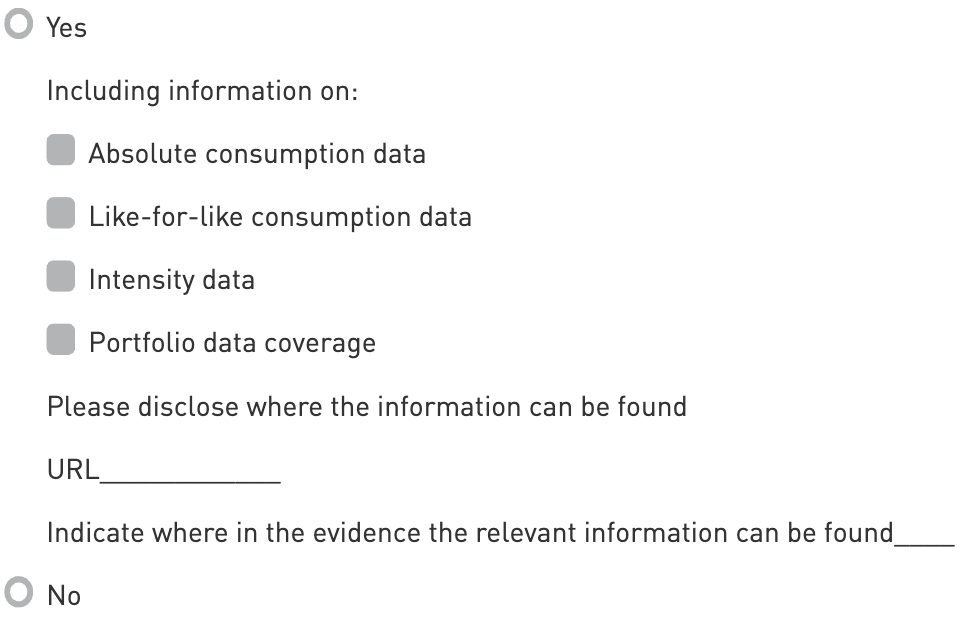
**Has the entity disclosed energy consumption data of its portfolio?**
{% columns %}
{% column width="66.66666666666666%" %}
{% endcolumn %}
{% column width="33.33333333333334%" %}
{% endcolumn %}
{% endcolumns %}
## Assessment Instructions
Intent: What is the purpose of this indicator?
Energy consumption accounts for a large share of a building’s environmental footprint and financial costs. Consistently measuring and reporting energy consumption helps organizations increase the energy efficiency of their portfolio, thus reducing economic and environmental impacts associated with fossil fuel energy use.
Input: How do I complete this indicator?
Select yes or no. If yes, disclose where the online information can be found.
### Terminology
**Absolute data**
> An absolute consumption, emission or production measure provided by a firm regarding its emissions and use of waste, GHG, water or energy for the reporting year.
**Disclosure**
> The act of making information or data readily accessible and available to all interested individuals and institutions. Disclosure does not need to be public, but must be external to the reporting entity and cannot be an internal and/or ad hoc communication within the participating entity.
**Energy consumption data**
> Data obtained through monitoring the energy consumption of the portfolio. The operational energy consumption of buildings leads to substantial environmental impact. Monitoring consumption is an important basis for reducing this impact.
**Intensity data**
> The amount of Energy/GHG Emissions/Water/Waste used or produced per unit of an appropriate denominator, including but not limited to: floor area and persons.
**Like-for-like data**
> A metric that enables comparison of results between years whilst controlling for changes such as expansions and acquisitions of the portfolio that could over or understate the values of one year as compared to another.
**Portfolio data Coverage**
> Information about the part of the portfolio for which the Energy/Water/GHG/Waste data is disclosed. This can be a percentage of floor area or number of assets covered, or a description (e.g., only consumption data from common areas is disclosed, or the consumption data relates to all directly managed assets).
Validation: What evidence is required?
**Evidence**: URL. Ensure that the hyperlink is not outdated and the relevant page is directly accessible. It is possible to provide multiple hyperlinks.
* Absolute energy data must be a measure given in a metric value and be comparable.
* Like-for-Like consumption data must state the use of the Like-for-Like methodology when calculating energy values.
* Intensity data should be recorded using a clear, appropriate denominator.
* Portfolio Coverage points can only be awarded if a clear percentage of the floor area or number of assets covered by the energy value is stated.
> Best practice disclosures would split up energy consumption per property type and/or location, and clearly indicate for which areas data is disclosed/available (tenant spaces, common areas, base building).
## Scoring
Scoring: How does GRESB score this indicator?
Points are awarded to each selected checkbox option and are then aggregated to calculate the indicator’s final score.
It is not necessary to select all answer options in order to obtain the maximum score for this question.
The answer options are validated by using the hyperlink(s) collected by GRESB or provided by the constituent. Points are contingent upon the validity of the disclosure.
***
References
GRI Sustainability Reporting Standards (2016): 102-20
GRI Sustainability Reporting Standards (2016): 103-32
RobecoSAM Corporate Sustainability Assessment (2017): 3.1.5, Responsibilities & Committees
Recommendations of the Task Force on Climate-Related Financial Disclosures (June 2017): Governance A\&B
---
# Agent Instructions
This documentation is published with GitBook. GitBook is the documentation platform designed so that both humans and AI agents can read, navigate, and reason over technical content effectively. Learn more at gitbook.com.
## Querying This Documentation
If you need additional information that is not directly available in this page, you can query the documentation dynamically by asking a question.
Perform an HTTP GET request on the current page URL with the `ask` query parameter, and the optional `goal` query parameter:
```
GET https://guides.gresb.com/publicdisclosure/completing-the-assessment/2026-public-disclosure-guidance/operational-performance/d15-energy-consumption-data.md?ask=&goal=
```
`ask` is the immediate question: it should be specific, self-contained, and written in natural language.
`goal` is optional and describes the broader end goal you are ultimately trying to accomplish on behalf of the user. GitBook uses it to tailor the answer towards what is most useful for that goal.
The response will contain a direct answer to the question and relevant excerpts and sources from the documentation.
Use this mechanism when the answer is not explicitly present in the current page, you need clarification or additional context, or you want to retrieve related documentation sections.