> For the complete documentation index, see [llms.txt](https://guides.gresb.com/llms.txt). Markdown versions of documentation pages are available by appending `.md` to page URLs; this page is available as [Markdown](https://guides.gresb.com/sfdr-reporting-solution/2026-sfdr-asset-assessment/table-1-climate-and-other-environment-related-indicators/indicator-1-ghg-emissions.md).
# Indicator 1: GHG Emissions
Cover image
:bullseye: Maximum Score
Not scored
:pen-to-square: Prefill
:check:Eligible
:shield-check: Validation
Evidence is not required
:arrow-trend-up: 2026 Updates
None
***
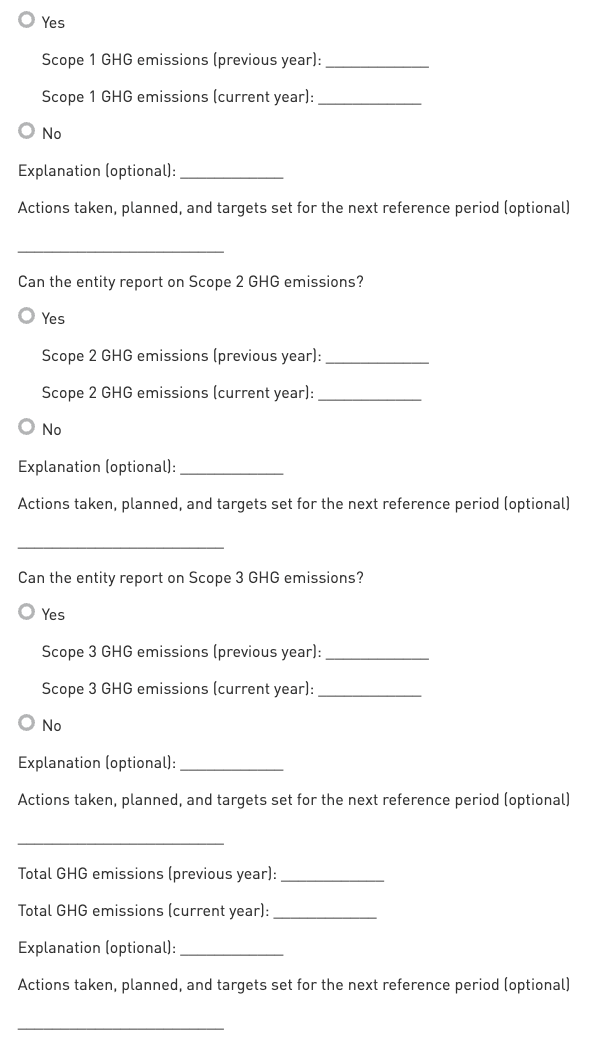
**Can the entity report on Scope 1 GHG emissions?**
{% columns %}
{% column width="75%" %}
{% endcolumn %}
{% column width="25%" %}
{% endcolumn %}
{% endcolumns %}
## Assessment Instructions
Intent: What is the purpose of this indicator?
The intent of this indicator is to assess the entity’s measurement of GHG emissions. GHG emissions are the primary driver of anthropogenic climate change and a critical source of local, regional, and global environmental impacts. GHGs may result from the consumption or generation of energy, or from processes that produce GHGs directly, such as the production of cement. Evaluating direct and indirect GHG emissions (or Scope 1 and 2 emissions) has become the norm for organizations. Additionally, an increasing number of organizations are looking at emissions throughout their value chains (Scope 3 emissions).
Input: How do I complete this indicator?
**Select Yes or No:** If selecting 'Yes', the entity must be actively tracking and reporting on all of the mandatory reporting metrics.
**Previous Year Data (2024):** Enter the relevant data from during the previous reference period for each metric. 'Zero' is an acceptable answer if it is true and accurate.
**Current Year Data (2025):** Enter the relevant data from during the current reference period for each metric. 'Zero' is an acceptable answer if it is true and accurate.
**Explanation (optional):** Provide context to the answer that was provided. This helps investors gain an understanding of the methodologies and assumptions used.
**Action taken (optional):** Give context to the answer that was provided to explain any action that may have been taken within the last year, as well as any actions planned or targets set for the next reference period.
**Calculated field:** Total greenhouse gas emissions is calculated as the sum of reported scope 1,2 and 3 emissions. The calculated value will appear on the SFDR report of the entity.
### Terminology
**Greenhouse gas emissions**
> Refers to the seven gases listed in the Kyoto Protocol: carbon dioxide (CO2); methane (CH4); nitrous oxide (N2O); hydrofluorocarbons (HFCs); perfluorocarbons (PFCs); nitrogen trifluoride (NF3) and Sulphur hexafluoride (SF6).
**Scope 1 carbon emissions**
> Emissions generated from sources that are controlled by the company that issues the underlying assets; (EU)
**Scope 2 carbon emissions**
> Emissions from the consumption of purchased electricity, steam, or other sources of energy generated upstream from the company that issues the underlying assets; (EU)
**Scope 3 carbon emissions**
> All indirect emissions that are not covered by points (i) and (ii) that occur in the value chain of the reporting company, including both upstream and downstream emissions, in particular for sectors with a high impact on climate change and its mitigation; (EU)
***
## References
References
[Annex III of Regulation (EU) 2016/1011;](https://www.legislation.gov.uk/eur/2016/1011/annex/III)
[(1) of Article 3 of Regulation (EU) 2018/842 of the European Parliament and of the Council (12)](https://eur-lex.europa.eu/legal-content/EN/TXT/?uri=celex%3A32018R0842)
[Regulation (EU) No 525/2013 of the European Parliament and of the Council of 21 May 2013 on a mechanism for monitoring and reporting greenhouse gas emissions](https://eur-lex.europa.eu/legal-content/EN/TXT/?uri=celex%3A32013R0525)
---
# Agent Instructions
This documentation is published with GitBook. GitBook is the documentation platform designed so that both humans and AI agents can read, navigate, and reason over technical content effectively. Learn more at gitbook.com.
## Querying This Documentation
If you need additional information that is not directly available in this page, you can query the documentation by asking a question.
Perform an HTTP GET request on the following URL with the `ask` and `goal` query parameters:
```
GET https://guides.gresb.com/sfdr-reporting-solution/2026-sfdr-asset-assessment/table-1-climate-and-other-environment-related-indicators/indicator-1-ghg-emissions.md?ask=&goal=
```
`ask` is the immediate question: it should be specific, self-contained, and written in natural language.
`goal` is what the user is ultimately trying to achieve, the reason they need the answer. Sharing it helps GitBook give you a better, more relevant answer. A goal is most helpful when it describes the outcome the user wants rather than restating the question. For example, with `ask=how do I create an API token`, a goal like `automate deployments from our CI pipeline` lets GitBook tailor the answer to that use case.
The response will contain a direct answer to the question and relevant excerpts and sources from the documentation.
Use this mechanism when the answer is not explicitly present in the current page, you need clarification or additional context, or you want to retrieve related documentation sections.