> For the complete documentation index, see [llms.txt](https://guides.gresb.com/llms.txt). Markdown versions of documentation pages are available by appending `.md` to page URLs; this page is available as [Markdown](https://guides.gresb.com/sfdr-reporting-solution/2026-sfdr-asset-assessment/table-2-additional-climate-and-other-environment-related-indicators/indicator-2-emissions-of-air-pollutants.md).
# Indicator 2: Emissions of Air Pollutants
Cover image
:bullseye: Maximum Score
Not scored
:pen-to-square: Prefill
:check:Eligible
:shield-check: Validation
Evidence is not required
:arrow-trend-up: 2026 Updates
None
***
**Can the entity report on air pollutants?**
{% columns %}
{% column width="83.33333333333334%" %}
{% endcolumn %}
{% column width="16.666666666666657%" %}
{% endcolumn %}
{% endcolumns %}
## Assessment Instructions
Intent: What is the purpose of this indicator?
The intent of this indicator is to assess the entity’s emissions of air pollutants. This indicator is considered to be optional for SFDR.
Input: How do I complete this indicator?
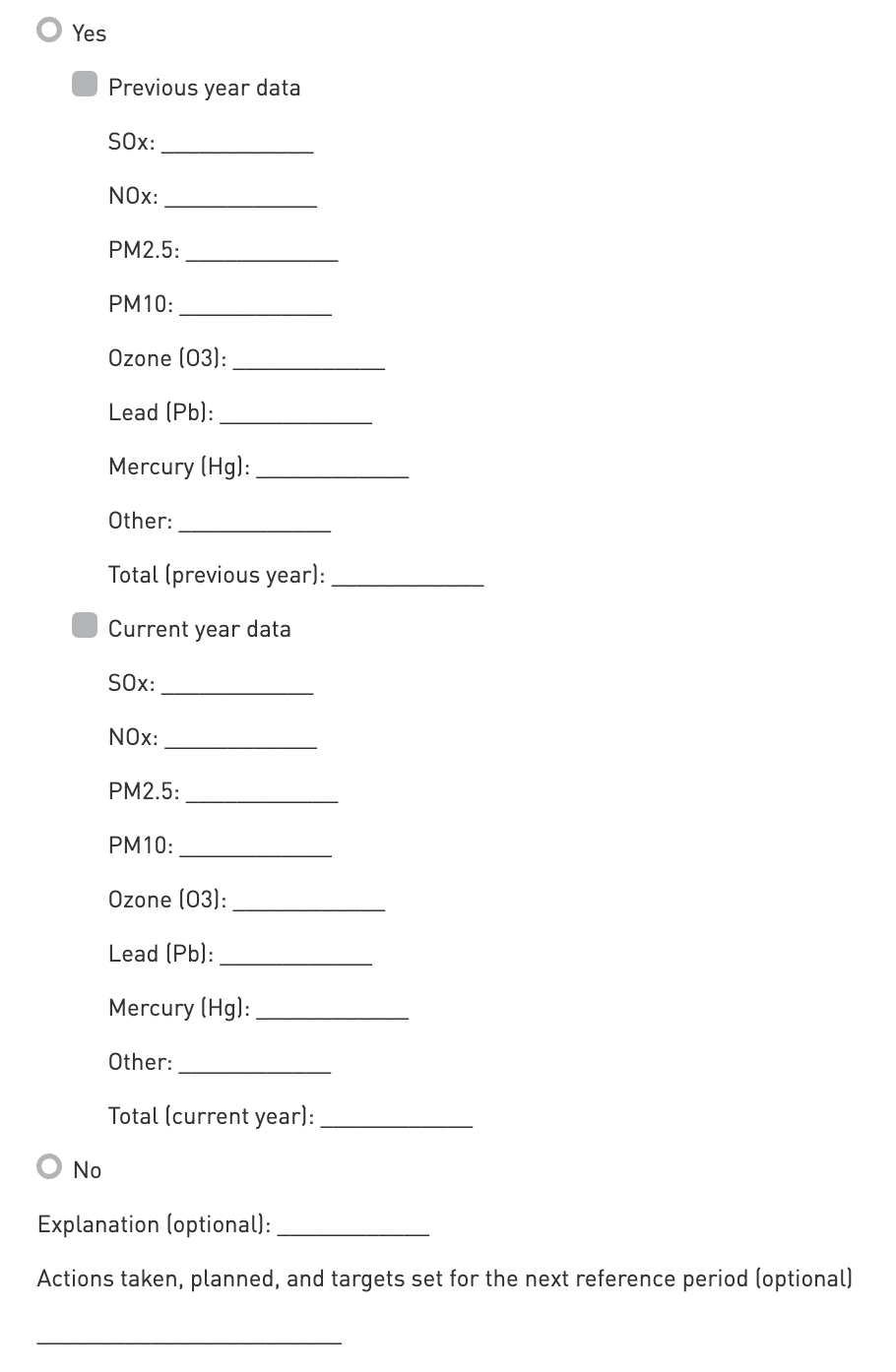
**Select Yes or No:** If selecting 'Yes', the entity must be actively tracking and reporting on all of the mandatory reporting metrics.
**Previous Year Data (2024):** Enter the relevant data from during the previous reference period for each metric. 'Zero' is an acceptable answer if it is true and accurate.
**Current Year Data (2025):** Enter the relevant data from during the current reference period for each metric. 'Zero' is an acceptable answer if it is true and accurate. This metric is mandatory to report on if the entity selects “Yes” to the overall indicator.
**Explanation (optional):** Provide context to the answer that was provided. This helps investors gain an understanding of the methodologies and assumptions used.
**Action taken (optional):** Give context to the answer that was provided to explain any action that may have been taken within the last year, as well as any actions planned or targets set for the next reference period.
### Terminology
**Air pollutants**
> means direct sulphur dioxides (SOx/SO2) emissions, direct nitrogen oxides (NOx/NO2) emissions, direct non-methane volatile organic compounds (NMVOC) emissions and direct particulate matter (PM2.5) emissions as defined in points (5) to (8) of Article 3 of Directive (EU) 2016/2284 of the European Parliament and of the Council, as well as direct ammonia (NH3) and direct total heavy metals (HM) emissions (encompassing cadmium, mercury and lead) as referred to in Annex 1 of that same Directive.
>
> (5) **‘sulphur dioxide’** or ‘SO2’: means all sulphur compounds expressed as sulphur dioxide, including sulphur trioxide (SO3), sulphuric acid (H2SO4), and reduced sulphur compounds such as hydrogen sulphide (H2S), mercaptans and dimethyl sulphides; (EU).
>
> (6) **‘nitrogen oxides’** or ‘NOx’: means nitric oxide and nitrogen dioxide, expressed as nitrogen dioxide; (EU).
>
> (7) **‘non-methane volatile organic compounds’** or ‘NMVOC’: means all organic compounds other than methane, that are capable of producing photochemical oxidants by reaction with nitrogen oxides in the presence of sunlight; (EU).
>
> (8) **‘fine particulate matter’** or ‘PM2,5’: means particles with an aerodynamic diameter equal to or less than 2,5 micrometres (μm); (EU).
***
## References
References
[Directive (EU) 2016/2284 of the European Parliament and of the Council](https://eur-lex.europa.eu/legal-content/EN/TXT/?uri=uriserv%3AOJ.L_.2016.344.01.0001.01.ENG)
[Directive (EU) 2016/2284 of the European Parliament and of the Council](https://eur-lex.europa.eu/legal-content/EN/TXT/?uri=uriserv%3AOJ.L_.2016.344.01.0001.01.ENG)
---
# Agent Instructions
This documentation is published with GitBook. GitBook is the documentation platform designed so that both humans and AI agents can read, navigate, and reason over technical content effectively. Learn more at gitbook.com.
## Querying This Documentation
If you need additional information that is not directly available in this page, you can query the documentation by asking a question.
Perform an HTTP GET request on the following URL with the `ask` and `goal` query parameters:
```
GET https://guides.gresb.com/sfdr-reporting-solution/2026-sfdr-asset-assessment/table-2-additional-climate-and-other-environment-related-indicators/indicator-2-emissions-of-air-pollutants.md?ask=&goal=
```
`ask` is the immediate question: it should be specific, self-contained, and written in natural language.
`goal` is what the user is ultimately trying to achieve, the reason they need the answer. Sharing it helps GitBook give you a better, more relevant answer. A goal is most helpful when it describes the outcome the user wants rather than restating the question. For example, with `ask=how do I create an API token`, a goal like `automate deployments from our CI pipeline` lets GitBook tailor the answer to that use case.
The response will contain a direct answer to the question and relevant excerpts and sources from the documentation.
Use this mechanism when the answer is not explicitly present in the current page, you need clarification or additional context, or you want to retrieve related documentation sections.